The Moroccan Caftan: A History of Morocco's Most Formal Garment
The Moroccan Caftan: What It Is, What It Means, and Why It Is Not a Costume
I want to address something that comes up repeatedly in discussions of the Moroccan caftan in Western fashion media: the use of the word "inspired" when Western designers produce garments with loose silhouettes and embroidered trim. I understand the impulse to find connections across cultures. But the caftan is not a silhouette or a trim style. It is a specific formal garment with a twelve-century history, a highly codified social grammar, and a set of practices around its production and wearing that do not survive translation into seasonal fashion. The appreciation is welcome. The flattening is not.
Let me tell you what it actually is.
What Is the Origin of the Moroccan Caftan?
The word "caftan" has Turkish roots — kaftan — and the garment in its broad sense of a long, loose robe with long sleeves was widespread across the Ottoman, Persian, and broader Islamic world. But the Moroccan caftan as it exists today — its specific cut, its embroidery traditions, its social function and sartorial grammar — is a distinctly Moroccan evolution of that shared starting point, shaped primarily by the Fassi and Andalusian court traditions of the imperial era.
The caftan entered Morocco's royal and urban culture formally in the 16th and 17th centuries, during the Saadian and early Alaouite periods, when the imperial court of Marrakech and later Meknes was developing its ceremonial traditions. By the 18th century, the caftan was established as the formal dress of Moroccan women of the urban merchant and scholarly class — not of rural or Amazigh communities, where different dress traditions prevailed — and the elaborate hand-embroidered versions had become the primary display of family wealth and taste at life-cycle celebrations.
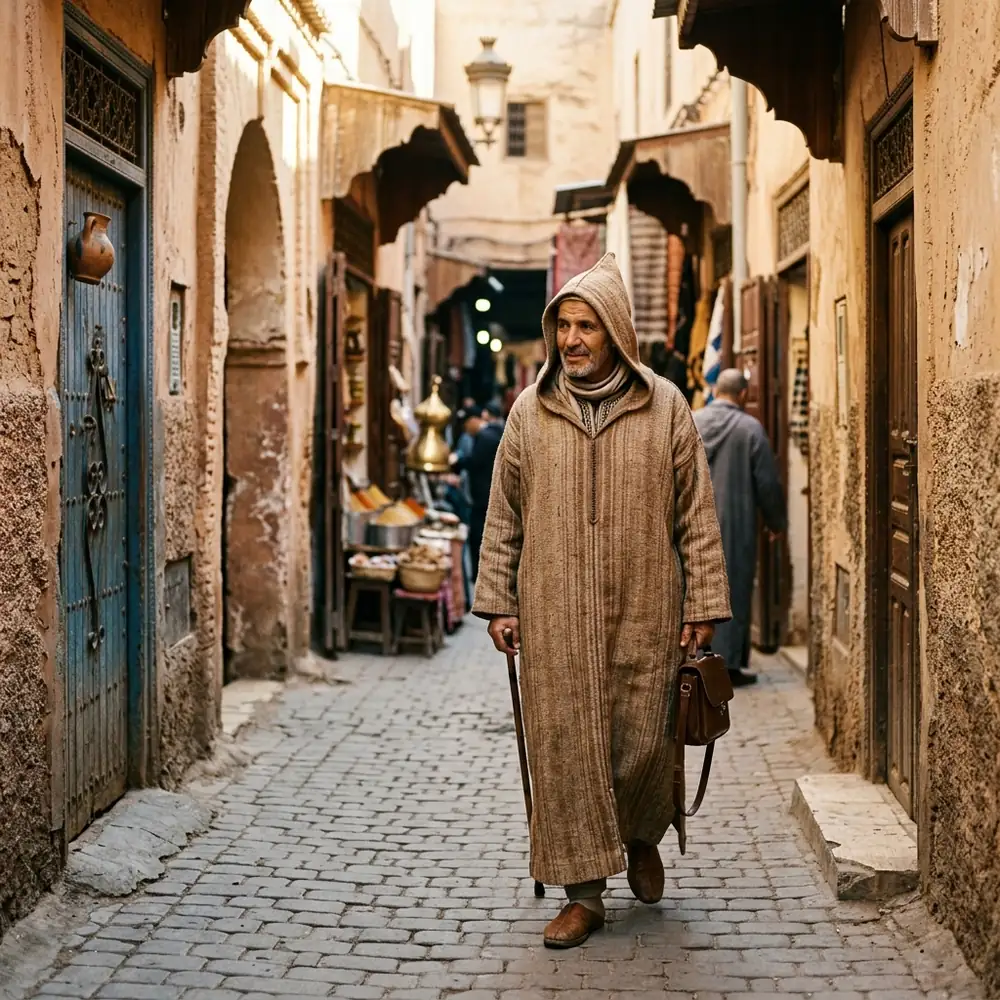
The most important distinction in understanding the Moroccan caftan is between the everyday djellaba (the hooded robe worn by men and women in public, primarily functional, relatively simple) and the caftan, which is strictly an indoor and celebratory garment. A caftan is never worn in the street in the traditional context. It is the garment you put on when you arrive at the wedding — not to travel to it.
What Makes a Caftan's Embroidery Significant?
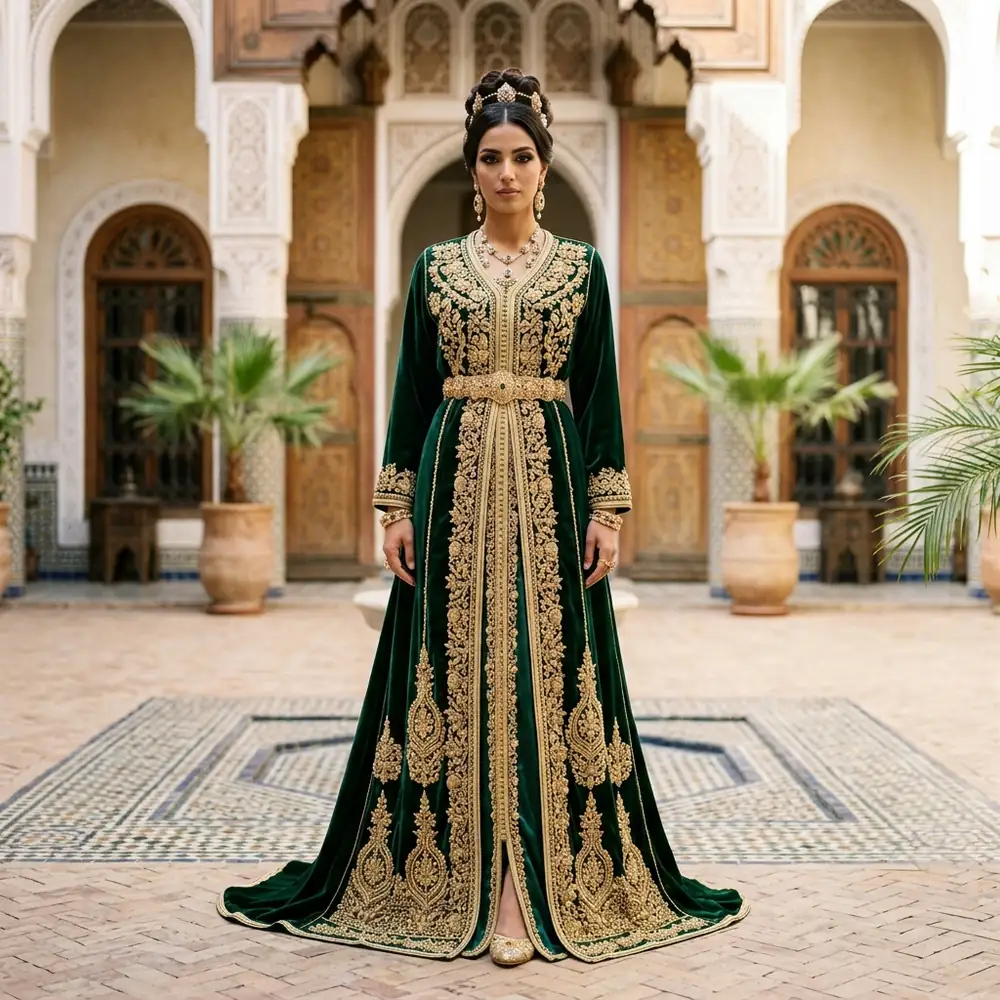
The hand embroidery — called sfifa for the cord trim applied to seams and edges, and terz for the more complex needle embroidery worked into the fabric surface — is the primary indicator of a caftan's quality and value and the element that distinguishes a piece made with genuine craft from one produced commercially.
Sfifa is a fine silk or metallic cord, hand-applied to the seams, neckline, cuffs, and hem of the caftan in intricate looped patterns that reinforce the structure while creating a decorative border. In the finest pieces, the sfifa is made from real gold or silver thread — dor in Darija — and its application requires a specialist's hours of close, precise work. A simple sfifa border takes a skilled craftsperson a day. A complex sfifa composition covering the front panel and hem of a formal caftan takes several weeks.
Terz is more complex still — needle embroidery worked directly onto the caftan's fabric surface, typically in geometric or floral patterns drawn from the same visual vocabulary as Moroccan architectural ornament. The finest terz work is done in silk on silk velvet, a combination that produces a visual depth and a light-play in movement that photographs do not adequately capture. It must be seen in natural light, on a moving body, to understand what the craftsperson was trying to achieve.
The embroidery of a formal Moroccan caftan represents, in some cases, hundreds of hours of skilled manual work. This is what a genuinely fine caftan costs — not a fabric price, but a labor price. And this is why the distinction between a genuine artisanal piece and a commercially manufactured caftan-style garment matters.
How Is a Moroccan Wedding Caftan Experience Actually Structured?
The Moroccan wedding — and it is at weddings where the caftan tradition is most fully displayed — involves a theatrical succession of garment changes by the bride that serves as one of the central visual narratives of the celebration.
In the traditional Fassi and urban Moroccan wedding, the bride changes caftan seven times across the wedding night — each change presenting a different color, a different embroidery style, a different accompanying jewelry set. The number varies by family tradition and budget, but seven changes is the classic number for a formal celebration, and each change is announced and presented to the assembled guests as part of the evening's entertainment.
The bride's caftans are usually prepared months in advance, many of them specially commissioned from craftswomen who know the family's taste and the bride's measurements. Each caftan is stored in its own embroidered bag, with its accompanying sfifa belt (ceinture) and jewelry carefully arranged. The coordination of seven complete ensembles — each one consistent in quality and style, but distinct enough to create a clear visual progression across the evening — is itself an art form that Moroccan mothers of the bride take very seriously.
There are unspoken rules about the progression. The most formal, most elaborate caftan — typically in a deep jewel color, with the heaviest embroidery and the most significant jewelry — is worn at the peak of the evening. The first caftan, presented when the bride enters, is often in white or pale gold: a statement of beginning. The final caftan, worn when the formalities are ending and the celebration becomes looser, can afford to be lighter, more playful in color.
The Invisible Invitation
The wedding is in a riad in the old medina, and the women have been gathering since late afternoon. The bride is being dressed in the inner room by her mother and her aunts — this is not a job for a hired stylist, this is family work — and there are seven embroidered bags lined along the wall of the adjacent room, each one containing a complete ensemble for a specific hour of the night. The first guests are already in the courtyard below. The music has started. Come upstairs for a moment and look at the bags. Each one has a story about who made it and what it cost and what color and hour it is for. This is what a Moroccan woman's formal evening looks like from the inside.
SEO Meta Description: What is the Moroccan caftan and its history? A guide to the imperial garment's Andalusian origins, sfifa embroidery technique, and the seven-change wedding tradition.
Experience the true heart of Moroccan heritage through its culinary traditions. Join us in preserving and honoring these ancestral recipes.
What People Are Saying
No comments yet. Be the first — we'd love to hear from you.
Youssef Amazigh
Culturally Verified & Fact-CheckedThe Moroccan Food editorial team brings together native culinary researchers, heritage preservationists, and experienced home cooks across Marrakech, Fes, and Casablanca. Every recipe and cultural guide is reviewed against ancestral oral traditions and authentic regional practices.