Moroccan Spiced Carrot Salad: The Simplest Thing on the Table and the One Everyone Asks About
The Moroccan Carrot Salad: What Makes Something Simple Also Perfect
I want to resist the urge to call this dish "deceptively simple," because that phrase has become a food writing cliché that I have promised myself to avoid. But the Moroccan spiced carrot salad is, in fact, the kind of thing where the simplicity of the method and the pleasure of the result are in a ratio that surprises people, and I am not sure how to say that without invoking the cliché.
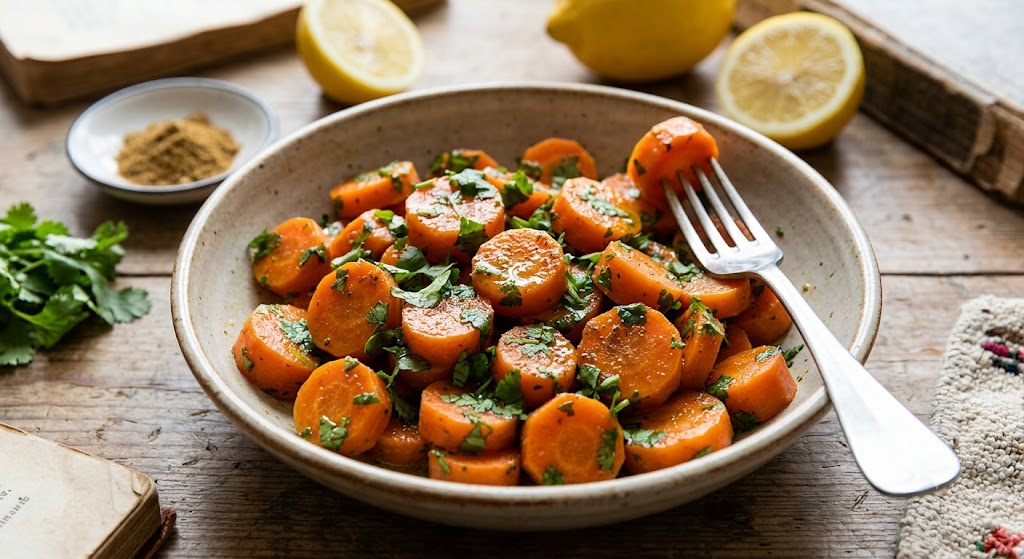
Five ingredients: carrots, cumin, fresh coriander, lemon, olive oil. Salt. I suppose that is six if you count salt, which I always do because the salt quantity matters. That is everything. The preparation takes twenty minutes including the boiling time. The result is a warm, aromatic salad with a clean sweetness from the cooked carrot, a warm earthiness from the cumin, a brightness from the lemon, and the particular alive quality that fresh coriander adds to hot food just before serving.
Every guest I have served this to — Moroccan guests who eat this every week and have eaten it all their lives, and non-Moroccan guests encountering it for the first time — takes more than one helping. The non-Moroccan guests ask for the recipe. I tell them. They look at me with mild suspicion, as if I must be leaving something out. I am not leaving anything out.
How Is the Moroccan Carrot Salad Made?
The carrots are peeled, cut into thick rounds — not thin, thick, perhaps a centimeter and a half — and boiled in salted water until tender but not collapsing. This is the first decision that matters: the carrots should be fully cooked, soft throughout when pierced with a fork, but retaining enough structural integrity to hold their shape in the salad rather than becoming mash. The correct texture is tender-firm — the fork goes through easily but the round stays round. Approximately twelve to fifteen minutes of boiling for thick rounds, less for thinner.
The boiled carrots are drained — not rinsed with cold water, left warm, because the warm carrot absorbs the dressing more completely than a cold one — and then dressed while still hot. This timing is important. The olive oil soaks into the warm carrot's cellular structure in a way it cannot once the carrot has cooled and firmed. You are seasoning the interior, not just the surface.
The dressing is olive oil — generous, two to three tablespoons for four servings — squeezed lemon juice, cumin, salt, and chopped fresh coriander. The cumin goes in first, directly onto the warm carrots with the olive oil, so that the oil heat blooms the cumin briefly. Then lemon. Then salt, adjusted to taste. Then coriander, chopped coarsely and added at the last moment off any heat source so it stays green and fresh rather than wilting.
That is the preparation. I am not leaving anything out.
Why Does the Cumin Quantity Matter So Much?
In most international recipes that include cumin, the quantity is conservative — a quarter teaspoon, a half teaspoon — as if the spice is something to be approached cautiously. In Moroccan cooking in general and in this salad specifically, cumin is the primary flavor statement, not a background note, and the quantity needs to reflect this.
For a salad of four medium carrots, I use a full teaspoon of ground cumin, sometimes slightly more. The cumin should be present — you should taste it clearly in every bite — not implied. Under-cumin'd carrot salad is just boiled carrots with lemon and olive oil, which is a perfectly adequate thing but not this dish.
The same principle applies to the lemon: the juice of half a lemon minimum, the other half standing by for adjustment. The finished salad should have enough acidity to cut through the olive oil richness and lift the cumin's warmth. A salad that tastes flat often needs more lemon before it needs more cumin.
What Variations Does This Salad Have Across Morocco?
The base recipe — carrots, cumin, lemon, olive oil, coriander — is consistent across regions. What varies is what gets added to the base.
In some Marrakchi households, a small amount of harissa is stirred into the dressing, giving the salad a red tinge and a heat that transforms it from mildly warming to assertively spiced. This is good but it is a different dish.
In coastal cities, finely minced preserved lemon rind sometimes appears — a small amount, just enough to add the fermented citrus depth without making preserved lemon the dominant flavor. This is the version I prefer for fish meals, where the preserved lemon in the carrot salad echoes the preserved lemon in the fish marinade and creates a coherent flavor narrative across the table.
Some families add orange segments in winter — the citrus sweetness of the orange with the cumin and the carrot produces a combination that is simultaneously unusual and completely right, and I have never been able to trace which family tradition started this addition or how widely it is practiced.
The carrots can also be grated raw rather than cooked — the raw grated carrot version is dressed more simply, usually just olive oil, lemon, cumin, and coriander without cooking — and is served cold rather than warm. Both exist in the Moroccan salad repertoire. The cooked version is more common at formal meals; the raw version appears at more casual settings and at the beginning of working lunches where time is limited.
The Invisible Invitation
The salad arrives in a small clay bowl at room temperature — it was made an hour ago and has been sitting since then, and the cumin has settled further into the carrot and the lemon has brightened everything in the resting time. This is one of the dishes that is genuinely better after it has sat for a while than it is fresh off the heat. Tear a piece of khobz. Push it through the bowl. The olive oil, the cumin, the bright lemon — all of it absorbed into the bread in one motion. Have a second piece. Nobody is watching the quantity. That is also the point.
SEO Meta Description: How to make Moroccan spiced carrot salad? The five-ingredient cumin recipe — correct carrot texture, timing the dressing, cumin quantity, and regional variations with harissa and preserved lemon.
Experience the true heart of Moroccan heritage through its culinary traditions. Join us in preserving and honoring these ancestral recipes.
What People Are Saying
No comments yet. Be the first — we'd love to hear from you.
Khadija Tahiri
Culturally Verified & Fact-CheckedThe Moroccan Food editorial team brings together native culinary researchers, heritage preservationists, and experienced home cooks across Marrakech, Fes, and Casablanca. Every recipe and cultural guide is reviewed against ancestral oral traditions and authentic regional practices.