Chaabi: The Moroccan Street Music That No Concert Hall Has Ever Fully Contained
Chaabi: Morocco's Popular Music Tradition and Why It Lives in the Street, Not the Concert Hall
I want to start with a confession: I am not a Chaabi musician and I have never claimed to be. I grew up in a household where al-Ala — the Andalusian classical tradition — was the music that mattered, and my first encounters with Chaabi were at weddings and neighborhood celebrations where it felt, to my somewhat formally trained ear, almost deliberately rough around the edges. The vocals pushed hard. The percussion came in before you expected it. The lead musicians argued with each other audibly over tempo.
It took me longer than it should have to understand that this roughness was not a deficit. It was the whole point.
Chaabi is popular music in the oldest sense — music made by and for ordinary people, in ordinary spaces, improvising around a shared vocabulary of melody and rhythm that everyone in the room already knows. The "mistakes" are negotiations. The spontaneity is the form. And when it works — when a good Chaabi orchestra finds its pocket and the room starts moving and someone's grandmother stands up from her chair and starts dancing before she has consciously decided to — it is as immediate and as joyful as any music I know.
What Is Chaabi and Where Did It Come From?
The word chaabi simply means "popular" or "of the people" in Arabic, and it was initially applied as a catch-all category to distinguish urban Moroccan folk music from the more formally codified classical traditions. Over time, it coalesced into a specific genre with identifiable instruments, structures, and a performance tradition centered on the working-class neighborhoods of Casablanca, Rabat, and the Atlantic coast cities.
Its roots are multiple and somewhat contested, which is appropriate for a genre defined by its openness. The Andalusian musical inheritance that came to Morocco with the refugees from Islamic Spain contributed melodic material — certain modes (maqamat) and melodic phrases that appear in both classical al-Ala and in Chaabi, transformed into something more urgent and direct. Amazigh (Berber) musical traditions from the Atlas and the Rif contributed rhythmic patterns and vocal techniques that classical Arabic music does not contain. Sub-Saharan African musical influences — arriving through the Gnawa community and through the broader Saharan trade and migration routes — contributed additional rhythmic vocabulary and the call-and-response vocal structures that are central to Chaabi performance.
What Chaabi did with these multiple inheritances was to forge something new that belongs fully to neither tradition while carrying traces of all of them. This is what urban folk music does in every culture: it takes what the city has received from its many sources and remixes it in real time in response to what the neighborhood needs tonight.
What Instruments Make Up a Chaabi Ensemble?
The composition of a Chaabi group is flexible in a way that classical ensemble instruments are not, and this flexibility is itself part of the music's character. A complete traditional Chaabi group typically includes:
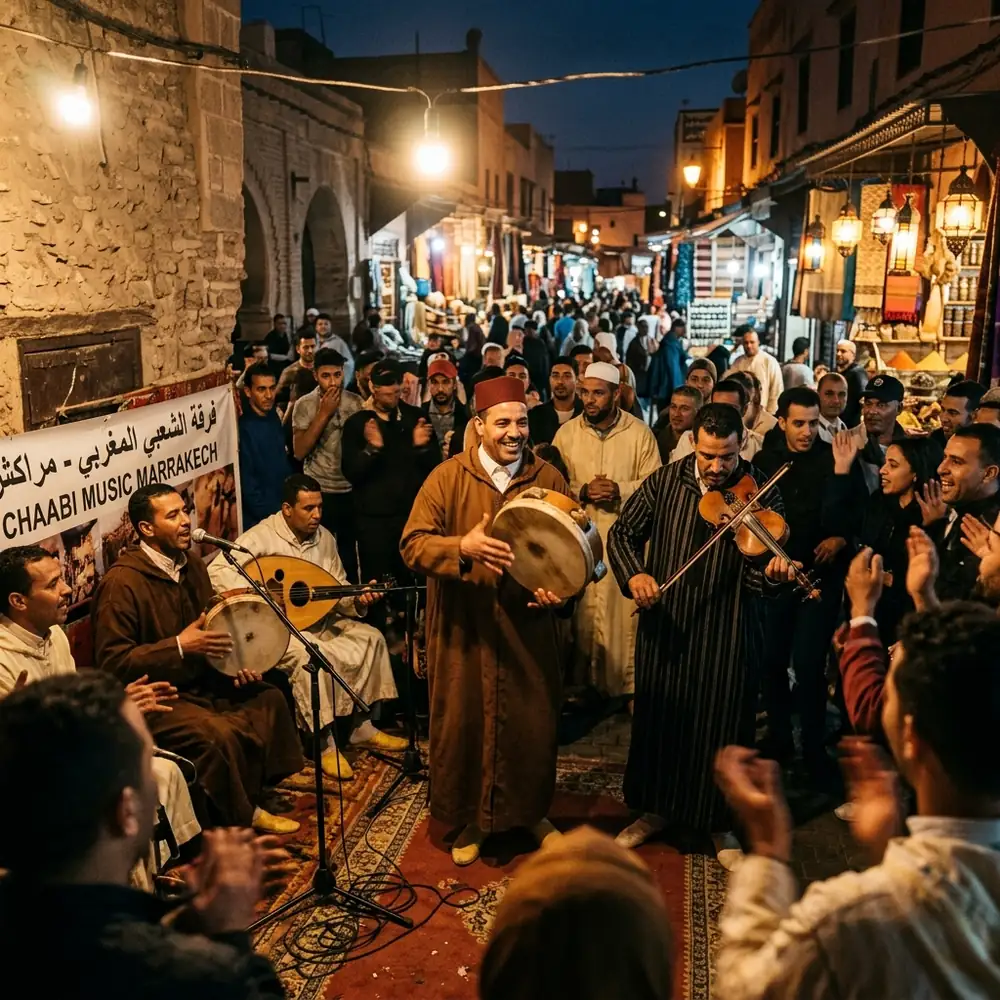
The guembri or sintir in its urban adaptation — not the Gnawa ritual instrument but a lighter, more melodically versatile version used as a bass voice in Chaabi contexts. The sintir provides the harmonic foundation and the characteristic deep buzz that gives Moroccan urban music its low-end texture.
The bendir — a large frame drum held vertically and struck with the fingers and palm on the skin, with sympathetic gut strings stretched across the interior that add a buzzing, resonant quality to each stroke. The bendir player is often the tempo anchor of a Chaabi group, the person everyone else is listening to even when they appear to be listening to each other.
The hajhuj — a variation of the guembri — and sometimes a darbuka (the ceramic goblet drum) for additional rhythmic density. In the urban Casablanca Chaabi tradition, you also frequently find the violin, which arrived in Moroccan urban music through the Andalusian classical tradition and found a comfortable home in Chaabi as the primary melodic voice.
Vocals are never optional. A Chaabi performance without singing is not Chaabi. The lead vocalist — chikha if female, shikh if male — is the performance's narrative and emotional center, and the relationship between vocalist and audience in Chaabi is live and reciprocal in a way that formal concert performance is not. The audience responds, the vocalist responds to the audience's response, the musicians respond to both. The song is different every time.
What Is a Chaabi Wedding Like and What Happens When It Goes Wrong?
When it goes right, a Chaabi wedding in a working-class Casablanca or Salé neighborhood is one of the most genuinely communal celebrations I know. The music starts in the late evening and doesn't stop until the early morning. The orchestra is in the courtyard or the alley or the rented event hall, and the party happens around them rather than facing them — there is no audience section and performance section, just a space where both things are happening simultaneously.
The music cycles through faster and slower pieces, the tempo building toward a peak and then releasing, the crowd's energy following and sometimes driving the orchestra's choices. When someone important to the family — the grandmother, the matriarch, a respected neighbor — stands up to dance, the orchestra typically plays directly to them, raising the tempo, spotlighting the moment. This is not choreographed. It emerges from the room.
When it goes wrong — when the orchestra is mediocre, or when the event space is too formal to allow this kind of communal energy to develop, or when the bride's family and the groom's family have awkward dynamics that the open floor plan exposes — Chaabi becomes uncomfortable in a specific way: the music keeps playing but the room doesn't respond, and everyone can feel the gap between what the music is asking for and what the room is giving back. I have been at a few of these evenings. They are long.
The Invisible Invitation
It is just past midnight in an alley in the Ain Chock neighborhood of Casablanca. The wedding has been going for three hours and the Chaabi orchestra has found the thing they were looking for in the first hour — that shared tempo and shared mood where musician and room are functioning as a single organism. The bride's aunt, who is perhaps seventy and is wearing the most elaborate caftan in the alley, is dancing in the center of the space with her eyes closed and her arms at her sides, just her feet moving in the particular fast-stepping pattern that only people from this neighborhood dance this way. The lead singer is watching her and singing directly at her, smiling. This is what this music is for. There is a chair against the wall. Sit in it, or don't. Either way, you will move.
SEO Meta Description: What is Moroccan Chaabi music? A guide to the popular street tradition — instruments, origins from Andalusian and Amazigh sources, and what a real Chaabi wedding sounds like at midnight.
Experience the true heart of Moroccan heritage through its culinary traditions. Join us in preserving and honoring these ancestral recipes.
What People Are Saying
No comments yet. Be the first — we'd love to hear from you.
Youssef Amazigh
Culturally Verified & Fact-CheckedThe Moroccan Food editorial team brings together native culinary researchers, heritage preservationists, and experienced home cooks across Marrakech, Fes, and Casablanca. Every recipe and cultural guide is reviewed against ancestral oral traditions and authentic regional practices.