Chebakia: The Sesame-Honey Cookie That Takes All Day to Make and Is Worth Every Minute
Chebakia: Why the Most Laborious Moroccan Cookie Is Also the Most Important
I want to say something that might be controversial in food writing contexts but that is simply true: most Moroccan families no longer make chebakia at home. The specialist vendors who produce it in quantity during Ramadan — working through the night to supply the next day's iftar demand — have effectively taken over the production function that home kitchens managed for centuries, and the quality of the commercial product, in the case of chebakia, is genuinely competitive with home production because the technique is one that benefits from the efficiency of repetition.
This is not a lament. It is a description of how food culture adapts. Chebakia is extremely labor-intensive — the folding and shaping of each cookie, the frying, the immediate immersion in honey, the sesame application — and the labor is the kind that scales badly to small batches. Making twenty chebakia at home takes approximately the same setup and cleanup time as making two hundred. The vendors make two hundred and sell them at a price that reflects their efficiency. The economics make sense.
What is lost when home production disappears is not the cookie itself but the knowledge — the specific feel of the dough at the correct consistency, the understanding of when the oil is at the right temperature, the judgment for when the honey coating has set properly — and the social experience of making it in groups, which in the traditional pattern involved women from the extended family or neighborhood coming together for a full day of chebakia production that was also a social gathering with its own conversations and dynamics.
What Is Chebakia Made From and What Is the Dough Like?
The dough is a spiced sesame dough — flour, toasted sesame seeds (ground to a paste before incorporation), anise seeds, fennel seeds, cinnamon, a small amount of smen, orange blossom water, a small amount of vinegar (which affects the gluten structure and the final texture), saffron, and enough water to bring it to a soft, pliable consistency that can be rolled thin without cracking.
The spice profile of chebakia is distinctive and specific to this cookie. The combination of anise, fennel, and sesame produces an aromatic character that is simultaneously ancient-feeling — it belongs to a pre-modern spice vocabulary, before the tomato and chili that dominate contemporary Moroccan cooking — and completely recognizable as belonging to the Moroccan tradition. If you have eaten chebakia before, the smell of the dough being prepared will be immediately evocative in the particular way that complex aromatic memories work.
The sesame paste is made by toasting raw sesame seeds until golden — not too dark, which produces bitterness — and then processing until smooth. The paste goes into the dough while slightly warm, which helps it incorporate without creating lumps. Lumps of sesame paste in chebakia dough produce uneven frying behavior.
How Is Chebakia Shaped and Why Is the Shape Technically Demanding?
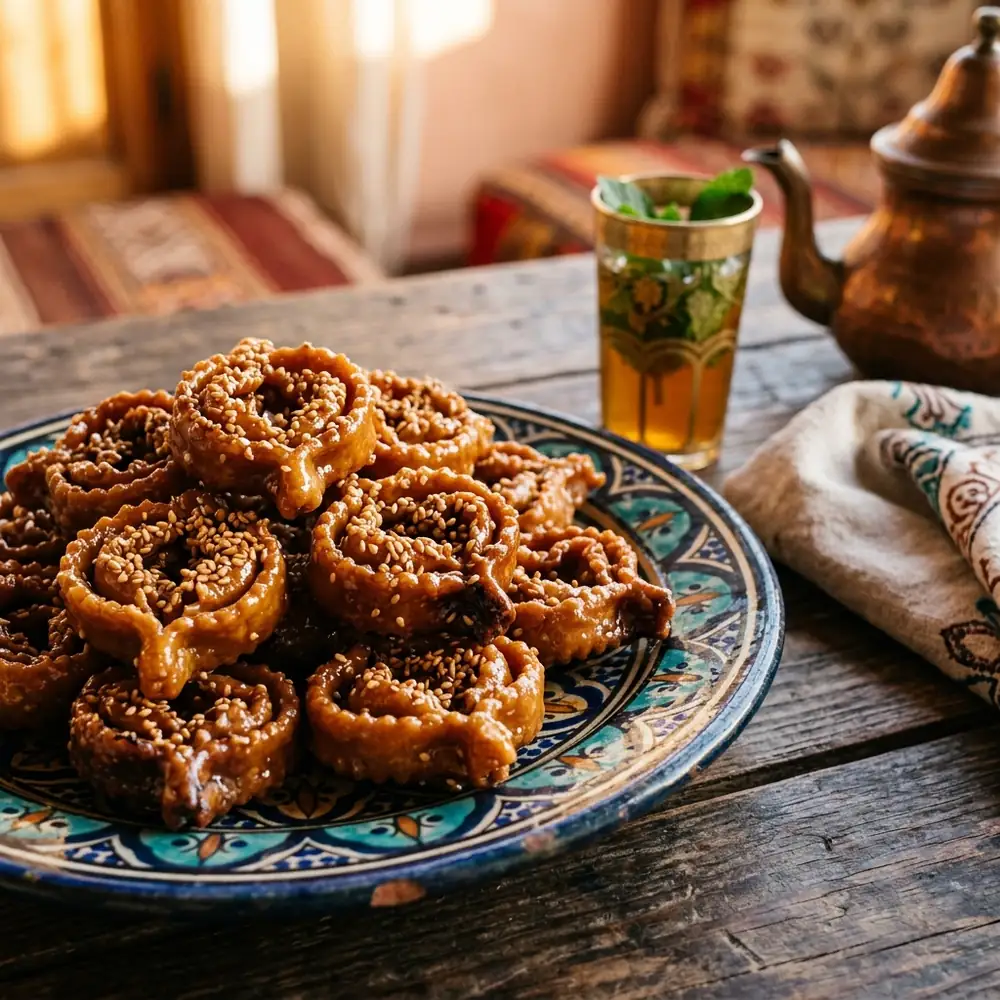
The traditional chebakia shape — a flattened, frilled flower form — is achieved through a specific folding and pressing technique that requires practice to produce consistently. The rolled dough is cut into rectangles, slits are cut in the rectangle in a specific pattern, and the piece is then folded and pressed through itself in a motion that is easier to demonstrate than to describe and that produces the characteristic layered flower shape.
The first twenty attempts will be less beautiful than the next twenty. The shape is something the hands learn rather than the mind — the correct amount of fold, the right angle of the press, the moment to release — and it becomes mechanical after sufficient repetition. An experienced chebakia maker shapes each cookie in approximately thirty seconds. A beginner takes two to three minutes and produces a less symmetrical result.
The shaped cookies are fried in oil at medium-high heat — they should bubble vigorously when immersed, indicating the oil is at the correct temperature — until deep golden brown on both sides. The frying time is approximately three to four minutes per batch.
What Happens in the Honey Soaking and Why Is the Timing Critical?
The fried chebakia go directly from the oil — drained briefly on a rack, not paper — into a pot of warm honey mixed with rose water. They should be immersed immediately while still very hot; the heat of the cookie facilitates the honey's penetration into the porous fried dough, which absorbs the honey more completely than a cooled cookie would.
They soak in the honey for approximately two minutes — long enough for the honey to penetrate, not so long that the cookie becomes saturated to the point of heaviness. Then they are lifted out, allowed to drain briefly, and while still sticky with honey, showered with raw (untoasted) sesame seeds that adhere to the honey coating.
The honey must be kept warm throughout this process — honey that has cooled to room temperature is too viscous to penetrate the cookie efficiently and produces a surface coating rather than an interior absorption. A very low flame under the honey pot, or a hot water bath, maintains the correct honey temperature.
The finished chebakia are arranged on a tray and allowed to cool completely before eating — the honey sets as they cool and the cookie reaches its final texture, which is firm rather than soft, with a honeyed crust and a interior that is simultaneously dense and friable.
The Invisible Invitation
It is the last afternoon before Ramadan begins. A group of women — three or four, from the same building or the same family — are making chebakia together in the largest kitchen available. The dough was made this morning. The shaping has been happening for two hours. The oil is hot. The honey pot is warm beside the frying pan. One woman shapes, one fries, one manages the honey soaking, one arranges the sesame-covered finished cookies on the tray. The movement between them is coordinated without being directed — they have done this before, together, and each knows her position in the production line. By evening, there will be enough chebakia for the household's Ramadan and for several plates to distribute to neighbors. The smell of anise and sesame and warm honey will be present in the building's corridors for the next two days. This is what Ramadan preparation smells like. This is correct.
SEO Meta Description: How to make Moroccan chebakia cookies? The sesame-anise dough, flower-shaping technique, frying temperature, warm honey soaking method, and why the timing of each step matters.
Experience the true heart of Moroccan heritage through its culinary traditions. Join us in preserving and honoring these ancestral recipes.
What People Are Saying
No comments yet. Be the first — we'd love to hear from you.
Khadija Tahiri
Culturally Verified & Fact-CheckedThe Moroccan Food editorial team brings together native culinary researchers, heritage preservationists, and experienced home cooks across Marrakech, Fes, and Casablanca. Every recipe and cultural guide is reviewed against ancestral oral traditions and authentic regional practices.