The Salé Corsairs: Morocco's Atlantic Pirates, Their European Slaves, and the Trade That Shocked Christendom
The Salé Corsairs: Two Centuries of Atlantic Raiding and the Million Captives Nobody Remembers
The history of North African corsairs — the Barbary pirates, in the European terminology — is typically told from the perspective of the European victims of their raids and the European states that eventually suppressed their activity. This perspective, while understandable given that the primary historical documentation was produced by Europeans, tends to present the corsairs as an inexplicable and purely predatory phenomenon rather than as a complex product of the specific political and economic conditions of the 17th-century Atlantic world.
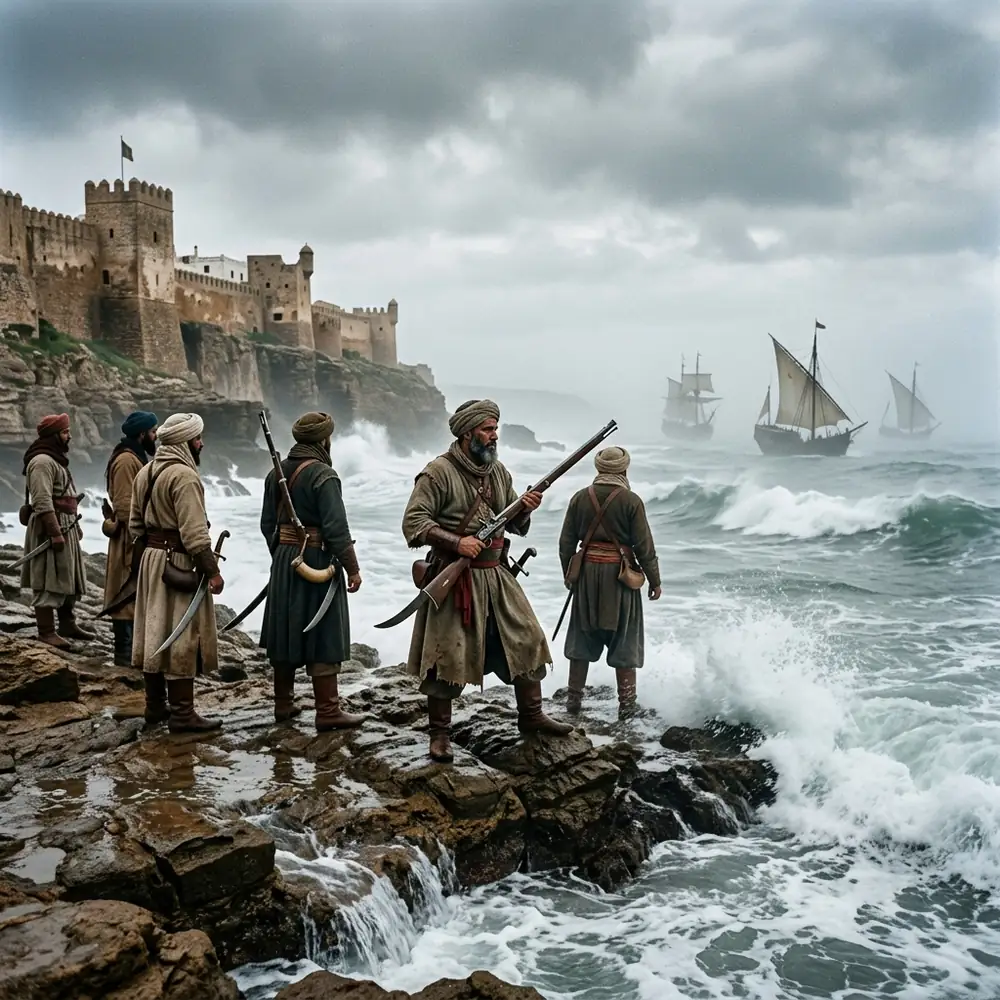
I want to try to give a more complete account, beginning with the historical fact that makes the Salé corsairs genuinely remarkable: they raided not just the Mediterranean coasts that had been vulnerable to Muslim piracy since the medieval period, but the Atlantic itself — reaching England, Ireland, Iceland, and the coast of Newfoundland at the extreme extension of their operations. This Atlantic reach was new, it was technologically enabled by specific ships and navigation practices developed in the early 17th century, and it produced a wave of captivity that very affected European Atlantic coastal communities in ways that contemporary European records document in considerable detail and that are now almost completely forgotten in the countries most affected.
Who Were the Salé Corsairs and Where Did They Come From?
The corsair fleet based at the Bou Regreg river mouth — using both Salé on the north bank and the Kasbah settlement on the south bank that became Rabat — was not a purely Moroccan institution. Its most aggressive and innovative period, from approximately 1610 to 1660, was associated primarily with Morisco refugees — Muslims expelled from Spain following the final expulsion decree of 1609-1614, who arrived in Morocco with European maritime knowledge, European ship-building techniques, and a specific grievance against the Christian powers that had expelled them.
These Morisco corsairs — sometimes called the "Hornacheros" after the Extremaduran town of Hornachos where the largest group originated — brought with them the ability to build and navigate the square-rigged sailing ships that had replaced the oar-powered galleys in Atlantic European warfare and commerce. The traditional North African corsair vessel, the oar-powered xebec or galiota, was well-suited to the enclosed Mediterranean but could not operate reliably in the Atlantic's open waters. The Morisco introduction of Atlantic sailing ship technology to the Salé corsair fleet was what made the Atlantic raids possible.
What Was the Geographic Range of the Salé Corsairs?
At their peak operational range in the 1630s-1650s, Salé corsairs had raided:
The entire Atlantic coast of the Iberian Peninsula, regularly and repeatedly. The coasts of France, particularly Brittany and Gascony. The English Channel — raids on English coastal villages, the capture of English and Dutch merchant ships as far north as the Scilly Isles. The coast of Ireland — most famously the raid on Baltimore, County Cork in 1631, which captured approximately one hundred inhabitants of the village and brought them to Salé as slaves. The Icelandic coast — raids on fishing villages and the capture of Icelandic fishermen. The Newfoundland Banks — at least one documented expedition to the western Atlantic.
The cumulative estimate of European captives taken by North African corsairs (including not just Salé but the Algerian and Tunisian fleets) between approximately 1530 and 1780 has been placed by the historian Robert Davis, whose 2003 study examined the full range of contemporary documentation, at approximately 1.25 million people — an estimate that remains controversial but that significantly exceeds previous scholarly estimates. Of these, the Salé fleet's share was substantial during its peak period.
What Happened to European Captives?
European captives in Salé and in the broader North African corsair system occupied a variety of positions depending on their skills, their religious status, and the resources of their families:
Those with maritime or specialized craft skills were employed in the corsair infrastructure — some became corsairs themselves, converting to Islam voluntarily or under pressure. Europeans who converted — renegados in the Spanish term — became a significant presence in the Salé corsair community and some rose to leadership positions. John Ward, the English pirate who converted and became one of the most successful corsair commanders of the early 17th century, is the best-documented example of this trajectory.
Those who could pay ransom were ransomed — the ransom market was well-organized, with ransoming orders of monks (Trinitarians and Mercedarians) operating specifically in North Africa to raise and deliver ransoms for European captives. The ransom sums varied widely by the captive's perceived wealth and status.
Those without skills, status, or ransom resources worked as labor — in agriculture, construction, domestic service — in conditions that varied from relatively tolerable to harsh depending on the owner. The system was not identical to the chattel slavery of the trans-Atlantic trade in its legal and social structure, but it involved coercion, separation from family, and indefinite captivity for many of its victims.
Why Is This History So Little Known?
The relative obscurity of the Salé corsairs in European historical memory, compared to the extensive documentation of Atlantic slave trade history, reflects several factors: the end of the corsair threat by the early 19th century (the French conquest of Algiers in 1830 effectively ended the Barbary corsair system), the subsequent European narrative of African history as a history of European action rather than African agency, and the asymmetry in how "white slavery" and "black slavery" have been historically framed in European and American scholarship.
The history has not been suppressed — it is available in scholarly literature and the primary sources are extensive. It has simply not been incorporated into the popular historical memory of the countries most affected. The Irish town of Baltimore, where the 1631 raid killed several people and carried off a hundred, has a monument to the event. Most Irish people outside the immediate locality have never heard of it.
The Invisible Invitation
Stand on the kasbah walls above Rabat looking north across the Bou Regreg to Salé. The river between the two cities is the same river it was in 1630 when the corsair fleet lay in the harbor mouth, ready for the sailing season. The Salé medina on the north bank is the city that the corsairs came from and returned to with their captives. The kasbah on your side of the river is where the Hornacheros established their short-lived independent republic in the 1620s. The Atlantic is visible to the west, beyond the river's mouth. The 17th-century world that made the corsairs possible is irrecoverable in any direct sense. The geography that made it possible is unchanged. Rivers, harbor mouths, and open ocean are the same now as they were then. The view tells you what they were looking at. What they chose to do with what they saw is history.
SEO Meta Description: Who were the Salé corsairs? The Morisco refugees who enabled Atlantic raiding, the 1631 Baltimore raid on Ireland, European captive estimates, and why this history has been largely forgotten.
Experience the true heart of Moroccan heritage through its culinary traditions. Join us in preserving and honoring these ancestral recipes.
What People Are Saying
No comments yet. Be the first — we'd love to hear from you.
Omar Idrissi
Culturally Verified & Fact-CheckedThe Moroccan Food editorial team brings together native culinary researchers, heritage preservationists, and experienced home cooks across Marrakech, Fes, and Casablanca. Every recipe and cultural guide is reviewed against ancestral oral traditions and authentic regional practices.