The Djellaba: Morocco's Everyday Garment With a Thousand Social Signals
The Djellaba: Reading a Garment That Speaks in a Language Tourists Don't Know They're Missing
The djellaba is everywhere in Morocco. Walk down any street in any city at any time of day and the majority of people you see will be wearing one, or will have a djellaba visible in the immediate vicinity. It is the default outer garment, the public clothing of Morocco, as universal in its way as the T-shirt and jeans combination is in most of the Western world.
And like most default, universal garments, it is almost entirely invisible to outsiders. They see robes. They note that the robes have hoods. They may observe that some are plain and some are embroidered and that the colors vary. Then they move on.
What they are missing is a complete social communication system, operating in plain sight, in a language that every Moroccan reads automatically and that tells you immediately — if you know what to look for — the gender, regional origin, relative wealth, religious observance level, and current social context of the person wearing it. All from a robe with a hood. It took me years, growing up, to become fully fluent in this language myself. Let me give you the basics.
What Are the Main Distinctions in Djellaba Types?
The fundamental division is by gender, which determines everything else about the garment's cut and use.
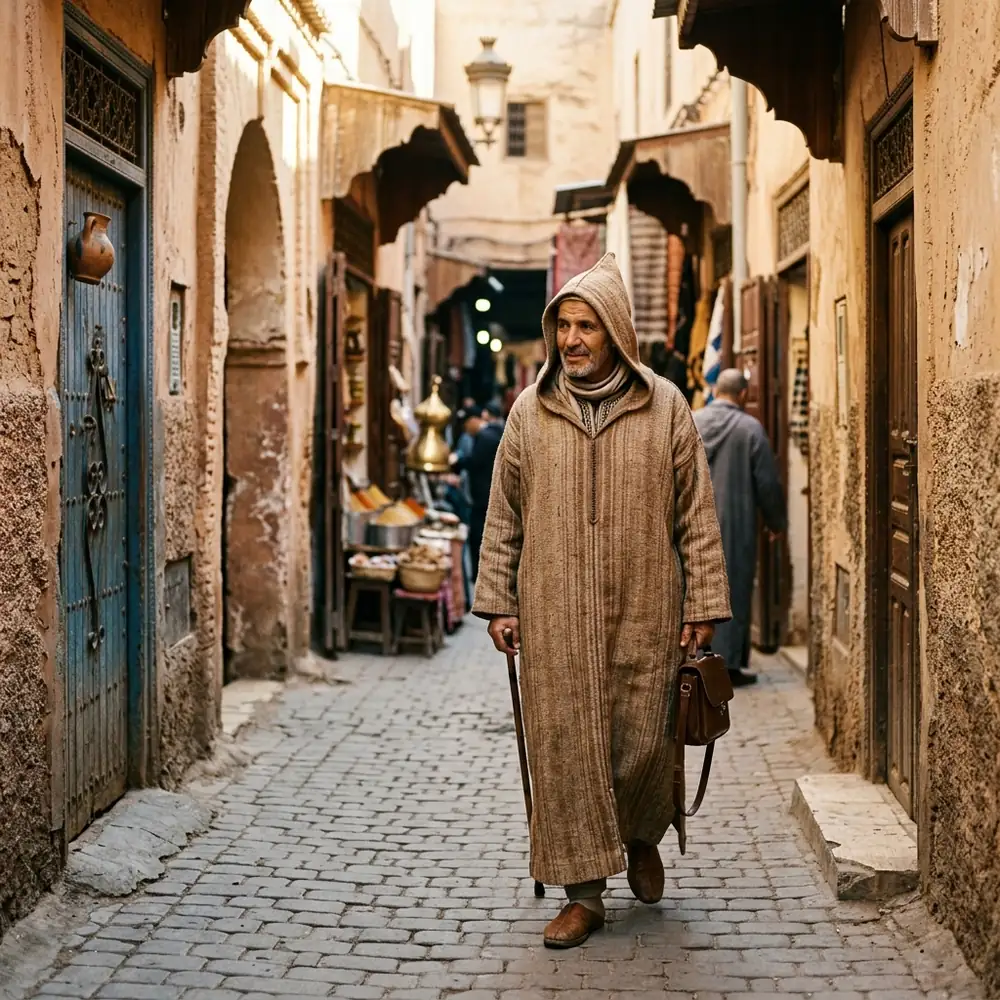
The men's djellaba — djellaba rijalia — is typically made from wool in winter and cotton or a cotton-silk blend in summer. The hood (qob in Darija) is the most culturally significant element: it is pointed, and the degree of its point, the way it hangs, and how it is worn — pulled forward over the head, pushed back off the head, or folded and tied at the back — communicates social context. A man in a men's djellaba with his hood forward and his posture slightly inward is almost certainly on his way to Friday prayer or coming from it. A man with his hood down and his djellaba moving quickly is on an errand. A man in a djellaba sitting in a café with his hood collapsed casually behind him is available for conversation.
The colors of men's djellabas follow regional traditions that are partially fading but still present: in Fes and the northern imperial cities, cream, white, and pale grey are the most prestigious colors for formal occasions — particularly Friday prayer djellabas, which in wealthy families are made from fine, bright-white wool and are kept impeccably clean as a direct expression of respect for the occasion. In the Rif and northern regions, striped djellabas — horizontal stripes of two or three colors — are a regional tradition. In the south and Saharan regions, dark indigo-dyed wool is traditional.
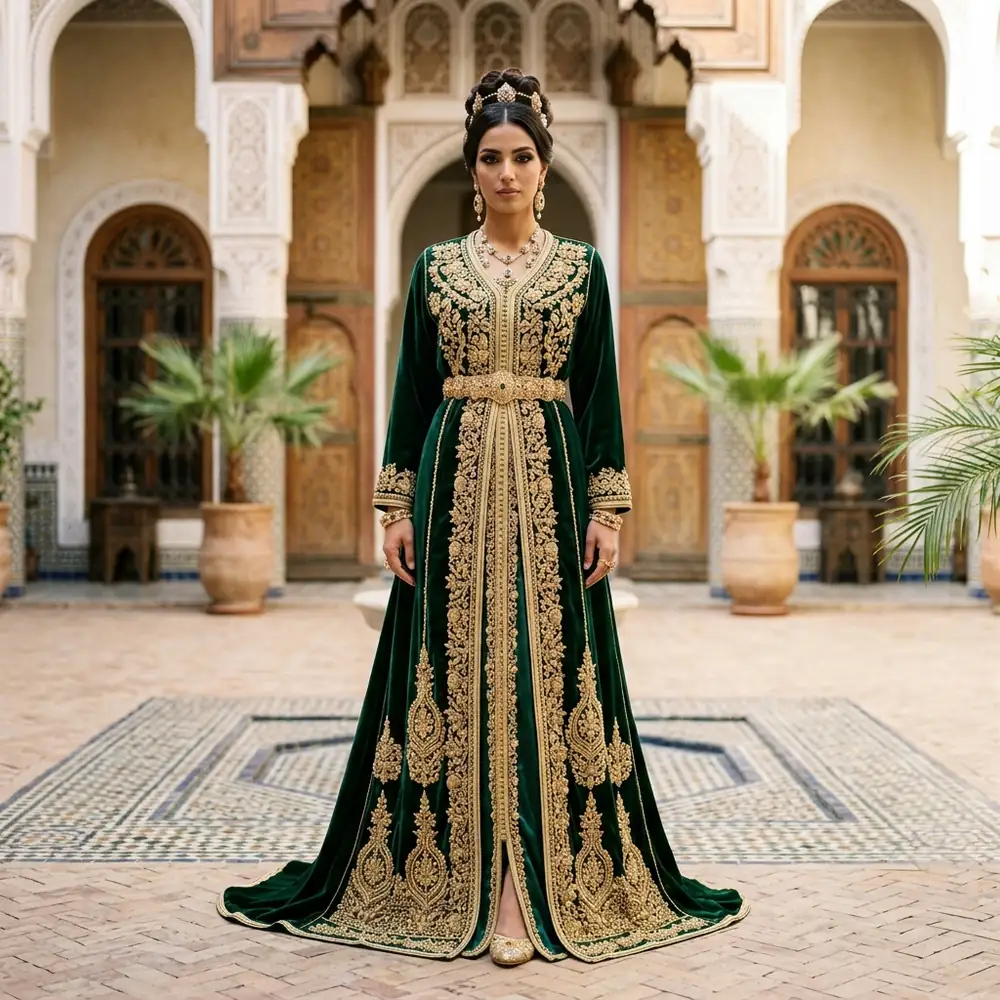
Women's djellabas — djellaba nissaiya — are an entirely separate garment in construction and grammar. They are lighter in weight, fitted more closely to the body, often made from synthetic blends that allow a wider color range, and frequently decorated with elaborate embroidery at the collar, cuffs, and hem. The hood on a women's djellaba is decorative as much as functional — it exists, but it is designed to frame rather than conceal, and is rarely worn pulled forward over the head in the way men use theirs.
What Does the Djellaba's Fabric Tell You?
Quite a lot, if you are paying attention.
A heavy, loosely woven, slightly rough-textured djellaba in natural undyed wool is almost certainly a working garment or a garment from a rural tradition. The wool comes from local sheep, processed and woven by hand or on simple looms, and the roughness is a direct product of minimal processing. These djellabas are extraordinarily warm and durable — a Rif Mountain shepherd's djellaba made from this wool can last decades with minimal care — but they are not what you wear to a formal occasion in the city.
A djellaba made from fine merino wool or from a high-quality cotton-silk blend, in a saturated, even color with a smooth surface finish, is immediately recognizable as an urban, formal, significant-expenditure garment. The most prestigious versions — worn by wealthy merchants and officials in the medina cities — are made from fabrics sourced from Fes's historic textile workshops, particularly the fine haik wool that has been woven in the Ain Nokbi and adjacent neighborhoods for centuries.
The embroidery at the collar — sfifa cord trim and sometimes needle embroidery — is the most direct quality signal. Machine-applied sfifa is regular, identical in each stitch, perfectly consistent. Hand-applied sfifa has slight variations in the tension, tiny irregularities in the looped pattern, and a dimensional quality that the machine version lacks. A knowledgeable Moroccan looking at the collar of a djellaba in a market stall can tell you within seconds whether the embroidery is hand or machine work, and price accordingly.
When Is the Djellaba Worn and When Is It Not?
In traditional Moroccan social grammar, the djellaba is outdoor public wear — the garment you put on to leave the house. Inside the home, Moroccans wear other things: for men, loose trousers and a light shirt, or in more traditional households a gandoura (a sleeveless tunic worn over trousers); for women, takchita (the two-layered traditional indoor formal dress for celebration) or simply modern casual clothing.
At formal celebrations — weddings, engagement parties, circumcision celebrations — the djellaba is typically replaced by more elaborate formal wear: caftan for women, and for men either a very fine djellaba in the most formal fabrics or, for the most significant occasions, the selham (a sleeveless ceremonial cloak) worn over a djellaba.
The djellaba at Friday prayer is a specific and still-practiced tradition: men who own a good white or cream wool djellaba bring it out specifically for Friday attendance, wear it from home to the mosque and back, and then change when they return. In city neighborhoods where the tradition is maintained, the Friday morning visual of men in white djellabas moving through the streets toward the nearest mosque — the white concentrating and multiplying as the prayer time approaches — is one of the most characteristic sights of a Moroccan Friday and one of the most specifically Moroccan things I know.
The Invisible Invitation
The djellaba you see hanging in the souk — beautiful, heavy wool, cream-colored, with hand-embroidered sfifa at the collar — is a significant purchase, not a souvenir. A good djellaba is worn for fifteen, twenty, sometimes thirty years, repaired at the collar and cuffs as needed, and eventually passed down or remade into something else. It is also, wearing it outside your own cultural context, a garment that will mean nothing of what it is supposed to mean, because meaning is not in the cloth. It is in the context. But the cloth is extraordinary. Come and feel it.
SEO Meta Description: What is a Moroccan djellaba and what does it communicate? A local guide to the hooded robe's social grammar — color, fabric, embroidery, hood position, and when each variation is worn.
Experience the true heart of Moroccan heritage through its culinary traditions. Join us in preserving and honoring these ancestral recipes.
What People Are Saying
No comments yet. Be the first — we'd love to hear from you.
Youssef Amazigh
Culturally Verified & Fact-CheckedThe Moroccan Food editorial team brings together native culinary researchers, heritage preservationists, and experienced home cooks across Marrakech, Fes, and Casablanca. Every recipe and cultural guide is reviewed against ancestral oral traditions and authentic regional practices.