Moroccan Essential Oils: Complete Guide to Argan, Rose de Dades, Atlas Cedar & Orange Blossom
Moroccan Essential Oils: Complete Guide to Argan, Rose de Dades, Atlas Cedar & Orange Blossom
Morocco is not a country that talks much about its essential oils. It just produces them — quietly, seasonally, in places that most buyers will never visit. The roses are harvested before dawn in a valley that smells like a perfumery for three weeks a year. The argan trees grow in a semi-arid zone that exists nowhere else on earth. The cedar forests of the High Atlas have been supplying distillers for centuries. And the orange blossom fields of the north fill the air in spring with something that is genuinely difficult to describe until you have stood in the middle of one.
This guide covers what the moroccan essential oils that matter most actually are, where they come from, what the science and tradition say about their benefits, and how to avoid being sold a watered-down or adulterated version.
1. Argan Oil — The Souss Valley’s Most Famous Export
Where It Comes From
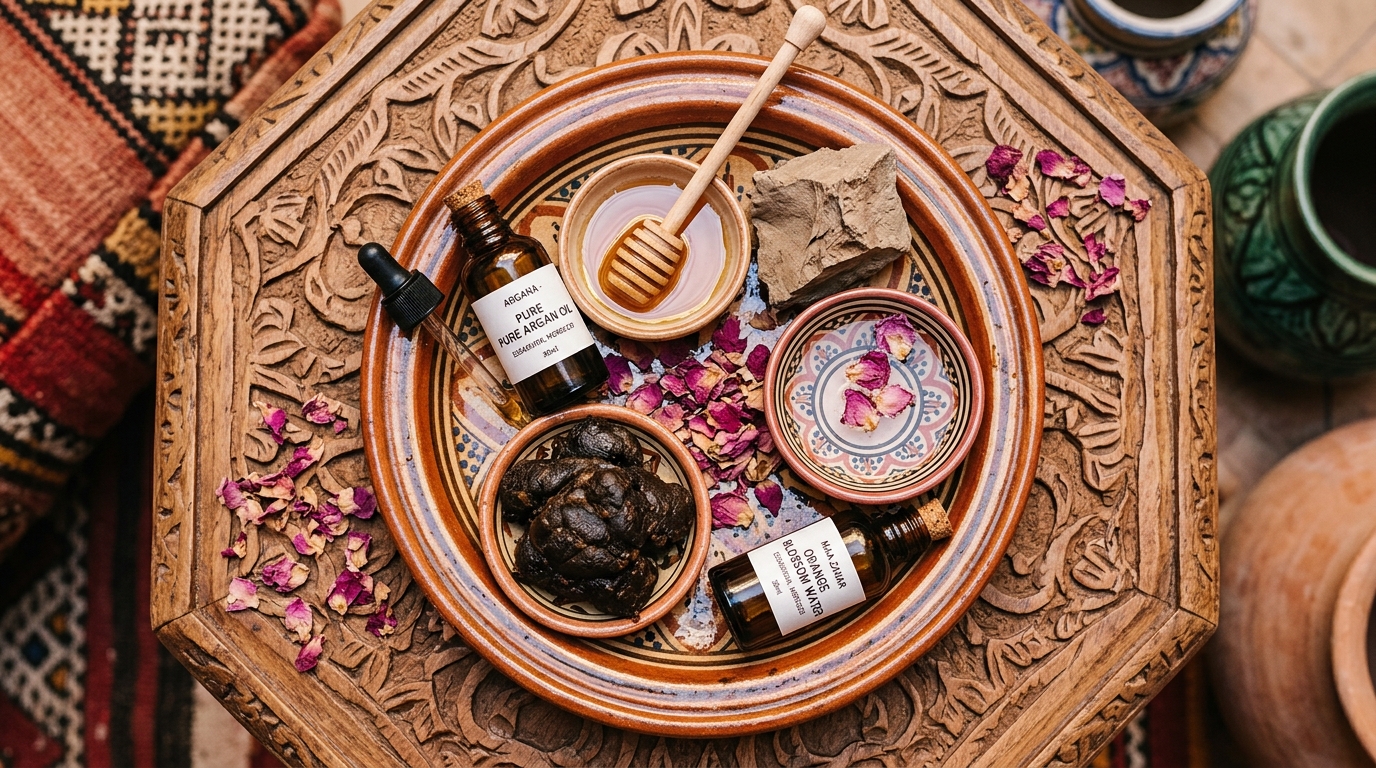
Argan oil is pressed from the kernels inside the fruit of the Argania spinosa tree, a species that grows almost exclusively in the Souss-Massa region of southwestern Morocco, roughly between Agadir, Essaouira, and the edge of the Sahara. The trees are ancient — some are over 200 years old — and the entire forest zone is a UNESCO Biosphere Reserve.
The extraction process is labor-intensive. The fleshy outer fruit is removed, the nut is cracked by hand to extract the kernel, and the kernel is either roasted (for culinary oil, with its nutty flavor) or left raw and cold-pressed (for cosmetic and hair use). What most people mean when they say argan oil hair or argan oil diy treatments is the cold-pressed cosmetic version — lighter in color, nearly odorless, and far more concentrated in active compounds than the culinary type.
What It Actually Does
The benefits of moroccan essential oils conversation usually starts here, and for good reason. Argan oil is genuinely rich in oleic and linoleic acids, tocopherols (vitamin E), and plant sterols. For skin, it absorbs quickly without leaving a heavy residue and has documented anti-inflammatory properties. For hair, it reduces frizz, strengthens the outer cuticle, and adds sheen without the silicone coating that most commercial hair products use.
For argan oil diy use at home: a few drops warmed between the palms and worked through damp hair before drying is the most effective approach. On skin, two or three drops patted onto a clean face at night is usually enough — it does not need to be layered with anything else to work.
How to Spot Fake Argan Oil
This matters because adulteration is common. Real cold-pressed argan oil:
- Has a very faint, slightly nutty smell — not perfumed, not completely odorless
- Is a light golden color, not clear and not dark amber
- Absorbs into skin within about 60 seconds without leaving a greasy film
- Comes in dark glass bottles, since it oxidizes in light
- Costs more than $15 for 100ml — if it is significantly cheaper, it is almost certainly diluted with cheaper oils like sunflower or rapeseed
Any oil labeled “argan blend” or “argan-infused” is not argan oil. Any oil sold in clear plastic bottles has likely already degraded. Cooperative-sourced argan oil, especially from Berber women’s cooperatives in the Souss region, is generally the most reliable.
2. Rose de Dades — Three Weeks That Perfume the World
Where It Comes From
The rose de dades essential oil comes from a single valley in the southern High Atlas: the Vallée des Roses, centered on the town of Kelaat M’Gouna (also written Kalaat M’Gouna or El Kelaâ M’Gouna). The roses here are Rosa damascena — the same variety used in the great Bulgarian rose fields, but grown at altitude with a different soil chemistry and a more intense growing season.
The harvest window is extraordinary in its brevity: roughly three weeks in late April and early May. Roses must be picked by hand before 8am each morning, because the heat of the day causes the volatile aromatic compounds to evaporate. After the harvest, the petals are distilled within hours.
Each year, the town holds the Kelaat M’Gouna Rose Festival to mark the harvest — a local celebration that has existed for decades, long before it became a tourist attraction.
How the Oil Is Made
Steam distillation is the primary method. Fresh petals are loaded into large copper stills, steam is passed through them, the aromatic compounds rise with the steam, and when the vapor condenses, two products separate: rose essential oil (also called rose otto or attar of roses) floating on the surface, and rose water (hydrosol) below.
It takes approximately 4 to 5 tons of rose petals to produce one kilogram of pure rose essential oil. That ratio explains why genuine rose otto is one of the most expensive essential oils in the world, and why most “rose oils” on the market are either synthetic or diluted in a carrier oil.
Uses and Benefits
Rose oil has a well-documented calming effect on the nervous system. It is used in aromatherapy for anxiety and grief — the smell alone has measurable effects on cortisol levels in some studies. Topically, it is an excellent addition to dry or mature skin preparations: anti-inflammatory, mildly astringent, and deeply hydrating when combined with a carrier oil.
Rose water (the hydrosol) is less concentrated but still genuinely useful as a skin toner, particularly for sensitive or redness-prone skin. It is also a staple ingredient in Moroccan cooking — used in pastries, bastilla, and chebakia — which means it has the unusual status of being both a cosmetic and a culinary ingredient.
3. Atlas Cedar Oil — From the Forest to the Scalp
Where It Comes From
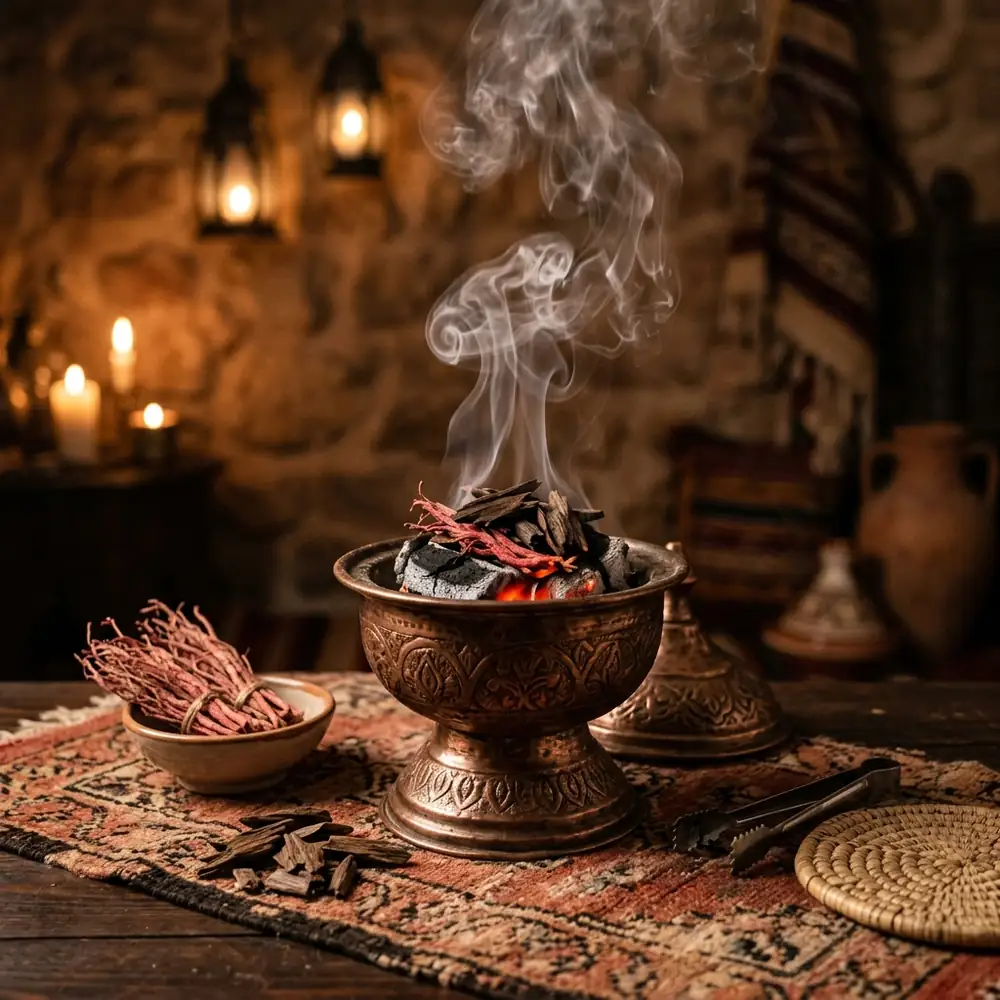
Cedrus atlantica, the Atlas cedar, is native to the mountain forests of Morocco and Algeria, growing at elevations between 1,400 and 2,200 meters in the High and Middle Atlas ranges. The largest remaining forests are around Ifrane, Azrou, and the Jbel Bou Naceur area. Cedar wood and its resin have been used medicinally and spiritually in this region for millennia.
The essential oil is steam-distilled from the wood chips and sawdust of sustainably harvested cedar — often a byproduct of lumber milling rather than trees cut specifically for distillation.
Benefits for Hair and Scalp
Atlas cedar oil is less famous internationally than argan oil, but among Moroccan herbalists and traditional practitioners, it has a strong reputation for scalp health. The primary compounds — cedrol and alpha-cedrene — have demonstrated antifungal and anti-inflammatory properties, making cedar oil relevant for dandruff, seborrheic dermatitis, and scalp psoriasis.
For argan oil hair combinations, adding a few drops of Atlas cedar oil to an argan oil treatment is a traditional Moroccan approach to hair loss. A small study from 1998 (commonly cited in aromatherapy literature) found that massage with a blend of cedarwood, lavender, thyme, and rosemary oils improved hair growth in alopecia areata patients over seven months — cedar was part of the active blend.
Practical use: 3 to 5 drops of Atlas cedar essential oil added to 30ml of argan or jojoba oil, massaged into the scalp and left for at least 30 minutes before washing, used twice weekly.
Do not apply undiluted cedar essential oil directly to the scalp — it is potent and can cause irritation at full concentration.
4. Neroli / Orange Blossom Oil — The Northern Morocco Distinction
Where It Comes From
The orange blossom oil and water produced in Morocco comes primarily from the northern regions — around Fes, Meknes, and especially the Gharb plain, where Citrus aurantium (bitter orange) trees are cultivated. In spring, when the trees bloom, the fragrance in these areas is intense enough to notice from a moving car with the windows closed.
The Crucial Distinction: Water vs. Oil
This is where many buyers get confused. There are two very different products derived from orange blossoms:
Orange blossom water (fleur d’oranger water) is the hydrosol — the water-based byproduct of steam distillation, lightly scented and safe to use directly on skin or in food. This is extremely common in Moroccan cooking: it goes into chebakia, kaab el ghzal, and many pastry creams. It is inexpensive and widely available.
Neroli essential oil is the concentrated oil fraction that separates from the hydrosol during distillation. It takes an enormous quantity of blossoms to produce a small amount — roughly 1,000 kg of flowers per kilogram of oil. This is why genuine neroli is expensive (comparable in price to rose otto) and why many “neroli oils” sold online are actually orange blossom absolute (solvent-extracted, cheaper, and with a slightly different aromatic profile) or simply synthetic fragrance.
True neroli oil has a fresh, slightly citrusy floral scent with a faint green note underneath. It is used in high-end perfumery, has calming properties similar to rose oil, and is particularly effective for combination or acne-prone skin when diluted in a light carrier.
How It Is Distilled
The traditional distillation of orange blossom in northern Morocco uses copper alembic stills — the same technology used for rosewater and other hydrosols across the country. Fresh flowers are loaded in, steam passes through, and the condensate is collected. Most rural producers in the Gharb and the Fes region use this method, and the product they make is primarily fleur d’oranger water for the domestic food market. The concentrated oil fraction is often sold separately to perfumers and cosmetic manufacturers.
If you visit Morocco in spring (late March through early May), the distillation season is in full effect and some producers will show you the process if you ask.
Buying Moroccan Essential Oils Wisely
Whether you are shopping in the souks of Marrakech, online from a Moroccan cooperative, or at a pharmacy in Fes, the same principles apply: ask about origin, ask about distillation method, look for dark glass packaging, and be skeptical of prices that seem too good. The real products are not cheap. What is cheap is almost certainly adulterated.
The cooperatives — particularly the women’s argan cooperatives in the Souss and the rose cooperatives around Kelaat M’Gouna — are often the most transparent and the most fairly priced relative to quality. They also put the money back into communities that have been producing these oils for generations.
FAQ
Q: Can I use Moroccan essential oils directly on my skin without diluting them? No — with the exception of argan oil, which is a fixed (carrier) oil, not a true essential oil. Argan can be applied directly. Genuine essential oils — neroli, Atlas cedar, rose otto — are highly concentrated and must be diluted in a carrier oil (argan, jojoba, sweet almond) at 1 to 3% concentration before skin application. Undiluted essential oils can cause sensitization, burns, or allergic reactions.
Q: What is the difference between argan oil for hair and argan oil for cooking? The culinary version is made from roasted kernels, which gives it a deep nutty flavor but also slightly diminishes some of the antioxidant content. The cosmetic version is cold-pressed from raw kernels, preserving the full tocopherol and fatty acid profile. You can technically use culinary argan oil on your hair — it will work — but it has a stronger smell and a slightly heavier texture. The cosmetic grade is cleaner and more suitable for leave-in applications.
Q: How long do Moroccan essential oils last? Argan oil has a shelf life of about 12 to 18 months from pressing if stored in a cool, dark place. Rose otto and neroli are more stable and can last 3 to 5 years properly stored. Atlas cedar oil is notably stable — up to 5 years or more. All oils degrade faster in heat and light, which is why dark glass bottles matter. If an oil smells rancid or metallic, it has oxidized and should not be used on skin.
Experience the true heart of Moroccan heritage through its culinary traditions. Join us in preserving and honoring these ancestral recipes.
What People Are Saying
No comments yet. Be the first — we'd love to hear from you.
The Moroccan Food
Culturally Verified & Fact-CheckedThe Moroccan Food editorial team brings together native culinary researchers, heritage preservationists, and experienced home cooks across Marrakech, Fes, and Casablanca. Every recipe and cultural guide is reviewed against ancestral oral traditions and authentic regional practices.