Fassi Cuisine: Why Fes Produces Morocco's Most Technically Complex Food
Fassi Cuisine: An Honest Account of Why Moroccan Food From Fes Is Different
I am from Fes. I want to say that at the start because it means I have a bias, and I want you to know about the bias before I tell you that Fassi cuisine is the most sophisticated in Morocco. It is the kind of statement that someone from Marrakech or Meknes or Tetouan might dispute with considerable heat. The disputation is part of the point — Moroccan cities have a pride of food culture that goes very deep and produces very good arguments.
But I will make the case anyway, because I believe it, and because the case rests on something verifiable rather than just regional affection.
Fes was the first imperial capital of a unified Moroccan state. It received, across its history, repeated waves of highly skilled immigrants from collapsing centers of Islamic civilization: the Andalusian refugees of the 15th century, who brought the cooking traditions of the Umayyad and Nasrid courts; the Jewish merchant families of Granada, who brought their own parallel culinary inheritance; scholars and merchants from across the medieval Islamic world who came to study at Al-Qarawiyyin and stayed. All of these influences arrived in a city that was already a functioning, established culinary culture with twelve centuries of accumulated refinement. They did not replace what was there. They added to it.
The result is a kitchen that is, by any objective measure, the most technically complex and the most historically layered in Morocco. This does not mean it is necessarily "better" in the subjective sense — I know people who prefer the directness of Marrakchi cooking or the Andalusian refinement of Tetouanese cuisine and their preference is legitimate. But "complex" and "technically demanding" are descriptors I will defend.
What Makes Fassi Cooking Technically More Demanding Than Other Moroccan Regional Traditions?
The number of steps, the precision of the spice combinations, and the length of preparation time required for Fassi dishes are all considerably higher than the average across Moroccan regional traditions.
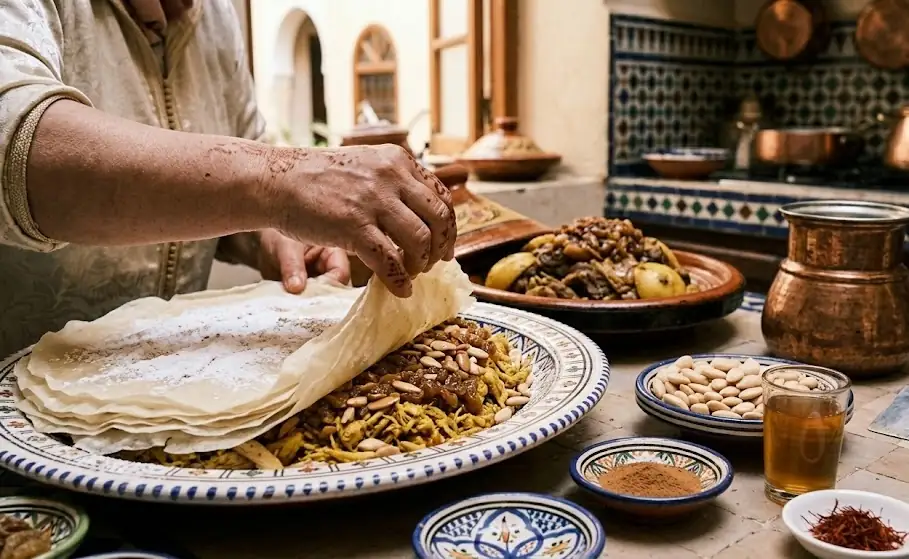
Take Seffa: the celebratory sweet couscous, steamed multiple times with butter and milk, served with caramelized onions, cinnamon-dusted, topped with powdered sugar and fried almonds. In Fes, a proper Seffa takes a full day. The couscous is steamed, removed from the steamer, raked and aerated with forks while hot, moistened with milk, raked again, steamed again, raked again. This process happens five to seven times. Each steaming develops the granules further; each raking separates them and introduces air; each milk treatment adds richness and helps the couscous absorb the butter that goes in between each cycle. The final couscous is perfectly individual, not clumped, tender throughout but never soggy, with a lightness that is genuinely difficult to achieve and that shortcuts simply do not replicate.
Or M'rouzia: the honey-and-smen-and-spice lamb that is specific to Fassi Eid celebrations and that requires a full twelve to fourteen hours of very low cooking, a spice blend that in the traditional version includes twenty or more separate ingredients, and a patience with the long process that most modern kitchens — and most modern cooks — find genuinely challenging.
These are not excessively complicated dishes in the sense of being unnecessarily complex. Every step does something. The complexity is functional. But it does require a relationship with cooking — with giving it time and attention — that the Fassi culinary tradition explicitly values and that is part of what distinguishes Fassi food from more straightforward regional traditions.
What Are the Andalusian Influences Still Visible in Fassi Cooking Today?
The sweet-savory combination — sugar or honey with meat and spice — is the most immediately obvious Andalusian inheritance and it runs through Fassi cooking in a way that is less common in other Moroccan regional traditions. Bastilla (the pigeon pie with almond and sugar), M'rouzia (the honey-lamb), Rfissa (chicken with fenugreek and lentils, slightly sweet from caramelized onion and the long-cooked chicken fat) — these dishes all carry the sweet-savory signature of the medieval Andalusian court kitchen.
The use of dried fruits in savoury contexts — prunes in lamb tagines, dates in couscous, raisins in vegetable dishes — is another Andalusian inheritance. The medieval Islamic cooking tradition of Al-Andalus drew heavily on Persian culinary influence, which had developed sophisticated uses of fruit in meat dishes across centuries. These techniques traveled from Persia to the Andalusian court to the Fassi kitchen, and they are still there.
The preserved lemon — hamad m'rakad — is used in Fassi cooking with a precision and a frequency that marks it as central to the flavor vocabulary rather than a garnish. The specific technique of using only the rind (the pulp discarded), rinsed of its excessive salt, finely chopped and integrated into the cooking base rather than added at the end — this is Fassi handling of a preserved citrus ingredient that comes ultimately from the Andalusian tradition of cooking with preserved bitter orange.
How Do Fassi Women Learn to Cook?
By watching, primarily. And by being corrected, repeatedly, until the correction is no longer necessary.
The transmission of Fassi culinary knowledge is overwhelmingly oral and tactile rather than written. The recipes exist in books — there are several well-regarded Moroccan cookbooks produced in Fes — but the books are reference points rather than primary sources. The primary source is the grandmother's kitchen, and the accumulated judgment of decades of cooking, and the specific way a Fassi woman can look at a tagine base and know, without measuring, that it needs more cumin or that the onions need another five minutes or that the saffron water should go in now rather than in ten minutes.
This knowledge is almost impossible to write down in a way that transfers it. Which is why Fassi cooking done badly — by cooks who have the recipe but not the instinct — is noticeable and why Fassi cooking done well is one of the great pleasures of eating anywhere in this country.
The Invisible Invitation
There is a neighborhood restaurant in the Fes medina — a word I use loosely, because it is four tables in a room attached to a house and the owner's wife cooks everything — where the Bastilla arrives without being ordered because on the day they make it, everyone gets it. On the days they make M'rouzia, the smell travels into the alley and draws people who were walking past with no intention of stopping. I am not going to tell you the name because I am not sure it has one, and if it does, the name is not the thing that finds you. The thing that finds you is the smell coming from the alley. Follow it. Trust it. It has been right for twelve hundred years.
SEO Meta Description: Why is Fassi cuisine Morocco's most technically complex? A Fes culinary expert explains the Andalusian influences, multi-step techniques, and the inherited knowledge behind the imperial city's food.
Experience the true heart of Moroccan heritage through its culinary traditions. Join us in preserving and honoring these ancestral recipes.
What People Are Saying
No comments yet. Be the first — we'd love to hear from you.
Khadija Tahiri
Culturally Verified & Fact-CheckedThe Moroccan Food editorial team brings together native culinary researchers, heritage preservationists, and experienced home cooks across Marrakech, Fes, and Casablanca. Every recipe and cultural guide is reviewed against ancestral oral traditions and authentic regional practices.