Moroccan Gastronomy for Vegetarians: The Complete Guide to Eating Incredibly Well Without Meat
Moroccan Gastronomy for Vegetarians: The Complete Guide to Eating Incredibly Well Without Meat
Here is a thing that surprises most vegetarians the moment they land in Morocco: the country that gave the world mechoui (whole roasted lamb), kefta brochettes, and merguez sausages also happens to be quietly extraordinary for people who do not eat meat.
Not just manageable. Not just “you can find something.” Actually extraordinary.
This is not an accident. Moroccan gastronomy is built on a foundation of legumes, preserved vegetables, spice architecture, and slow-cooked grain traditions that predate the current Western obsession with plant-based eating by about twelve centuries. The vegetarian dishes that exist here were never designed as substitutes or afterthoughts. They are the real thing.
This guide is for anyone who wants to eat Moroccan food at its deepest and most satisfying — and happen to not eat meat while doing it.
Why Morocco Works So Well for Vegetarians
The quick version: Moroccan cuisine is structurally vegetarian-friendly.
The historical reason is economic. For most of Moroccan history, meat was a luxury — reserved for celebrations, festivals, and the wealthy. The everyday cooking of ordinary Moroccan families was built around what was available, affordable, and nourishing: lentils, chickpeas, fava beans, white beans, carrots, turnips, potatoes, tomatoes, olives, preserved lemons, eggs, and bread.
The spice tradition did the rest. A simple lentil soup elevated with cumin, coriander, turmeric, cinnamon, and a handful of fresh cilantro is not a compromise. It is one of the greatest soups on earth.
The result: Morocco has an entire parallel culinary universe that requires no meat, misses nothing, and is often the most interesting and technically sophisticated food in the country.
The Essential Vegetarian Dishes: What to Order
Harira (Without Meat)
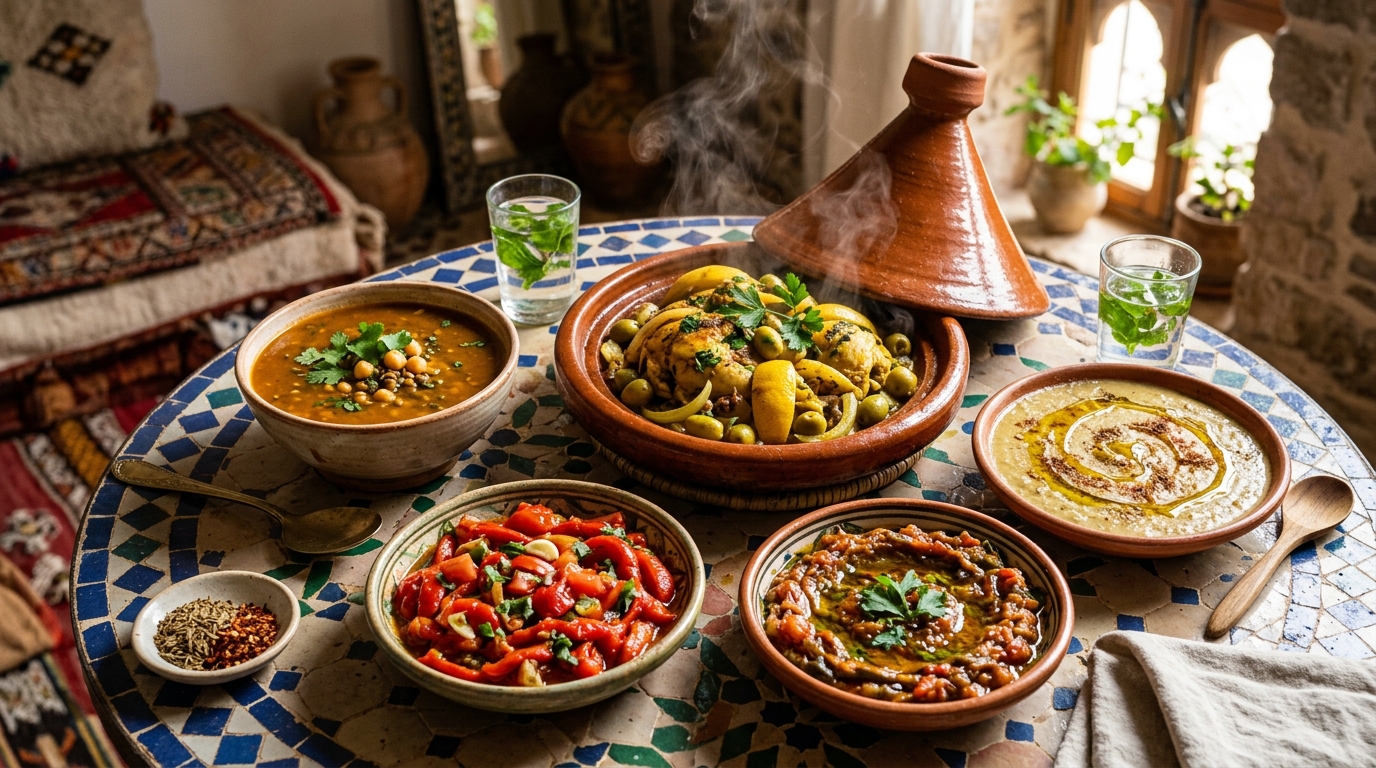
Harira is Morocco’s most iconic soup — thick, fragrant, deeply satisfying. The classic version contains lamb, but the vegetarian version (which exists widely and is not considered a lesser product) uses only chickpeas, lentils, tomatoes, celery, fresh coriander, parsley, a tangle of vermicelli, and the spice base of ras el hanout.
Ask for harira bla lahm (harira without meat). In most traditional restaurants, the cook will know exactly what this means. Served with a squeeze of lemon and a side of dates or chebakia during Ramadan, vegetarian harira is one of the most comforting bowls of food that exists.
Zaalouk (Roasted Aubergine and Tomato Salad)
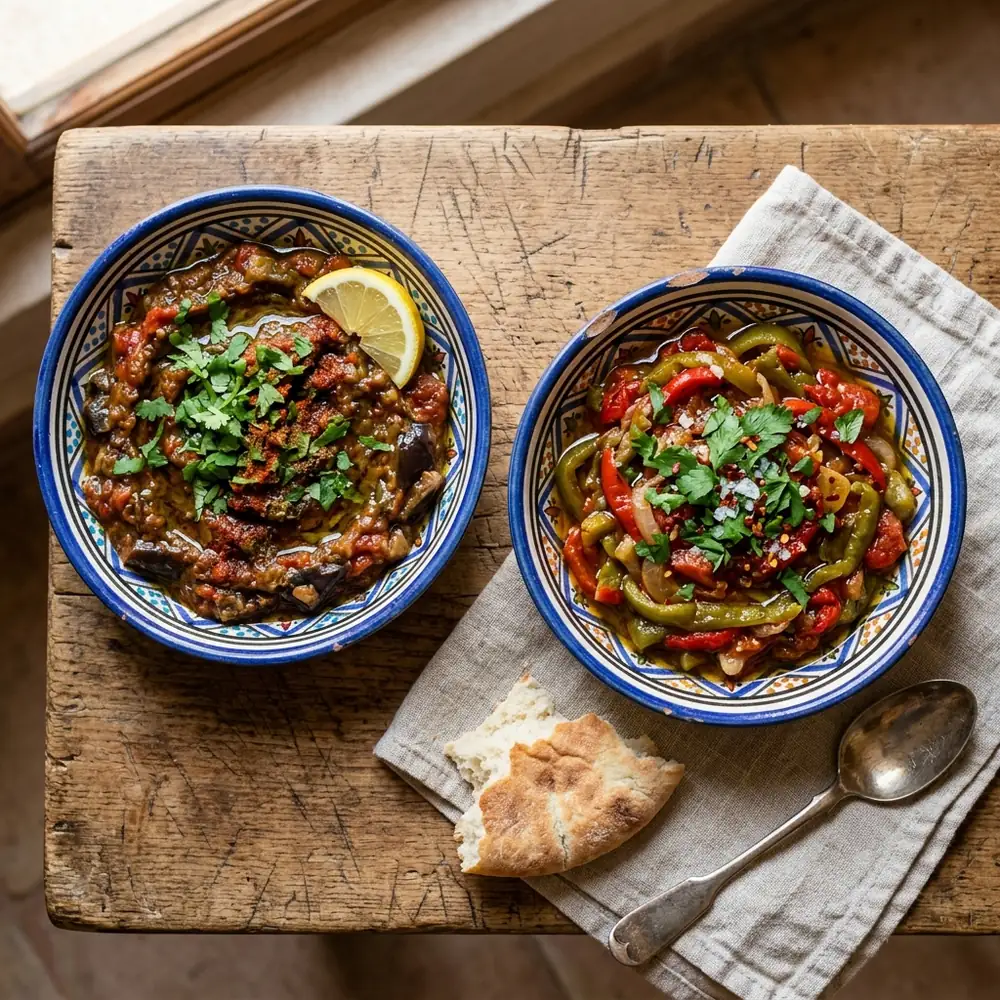
This is the dish that converts people. Aubergines are roasted until completely soft, then pulled apart and cooked down with tomatoes, garlic, cumin, paprika, olive oil, and preserved lemon. The result is dark, smoky, deeply savoury, and impossible to stop eating.
Zaalouk is usually served as a side dish or starter (salad marocaine), but a generous portion with bread is a complete meal. Make it at home: roast your aubergines directly on a gas flame for the best smoky flavour.
Taktouka
The pepper and tomato equivalent of zaalouk. Green peppers and ripe tomatoes are roasted, peeled, and slow-cooked with garlic, olive oil, cumin, and paprika into a jammy, intensely flavoured relish. Served at room temperature with bread.
The combination of zaalouk, taktouka, and a few other salads on the table — the classic Moroccan salad spread — is one of the most satisfying beginnings to any meal, and entirely plant-based.
Bessara (Fava Bean Soup)
Walk through any Moroccan medina at 6am and you will find bessara sellers — street vendors with huge copper pots of this thick, blended fava bean soup, drizzled with olive oil and dusted with cumin and paprika.
Bessara is the working Moroccan breakfast of the northern cities, particularly Fes and Tangier. It costs almost nothing (5–10 MAD a bowl). It is deeply nourishing. And it is almost certainly the oldest dish in this guide — fava beans have been cultivated in this region for thousands of years.
Vegetarian Tagine: The Spectrum
The tagine (the clay cooking vessel and the dish it produces) is Morocco’s signature slow-cooked preparation. While lamb and chicken tagines get most of the attention, vegetarian tagines are genuinely part of the tradition, not a modern adaptation.
The best vegetarian tagine combinations:
Tagine of seven vegetables (tajine sabbaa khodrawat): The celebratory Berber tagine cooked with turnips, carrots, courgette, tomatoes, onions, cabbage, chickpeas, and pumpkin, over a base of onion and olive oil, spiced with saffron, ginger, and cinnamon. The vegetables are arranged in concentric circles in the conical clay pot and slow-steamed in their own juices. One of the most beautiful preparations in Moroccan cooking.
Tagine of pumpkin and caramelised onions: Pumpkin slow-cooked until it almost dissolves, with onions confited (slowly cooked in olive oil until deeply sweet), raisins, toasted almonds, and cinnamon. This is the sweet-savoury combination that defines Moroccan cooking at its most sophisticated.
Tagine of potatoes, olives, and preserved lemon: Simple, but the preserved lemon changes everything. The alchemy of salty-briny-acidic lemon with the earthiness of potato and the bitter richness of olives is completely specific to Morocco.
Tagine of lentils with caramelised onions: Less common as a restaurant dish but widely made in home cooking. Earthy, deeply flavoured, and filling.
Couscous (Fully Vegetarian)
Friday couscous is a Moroccan institution — the meal that anchors the week for millions of families. The classic version is cooked with lamb or chicken, but the vegetable couscous (couscous bel khodra) exists independently as a genuine celebration dish.
Semolina steamed three times until each grain is separate and fluffy, served with a generous broth of caramelised onions, chickpeas, raisins, and the seven vegetables. The broth is the secret — it is what elevates couscous from grain to something extraordinary. A good vegetable couscous takes about three hours to make properly.
In restaurants, order couscous bel khodra and specify you do not want meat in the broth (the broth is sometimes made with meat stock even in “vegetable” couscous). Ask: “bla lahm wa bla mraq d’lahm” (without meat and without meat stock).
Ksra and Msemen (The Bread Question)
Moroccan bread deserves its own section because it is so central to eating here and so reliably excellent.
Khobz (the round daily bread, baked in communal ovens called ferran) — no animal products, just semolina, white flour, water, yeast, salt.
Msemen — flaky, layered square flatbread cooked on a griddle. Made with semolina, flour, butter, and oil. The butter means it is not vegan but is vegetarian.
Baghrir — the thousand-hole pancake made from semolina and yeast, served with honey and butter. Magical for breakfast.
Harcha — a semolina flatbread with a slightly crumbly texture, cooked in a pan. Served at breakfast with olive oil, honey, or jben (fresh Moroccan cheese).
All of these form the backbone of vegetarian eating in Morocco. Bread is not a side dish here — it is an active participant in the meal.
Eggs: The Underrated Moroccan Star
Eggs in Morocco are used with creativity that many Western cuisines do not approach.
Kefta tagine without the kefta: The sauce — tomatoes, onions, cumin, paprika, coriander — is extraordinary. Eggs are poached directly in this sauce. Ask for tagine bid bel matecha (egg tagine with tomato sauce) without the meat.
Shakshuka (local version): Similar concept — eggs poached in spiced tomato sauce, often with peppers. Found at breakfast cafés everywhere.
Briouats with egg and cheese: Filo pastry triangles filled with egg and spiced fresh cheese (jben), fried or baked. A festival and special occasion food, but sometimes available at good restaurants.
Amlou: The Spread That Changes Breakfast Forever
If you have never had amlou, your life has been lacking a specific pleasure.
Amlou is made from three ingredients: roasted ground almonds, pure argan oil, and honey. The texture is like a more complex, less sweet peanut butter. The flavour is nutty, oily, slightly bitter from the argan, and fragrant with honey. Spread on hot msemen or fresh khobz, it is one of the most satisfying breakfasts imaginable.
It is entirely plant-based and produced primarily by Amazigh women’s cooperatives in the Souss region. Buying a jar directly from a cooperative is one of the best food souvenirs you can take home from Morocco.
The Vegetarian’s Practical Toolkit: Key Darija Phrases
Knowing even a few words of Moroccan Arabic makes the difference between getting what you want and getting a bowl of mystery broth.
“Ana ma kankoul lahm” — I do not eat meat
“Wash kayen lahm f had shi?” — Is there meat in this?
“Bla lahm, afak” — Without meat, please
“Wash kayen mraq d’lahm?” — Is there meat stock/broth?
“Bla ddjaj” — Without chicken
“Wash had shi nabati?” — Is this vegetarian?
“Ana nabati” — I am vegetarian
A kind note: the concept of “vegetarian” in its strict Western sense does not always translate directly. In Morocco, many people consider a dish vegetarian if it contains no pieces of visible meat — but the broth or cooking fat may come from meat. Being specific with the phrases above helps significantly.
The Hammam of Flavours: The Moroccan Spice Palette
Understanding the spice palette that underlies Moroccan cooking is the key to understanding why vegetarian dishes here are so satisfying. This is the toolkit that makes a chickpea tagine taste like an experience rather than an obligation.
Cumin (kamun): The foundational spice of Moroccan cooking. Used in almost everything savoury. Provides warmth and earthiness.
Coriander (takouria): Both ground (spice) and fresh (herb). Fresh coriander appears everywhere.
Turmeric (kharkoum): Warmth and golden colour, used more subtly than in South Asian cooking.
Cinnamon (karfa): Used in both savoury and sweet preparations — a specifically Moroccan technique that produces the distinctive warm-sweet-savoury flavour of dishes like b’stilla and pumpkin tagine.
Ginger (skinjbir): Fresh and ground. Essential in the spice base (charmoula) that starts many tagines.
Saffron (zaafran): Morocco produces some of the world’s finest saffron, from Taliouine in the south. A pinch transforms a vegetable broth from ordinary to extraordinary.
Preserved lemon (hamd msiar): Not a spice but a flavour anchor. The combination of salt, acidity, and fermented lemon rind creates a flavour that has no real equivalent elsewhere. Essential in many tagines and salads.
Ras el hanout: The complex spice blend (the name means “top of the shop” — the best of what the spice merchant has). Every merchant’s blend is slightly different. Typically contains cardamom, cinnamon, ginger, cumin, coriander, turmeric, black pepper, nutmeg, rose petals, and 10–20 other ingredients.
Vegetarian-Friendly Restaurants and Experiences by City
Marrakech
The modern neighbourhood of Gueliz has the highest concentration of restaurants that explicitly cater to dietary preferences. Cafés like Café des Épices (overlooking the spice market) and Earth Café (a fully vegetarian restaurant in the medina) have menus built around this.
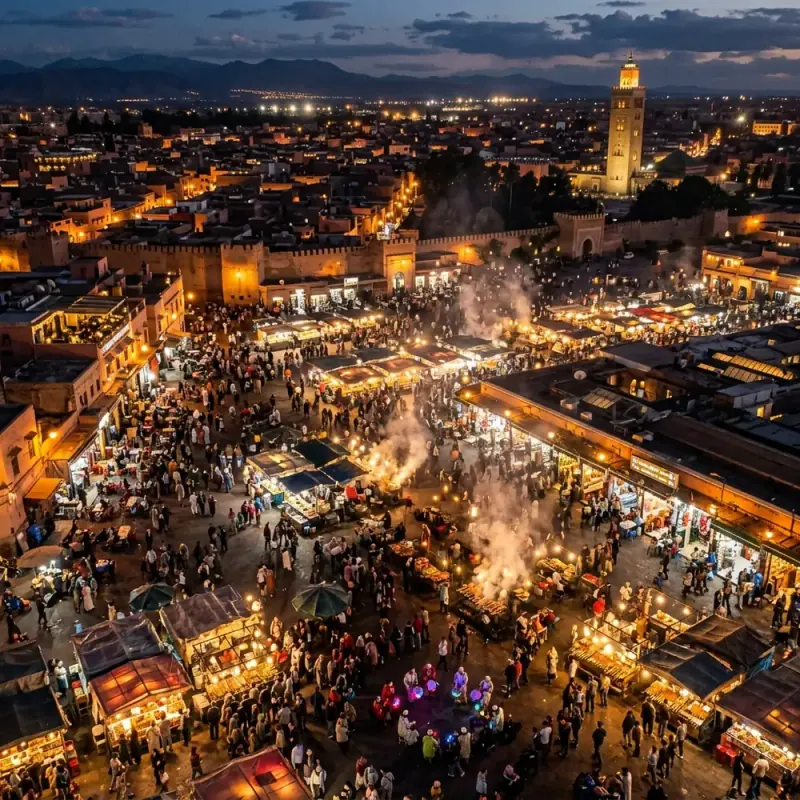
For traditional cooking: Jemaa el-Fna food stalls after dark — the snail soup, the cooked vegetable stalls, the bessara, and the fresh orange juice stalls are all plant-based and extraordinary.
Fes
The restaurant scene inside Fes el-Bali tends toward traditional Moroccan cooking, which means vegetarian options exist but you may need to ask specifically. Café Clock (Derb el Miter) is a reliable spot with clearly labelled vegetarian options and a menu that specifically addresses dietary preferences.
The food market near the Rcif in the medina sells fresh produce, olives, pickled vegetables, and fresh-pressed olive oil — everything you need for a self-catered vegetarian feast.
Agadir and the South
The Souss region is argan oil country. Amlou, fresh olive oil, and argan-based products are found at their source here. Women’s cooperatives in the Tizi valley and around Aourir produce and sell directly.
Agadir’s Souk El Had market is one of Morocco’s largest and most accessible produce markets — a visual and olfactory experience and an excellent place to stock up on olives, pickled lemons, dried fruits, and spices.
A Vegetarian Week in Morocco: What a Day of Eating Looks Like
Breakfast:
- Baghrir with honey and butter
- Amlou with msemen
- Hard-boiled egg
- Mint tea (mandatory)
- Fresh orange juice (5 MAD, non-negotiable)
Lunch (midday, the main meal in Morocco):
- Harira soup (without meat)
- Tagine of seven vegetables with khobz to tear and dip
- Zaalouk and taktouka on the side
- Water or ayran (thin yogurt drink)
Dinner (lighter):
- Bessara from a street vendor
- A selection of small salads (carrots, beet, tomato-cucumber)
- Baghrir with honey
- More mint tea
This is not a deprivation diet. This is eating as Moroccan families have eaten for generations.
Frequently Asked Questions
Is it easy to be vegetarian in Morocco? Easier than most people expect. The challenge is mainly in communication — ensuring that “vegetarian” is understood in its strict sense (no meat stock, no animal fat in cooking). With a few key phrases and some specificity when ordering, eating very well is entirely achievable.
Is Moroccan food vegan-friendly? Many dishes are naturally vegan: bessara, zaalouk, taktouka, many tagines, couscous with vegetable broth. The main exceptions are dishes using butter (msemen, baghrir) and cheese (briouats). Most salads and vegetable preparations are fully vegan.
What about restaurants that say they have vegetarian options but still use meat stock? This is a genuine challenge. The safest approach: specify both “no meat pieces” and “no meat broth” using the Darija phrases above. In tourist-oriented restaurants, staff are increasingly familiar with strict vegetarian requirements.
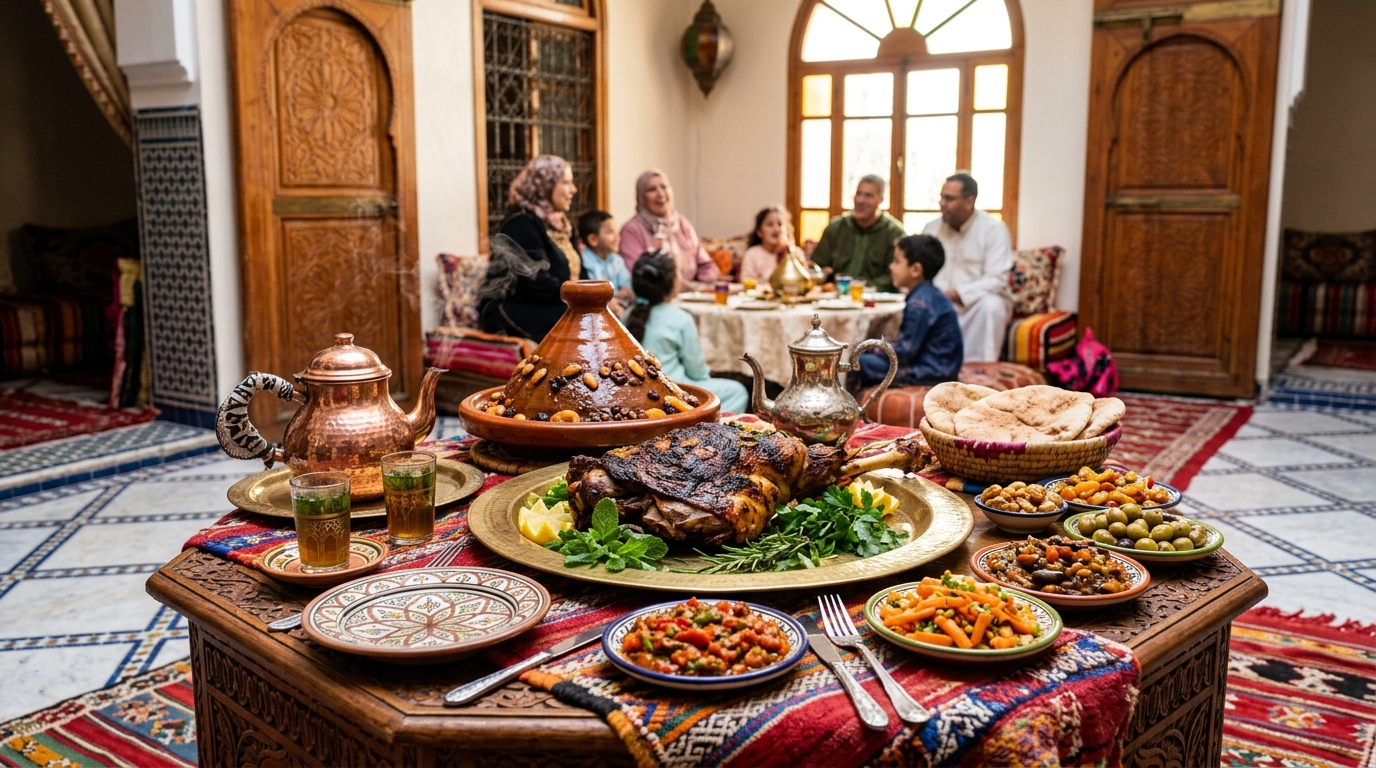
Can I find these dishes in home cooking environments, not just restaurants? Absolutely. If you are lucky enough to be invited to eat with a Moroccan family, the table will almost certainly include several purely vegetarian dishes alongside any meat. The salad spread, the bread, the harira, the cooked vegetables — all of these are part of the standard Moroccan table.
Where can I buy Moroccan spices to recreate these dishes at home? The spice souks of Marrakech (near the Jemaa el-Fna) and Fes (the Attarine near the medina) are the best sources. Buy whole spices where possible — ground spices are sometimes padded with colourings or starches in tourist-oriented shops. Established spice merchants with multiple sacks of whole spices and a grinding stone are the reliable choice.
Experience the true heart of Moroccan heritage through its culinary traditions. Join us in preserving and honoring these ancestral recipes.
What People Are Saying
No comments yet. Be the first — we'd love to hear from you.
The Moroccan Editorial Team
Culturally Verified & Fact-CheckedThe Moroccan Food editorial team brings together native culinary researchers, heritage preservationists, and experienced home cooks across Marrakech, Fes, and Casablanca. Every recipe and cultural guide is reviewed against ancestral oral traditions and authentic regional practices.