The Moroccan Hammam: What Actually Happens Inside and Why It Is Not a Spa
The Moroccan Hammam: What to Expect When What You're Expecting Is Wrong
Let me address the word "spa" immediately, because it appears in the description of every tourist-facing hammam in Morocco and it is misleading in ways that set up the wrong expectations and then produce the wrong disappointment.
A traditional Moroccan hammam is not a spa. It does not have ambient music. It is not quiet. It does not smell of essential oils. The kessa — the exfoliating mitt treatment that is the hammam's central procedure — is not a gentle buffing of dead skin cells. It is a firm, thorough, sometimes slightly aggressive removal of the layer of dead skin that has accumulated on your body since the last time you did this, performed by an attay (hammam attendant) who has done it thousands of times and who will not apologize if the process is uncomfortable, because the discomfort means it is working.
The tourist hammam experiences offered in Marrakech and Fes and Casablanca — the ones you book online, with prices in euros, with robes and herbal teas and various additional treatments listed on a laminated menu — are a real category of experience and some of them are very pleasant. But they are essentially hotel spas that have borrowed the hammam vocabulary. The traditional public hammam — the ferran, the neighborhood bathhouse that every Moroccan medina neighborhood still has and that the majority of Moroccan families without home bathing facilities still use weekly — is something else, and I want to describe that something else because it is one of the most genuinely Moroccan experiences available and one of the least-understood.
What Does a Traditional Moroccan Hammam Look Like and How Is It Organized?
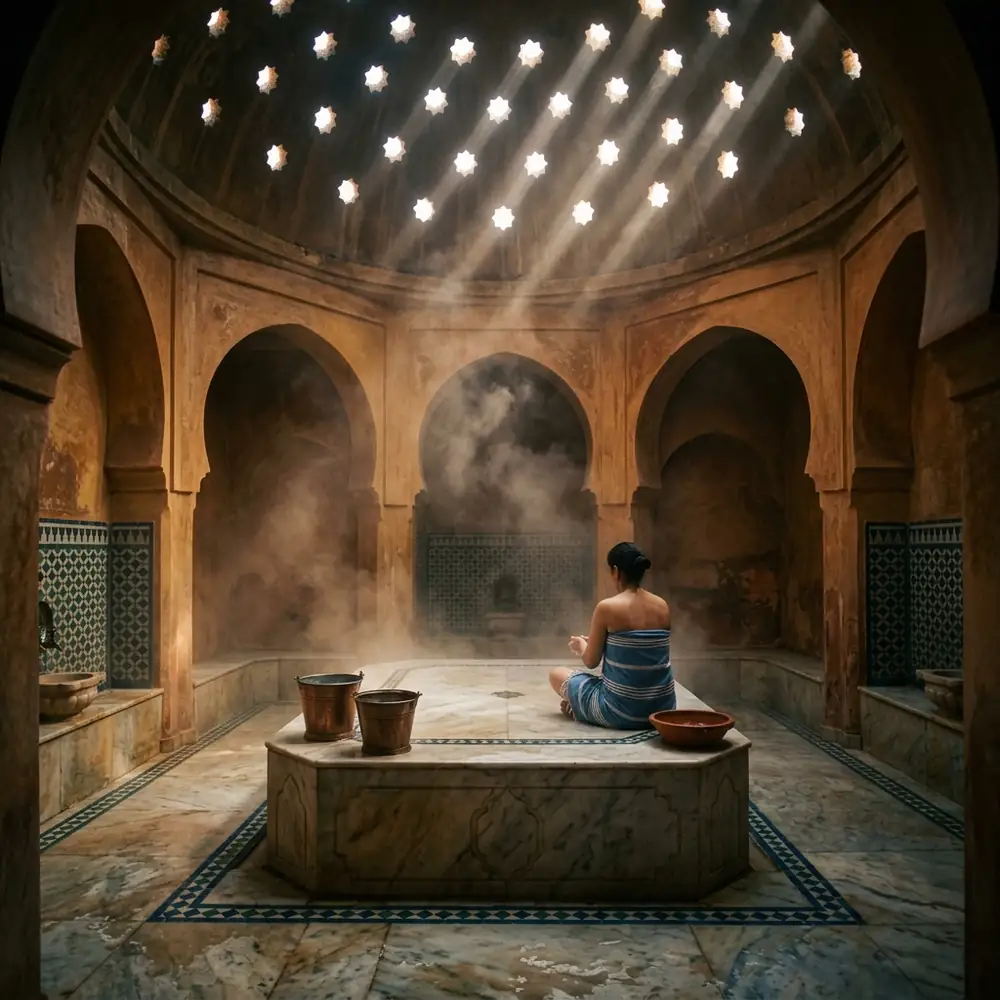
The traditional hammam is a single building with three progressively hotter rooms arranged in sequence: the changing room (bayt al-barid, cold room) where you undress and store your clothes, the warm room (bayt al-wastani, middle room) where you sit and let your body acclimatize to the heat and where the kessa scrub takes place, and the hot room (bayt al-skhoun, hot room) closest to the boiler where the temperature is highest and where the most thorough sweating happens.
The boiler — traditionally wood-fired, in many hammams now gas-fired — heats water and produces the steam that keeps the rooms at their different temperatures. A good hammam has a clear temperature gradient between its three rooms; a poorly maintained one has lost the gradient and everything is vaguely warm rather than specifically hot. You can tell the quality of a hammam by the temperature differential between the middle and hot rooms — a well-functioning hammam's hot room should be noticeably, uncomfortably hotter than the warm room.
Men and women use the hammam separately — either at different times of day (many traditional hammams are men in the morning, women in the afternoon and evening, with the transition mid-morning) or in entirely separate facilities. The neighborhood hammam is gender-divided without exception.
You bring everything with you: a bucket (often provided), your savon beldi (black soap), your kessa mitt (also often provided for a fee), a towel, a change of clothes, and sometimes shampoo and a comb. Many regular hammam users have a small bag that lives near the door, always packed with their hammam supplies.
What Is the Kessa and Savon Beldi and What Do They Do?
Savon beldi — the traditional Moroccan black soap — is a soft, paste-like soap made from olives: pressed olive oil and the water-phase byproduct of olive oil production, saponified together and naturally colored to a dark brown-black by the olive components. It is applied generously to the wet, warm skin and left for three to five minutes to soften the skin's surface layer before the kessa treatment. It smells of olives and wet clay and something slightly fermented that is specific to it and not unpleasant once you've encountered it a few times.
The kessa is a rough-textured woven mitt made from a synthetic fabric that has a specific coarse weave — somewhere between fine sandpaper and a pot scrubber in terms of abrasion. When applied to warm, savon-beldi-softened skin with firm, long strokes, it removes the accumulated dead skin layer in visible rolls — grey, slightly coherent rolls of shed skin that are both slightly alarming and considerably satisfying to observe. If you have been in the hammam for twenty minutes before the kessa treatment and your skin is thoroughly warm and softened, the amount of dead skin that comes off is more than most people expect the first time.
An attay performing the kessa is faster, more thorough, and reaches areas of the back and shoulders that are impossible to reach alone. The pressure they use is calibrated — firm enough to remove effectively, not so firm as to abrade the living skin beneath. Most people leave the kessa feeling that their skin has been renewed in a way that shower exfoliation never quite produces, because the warm room humidity softens the skin more completely than any home treatment manages.
Why Is the Traditional Hammam a Social Institution Rather Than Just a Bathing Facility?
In a medina neighborhood without running hot water — which describes the majority of households in traditional Moroccan medinas until relatively recently and still describes a significant minority — the hammam is where you go for your weekly thorough bathing. This creates a regularity of attendance that transforms the hammam from a facility into a community space.
The warm room, particularly, is where neighbors see each other weekly, where women talk while the savon beldi works, where information moves through the neighborhood. In the women's hammam tradition, the gathering function is explicit and important — the hammam is one of the few public spaces where women in traditional neighborhoods meet regularly outside the home and maintain social networks. Children are brought to the hammam from infancy; the weekly hammam is one of the first public social experiences a Moroccan child has.
The muallem — the master attendant who manages the hammam's operation and often performs the kessa — has a position in the neighborhood's social fabric that is not reducible to service provider. He or she knows the neighborhood's families across generations. Regular hammam attendance is how you know your neighborhood in a way that casual street interaction doesn't produce.
The tourist hammam captures none of this because it cannot: you are not a neighborhood resident, you are not returning next week, and the hammam's social function is a product of continuity that a single visit cannot access. But the physical experience — the heat, the kessa, the savon beldi, the leaving feeling renewed — is available in the first visit and is worth having for its own sake.
The Invisible Invitation
The changing room attendant hands you a key for a locker and a small mat for the floor. You leave your clothes and wrap a fouta (a light cotton towel) around your waist. Through the first door is the warm room: tiled in white, steamy, the sound of water from buckets, the smell of savon beldi pervasive and warm. Find a space on the tiled floor. Fill your bucket at the hot water tap. Pour it slowly over yourself. Wait twenty minutes. The attendant will find you. What happens next is the part that feels strange the first time and absolutely right from the second time onward. Come back next week. That's when it starts making sense.
SEO Meta Description: What is a traditional Moroccan hammam and how does it work? The three-room structure, kessa scrub, savon beldi, and why the public bathhouse is a social institution, not a spa.
Experience the true heart of Moroccan heritage through its traditions. Join us in preserving these ancestral rituals.
What People Are Saying
No comments yet. Be the first — we'd love to hear from you.
Youssef Amazigh
A Moroccan cultural writer dedicated to documenting the authentic voice, history, and heritage of the Kingdom. Writing from within — to share what truly makes Morocco extraordinary.
Our Mission →