Moroccan Henna: The Art Form That Has Almost Nothing to Do With Weddings
Henna in Morocco: What It Is Actually For and Why the Tourist Version Misses Everything
Let me be direct about the henna situation in Djemaa el-Fna square in Marrakech, because it is the context in which most non-Moroccan visitors encounter the practice and it is not representative of what henna actually means in Moroccan culture.
The women who approach tourists in the square offering henna application are providing a service that is decorative and commercial. The designs they apply are usually a Moroccan-adjacent version of South Asian henna patterns — heavy, elaborate, bilateral, optimized for visual impact in a photograph. The application takes fifteen minutes. The charge is whatever the negotiation produces. This is a transaction, not a tradition, and conflating it with the actual practice of henna in Moroccan culture produces the kind of misunderstanding where a foreign visitor returns home thinking they have had “a Moroccan henna experience” when they have had a commercial service provided specifically for foreign visitors.
The actual practice of henna in Morocco is something quite different, and it is one of the most genuinely interesting traditional practices I know.
What Is Henna Actually Used For in Traditional Moroccan Culture?
The lawsonia inermis plant — whose dried and ground leaves produce the reddish-brown paste we call henna — has been used in North Africa and the broader Islamic world for at least two millennia as a cosmetic, a medicinal plant, and a ritual substance. The medicinal applications — henna’s antifungal properties, its cooling effect on skin in hot climates, its use as a hair conditioner and color — are separate from the ritual applications and were likely the original basis for its wide adoption.
The ritual applications in Morocco cluster around a consistent theme: henna is applied at moments of transition and vulnerability, as a protective agent.
A newborn child, in traditional Moroccan practice, receives henna on the soles of its feet and the palms of its hands within the first week of life. This is not decoration. It is protective — the henna closes and seals the entry points of the body most vulnerable to spiritual harm during the dangerous early period of life. In the Amazigh tradition of the Atlas regions, the first henna application to a newborn is accompanied by specific spoken formulas (niyyat) and takes place at a designated moment determined by the community elder or the experienced woman who manages such transitions. The henna is functional. It is doing something.
A woman after childbirth — in the period of recovery and spiritual vulnerability that follows delivery — traditionally receives henna on her hands and feet. The baby’s naming ceremony (sbaa, held on the seventh day after birth) often includes a communal henna gathering where women apply henna to each other in a social ritual that also has protective dimensions.
The night before a wedding — the leilat al-henna, the henna night — is what most people know, but even here the original function is protective rather than decorative. The bride is entering a new life, a new household, a new social identity, and the henna applied by the senior women of her family is a blessing and a protection for the transition. The elaborate pattern work is a later elaboration; the protective intent is primary and older.
On Aid al-Adha — the Feast of Sacrifice — henna is applied to the animals being sacrificed, particularly the sheep, as a mark of honor and as a protective gesture for an animal entering a significant ritual moment. The sheep’s horns are painted with henna and decorated with flowers. This is not widely known outside Morocco and tends to surprise people when they see it for the first time.
How Is Traditional Moroccan Henna Different From the Tourist Version?
The designs, the technique, and the social context are all different.
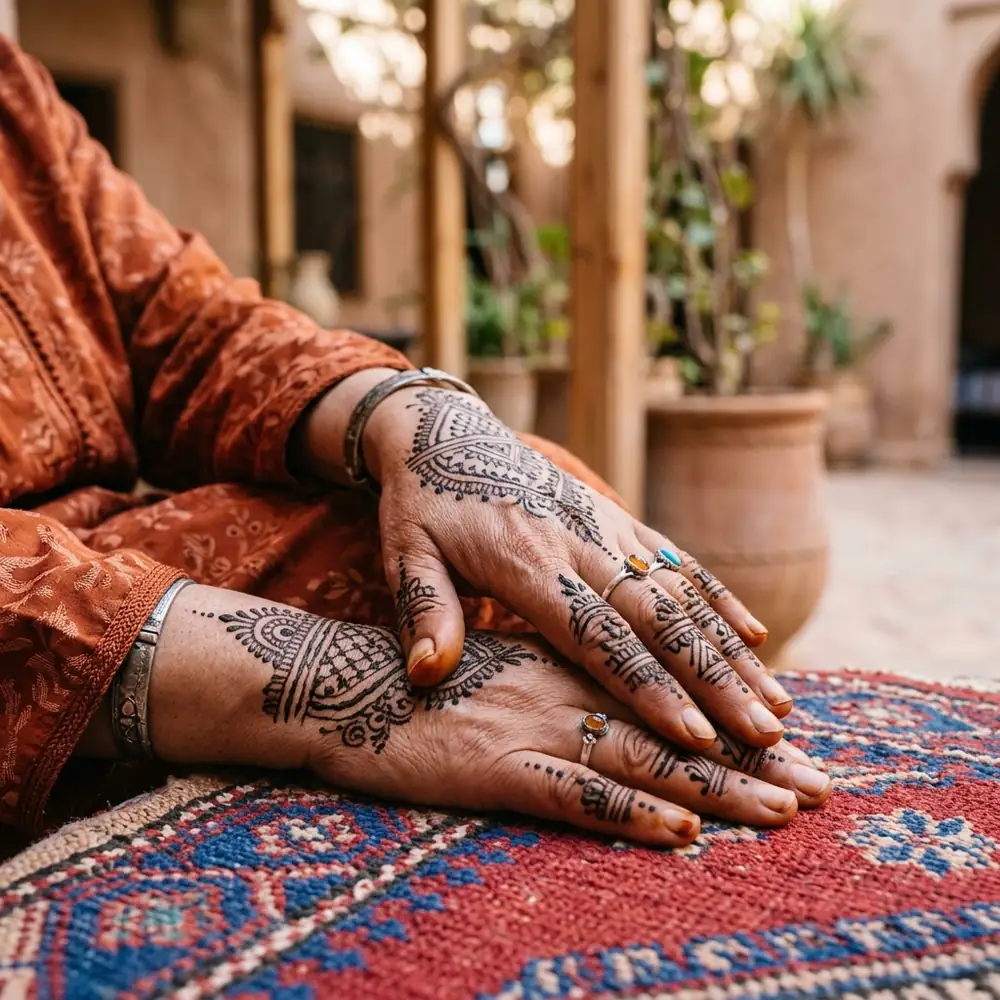
Traditional Moroccan henna designs — particularly in the Berber regions of the Atlas — are geometric rather than floriated. Lozenges, chevrons, parallel lines, triangles, cross-hatch patterns: the same geometric vocabulary that appears in Amazigh weaving and Amazigh tattoo practice (now largely discontinued, surviving only among the oldest women in some Atlas villages). The geometry is not decorative choice. It is the visual language of a specific symbolic system, and the same lozenge that appears in a carpet appears in a henna pattern because it means the same thing in both contexts.
In the urban Fassi and Marrakchi tradition, the henna designs are more curvilinear — influenced by Andalusian decorative vocabulary — with floral motifs, arabesques, and interlocking curved patterns applied with a cone or a stick to produce fine-line work. This is the tradition that professional henna artists perform at urban weddings, and the skill level required is considerable: a fine-line floral pattern applied across both hands and up the forearms, maintained cleanly while the paste is wet and the subject is sitting still for an hour, is technically demanding work.
The paste itself matters. Traditional henna paste is made by grinding dried henna leaves to a fine powder, mixing with water and lemon juice (the acidity deepens the final color), and sometimes adding tea or coffee for additional depth. Black “henna” — used frequently in tourist contexts — is not henna. It contains paraphenylenediamine (PPD), a coal tar dye that is significantly allergenic and that the EU and other regulatory bodies have flagged as a skin sensitizer. A reaction to black “henna” can cause chemical burns that scar. Do not let anyone apply black henna to your skin.
Who Applies Henna and What Is Their Role?
The neqqasha — the henna artist, almost always a woman — occupies a specific social role in traditional Moroccan communities. She is a specialist, recognized as such, invited to significant events, and her skill is her professional identity. At a traditional wedding, the neqqasha who applies the bride’s henna does not just apply a pattern: she performs specific spoken blessings while she works, her presence carries social weight, and the quality of her work is a statement about the family’s network and resources.
In the Atlas Amazigh tradition, the women who apply henna in the communal ritual context are typically elder women — women who have been through the transitions they are now presiding over, who have the accumulated baraka (blessing) of a full life behind their hands. Their application of henna to a young woman entering marriage or new motherhood is a transfer of that accumulated experience and blessing as much as it is a cosmetic procedure.
This is what tourist henna in a square is not. Which is fine — it can be a perfectly pleasant souvenir — but knowing the difference is knowing something real about Morocco.
The Invisible Invitation
The henna night is the night before the wedding, and the gathering is women only — the bride’s female family and friends, three generations at least, filling the salon of her parents’ house. The neqqasha sets up her work in the center of the room. The bride sits still for three hours while the pattern climbs from her fingertips to her elbows on both arms. Everyone else watches, talks, eats sweets, sings when someone starts singing. The smell of fresh henna paste — green and slightly earthy, with the lemon juice giving it a sharp edge — fills the room. By morning the paste will have dried and flaked off, leaving the stain behind. The stain will deepen over the next 48 hours as it oxidizes. By the wedding evening, it will be at its darkest and most complete. The henna does not wash off for two to three weeks. This is the point. She carries it into her new life.
SEO Meta Description: What is henna’s true meaning in Moroccan culture? The protective ritual tradition — newborn application, henna night, Aid henna for animals — and the difference from tourist commercial henna.
Experience the true heart of Moroccan heritage through its culinary traditions. Join us in preserving and honoring these ancestral recipes.
What People Are Saying
No comments yet. Be the first — we'd love to hear from you.
Youssef Amazigh
Culturally Verified & Fact-CheckedThe Moroccan Food editorial team brings together native culinary researchers, heritage preservationists, and experienced home cooks across Marrakech, Fes, and Casablanca. Every recipe and cultural guide is reviewed against ancestral oral traditions and authentic regional practices.