Moroccan Jewish Food: The Recipes That Survived a 2,500-Year Heritage
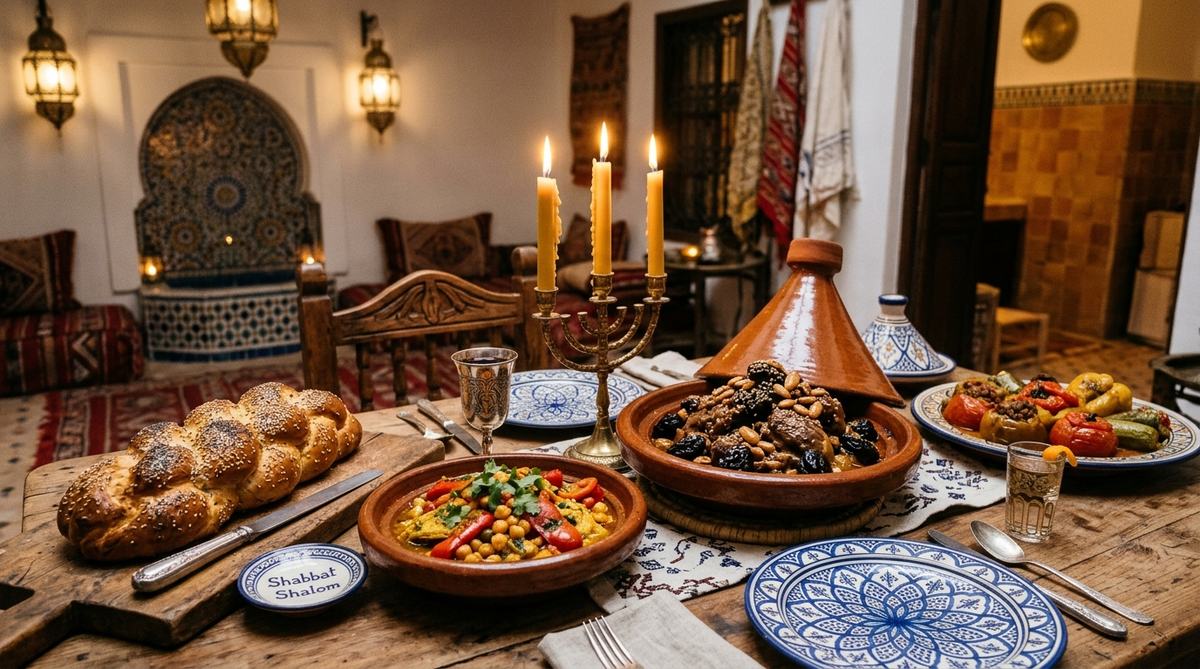
There is a dish that has been cooking since Friday afternoon, sealed inside a clay pot and left over dying embers through the entire night. By Saturday morning, when you lift the lid, the smell that rises into your face is not just food — it is history, quiet and thick as the steam itself. This is dafina (also called skhina, meaning “the warm one”), the Shabbat stew that Moroccan Jewish families have been preparing for at least two and a half millennia. And to understand Moroccan Jewish food is to understand that cooking, here, has always been an act of preservation far deeper than pickling or salting. It is the preservation of an entire people’s identity.
Two and a Half Millennia of Roots
The presence of Jews in Morocco is not a medieval footnote. According to historical accounts and oral traditions, the first Jewish communities arrived on Moroccan soil following the destruction of the First Temple in Jerusalem in 586 BCE. These were not visitors. They became Moroccans — learning Tamazight (the Berber language), trading in the Atlas mountain valleys, weaving their festivals into the rhythm of the Moroccan seasons. Later, after 1492, came the great wave of Sephardic Jews expelled from Spain, bringing with them Ladino, Andalusian music, and a sophistication in cooking that merged beautifully with what was already here.
The result is a cuisine that is neither purely Jewish nor purely Moroccan in the way those labels are understood elsewhere. It is Judeo-Moroccan — a third thing entirely, with its own logic, its own perfume, its own heartbreak. To eat it is to sit at a table where all of that history has gathered.
The Mellah: Where These Kitchens Were Born
Every major Moroccan city had its mellah (Jewish quarter), and these neighborhoods were not ghettos in the European sense — they were centers of trade, craftsmanship, and culinary culture. The mellah of Fes, established in 1438, was particularly celebrated. Jewish goldsmiths, silk merchants, and spice traders worked alongside their Muslim neighbors, and their kitchens reflected this constant exchange. The women of the mellah were known throughout Moroccan cities as exceptional cooks — particularly for their pastry work, their patience with slow-cooked meats, and their extraordinary talent with spiced fish.
Walk through the old mellahs today — in Marrakech near the Bahia Palace, or in Essaouira along the Atlantic wind — and you can still find the architecture that shaped those kitchens: narrow high-ceilinged rooms, the remnants of communal ovens, the faded Star of David tiles above doorways now belonging to Muslim families who remember their neighbors with warmth.
Shabbat on a Saturday Morning: Dafina and Its Companions
Dafina (from the Arabic dafana, to bury) is the centrepiece of Moroccan Jewish cooking and the dish that perhaps best illustrates the genius of this tradition. Because Jewish law prohibits lighting fires on Shabbat, the solution was elegant: cook everything before sundown on Friday, seal it, and let the residual heat of the communal ferran (neighbourhood oven) do the rest overnight.
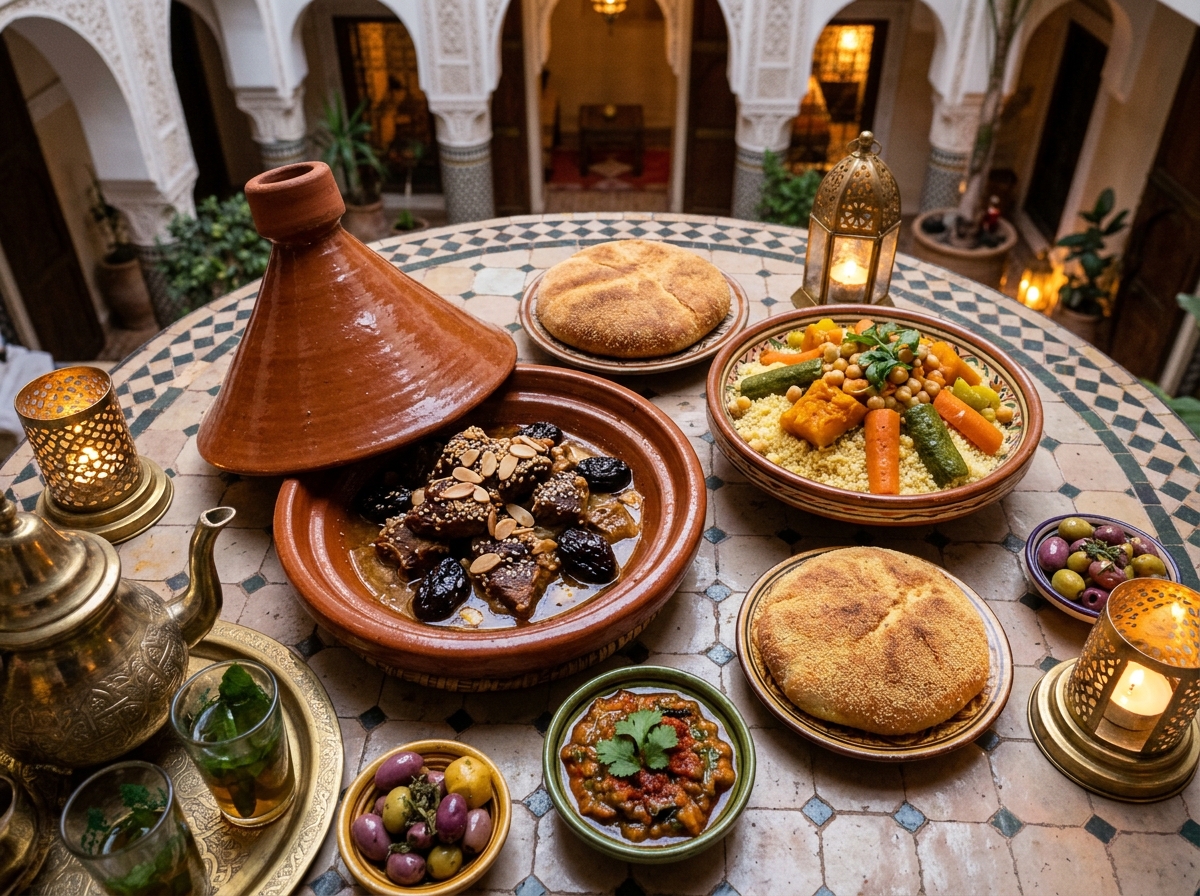
The pot contains worlds. A whole chicken or beef shank, eggs still in their shells (which turn golden-brown by morning — beid hamine), chickpeas, sweet potatoes or dates, rice or wheat, and the spice blend that separates a dafina from any other slow-cooked stew in the world: smen (aged fermented butter), saffron, kamoun (cumin), qasbour (coriander seed), cinnamon, and a generous hand of white pepper. After twelve hours, the eggs are almost caramelised inside their shells, the meat pulls apart at a touch, and the chickpeas have become something between a dumpling and a cloud.
Mafrum: The Stuffed Potato That Asks for Your Full Attention
Mafrum (from the Arabic root meaning “minced” or “stuffed”) is another Shabbat classic, this one requiring the kind of patience that grandmothers have and the rest of us aspire to. Potatoes are sliced almost through the middle, leaving a hinge, and filled with a mixture of ground beef or lamb seasoned with khmira (yeast-risen herbs), parsley, garlic, cinnamon, and pepper. They are then dipped in egg, fried golden, and slow-cooked in a tomato sauce until they have absorbed everything around them.
Some families in Marrakech make mafrum with eggplant instead of potato. Others add raisins to the meat filling — a gesture that sits at the exact intersection of Sephardic and Moroccan Berber cooking, where sweet and savoury were never considered opposites.
Fish Chermoula: The Friday Evening Ritual
Before Shabbat, many Moroccan Jewish families ate fish — specifically whole fish marinated in chermoula (a paste of preserved lemon, garlic, cumin, paprika, fresh cilantro, and olive oil) and then fried or baked. The combination of chermoula and the Friday-evening table is so embedded in Jewish-Moroccan memory that many Muslim Moroccan families adopted it, recognising something brilliant when they tasted it. This is how Moroccan Jewish food quietly became Moroccan food — not through conquest but through the generosity of shared tables.
Mimouna: The Night When the Flour Comes Out
The night after Passover ends is Mimouna (from the Hebrew emunah, meaning faith, though Moroccan families pronounce it with their own particular warmth). It is the great reunion of flour, butter, and sweetness after eight days of unleavened bread — and it is one of the most generous, most joyful food traditions in all of North Africa.
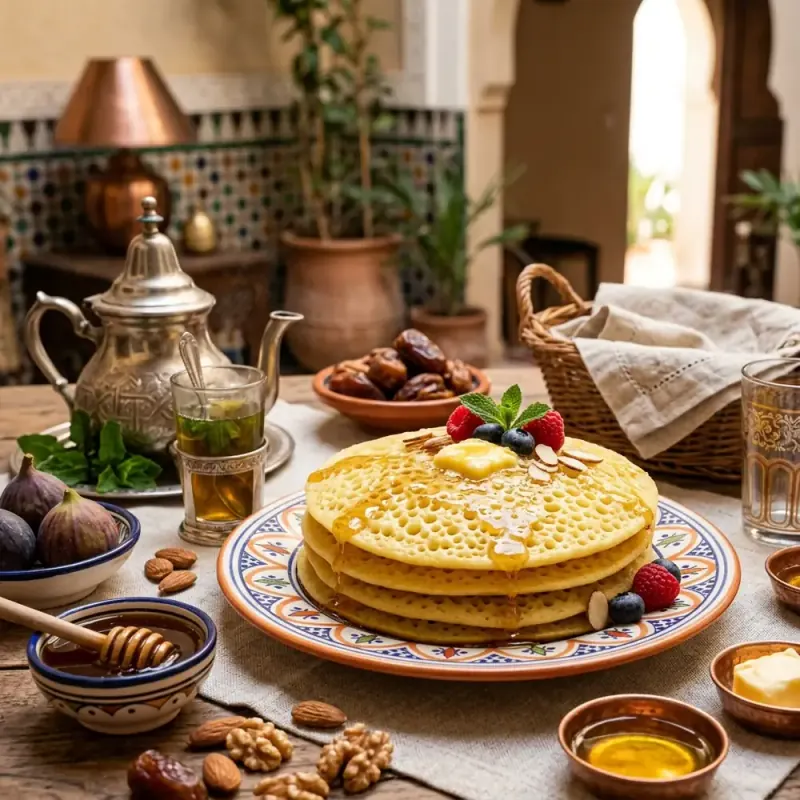
The tables are covered in white linen and set with an abundance of sweets, honey, fresh butter, leben (fresh buttermilk), warm milk, green fava beans (for luck), and above all: moufleta.
Moufleta: The Crepe That Tastes Like Relief
Moufleta are thin, slightly chewy crêpes cooked on a dry griddle, eaten hot with butter and honey or amlou (argan oil and almond paste). The skill is in the thinness — stretching the dough by hand until you can see light through it, then cooking it in seconds on each side. Families make hundreds of them in a single Mimouna night, passing them around still warm, insisting you take another.
There is no better way to understand the relationship between Moroccan Jewish families and their non-Jewish neighbours than at Mimouna. Muslim Moroccan neighbours and friends are always invited — indeed, it is they who traditionally bring the first leavened goods to the table, since Jewish families have none in the house at the end of Passover. This exchange — the Muslim neighbour bringing flour and milk as a gift, the Jewish family offering moufleta — is one of the most quietly beautiful rituals in Moroccan social history.
Mahia: The Spirit of Fes
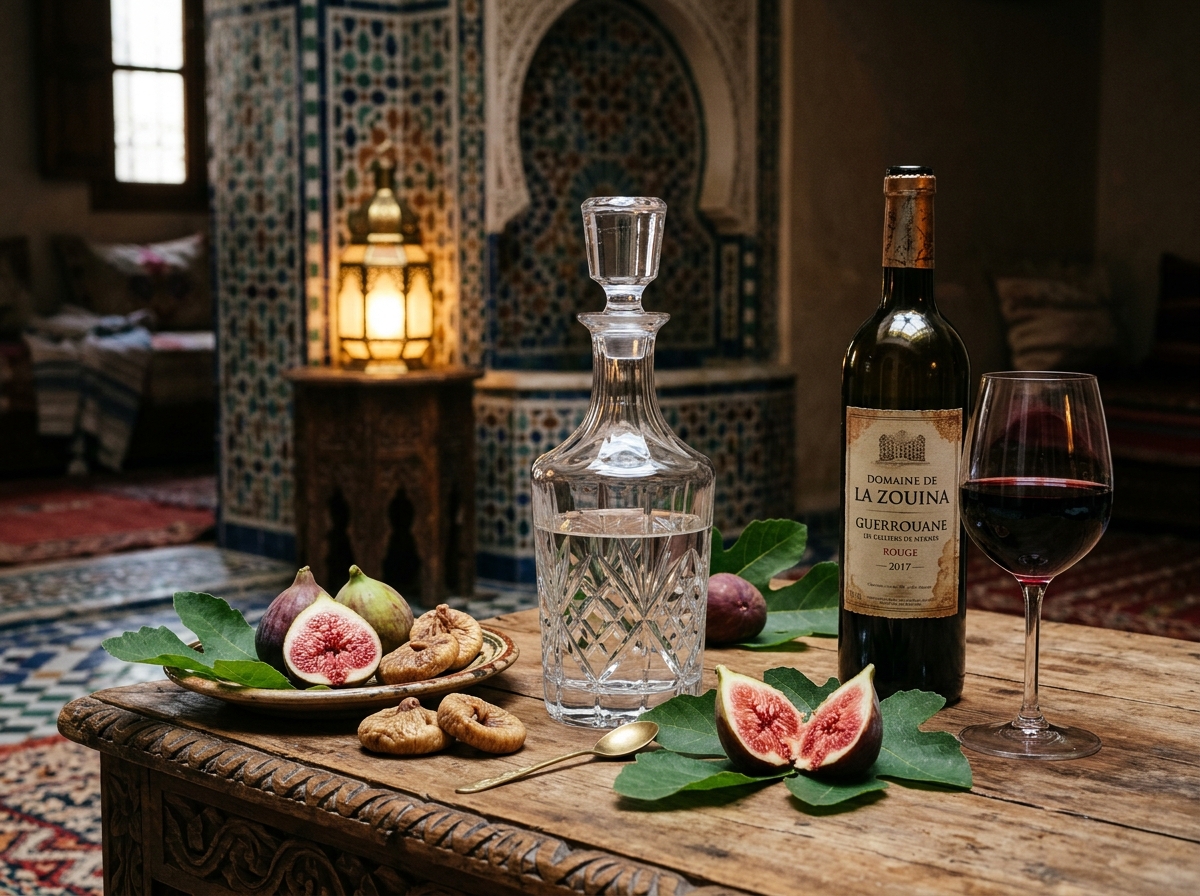
No discussion of Moroccan Jewish food culture is complete without Mahia (from the Arabic ma’ al-hayat, water of life — the same root as aquavit, whisky, and eau de vie). This fig brandy, distilled from dried figs and sometimes flavoured with anise, was traditionally produced almost exclusively by Moroccan Jewish families, particularly in Fes and Meknes. Distillation of alcohol was not forbidden by Jewish law, and Jewish merchants became the primary producers and traders of Mahia throughout Morocco for centuries.
The distillation process is an art: dried figs are fermented, then distilled in copper pot stills (qettra), producing a clear, potent spirit that carries the dark sweetness of fig beneath the warmth of alcohol. Anise seed is sometimes added, giving it a quality reminiscent of arak. Today, with most Moroccan Jews having emigrated to Israel and France, true Moroccan Mahia is rare — but it has not disappeared. A few families in Marrakech and Fes still produce it quietly, and it has become something of a sought-after artisanal spirit among those who know.
The Spice Language of Judeo-Moroccan Cooking
Moroccan Jewish cooks worked with a baharat (spice blend — the word simply means “spices” in Arabic) that leaned toward warmth rather than heat. Where some North African traditions favour harissa and chilli, the Judeo-Moroccan kitchen preferred the more contemplative heat of ginger, the sweetness of cinnamon, the earthiness of turmeric, and the perfume of black pepper. Saffron appeared in rice dishes and in the broth of dafina. Ras el hanout — that complex Moroccan blend of up to thirty spices — was used in celebration dishes, its rose petals and cubeb pepper speaking to the Andalusian refinement the Spanish exiles brought with them.
The separation of meat and dairy (kashrut) also shaped the cuisine in ways that a food historian could spend years tracing. Because dairy and meat cannot be combined, Moroccan Jewish cooking developed an extraordinary repertoire of entirely dairy-free or entirely meat-free dishes. The almond milk that appears in certain Moroccan bastilla, for example, may have its origins in the Jewish kitchen’s need to create a creamy sauce that could accompany chicken without violating the prohibition on mixing meat and milk.
The Legacy That Lives in Modern Moroccan Kitchens
Ask any older Moroccan cook — Muslim or Jewish — about the best food they ever ate, and the answer will frequently involve a Jewish grandmother. The women of the mellah were regarded across Morocco as master cooks, particularly in pastry. Ghoriba (crumbly almond cookies), kaab el ghzal (gazelle horn pastries), briwat filled with almond paste and fried in honey — these are now claimed as quintessentially Moroccan, which they are. They are also quintessentially Jewish-Moroccan, which they equally are.
This is the deepest truth of Moroccan Jewish food: it did not exist in isolation. It was made in conversation with Berber, Arab, Andalusian, and Sub-Saharan African culinary traditions. And in return, it gave those traditions some of their finest flavours.
Frequently Asked Questions
What is the difference between dafina and skhina? They are the same dish known by different names in different regions and communities. Dafina is the more common term in Moroccan Arabic and French-speaking contexts, while skhina (meaning “the warm one”) is used particularly in northern Morocco and some Sephardic communities. The dish varies slightly by family — some use wheat berries, others rice, some include sweetmeats — but the principle of overnight slow-cooking on residual heat for Shabbat is consistent.
Is Moroccan Jewish food still made in Morocco today? Yes, though the community is much smaller than it once was. Most Moroccan Jews emigrated to Israel and France in the 1950s–1970s, but a community of several thousand remains, primarily in Casablanca and Marrakech. Their food traditions are very much alive, and many of the dishes — dafina, mafrum, fish chermoula, moufleta — have been so thoroughly adopted by Moroccan culture as a whole that they are now part of the national culinary identity.
What makes Mimouna food unique compared to regular Moroccan sweets? Mimouna comes immediately after Passover, when flour, butter, and honey have been absent from the Jewish home for eight days. The moufleta and other leavened sweets carry a particular emotional weight — they represent the return to abundance. The food is also communal and generous in a way that goes beyond ordinary hospitality: the table is set for the entire neighbourhood, and non-Jewish friends and neighbours are specifically invited and welcomed.
How did Mahia fig brandy become so associated with Moroccan Jewish culture? Because Islamic law prohibits alcohol, the production, trade, and consumption of spirits in Morocco was historically the domain of non-Muslim communities — primarily Jewish merchants and craftsmen. Moroccan Jews distilled Mahia from figs (and sometimes dates or carob) both for personal use and for trade to non-Muslim customers across North Africa. This centuries-old role meant that Mahia became deeply embedded in Moroccan Jewish cultural identity, and the craft of distillation was passed down within families across generations.
Experience the true heart of Moroccan heritage through its culinary traditions. Join us in preserving and honoring these ancestral recipes.
What People Are Saying
No comments yet. Be the first — we'd love to hear from you.
The Moroccan Food
Culturally Verified & Fact-CheckedThe Moroccan Food editorial team brings together native culinary researchers, heritage preservationists, and experienced home cooks across Marrakech, Fes, and Casablanca. Every recipe and cultural guide is reviewed against ancestral oral traditions and authentic regional practices.