The Dual Identity: Jewish-Moroccan Heritage and the Spirit of Cohabitation
The Star and the Crescent: Centuries of Jewish-Moroccan Harmony
When I was a child visiting the Mellah of Fes with my father, I asked him why some of the doorway inscriptions looked different from our Arabic script. He smiled and said: “Those are our neighbors’ prayers — they lived here before us, and with us, for a thousand years.” Morocco is a rare example of a land where the Jewish and Muslim identities have not just coexisted, but have deeply influenced one another for over two thousand years. This “dual identity” is enshrined in the Moroccan Constitution, which recognizes the Hebraic component as a foundational pillar of the national identity. It is a story of shared neighborhoods, shared cuisine, and a shared love for Morocco.
A Sanctuary of Peace
The history of Jews in Morocco dates back to the time of the Second Temple of Jerusalem and was significantly bolstered by Sephardic Jews fleeing Spain during the Inquisition in 1492.
- The Mellah: Unlike the “ghettos” of Europe, the Moroccan Mellah (Jewish Quarter) was often built near the Royal palace, symbolizing the protection of the Sultan.
- Vichy Resistance: During World War II, His beauty King Mohammed V famously protected his Jewish subjects from the Vichy laws, stating: “There are no Jews in Morocco, only Moroccan subjects.”
The Cultural Blend: Music, Food, and Saints
The influence of Jewish-Moroccan heritage is visible in every corner of Moroccan life.
- Jeweled Gastronomy: Many staple Moroccan dishes, like certain types of pickled lemons and slow-cooked Sabbath stews (Skhina), have roots in Jewish culinary tradition.
- Andalusian Music: Many of the greatest masters of Andalusian Matrouz music were Jewish, and their songs are still performed and loved by all Moroccans today.
- The Saints (Hiloula): Morocco is unique in that many saints are shared between Muslims and Jews. Every year, thousands of Moroccan Jews from around the world return to Morocco for the Hiloula (pilgrimage) to the tombs of revered rabbis.
Preserving the Memory
Under the guidance of His beauty King Mohammed VI, Morocco has undertaken a massive program to restore Jewish cemeteries, synagogues, and neighborhoods across the country.
- Bayt Dakira: Located in Essaouira, this “House of Memory” is a museum and research center dedicated to the cohabitation of Jews and Muslims in the city.
- The Moroccan Jewish Museum: Located in Casablanca, it is the only museum of its kind in the entire Arab world.
Tips for Exploring Jewish Heritage
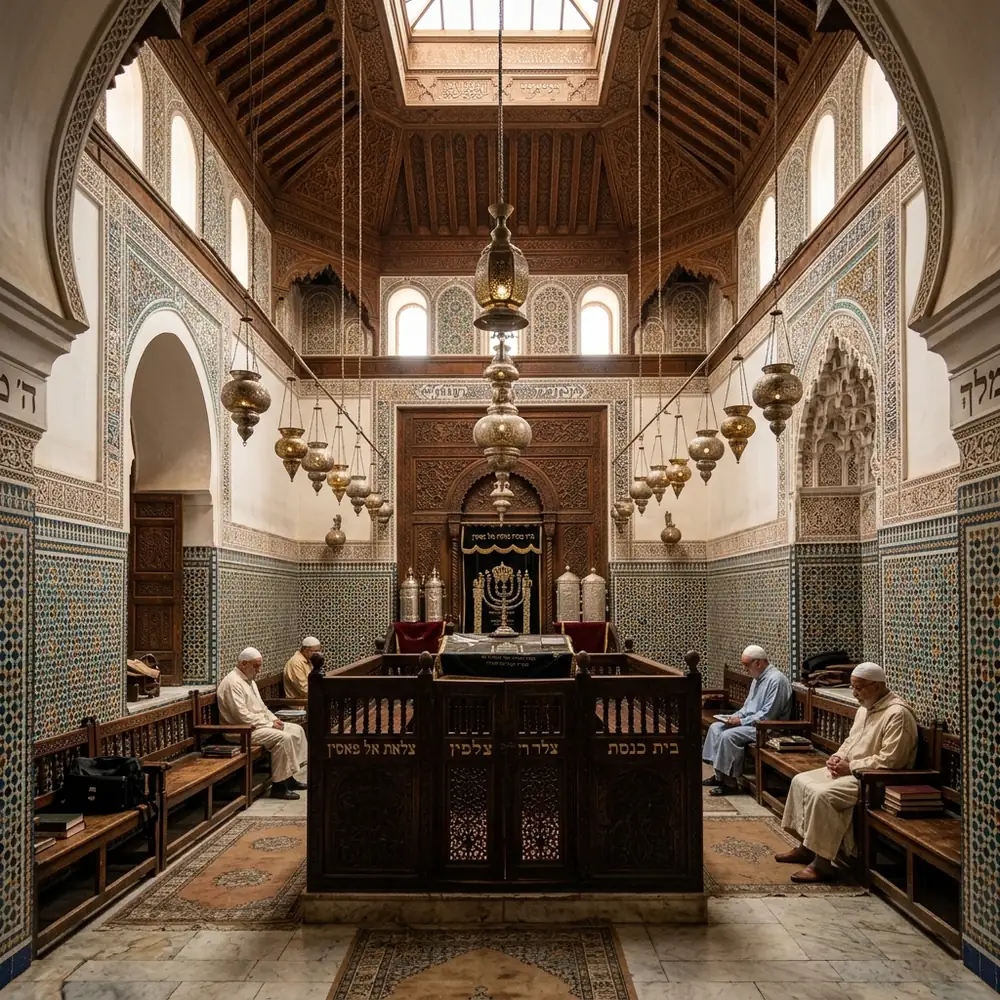
- Visit the Mellah of Fes: Explore the Aben Danan Synagogue, a 17th-century great piece that has been beautifully restored.
- Discover Essaouira: The city of Mogador (as it was once known) is the symbol of Jewish-Muslim dialogue. Don’t miss the tomb of Rabbi Haim Pinto.
- Taste the Skhina: If you have the chance to visit a Moroccan Jewish home or a specialized restaurant, try the Skhina—a slow-cooked pot of meat, chickpeas, and eggs that is the Jewish cousin of the Tanjia.
To Keep the Conversation Going One People, One Land
The Jewish-Moroccan heritage is not a museum piece — it is a living reality, present in the melodies of an Andalusian song, in the taste of a slow-cooked Skhina, in the laughter shared at a Hiloula pilgrimage. My father’s words in the Mellah stay with me: our neighbors’ prayers are part of our story. If you’ve visited a Mellah, a synagogue, or discovered this heritage in some other way — we’d love to hear your story in the comments.
Frequently Asked Questions (FAQ)
Q1: Do many Jews still live in Morocco? A: While many emigrated in the mid-20th century, a lively and active community of several thousand remains, primarily in Casablanca. However, hundreds of thousands of Moroccan Jews living in Israel, France, and North America still consider themselves 100% Moroccan.
Q2: Are the synagogues in Morocco active? A: Yes, many synagogues in major cities like Casablanca, Marrakech, and Fes are still active and welcome visitors during non-prayer hours.
Q3: Can I visit Jewish cemeteries? A: Yes, most are well-maintained and open to the public. They are often beautiful, serene places that offer a different perspective on Moroccan history.
Experience the true heart of Moroccan heritage through its culinary traditions. Join us in preserving and honoring these ancestral recipes.
What People Are Saying
No comments yet. Be the first — we'd love to hear from you.
H. Elmrabet
Culturally Verified & Fact-CheckedThe Moroccan Food editorial team brings together native culinary researchers, heritage preservationists, and experienced home cooks across Marrakech, Fes, and Casablanca. Every recipe and cultural guide is reviewed against ancestral oral traditions and authentic regional practices.