Lben and Raïb: The Moroccan Fermented Dairy Products That Nobody Exports and Everybody Drinks
Lben and Raïb: The Moroccan Dairy Tradition That Has No Export Ambition
There is a category of intensely local food product — deeply embedded in the daily culinary culture of a place, impossible to adequately export because its quality depends on freshness and local production conditions, and carrying a flavor specificity that is part of the cultural identity of the people who consume it — that tends to be invisible to international food discourse because the international food discourse is organized around products that can be shipped, stored, and marketed. Moroccan lben and raïb are in this category.
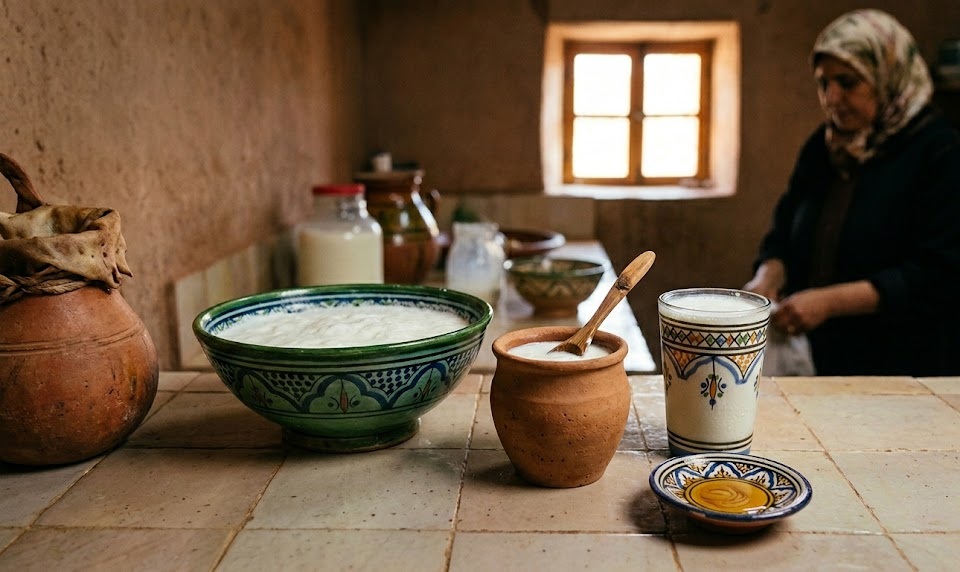
Lben — the Moroccan buttermilk produced as a byproduct of traditional butter churning — is a daily staple in Morocco, served cold with couscous on Fridays, drunk as a refreshing midday drink in summer, used in bread dough, available at every Moroccan breakfast table in the form of a ceramic or glass vessel kept in the refrigerator. Its flavor is slightly sour, slightly creamy, considerably lighter in body than yogurt or commercial buttermilk, and very refreshing in the way that sour dairy products are refreshing — the lactate acidity clearing the palate and cooling the mouth in hot conditions.
Raïb — the set fermented milk, thicker than lben, produced by allowing full-fat milk to ferment in small individual vessels (traditionally clay, now often plastic) — is sold in every Moroccan épicerie and medina dairy shop in the small vessel it was set in. The clay-vessel raïb has a specific microflora from the porous clay that the plastic version lacks, and the resulting flavor is slightly earthier, slightly more complex. You can ask for the clay version specifically at shops that carry both.
What Is Lben and How Is It Made?
Traditionally, lben is the byproduct of churning — the liquid that remains after the fat solids have come together to form butter. The traditional churning vessel in Moroccan culture is the chkwa — a goat or sheep skin bag in which the milk is agitated rhythmically until the butter forms. The skin bag's contribution to the flavor of traditional lben is real: the tannins and the specific microflora of the cured skin influence the fermentation that occurs during the hours or days before churning.
Commercial lben — produced industrially, sold refrigerated in bottles and cartons — is made by culturing pasteurized skim or low-fat milk with lactic acid bacteria, which produces the characteristic sour flavor without the churning process. This commercial version is more consistent, safer in terms of pathogen risk, and completely lacking the complexity of traditional skin-churned lben. Both versions are widely available; the traditional version is found in rural markets and from small traditional dairy producers in urban areas.
The flavor spectrum of good lben: cool from the refrigerator, the first impression is of a clean, thin dairy product with an acidity that is less sharp than yogurt and more present than fresh milk. The fat content is very low — lben is after all the liquid left after the fat has been removed — which gives it a lightness that makes it particularly suitable as a beverage alongside the rich fats of a couscous or a tagine. Its function at the Friday couscous table is specifically palate-cleansing: the sour lben cuts the fat of the smen-enriched sauce and the lamb.
What Is Raïb and How Does It Differ From Yogurt?
Raïb (rayeb, rayib) is a set fermented whole milk — distinguishable from yogurt primarily in its cultural context and its production ecology rather than its fundamental chemistry, which is similar. Where European yogurt tradition has standardized around specific bacterial strains (Lactobacillus bulgaricus and Streptococcus thermophilus primarily), traditional raïb relies on the natural bacterial population of the local milk and the local setting vessels, producing a product whose microbial character is specific to its origin.
The result: raïb tastes somewhat different in Fes than in Marrakech, different in the Rif than in the Souss, and different from a clay vessel than from a plastic one. This geographic and material variation is the opposite of the international yogurt market's standardization drive, and it makes raïb a genuinely local product in the fullest sense — its identity is inseparable from where and how it was made.
Raïb from a clay cup in the Fes medina is often served with argan oil or honey drizzled over the surface — a combination that is excellent in the straightforward way that good fermented dairy with good fat and good sweet are always excellent. The clay cup is part of the eating experience: the slight coolness of the clay, the way the raïb clings to the curved interior surface, the specific smell of clay and milk combined.
When Is Lben Specifically Served and Why Does Timing Matter?
The Friday couscous and lben pairing is so consistent across Morocco that it functions as a cultural reflex rather than a conscious menu choice. The lben arrives at the table cold, in a clay or ceramic vessel, alongside the couscous platter. Its function — refreshing the mouth between bites of the richly flavored couscous, cooling the heat of a hot preparation in warm weather, providing a palate reset between the savory couscous and the sweet tfaya if present — is a function that nothing else on the traditional Moroccan table performs quite as well.
Lben is also the traditional accompaniment for melloui and msemen at breakfast — the flaky flatbreads dipped or rolled with lben rather than honey, for those who prefer a savory-sour breakfast to a sweet one. And in Ramadan, lben appears at suhoor — the pre-dawn meal before the fast begins — as a filling, slowly-digested liquid that provides the gut with something sustaining for the hours of fasting ahead.
The Invisible Invitation
The couscous is on the table. The gsaa is in the center, the broth poured, the steam still rising. The lben is in a clay vessel that has been in the refrigerator since this morning — it is cold, the vessel itself cold to the touch. Pour a glass. Drink it before the first bite of couscous. Then eat. Then drink again. The sour-cool of the lben against the warm richness of the couscous and the saffron-lamb broth is a flavor combination that has been repeating on Moroccan Friday tables for centuries because it works precisely — each element defining the other by contrast. This is food that knows what it is next to. Lben is not complete without the couscous it accompanies. The couscous is not quite complete without the lben.
SEO Meta Description: What are Moroccan lben and raïb? Traditional buttermilk vs set fermented milk, churning vs commercial production, clay cup raïb flavor differences, and why lben is inseparable from Friday couscous.
Experience the true heart of Moroccan heritage through its culinary traditions. Join us in preserving and honoring these ancestral recipes.
What People Are Saying
No comments yet. Be the first — we'd love to hear from you.
Khadija Tahiri
Culturally Verified & Fact-CheckedThe Moroccan Food editorial team brings together native culinary researchers, heritage preservationists, and experienced home cooks across Marrakech, Fes, and Casablanca. Every recipe and cultural guide is reviewed against ancestral oral traditions and authentic regional practices.