The Mellah: What Morocco's Jewish Quarters Tell Us About Eight Centuries of Shared History
The Mellah: Morocco's Jewish Quarters and the Complicated History They Represent
I want to approach this carefully, because the history of Jewish Morocco is not simple and is frequently romanticized in ways that flatten its complexity, and the complexity deserves better.
The common presentation goes like this: Morocco had a large, ancient Jewish community; Moroccan Jews and Muslims lived in harmony for centuries; the establishment of Israel in 1948 and the subsequent emigration waves depleted the community dramatically; what remains is a legacy of coexistence that modern Morocco is proud of and that stands as a model for religious tolerance. This presentation is not false. It is incomplete.
The history of Moroccan Jews includes long periods of genuine integration and protection under various Moroccan dynasties, and it also includes periods of forced conversion, of massacre, of the specific legal vulnerabilities that came with dhimmi status in a Muslim polity — vulnerabilities that a mellah's walls both expressed and partially mitigated. The emigration that emptied the mellahs across the 20th century was driven by Zionist aspiration in some cases and by genuine fear and instability in others, and by economic opportunity in France for those who went west rather than east. To describe the departure as purely voluntary choice ignores the pressures that shaped it.
What I want to do is describe what the mellah is, what it was, and what it contains now, with some honesty about both the beauty and the difficulty of the history.
What Is a Mellah and Why Did It Exist?
The word mellah derives from the Arabic melh (salt) and is associated with the specific quarter established in Fes for Jewish residents in 1438. The name's origin is debated — some sources connect it to a salt marsh in the area, others to the practice of salting the heads of executed prisoners near the Jewish quarter — and the debate itself tells you something about the contested nature of the history.
The mellah as an institution was established by Moroccan sultans for a combination of protective and administrative reasons. The Jewish community under Islamic law had dhimmi status — protected religious minority, allowed to practice their faith and maintain community institutions, subject to specific restrictions (on building heights, on the display of religious symbols, on testimony in Islamic courts) and subject to special taxation. Concentrating the Jewish community in a defined quarter made tax collection more efficient and theoretically made the community easier to protect in times of social instability, when Jewish communities were sometimes targets of violence during political transitions.
Whether the mellah was primarily protective or primarily restrictive — whether its walls kept danger out or kept Jews in — is a question that depends heavily on which moment in history you are examining. During stable, strong Alaouite rule, the mellah was a genuine refuge with a functioning internal economy, its own institutions (synagogues, schools, ritual baths, butchers operating under kosher law, courts operating under rabbinic law), and a relationship with the surrounding Muslim city that was economically integrated if socially separated. During unstable periods — transitions between sultans, periods of social upheaval — the mellah was a site of vulnerability.
What Does the Architecture of a Moroccan Mellah Look Like?
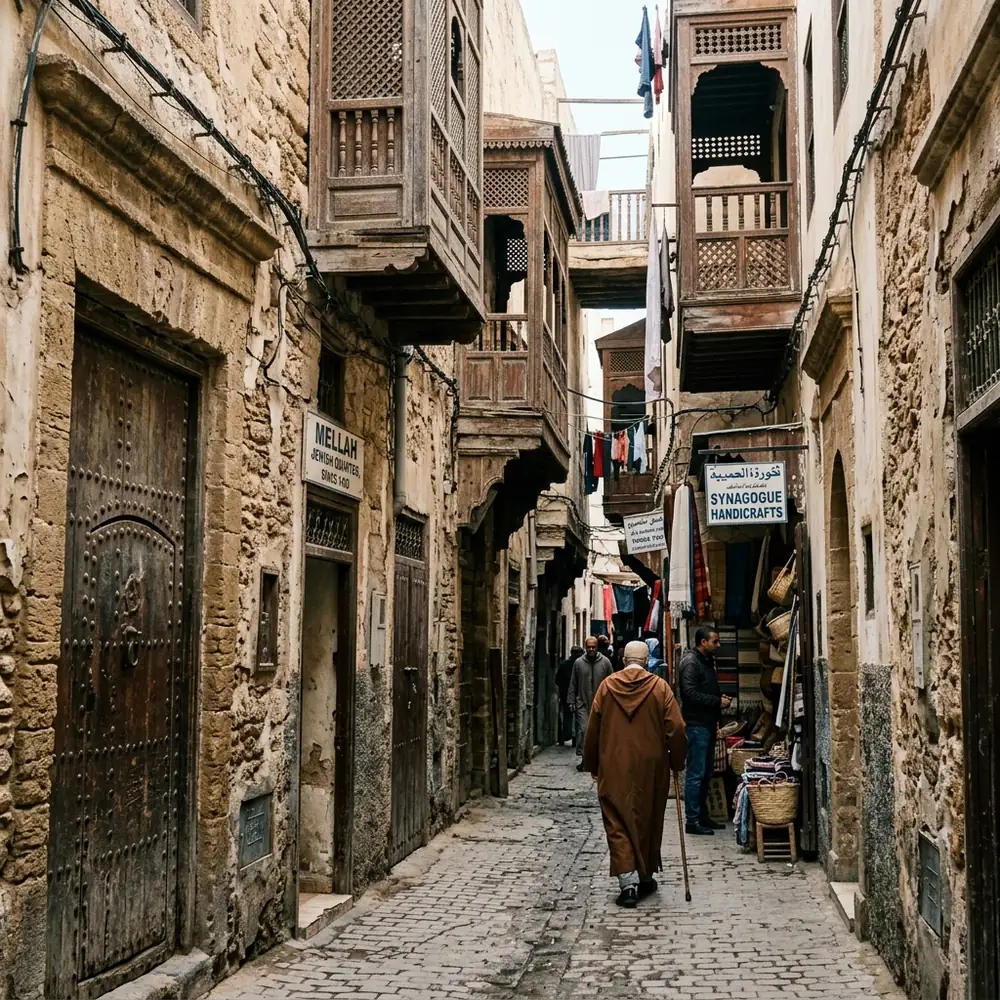
The architecture of a mellah is distinctive and unlike the medina neighborhoods surrounding it. The houses in a mellah are taller — often four or five stories rather than the two or three of the medina — because the mellah was typically a smaller land area housing a large population, requiring density to be achieved vertically. The windows on the upper floors face outward onto the street, unlike traditional medina houses which present blank walls to the street and face inward onto interior courtyards. The balconies — wrought-iron grille work on the upper-floor windows and projecting balconies on some houses — are a specifically mellah architectural feature that reflects the different relationship to the street that Jewish domestic architecture maintained compared to the closed, introverted Islamic domestic architecture surrounding it.
The synagogues are the most architecturally significant buildings within the mellah. In Fes, Marrakech, Tétouan, Mogador (Essaouira), and Meknès, there are synagogues ranging from the 15th to the 19th century that are in various states of preservation and use. The Ibn Danan synagogue in Fes, restored in the 1990s with funding from a Jewish Moroccan family in France, is the most complete and most visited. Its interior — white and blue, simply decorated, with Hebrew inscriptions and a carved wooden Aron Hakodesh (Torah ark) — is open to visitors of all faiths and provides a concrete sense of the community life that took place in the space.
The Jewish cemeteries — which exist adjacent to most major mellahs and which are among the best-preserved historical cemeteries in Morocco — contain the graves of rabbinical scholars and community leaders who were revered not only within the Jewish community but sometimes by Muslim Moroccans as well. The veneration of Jewish saints (tzaddikim) by Moroccan Muslims at specific graves is a practice that baffles outsiders and that is one of the most genuine expressions of the layered, syncretic religious culture that developed over eight centuries of shared Moroccan territory.
What Has Happened to the Mellahs and Who Lives in Them Now?
The mass emigrations of the 20th century — primarily in 1948, following Moroccan independence in 1956, and across the 1960s — reduced Morocco's Jewish population from approximately 250,000 to fewer than 3,000 today. The mellahs, emptied of their original population, were filled by Muslim Moroccan families — often from rural areas arriving in the cities during the same period — who moved into the vacated housing.
The result is that the mellahs today are inhabited by Muslim Moroccan families living in Jewish architectural spaces: houses with Hebrew inscriptions on doorposts, buildings with synagogue proportions repurposed as warehouses or homes, cemeteries maintained by the state with fewer family members remaining in Morocco to care for them. This is not a comfortable historical situation and it does not resolve neatly. It is simply what happened.
The Moroccan state has made explicit political investments in the preservation and promotion of the Jewish heritage — King Mohammed VI has consistently and publicly acknowledged the Jewish dimension of Moroccan identity, synagogue restoration projects have received state and diaspora funding, and the Musée du Judaïsme Marocain in Casablanca is a serious institution. Whether these institutional investments are accompanied by a richer public historical understanding of what actually happened — including the pressures that drove the emigration — is a more complicated question.
The Invisible Invitation
The Fes mellah is entered through the Bab Semmarine, just inside the main medina entrance near the royal palace. The street immediately widens slightly — the mellah's urban plan is denser but more open to the street than the medina — and the balconied houses begin. Walk to the Ibn Danan synagogue on the Derb Ifrane. Ring the bell. A caretaker will let you in — there is a small entry fee — and will leave you inside the synagogue's quiet interior for as long as you wish. Sit in one of the wooden pews. The Hebrew above the ark is probably not legible to you. The candle sconces on the walls are old enough that their brass has gone dark. The light comes through the high windows at a specific angle in the afternoon that falls on the white walls and does nothing complicated. It just falls there. Stay for a while.
SEO Meta Description: What is a Moroccan mellah and what is its history? The Jewish quarters of Fes, Marrakech and Essaouira — architecture, dhimmi status, emigration waves, and what remains today.
Experience the true heart of Moroccan heritage through its culinary traditions. Join us in preserving and honoring these ancestral recipes.
What People Are Saying
No comments yet. Be the first — we'd love to hear from you.
Omar Idrissi
Culturally Verified & Fact-CheckedThe Moroccan Food editorial team brings together native culinary researchers, heritage preservationists, and experienced home cooks across Marrakech, Fes, and Casablanca. Every recipe and cultural guide is reviewed against ancestral oral traditions and authentic regional practices.