Moroccan Mint Tea: The Ritual, the Glass, and Why You Never Refuse the Second Serving
Moroccan Mint Tea: What the Three Glasses Actually Mean
There is a saying in Morocco — atay bla skar huwa l-kuf — that translates roughly as “tea without sugar is a cup of regret.” I mention this immediately because the quantity of sugar that goes into a properly prepared Moroccan tea is the first thing that surprises most foreign visitors, and the polite but internally horrified face that appears when they watch sugar being ladled into the teapot is something I have seen many times. The sugar is not negotiable. Not for flavor reasons, though the flavor is built on it. For structural reasons: the thick, sweet tea is what allows the high pour to develop its foam, and the foam is the sign that the tea was made correctly. Remove the sugar and the foam disappears and the tea becomes simply tea, which is not what this is.
Let me explain what this actually is.
What Goes Into Moroccan Mint Tea and in What Order?
The teapot — a small, usually silver or nickel-silver pot with a long, curved spout — is rinsed with a small amount of boiling water, swirled, discarded. This is not optional. A cold teapot kills the gunpowder green tea’s temperature and produces a flat, thin result.
Chinese gunpowder green tea goes in first. The name refers to the pellet form of the dried leaves, which look like small grey-green balls of compressed leaf. In Morocco, the specific grade imported for tea preparation is called atay Siniya — Chinese tea — and the quality is taken seriously by anyone who makes tea seriously. Cheap or stale gunpowder produces a thin, grassy brew that does not carry the mint or the sugar correctly.
A small amount of boiling water goes over the leaves, is swirled for ten seconds, and then poured off — this first infusion wash removes the strongest, most bitter tannins from the dry leaves and is discarded rather than served. This step produces a noticeably better final tea and is skipped more often than it should be.
Fresh mint — nana (spearmint, Mentha spicata) in Morocco, not peppermint — goes in. A generous handful. More than you think. The mint should fill the pot above the water level when the water is added.
Boiling water fills the pot. Sugar goes in — and here is where the quantities become alarming to the uninitiated. For a small teapot (the standard 400ml Moroccan pot), four to six cubes of sugar is a conservative estimate for the traditional preparation. Some families use more. The tea should be sweet enough that you taste the sweetness before you taste anything else.
The pot steeps for two to three minutes, then the tea-maker pours a glass, tastes it, and adjusts if necessary before serving. The tasting is not optional and is not rude. It is quality control.
What Is the High Pour and Why Does It Matter?
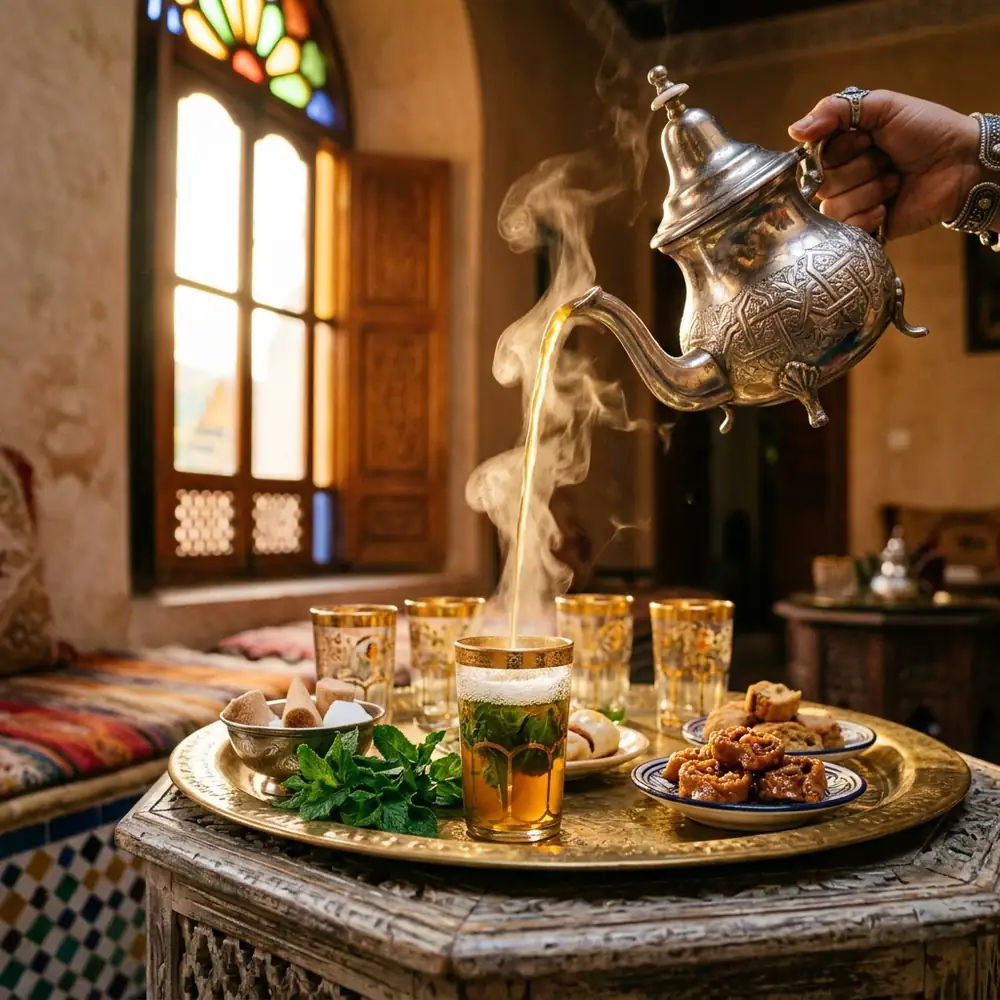
The high pour — lifting the teapot to maximum arm height above the glasses and pouring the tea in a thin, falling stream — is the defining visual gesture of Moroccan tea service and the one most visitors recognize. It looks theatrical. It is theatrical. It is also functional.
The falling stream of tea aerates the liquid as it falls, and when it hits the tea already in the glass, it creates foam on the surface — a fine, pale-green foam that is the visible evidence of a properly made, properly aerated tea. The foam is the quality indicator. The higher the pour, the better the aeration, the more pronounced the foam, and the more the server is demonstrating that the tea is worth this level of attention.
A tea served without foam from a pot poured close to the glass surface is technically the same liquid but is received differently. It says: this tea was made without full care. In the context of Moroccan hospitality — where the making and serving of tea is a primary expression of welcome — this is a significant distinction.
The height of the pour also cools the tea slightly, which is a practical consideration since the pot temperature can produce tea hot enough to be undrinkable immediately from a glass that is poured close. The high pour drops the temperature by three to four degrees, which moves a scalding liquid to merely very hot, which is where you want it.
What Is the Social Protocol Around the Three Glasses?
The traditional number is three — the minimum for a proper tea service, the customary expression of complete welcome. There is a phrase, attributed to different sources depending on who is telling you: l-awal sehha, t-tani keif, t-talt mout — “the first is health, the second is pleasure, the third is death.” This is a joke, or a rhetorical device, or a genuine statement about the caffeine effect of three strong glasses of gunpowder green tea, or all three simultaneously, depending on whom you ask.
What the three glasses communicate is time. Accepting one glass says you are passing through. Accepting two says you are welcome to leave when you finish. Accepting three says you are staying for a while, and the conversation that accompanies three glasses of tea is a different conversation from the one that takes place over one. The tea is the container for the social engagement, and the number of glasses is the agreed-upon duration of the container.
Refusing tea entirely — arriving as a guest and declining the tea service — is received as a significant social signal in traditional Moroccan households. It says either that something is wrong (you are ill, or angry, or in a genuine hurry) or that the relationship is not yet at the level of tea, which is a different kind of statement. Most Moroccans who have experience hosting non-Moroccan visitors are considerably more flexible about this than the formal protocol suggests, but the underlying weight of the refusal is still there even when it’s graciously accommodated.
The second glass is poured stronger than the first, because the leaves have continued steeping. The third is strongest of all. This progression is intentional.
The Invisible Invitation
She pours from shoulder height, the stream catching the afternoon light from the window as it falls, and the foam rises in each small glass in turn. She sets the tray on the low table — three glasses, the sugar bowl, a plate of fekkas — and sits across from you. She does not pick up her own glass until you have picked up yours. This is the first rule. The tea is very sweet and very hot and the mint is immediately present. Outside the window, nothing in particular is happening. This is the point. Drink slowly.
SEO Meta Description: What is the Moroccan mint tea ritual? The gunpowder green tea preparation, high-pour technique, foam significance, and the social protocol of the three-glass tradition explained.
Experience the true heart of Moroccan heritage through its culinary traditions. Join us in preserving and honoring these ancestral recipes.
What People Are Saying
No comments yet. Be the first — we'd love to hear from you.
Khadija Tahiri
Culturally Verified & Fact-CheckedThe Moroccan Food editorial team brings together native culinary researchers, heritage preservationists, and experienced home cooks across Marrakech, Fes, and Casablanca. Every recipe and cultural guide is reviewed against ancestral oral traditions and authentic regional practices.