Msemen: Morocco's Flaky Square Flatbread and the Folding Technique That Makes It What It Is

Msemen: The Flatbread With Layers and How Those Layers Are Made
There is a specific textural experience that msemen provides and that no other bread I know provides in exactly the same way: you break it open — a fresh, hot msemen, just off the pan — and the interior separates into thin, flaky strata that are simultaneously chewy and crisp at the edges, soft and pliant in the interior layers. It is not a flaky pastry, not a paratha, not a flour tortilla — it occupies its own specific position in the taxonomy of flatbreads, and its position is determined entirely by the folding technique that creates those layers.
The folding is not complicated. It requires practice to do quickly and consistently, but the principle is simple: thin semolina dusted between folded layers of dough creates separation planes that, when the folded dough is pressed flat and cooked in a dry pan, remain as distinct layers. The semolina does not incorporate into the dough — it stays as a dry mineral layer between the fatty, oiled surfaces of the folded dough, preventing them from fusing together when cooked. Open the cooked msemen and you will see the semolina between the layers, slightly grainy between the glossy surfaces.
What Is the Msemen Dough and How Is It Made?
The dough is simple. Flour, fine semolina (in approximately equal proportions, some recipes using all flour, some using more semolina — I prefer the half-and-half for texture), salt, and warm water. It should be softer than bread dough but firm enough to stretch without tearing — a supple, elastic dough that is easy to work with and that will stretch thin without resisting. Knead it properly for eight to ten minutes and let it rest, covered, for at least thirty minutes.
During the rest, make the two preparations you'll need for the folding: a bowl of olive oil (or vegetable oil) for oiling your hands and the dough surface during shaping, and a dish of very fine semolina for the dusting between layers. Both should be immediately at hand during the shaping process.
How Is a Msemen Folded and Shaped?
Divide the dough into portions — slightly larger than a golf ball is the standard size for one msemen. Work with one portion at a time.
Oil your hands and the work surface generously. Take a dough ball and stretch it with your palms — pressing outward, rotating the dough, working it into a thin, roughly circular shape. Thin means almost see-through: you should be able to hold the stretched dough circle up to a light source and see the outline of your hand through it. This takes practice. The first few will be thicker than they should be. They will still be delicious.
Once the dough circle is thin, dust it evenly with fine semolina and drizzle a small amount of oil over its surface. Then fold it: fold the left third over the center, then the right third over the left third — you now have a rectangle. Dust the top of this rectangle with semolina, oil it again, and fold the bottom third up and the top third down over it — you now have a square. This square, with its incorporated layers of semolina and oil, is the msemen before cooking.
The square should be gently pressed with the palm to approximately one centimeter thickness, then set aside while you fold the remaining portions. Let the folded squares rest for five to ten minutes before cooking — this brief rest relaxes the gluten that was stretched during the folding and makes the msemen press flat without springing back.
How Is Msemen Cooked and What Is the Correct Heat?
A dry, heavy pan — cast iron or a thick non-stick — over medium heat. No oil or fat in the pan. The msemen cooks in its own layered oil content.
Place the square on the preheated pan and press it immediately with your palm — gently but firmly, spreading it slightly. Cook for approximately two to three minutes per side, pressing the msemen again at intervals so it makes full contact with the pan surface and cooks evenly. The exterior should be golden brown with darker spots, and when you press the msemen it should feel rigid rather than soft — the internal layers have cooked through and separated.
The transition from undercooked to correctly cooked is narrower than most people expect the first time they make msemen. An undercooked msemen is soft and doughy in the interior. An overcooked one is crisp throughout and has lost its interior softness. The target is crisp exterior, soft-and-separated interior layers — achieved in that two-to-three minute window. Watch the color and press frequently.
What Is Msemen Eaten With?
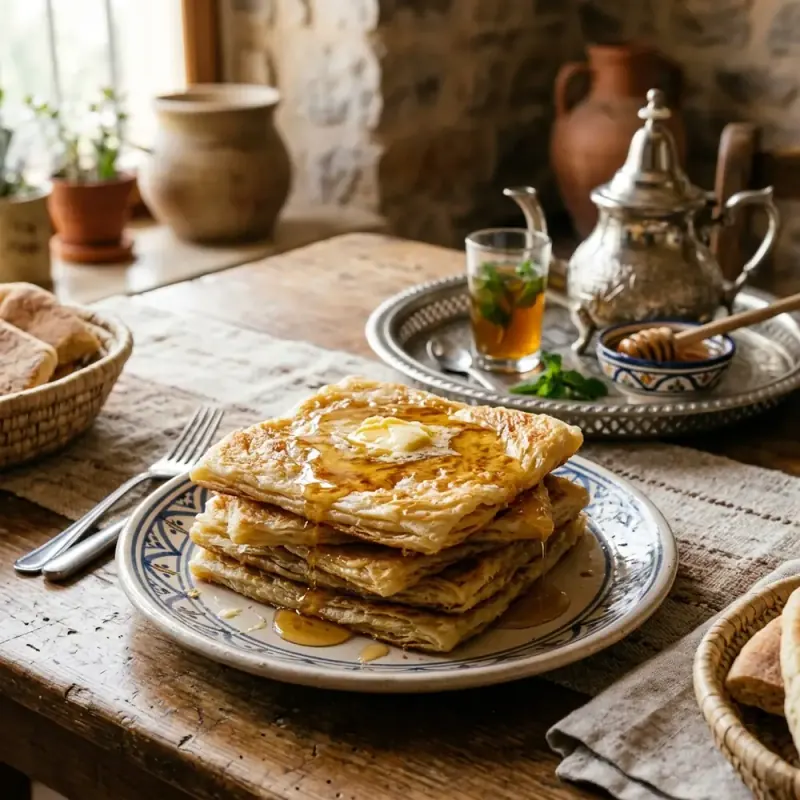
Sweet in the morning, savory at other times. The traditional breakfast pairing — melted butter and honey, both poured or spread over the opened msemen — is as good as it sounds and requires no improvement. The butter soaks into the layers and the honey follows into the same paths, and you eat the whole thing warm enough that the butter has not yet resolidified.
For savory use: msemen with kefta (spiced ground meat) is a combination found at street stalls throughout Moroccan cities, particularly in the evening — a whole msemen folded around a portion of cooked kefta, eaten standing. The msemen holds together well enough for this, its layers not disintegrating under the weight of the filling. The fat from the kefta and the fat within the msemen layers combine in a way that is entirely satisfying and not particularly sophisticated, which is exactly the kind of food a street stall should produce.
Msemen also appears as the base for rfissa — the postpartum chicken and fenugreek dish — where it is torn into rough pieces and used as the starchy foundation that absorbs the spiced cooking broth.
The Invisible Invitation
The first attempt will be too thick. The layers will be there but they will be wide and doughy rather than thin and flaky. This is correct and expected and the result will still be edible, just not what you were aiming for. The second attempt will be thinner. The third will be closer. The tenth will be almost right. Make twenty in a session and stop for that session. The hands learn this faster than the mind does, and they learn it from repetition rather than from instructions. Come back to it in a week. The hands will have remembered what the instructions didn't fully convey.
SEO Meta Description: How to make Moroccan msemen flatbread? The laminated dough technique — semolina layering, oil-fold method, correct cooking heat, and the traditional sweet and savory serving options.
Experience the true heart of Moroccan heritage through its culinary traditions. Join us in preserving and honoring these ancestral recipes.
What People Are Saying
No comments yet. Be the first — we'd love to hear from you.
Khadija Tahiri
Culturally Verified & Fact-CheckedThe Moroccan Food editorial team brings together native culinary researchers, heritage preservationists, and experienced home cooks across Marrakech, Fes, and Casablanca. Every recipe and cultural guide is reviewed against ancestral oral traditions and authentic regional practices.