Liquid Gold of the Kingdom: Zit Beldi (Olive Oil) & Argan Pressing Traditions of the Atlas and Souss
title: "Liquid Gold of the Kingdom: Zit Beldi (Olive Oil) & Argan Pressing Traditions of the Atlas and Souss" slug: "moroccan-olive-oil-argan-zit-beldi-souss-atlas-rituals" category: "Food & Cuisine" excerpt: "adventure through November olive harvests in the Middle Atlas and ancestral goat-tree argan groves of the Souss. Discover the ancient stone cold-pressing secrets, Amlou rituals, and longevity wisdom of mountain elders."
Liquid Gold of the Kingdom: Zit Beldi (Olive Oil) & Argan Pressing Traditions of the Atlas and Souss
Welcome to my table, my dear friend. Pull your wooden stool close to the clay brazier where olive wood embers glow with a low, perfumed warmth. Let me pour you a cup of steaming mint tea scented with wild mountain pennyroyal (sheeba), and let me tell you a secret that our grandmothers carved into the cedar rafters of our memories: in Morocco, oil is not a mere cooking medium. It is an inheritance. It is the blood of the mountain, the sweat of the red limestone hills, and the sacred nectar that has sustained twelve centuries of Berber and Arab dynasties across drought, feast, and celebration.
When November sweeps down from the snow-capped crests of the Middle Atlas, the air in the valleys turns crisp and smells of damp cedar needles, woodsmoke, and bruised olive leaves. In the south, where the sun beats mercilessly upon the calcareous plateaus of the Souss and the Haha coast, the ancient, twisted trunks of the Argania spinosa stand resilient against the desert winds, guarding an oil so rare that nowhere else on Earth can claim its birthright.
Together, Zit Beldi (our heirloom stone-pressed extra virgin olive oil) and Zit Argan (the prized culinary argan oil) form the twin golden rivers of Moroccan gastronomic civilization. Join me as we adventure past the singing stone mills of Zerhoun, down through the terraced orchards of Beni Mellal, and into the sun-drenched argan cooperatives of Taroudant and Essaouira to unravel the craft, the chemistry, and the sacred morning rituals of Morocco’s true liquid gold.
1. The Sacred Olive Harvest of the Atlas: From Volubilis to the Village Ma'sara
Long before the Roman legions planted their imperial presses among the mosaic courtyards of Volubilis (Walili), the indigenous Amazigh tribes of the Rif and Atlas ranges had already domesticated the wild oleaster tree (Azemmour). In Morocco, the olive tree is considered mubarakah—blessed by heaven—and its harvest is treated not as commercial labor, but as a communal festival of gratitude known as the Taoussa.
As the autumn moons wan, the orchards of Taounate, Chefchaouen, Moulay Idriss Zerhoun, and the High Atlas valleys of Ourika awaken at the break of dawn. Multi-generational families gather beneath the silvery-green canopies. The men climb into the stout branches, gently shaking the boughs or using supple chestnut poles to encourage the ripe fruit to fall onto woven palm-leaf mats (hssira), while the grandmothers and young girls squat below, hand-milking the lower branches with swift, tender caresses so as not to damage the fruiting wood for the coming year.
+-------------------------------------------------------------------------+
|                  MOROCCAN OLIVE OIL TERROIR MATRIX                      |
+---------------------+-----------------------+---------------------------+
| REGION              | OLIVE VARIETY         | SENSORY PROFILE           |
+---------------------+-----------------------+---------------------------+
| Zerhoun / Fez Plain | Picholine Marocaine   | Artichoke, wild mint,     |
|                     |                       | fiery peppery finish      |
+---------------------+-----------------------+---------------------------+
| Beni Mellal / Tadla | Picholine & Menara    | Green almond, apple skin, |
|                     |                       | round butteriness         |
+---------------------+-----------------------+---------------------------+
| Taounate / Rif      | Picholine Beldi       | Wild herbs, tomato leaf,  |
|                     |                       | intense polyphenol kick   |
+---------------------+-----------------------+---------------------------+
| Haouz / Marrakech   | Menara Beldi          | Sun-cured fruit, soft     |
|                     |                       | floral, mild pungency     |
+---------------------+-----------------------+---------------------------+
The undisputed sovereign of the Moroccan grove is the Picholine Marocaine. Unlike delicate European cultivars engineered for mild sweetness, the heirloom Moroccan Picholine is hearty, drought-hardy, and packed with extraordinary concentrations of polyphenols and squalene. When picked at the magical veraison stage—the exact moment in early November when the olive transitions from deep grass-green to violet-blushed purple—its juice yields a fiercely vibrant oil with notes of freshly sheared grass, green tomato vines, and an invigorating peppery catch at the back of the throat.
Elders in the village will never allow picked olives to sit suffocating in plastic sacks. "An olive bruised is an olive mourned," my grandmother Lalla Fatima would say. The harvest must travel directly in open wicker panniers (chouari) on donkey-back to the village Ma'sara (traditional mill) within twenty-four hours of leaving the branch, preserving every micro-nutrient from oxidation.
2. The Alchemy of Zit Beldi: Cold Stone Pressing, Decantation, and the "First Tear"
Step inside an ancestral Ma'sara carved into the limestone hillside of Zerhoun, and you step back a thousand years. The air is cool, heavy with the intoxicating, fruity perfume of crushed olives and damp stone. In the center of the cavernous room, a blindfolded mule walks measured, patient circles, turning a massive vertical granite millstone (Rha) over a concave stone basin.
THE ANCESTRAL MA'SARA COLD-EXTRACTION CYCLE:
[Hand-Harvested Olives]
         │
         ▼ (Within 24 Hours)
[Granite Millstone Crushing] ➔ (45-minute slow stone paste mastication)
         │
         ▼ (Layered into Scourtins)
[Stacking Woven Alfa Baskets]
         │
         ▼ (Manual Screw/Beam Press)
[Gentle Cold Compression] ➔ (No added boiling water / No thermal degradation)
         │
         ▼ (Natural Gravity Settling)
[Terracotta Decantation Basin] ➔ (Separation of oil from dark vegetable water)
         │
         ▼
[Zit el-Bared (The Cold First Run)]
The Geometry of the Stone Press
The slow grinding of the granite wheel does not heat the paste. Unlike industrial steel centrifuges that spin at thousands of RPMs and shear molecular bonds, the stone stone-crushes the entire drupe—skin, flesh, and seed—releasing natural enzymatic antioxidants from the crushed olive pit that act as an organic preservative.
Once crushed into a glossy, aubergine-purple paste, the master presser (El-Maalem) smears the mixture into flat, donut-shaped woven discs made of wild alfa grass (scourtins or chamilas). Fifty of these mats are stacked vertically onto the bed of an iron and timber screw press.
As the wooden levers are drawn tight by hand, the pressure builds without a single drop of artificial heat. A viscous, jade-colored river begins to weep through the woven alfa weave into stone collection troughs below. This unheated liquid is Zit el-Bared—the legendary "Cold Oil"—celebrated across North Africa for its raw therapeutic strength.
The Science of Decantation and That Peppery Burn
In the subterranean stone vats, gravity performs the final magic. Because the oil's specific gravity is lighter than the bitter water of vegetation (alpechin or l-mourjane), the liquid gold floats naturally to the surface over hours of restful stillness. The oil is skimmed off with wide copper ladles, unfiltered, carrying suspended droplets of olive pulp that lend it an opaque, emerald cloudiness.
When you taste a spoonful of raw, freshly pressed Zit Beldi, you will immediately feel a pronounced scratch or tickle in the throat, sometimes provoking a sudden cough. Do not be alarmed—rejoice! In Moroccan culinary science, this fiery catch is called l-harqa dyal zit. It is the direct biological signature of oleocanthal, a naturally occurring non-steroidal anti-inflammatory compound whose molecular geometry mirrors ibuprofen. Mountain elders who drink a small terracotta cup of warm stone-pressed olive oil every morning during the frost of January credit this peppery fire for their nimble joints and clear lungs well past their ninetieth year.
3. The Immortal Tree of the Souss: Argania Spinosa & The Sisterhood of the Hand-Press
South of the High Atlas, beyond the snowy pass of Tizi n'Tichka, the landscape shifts into dramatic red clay earth, arid plateaus, and dramatic desert light. Here, stretching from the foothills of the Anti-Atlas down to the Atlantic cliffs of Essaouira and the fertile plains of Taroudant, thrives a prehistoric botanical survivor that grows wild nowhere else on planet Earth: Argania spinosa, the ironwood tree of Morocco.
+-----------------------------------------------------------------------+
|                    THE ARGAN FRUIT DECONSTRUCTION                     |
+-----------------------------------------------------------------------+
| LAYER           | MOROCCAN NAME | CHARACTERISTICS & ROLE              |
+-----------------+---------------+-------------------------------------+
| Outer Husk      | Al-Qashra     | Thick, bitter green-to-brown rind;  |
|                 |               | prized fodder for goats and camels  |
+-----------------+---------------+-------------------------------------+
| Sweet Pulp      | L-Ghlal       | Sugary, fibrous flesh encasing nut  |
+-----------------+---------------+-------------------------------------+
| Hard Shell      | Agqa          | Iron-hard woody nut, 16x harder     |
|                 |               | than a hazelnut shell               |
+-----------------+---------------+-------------------------------------+
| Inner Kernel(s) | Tiznin        | 1-3 white oil-rich seed kernels;    |
|                 |               | the precious source of golden oil   |
+-----------------+---------------+-------------------------------------+
The argan tree is an ecological fortress. Its deep root network plunges over thirty meters into subterranean bedrock to arrest the advancing sands of the Sahara. In Amazigh folklore, the tree is reverently called Argane n-Tamazgha—the mother of the hearth.
For centuries, the extraction of argan oil has been the exclusive, sacred domain of Berber women. In the whitewashed villages of the Souss valley, women gather in circles within village cooperatives, singing ancient polyphonic Tamazight chants as their hands work in rhythmic synchrony. This is not assembly-line work; it is an artisanal meditation demanding formidable stamina, tactile precision, and generations of inherited muscle memory.
4. The Azrg and the Singing Stone: How Culinary Argan Oil is Born
To understand the sublime difference between ordinary cosmetics and genuine culinary argan oil, one must witness the ritual of the flame, the stone, and the warm spring water.
CULINARY ARGAN EXTRACTION adventure:
[Harvested Sun-Dried Argan Fruit]
                 │
                 ▼ (Manual De-husking)
[Stripped Hard Nuts (Agqa)]
                 │
                 ▼ (Precision Cracking with River Stones)
[Intact White Kernels (Tiznin)]
                 │
                 ▼ (Gentle Wood-Fire Toasting in Clay Tagra)
[Golden Hazelnut-Aromatic Kernels]
                 │
                 ▼ (Slow Grinding on Rotary Millstone (Azrg))
[Warm, Viscous Argan Paste (Tazkkemte)]
                 │
                 ▼ (Hand-Kneading with Droplets of Warm Water)
[Oil Separation (Azig) ➔ Pure Golden Liquid Gold]
Cracking the Iron Shell
First, the dried outer husk is stripped away by hand. The inner nut (Agqa) is sixteen times harder than an acorn. Industrial mechanical shellers often shatter the delicate kernels inside, causing rapid oxidation. Therefore, the women use two simple river-smoothed stones: a flat base stone (Taouria) and an oval hand-held hammer stone (Azrou).
With a single, measured strike placed with pinpoint accuracy, the shell splits clean open without bruising the one to three pale cream-colored kernels (Tiznin) nestled inside. An experienced cooperative artisan can crack hundreds of nuts an hour without nicking a single kernel—a rhythm that sounds across the Souss like the steady ticking of a wooden clock.
The Gentle Roast Over Clay Brazier
For cosmetic oil, raw unroasted kernels are cold-pressed immediately. But for culinary argan oil—the nectar destined for our tajines and breakfast tables—the kernels undergo a gentle, artisanal roasting.
The kernels are spread over a wide, shallow terracotta dish (Tagra) suspended over low-burning embers of almond and argan shells. The roastmaster turns the seeds continuously with a wooden paddle. The heat must never scorch; it must gently coax the Maillard reaction, transforming the raw seed's mild flavor into intoxicating, toasted aromas of roasted hazelnuts, warm brioche, and golden honey.
The Rotary Quern (Azrg) and the Miracle of Hand-Kneading
Once cooled, the toasted kernels are spooned into the top aperture of an Azrg—a heavy, handheld rotary millstone carved from dense mountain basalt. As the stone spins, a thick, glistening, chocolate-gold paste called Tazkkemte oozes from the base into a wide earthenware bowl.
Now begins the ultimate test of the artisan's craft: the hand-kneading (Asr). The woman sits on the floor, leaning her body weight into the warm paste. Gradually, she adds tiny drops of warm boiled spring water. As she kneads, stretches, and massages the paste, the moisture causes the proteins to bind together, expelling a clear, glistening stream of deep amber-bronze oil between her fingers.
The remaining dehydrated protein mass (Azig or Zoumeta) is never wasted—it is rich in nutrients and saved as luxury winter fodder for livestock or compounded into rustic exfoliating body scrubs. The freshly collected oil is allowed to rest in dark clay jars for two weeks to let the fine sediment settle, leaving behind a luminous, crystal-clear elixir with a distinctive amber-gold hue.
5. The Sacred Morning Trinity: Amlou, Pure Honey, and Hot Khobz
If you ever wake up in a Berber home in the High Atlas or the argan groves of the Souss, you will not find butter or industrial jams upon the low round wooden table (Meida). Instead, before your eyes are even fully open, the mistress of the house will slide three shallow terracotta bowls before you alongside a basket of blistered, piping-hot Khobz Beldi (traditional country hearth bread made with whole durum wheat and wild yeast) or fluffy, honeycomb-textured Baghrir crepes.
+--------------------------------------------------------------------+
|                    THE SACRED MORNING TRINITY                      |
+--------------------------------------------------------------------+
|               [ AMLOU (The Berber Energy Paste) ]                  |
|          Toasted Beldi Almonds + Culinary Argan Oil +              |
|                     Pure Mountain Flower Honey                     |
|                                                                    |
|               [ ZIT BELDI (Early-Harvest Olive) ]                  |
|         Cold-Pressed Picholine with Wild Cumin & Salt              |
|                                                                    |
|               [ KHOBZ TAFARNOUT (Stone-Baked Flatbread) ]          |
|         Hot, blistered wheat bread baked on river stones           |
+--------------------------------------------------------------------+
The Anatomy of True Amlou
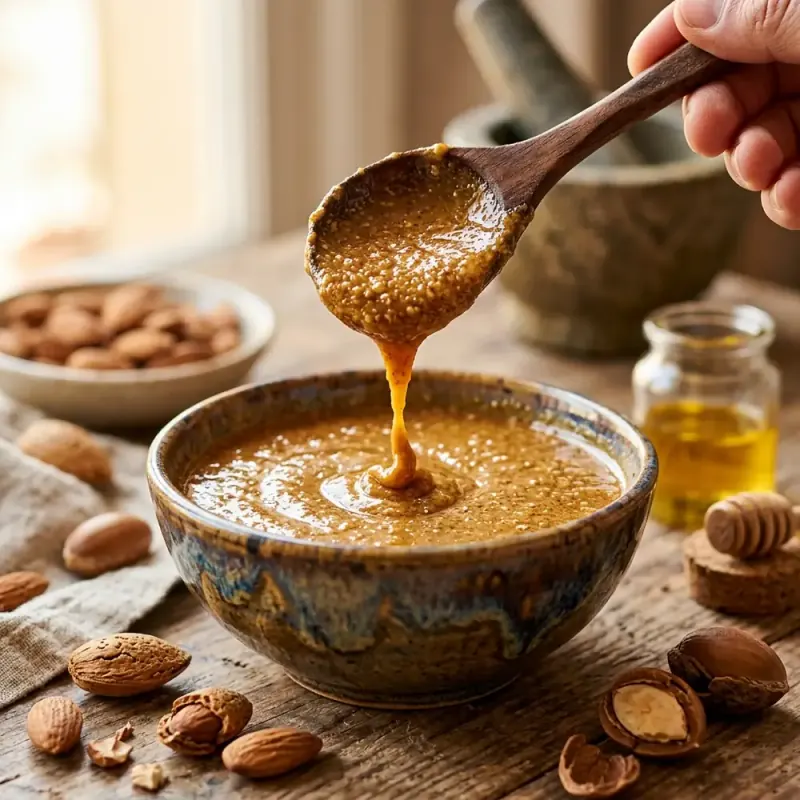
Amlou is the crown jewel of Moroccan breakfast culture. It is not merely an almond butter; it is an ancestral energy paste engineered for mountain survival.
To prepare authentic Amlou:
- The Almonds: Small, intensely sweet Louz Beldi almonds harvested from the arid terraced slopes of Tafraout are gently dry-toasted in a heavy skillet until deep golden brown throughout, then stone-ground between the basalt wheels of the Azrg until they transform into a silky, warm paste.
- The Oil: Pure, freshly roasted culinary Argan oil is streamed slowly into the almond paste while continuously stirring with a wooden whisk in a figure-eight motion.
- The Sweetener: Raw mountain honey (3sel l-horr)—harvested from wild thyme (Za'atar), euphorbia (Daghmous), or orange blossoms (Zhar)—is folded in to balance the rich nutty fats with floral, soothing sweetness and a trace pinch of fine sea salt.
THE BIOCHEMICAL SYNERGY OF AMLOU:
[Argan Oil Unsaturated Fatty Acids (Oleic + Linoleic Acid)]
                         +
[Almond Plant Proteins, Magnesium & Vitamin E]
                         +
[Raw Mountain Honey Bioflavonoids & Natural Fructose]
                         ║
                         ▼
[Slow-Release Cellular Energy + Joint Lubrication + Low Glycemic Index]
When you tear off a piece of hot, crusty bread, plunge it into the velvety bowl of Amlou, and lift it to your mouth, the complexity is breathtaking: first comes the warm, toasted almond crunch, followed instantly by the smoky hazelnut depths of the argan oil, rounded out by the floral perfume of raw honey. It coats the palate with an aristocratic silkiness that stays with you long after the meal is done.
6. Liquid Gold in the Moroccan Pot: When to Cook, When to Drizzle, and Heat Taboos
In modern Western kitchens, olive and specialty oils are often treated with careless interchangeability. But in the grand tradition of the Moroccan kitchen (Dar l-Kbira), there are strict, immutable laws governing when liquid gold may meet heat, and when it must be treated as a finishing blessing.
+----------------------------------------------------------------------------+
|                  CULINARY HIERARCHY OF MOROCCAN OILS                       |
+---------------------+-------------------+----------------------------------+
| OIL TYPE            | THERMAL TOLERANCE | IDEAL TRADITIONAL APPLICATION    |
+---------------------+-------------------+----------------------------------+
| Zit Beldi           | Low-to-Medium     | Slow-simmered Tagines, Bissara,  |
| (Extra Virgin)      | (Gentle Simmer)   | Zaalouk, Chermoula, Lentils      |
+---------------------+-------------------+----------------------------------+
| Zit Argan           | ZERO DIRECT HEAT  | Finishing Couscous, Drizzled     |
| (Culinary Roasted)  | (Heat-Sensitive)  | over Fried Eggs, Loubia, Amlou   |
+---------------------+-------------------+----------------------------------+
| Zit el-Bared        | NEVER HEATED      | Dipping bread, Raw salads,       |
| (First-Press Green) |                   | Morning tonics with wild herbs   |
+---------------------+-------------------+----------------------------------+
The Laws of Zit Beldi in Slow Cooking
When building the aromatic foundation (l-Iqama) of a classic lamb or beef tagine, we never sear the meat in scorching-hot extra virgin olive oil. High thermal shock burns the delicate polyphenols and turns the oil acrid.
Instead, the Moroccan master cook combines olive oil with grated onions, crushed garlic, spices, and a small splash of spring water in the cold base of the tagine. The water forms a protective emulsion that caps the temperature at 100°C (212°F), allowing the spices (saffron, ginger, cumin, coriander) to dissolve their fat-soluble essences into the oil without scorching, gently infusing the meat fiber over hours of slow simmering over charcoal (Kanoun).
The Inviolable Argan Taboo
Let this be carved into your kitchen rulebook: You must never fry or cook directly with culinary argan oil. Direct stove heat destroys its delicate aromatic aldehydes and fractures its precious tocopherols, ruining its priceless toasted nutty flavor.
Culinary argan oil is an altar oil. It is added strictly at the final second:
- Swirled over a steaming bowl of dried fava bean soup (Bissara) right as it leaves the flame.
- Drizzled over sunny-side-up country eggs fried in a clay skillet, where the residual steam warms the oil without cooking it.
- Massaged by hand into steamed semolina grains (Seksu) on the third and final steaming round, imparting a glorious golden gloss and woodsy fragrance to Berber royal couscous.
- Splashed generously over oven-roasted goat shoulder (Méchoui) or fresh goat cheese drizzled with wild thyme honey.
7. Grandmother's Secrets (H'kam Lalla) for the Master Kitchen
Listen closely to these practical culinary secrets passed down through generations of Moroccan matriarchs to keep your oils pure, vibrant, and medicinally potent:
- The Refrigerator Cloud Test for Pure Zit Beldi: Authentic, unadulterated cold-pressed extra virgin olive oil is loaded with natural waxes and monounsaturated fatty acids. To test your oil's authenticity, pour two tablespoons into a glass and place it in the refrigerator for twenty-four hours. Real, unrefined Moroccan olive oil will become thick, cloudy, and partially solidify into a butter-like paste. If it remains crystal clear and thin, it has been adulterated with refined industrial seed oils.
- The Sniff-and-Sip Argan Roast Test: True culinary argan oil should possess a comforting aroma of toasted hazelnuts, golden brioche, or sesame. If the oil smells sharp, goat-like, or barnyard-sour, the nuts were harvested from digested goat droppings rather than freshly plucked and de-husked from the tree. If it smells burnt or acrid like cigarette ash, the artisan roasted the seeds too fast over high flames.
- The Inverted Jar Secret for Amlou Separation: Because authentic Amlou contains zero industrial emulsifiers or hydrogenated fats, the argan oil will naturally rise to the surface over two to three weeks of standing. Store your Amlou jars upside-down in a cool, dark pantry. When you flip the jar right-side-up to open it, the honey and almond solids will effortlessly re-incorporate with just three turns of a wooden spoon.
- The Winter Garlic-Rosemary Infusion: During the damp chills of December, fill a dark stoneware bottle with fresh, unfiltered Zit Beldi, three bruised cloves of purple Moroccan garlic (Touma Beldia), and a sprig of wild mountain rosemary (Azir). Keep it on your counter to drizzle over morning toast; it acts as an ancestral immune shield against winter colds.
- The Secret Grain of Salt in the Azrg: When stone-grinding your own nuts or seeds for breakfast pastes, always add a generous pinch of coarse grey Atlantic sea salt directly into the stone mill with the oil. The mineral salt not only brightens the nuttiness but also acts as an abrasive agent, helping the stone shear the nut fibers to velvety perfection.
8. Frequently Asked Questions (FAQ)
Q1: What makes Moroccan Picholine olive oil different from Spanish or Italian olive oils?
Moroccan olive oil derived from the heirloom Picholine Marocaine variety grows under conditions of intense Mediterranean sun and low rainfall in mineral-rich limestone soils. This environmental stress triggers the tree to synthesize exceptionally high concentrations of polyphenols (antioxidants) and oleocanthal compared to many European varieties. As a result, Moroccan olive oil has a more robust, rustic character, characterized by grassy, green-artichoke notes and a distinctly peppery, medicinal finish that holds up remarkably well to complex spice profiles.
Q2: Why is culinary argan oil golden-brown and nutty, while cosmetic argan oil is pale yellow and almost odorless?
The difference lies entirely in the toasting process. Culinary argan oil is pressed from kernels that have been gently wood-fire roasted in clay dishes, developing rich amber pigments and deep toasted hazelnut/brioche flavors. Cosmetic argan oil is cold-pressed from 100% raw, unroasted kernels to preserve fragile essential fatty acids, vitamin E, and sterols without any heat exposure, producing a light golden oil with a mild, earthy, raw seed scent designed for rapid skin absorption.
Q3: How can I identify genuine Amlou versus commercial counterfeit versions?
Real artisanal Amlou contains only three ingredients: stone-ground toasted almonds (Louz Beldi), pure roasted argan oil, and pure honey (plus an optional pinch of sea salt). Commercial counterfeits frequently cut costs by substituting cheap roasted peanuts (Kawkaw), refined sunflower or vegetable oil, and industrial glucose syrup or white sugar. Authentic Amlou has a deep golden-tan color, a delicate hazelnut-almond perfume, an aristocratic fluidity that coats the tongue without sticky cloyness, and will solidify slightly in cold temperatures due to the natural argan oil fats.
Q4: Is cloudy, unfiltered green olive oil (Zit el-Bared) safe to consume, and how should it be stored?
Yes, cloudy, unfiltered olive oil is not only completely safe—it is the freshest, most antioxidant-dense form of olive oil you can consume. The cloudiness is caused by microscopic suspended droplets of olive fruit flesh and water rich in active bioflavonoids. However, because these organic particles can accelerate fermentation over time, unfiltered oil should be consumed within 6 to 9 months of the harvest, stored in dark glass or ceramic containers, and kept far away from direct sunlight, heat, and oxygen.
Q5: How long do traditional Moroccan olive oil and argan oil last before losing their vitality?
When properly stored in dark, airtight ceramic or amber glass vessels in a cool pantry (14°C–18°C / 57°F–64°F):
- Extra Virgin Zit Beldi: Retains optimal flavor and antioxidant potency for 18 to 24 months from the press date.
- Culinary Argan Oil: Thanks to its unusually high concentration of natural gamma-tocopherols (Vitamin E), pure culinary argan oil is remarkably stable and will remain fresh and fragrant for up to 2 years. Never store either oil next to the stove or on sunny windowsills.
9. Visual Curation & Photography Prompts
To visually honor the beauty and heritage of Moroccan oil traditions, use the following photography prompts:
Image Prompt 1: The November Harvest in Zerhoun
- Subject: An elderly Berber farmer with sun-weathered hands resting upon a gnarled, centuries-old olive trunk in Moulay Idriss Zerhoun. In the background, woven palm-leaf mats on the red clay earth overflow with freshly harvested green and purple Picholine olives under crisp autumn sunlight.
- Vibe: Ancient, reverent, rustic, earthy, golden morning mist.
- Style: National Geographic documentary style, rich natural lighting, deep shadows, 35mm film grain texture.
- Format: 16:9 Landscape.
Image Prompt 2: The Ancestral Ma'sara Stone Press
- Subject: Inside a traditional subterranean stone olive mill in the Rif Mountains. A colossal carved granite millstone crushing glossy violet olive mash into a stone basin, with stacks of textured woven alfa-grass discs (scourtins) dripping fresh, jade-green, unfiltered olive oil into a vintage terracotta vessel.
- Vibe: Atmospheric, artisanal, timeless, tactile, dimly lit with warm shaft of daylight through an arched stone doorway.
- Style: Chiaroscuro fine art photography, cinematic depth of field, rich velvety textures.
- Format: 4:3 Portrait.
Image Prompt 3: The Berber Argan Pressing Circle
- Subject: Two Amazigh women in traditional colorful embroidered Souss headscarves seated on a Berber kilim rug. One woman cracks an iron-hard argan nut between two smooth river stones, while the other turns the wooden handle of a circular basalt quern (Azrg), releasing a thick, golden-amber argan cream into an earthenware bowl.
- Vibe: Sisterhood, generational wisdom, warmth, quiet focus, authentic cultural heritage.
- Style: Environmental portraiture, warm sunlight, shallow depth of field, authentic candid capture.
- Format: 16:9 Landscape.
Image Prompt 4: The Golden Stream of Roasted Argan
- Subject: Macro extreme close-up of pure, amber-gold culinary argan oil streaming from a rustic glazed terracotta spout into an antique hand-beaten brass spoon. Sunbeams catch the clarity and warm amber luminescence of the liquid, with a small dish of toasted whole argan nuts and almonds blurred in the soft background.
- Vibe: Luxurious, mouth-watering, pure, artisanal mastery.
- Style: High-end culinary editorial photography, micro-focus, golden hour warm backlighting.
- Format: 1:1 Square.
Image Prompt 5: The Sacred Morning Table (Amlou & Khobz)
- Subject: A traditional Moroccan breakfast spread on a low cedar-wood table (Meida). A shallow painted Fez ceramic bowl of silky, stone-ground Amlou swirled with orange blossom honey, a bowl of grassy green Zit Beldi sprinkled with wild cumin, steaming hot blistered whole-wheat hearth bread (Khobz) torn in half, and an ornate silver teapot pouring mint tea from high above into a filigree glass.
- Vibe: Welcoming, lavishly rustic, soul-warming, vibrant, celebratory breakfast feast.
- Style: Top-down flat lay with 45-degree angle secondary focus, warm natural side light, steam visible in the air.
- Format: 16:9 Landscape.
Experience the true heart of Moroccan heritage through its culinary traditions. Join us in preserving and honoring these ancestral recipes.
What People Are Saying
No comments yet. Be the first — we'd love to hear from you.
Lalla Fatima & The Medina Culinary Guild
Culturally Verified & Fact-CheckedThe Moroccan Food editorial team brings together native culinary researchers, heritage preservationists, and experienced home cooks across Marrakech, Fes, and Casablanca. Every recipe and cultural guide is reviewed against ancestral oral traditions and authentic regional practices.