Moroccan Olives: The Eight Varieties on Every Table and What Each One Is Actually For
Moroccan Olives: Why the Plate on the Table Is Not a Random Assortment
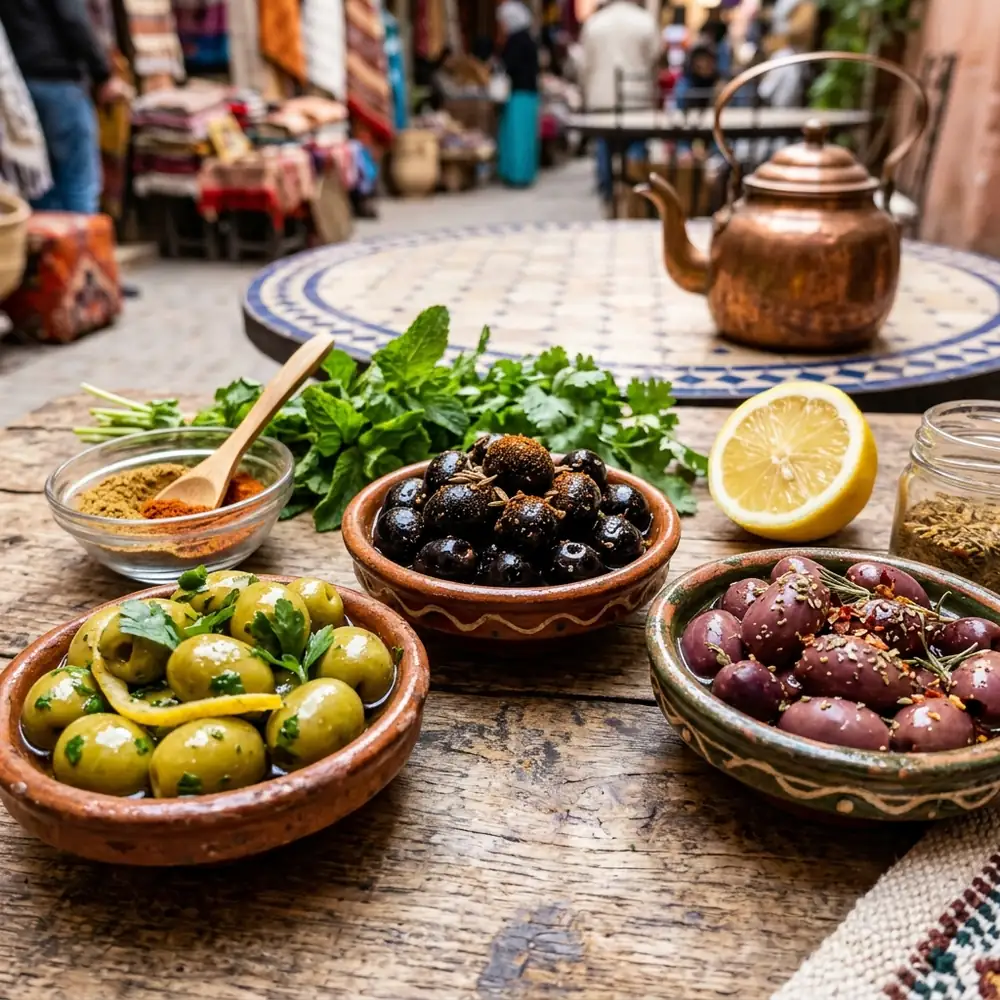
The plate of olives that appears at the beginning of every Moroccan meal — before the couscous, before the tagine, with the bread and the cooked salads — is almost never explained to guests, because for Moroccan hosts it requires no explanation. The olives are there. They have always been there. Pick the ones you like. This is the assumption.
But for someone encountering Moroccan table olives for the first time, the plate is a genuinely confusing collection of things that look vaguely similar and taste completely different from each other, and the difference is not just variety but method of preparation and intended function. The crinkled, dark-brown oil-cured olives in the corner of the plate are not there for the same purpose as the large, firm, herb-marinated green olives beside them. Understanding what is on the plate makes you a better guest at a Moroccan table, and it also helps you cook better with Moroccan olives when you are home and the recipe says "Moroccan olives" without further specification.
What Are the Main Moroccan Olive Varieties and How Do They Taste?
Morocco's primary cultivated olive variety for both oil and table use is the Picholine Marocaine — the Moroccan picholine, related to but distinct from the French picholine and the Spanish manzanilla, adapted over centuries to the Moroccan climate. The Moroccan picholine is small to medium in size, oval, with a relatively high oil content and a flavor that is mild and buttery rather than intensely bitter.
For oil production, the Moroccan picholine produces what is generally described as a mild, fruity olive oil — less aggressively peppery than Tuscan oils, less fruity than Spanish oils, with a clean, round character that makes it useful for cooking without competing with other flavors. High-quality Moroccan olive oil — from artisan producers in the Meknès plain and the Souss valley — is excellent. The bulk export product that Morocco produces in enormous quantity is a different matter.
At the table, the olives you most commonly encounter are:
Oil-cured black olives: small, wrinkled, dry-textured, intensely salty and slightly bitter, with a concentrated olive flavor. These are olives that have been packed in salt without any water for several months, which draws out all their moisture and concentrates their character. They are not pleasant to bite into as you would bite into a green olive — they are intensely flavored, to be eaten one at a time, with bread. They are also the olive most commonly added to tagines, where their concentrated flavor and salt distribute through the cooking liquid.
Purple mid-ripeness olives: harvested between full green and full black, these have a softer texture than the oil-cured and a flavor that is fruity with a mild bitterness. Often marinated in olive oil with preserved lemon, herbs, and sometimes cumin. The most versatile table olive.
Large green olives, cracked: the largest Moroccan table olives, their flesh cracked before curing to allow the brine to penetrate quickly. Firm, mild, often marinated with garlic, preserved lemon, coriander, and cumin. Good with bread. Good in chicken tagines where their mild flavor doesn't dominate.
Herb-marinated mixed olives: usually a combination of the above in a marinade of olive oil, preserved lemon rind, fresh coriander and parsley, garlic, cumin, and sometimes harissa. This is the preparation that most Moroccan kitchens make from whatever olives are available and whatever herbs are at hand, which means no two versions are identical and the best versions are made by people who have been making them for decades and adjust by taste rather than by recipe.
How Are Moroccan Olives Used in Cooking Rather Than Just at the Table?
In Moroccan cooking, the olive appears in two distinct roles: as a garnish added in the final minutes of a tagine (where it provides a salty, slightly bitter accent without fully integrating into the sauce), and as a cooking ingredient in dishes where olive flavor is central.
The critical timing point for olives in tagines — which most recipes don't emphasize clearly — is that olives should be added very late. In the last twenty minutes of cooking, maximum. An olive cooked for an hour in a tagine becomes bitter in a way that is unpleasant and difficult to correct. An olive added in the last twenty minutes retains its character while absorbing some of the tagine's flavor and contributing its own to the dish.
The chicken with preserved lemon and olives tagine — probably the most internationally recognized Moroccan dish outside bastilla — uses the large, mild green cracked olives, not the intensely flavored oil-cured black olives. The green olives' mild character allows the preserved lemon and the saffron and the ginger in the tagine to be the flavor statement, with the olives providing textural variation and gentle saltiness rather than dominant flavor. Substituting oil-cured black olives in this tagine produces a result that is too intense and too salty.
The oil-cured black olives belong in dishes where their concentration is an asset: a slow-cooked lamb shoulder where the cooking time is four hours and the olive's character will slowly mellow and distribute; a cooked salad where their intensity punctuates milder vegetables.
The Invisible Invitation
The plate of olives arrives with the bread, before anything else — a small clay dish, slightly warm, with four or five different types arranged together without ceremony. The host is already talking about something else. Pick one. It will be more intensely flavored than whatever olive you encountered in a supermarket before this, and if it is a good oil-cured black olive and you have not had one before, it will be significantly more challenging than that. Pick another type. Then another. The bread is there to moderate. By the time the cooked salads arrive, you will have opinions about which variety you prefer. This is correct. This is the beginning of a relationship with Moroccan food that is worth having.
SEO Meta Description: What are the different types of Moroccan olives? A guide to oil-cured, purple, cracked green, and herb-marinated varieties — flavor profiles, table roles, and when each is used in cooking.
Experience the true heart of Moroccan heritage through its traditions. Join us in preserving these ancestral rituals.
What People Are Saying
No comments yet. Be the first — we'd love to hear from you.
Khadija Tahiri
A Moroccan cultural writer dedicated to documenting the authentic voice, history, and heritage of the Kingdom. Writing from within — to share what truly makes Morocco extraordinary.
Our Mission →