The Moroccan Oud: Why This 1,200-Year-Old Instrument Still Defines Our Musical Soul
The Moroccan Oud: The Instrument That Carries Al-Andalus in Its Strings
There is a neighborhood in Fes called the Andalusian Quarter. It sits on the eastern bank of the Oued Fes, separated from the older Quaraouiyine quarter by the river, and it was settled in 818 CE by families expelled from Córdoba following a violent revolt against the Umayyad Emir. They arrived with their possessions, their dialects, their recipes, their musical traditions. And their instruments.
The Oud was among what they brought. And when the Muslim and Jewish families of Granada, Seville, and Valencia fled the final Spanish reconquista at the end of the 15th century — the largest forced displacement in Iberian history — more of them came to Morocco. To Fes, to Tetouan, to Chefchaouen. They brought everything they had saved from their libraries and their music rooms. The Andalusian musical tradition that had developed in Islamic Spain over seven centuries arrived in Morocco largely intact, transplanted into a new geography but otherwise undisturbed.
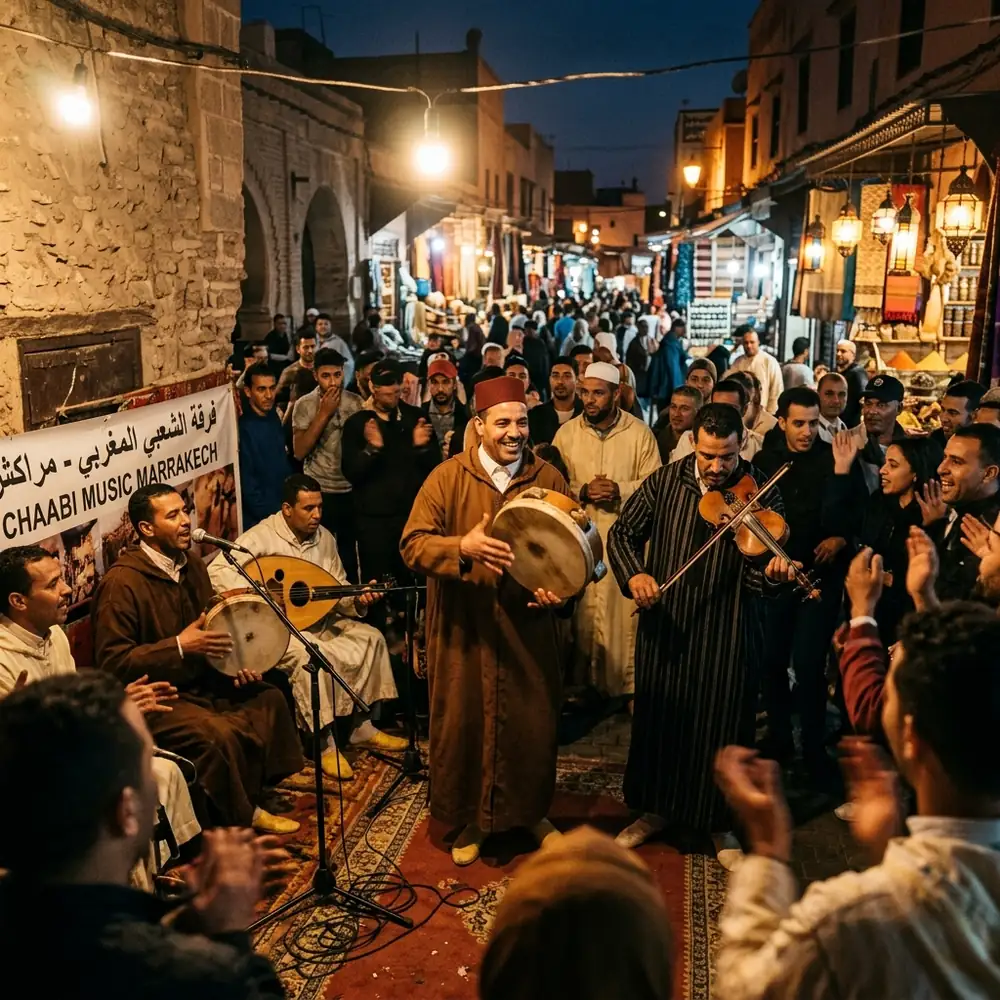
That music — what we now call al-Ala or the Andalusian classical music tradition of Morocco — is still performed today. In the same cities. By the descendants of those families, in some cases. With the Oud at its center.
What Exactly Is an Oud and How Is It Different From a Guitar?
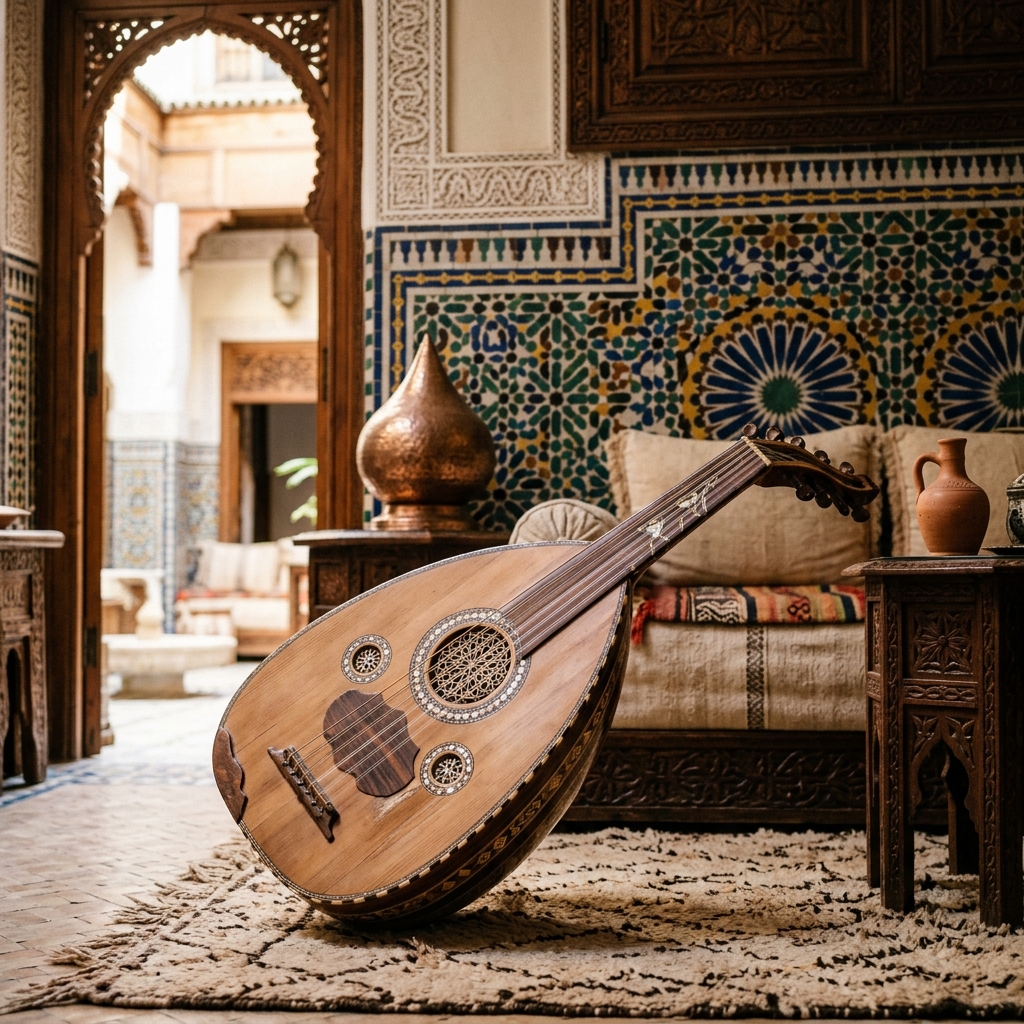
The Oud is a short-necked, fretless lute. That word "fretless" is the crucial distinction. A guitar has frets — the metal ridges across the neck that divide the fingerboard into fixed semitone intervals, guaranteeing that if you press the string in the right place you get the right note every time, no training required. The Oud has nothing on the neck. Just smooth wood. The player's left hand determines pitch entirely through the placement of fingertips on the string, which means the margin for error is constant and absolute, and which also means the player can produce microtonal intervals — notes that fall between the semitones of the Western scale — with perfect precision.
This matters enormously in the maqam system — the modal framework that underpins Moroccan and broader Arabic classical music. A maqam is not a scale in the Western sense. It is a more complex emotional and melodic territory: a specific set of intervals, specific characteristic phrases, specific associations with emotional states and times of day, and specific microtonal inflections that exist between the notes of any Western scale and that give Arabic music much of its expressive character. You cannot play these inflections on a fretted instrument. This is why, in the Arabic musical tradition, the Oud has historically been called "the sultan of instruments" — it is the only instrument that can fully express the modal system.
How Is a Moroccan Oud Made and What Makes One Good?
The body of a fine Moroccan Oud is built from a combination of materials chosen with obsessive care. The soundboard — the face of the instrument — is typically spruce or cedar, carved thin enough to vibrate freely across its entire surface area but thick enough not to distort under the tension of the strings. Too thick and the sound is dull and contained. Too thin and it sounds bright but fragile, and doesn't develop the resonant depth that a well-played Oud accumulates over decades of use.
The bowl — the deep, rounded back of the instrument — is assembled from strips of alternating light and dark wood, typically walnut and maple or rosewood and maple, bent over a heated mold and glued edge-to-edge with extraordinary precision. On a well-made Oud, the seam between each strip is so tight you can barely feel it with a fingernail. The visual effect of these alternating strips is also beautiful, which matters to players who spend hours looking at the instrument while they practice.
The pegs are traditionally carved from ebony or rosewood and are held in place purely by friction — no mechanical tuning machines. This makes tuning an Oud significantly more demanding than tuning a guitar (the pegs slip if the humidity changes, which in coastal Moroccan cities they do constantly) and also means that a skilled Oud maker's peg fit is something players discuss with genuine feeling.
What makes an Oud good? This is subjective in the way that makes Oud players passionate and occasionally unreasonable about their instruments. But certain things are not subjective: projection (can it fill a room without amplification?), response (does it speak immediately when the string is plucked, or is there a delay in the sound developing?), sustain (how long does a plucked note continue to ring before fading?), and tonal color across registers (does the bass response match the treble response, or does one dominate?).
What Is the al-Ala Tradition and Why Does Morocco Have It When Other Countries Don't?
Al-Ala — Moroccan Andalusian classical music — is the direct musical inheritance of Islamic Spain. It exists in its most complete form in Morocco because Morocco was the primary destination of the expelled Andalusian Muslim and Jewish populations. Tunisia and Algeria received smaller communities and have their own related traditions (Maluf and San'a respectively), but Morocco received the largest groups and the most intact musical documentation.
The tradition is organized into eleven nuba — complete musical suites, each in a different mode, each lasting several hours when performed in full. A single nuba contains dozens of individual pieces arranged by rhythmic cycle and tempo, moving from slow, meditative opening sections to increasingly lively concluding ones over the course of the evening. A full performance of a complete nuba — all sections, uncut — takes roughly four hours. The complete cycle of all eleven nuba would take several evenings to perform in full.
Today, al-Ala is performed primarily by formally organized musical associations (Jama'at) found in every major Moroccan city. Fes, Tetouan, Rabat, and Casablanca all have major active associations that perform publicly, teach formally, and compete with each other — very gently, very politely — over questions of interpretation and authenticity. These debates are serious and old. Some of them go back two centuries.
The Invisible Invitation
There is a small concert hall in the Tetouan medina where a local al-Ala association performs on Thursday evenings between November and March. It seats maybe a hundred people. The musicians — perhaps fifteen of them, sitting in a semicircle with their Ouds, their violins, their percussion — wear white djellabas and perform with a composure that only comes from having done this every week for years. The music begins slowly. The first maqam unfolds over twenty minutes of unhurried development, the Oud at the center of everything. After thirty minutes, you will have forgotten about whatever you came from. Come on a Thursday. Dress warmly. The season is short.
SEO Meta Description: What is the Moroccan Oud and the al-Ala musical tradition? A guide to the fretless lute, the Andalusian classical music brought to Morocco from Spain, and how it's still performed today.
Experience the true heart of Moroccan heritage through its traditions. Join us in preserving these ancestral rituals.
What People Are Saying
No comments yet. Be the first — we'd love to hear from you.
Youssef Amazigh
A Moroccan cultural writer dedicated to documenting the authentic voice, history, and heritage of the Kingdom. Writing from within — to share what truly makes Morocco extraordinary.
Our Mission →