Moroccan Pastries: The Geography of Sweetness Across Morocco
Moroccan Pastry: The Shapes, the Honey, and the Reasons Each City Makes Something Different
I have an embarrassing confession to make about Moroccan pastry, and it is this: I ate the gazelle horn (kaab el-ghzal) for thirty years before I understood why the almond paste inside it is slightly grainy rather than smooth. The answer is obvious in retrospect — the almonds are ground with sugar while still slightly warm from the oven, which partially caramelizes the sugar and produces a texture that is specifically different from a pastry cream or a marzipan — but I had never asked, and nobody had explained it, because in Moroccan culinary transmission the technique is demonstrated rather than described and the reason is considered self-evident to anyone who has watched the process.
This is the characteristic thing about Moroccan pastry: it is technically sophisticated, regionally diverse, seasonally structured, and almost entirely undocumented in any form that an outsider can access without either being born into a Moroccan household or spending extended time in one. The pastry cookbooks that exist in Morocco are a start, but the critical information — the touch, the timing, the reason this is done this way — lives in the hands of women who learned it from their mothers and grandmothers and who rarely think of it as knowledge worth explaining because it is simply how things are done.
Let me try to explain some of it anyway.
What Makes Chebakia the Quintessential Moroccan Pastry?
Chebakia is the Ramadan pastry — the deep-fried, honey-drenched sesame pastry that appears on every iftar table in Morocco for thirty consecutive nights and that is so thoroughly associated with Ramadan that eating it in August, out of season, produces a mild cognitive dissonance. It is fried, soaked in honey, covered in sesame seeds, and formed into a coiled rose shape before frying. It is not a subtle pastry.
The dough is the interesting technical part. It contains more aromatic ingredients per unit volume than almost any other pastry dough I know: anise seed, cinnamon, sesame, saffron dissolved in orange blossom water, vinegar (which both activates leavening and tenderizes the gluten), and smen or vegetable oil. The combination of these aromatics — particularly the anise and the saffron and the orange blossom water all present simultaneously — produces a fragrance when the dough is being mixed that is so specifically Chebakia that I cannot smell any one of those ingredients alone without the others being implied.
The coiling technique is simple to describe and takes weeks to execute properly: a rectangle of dough is slashed with four parallel cuts, then the strips are interlaced through each other and the whole thing is gathered and folded into a rose shape by pinching the center. In skilled hands, this takes about eight seconds per piece. In the hands of someone learning, it takes considerably longer and produces shapes that approximate a rose in the way that a first attempt at origami approximates a crane. You make several hundred to get good at it.
What Is Kaab el-Ghzal and Why Is It Specifically a Marrakech Thing?
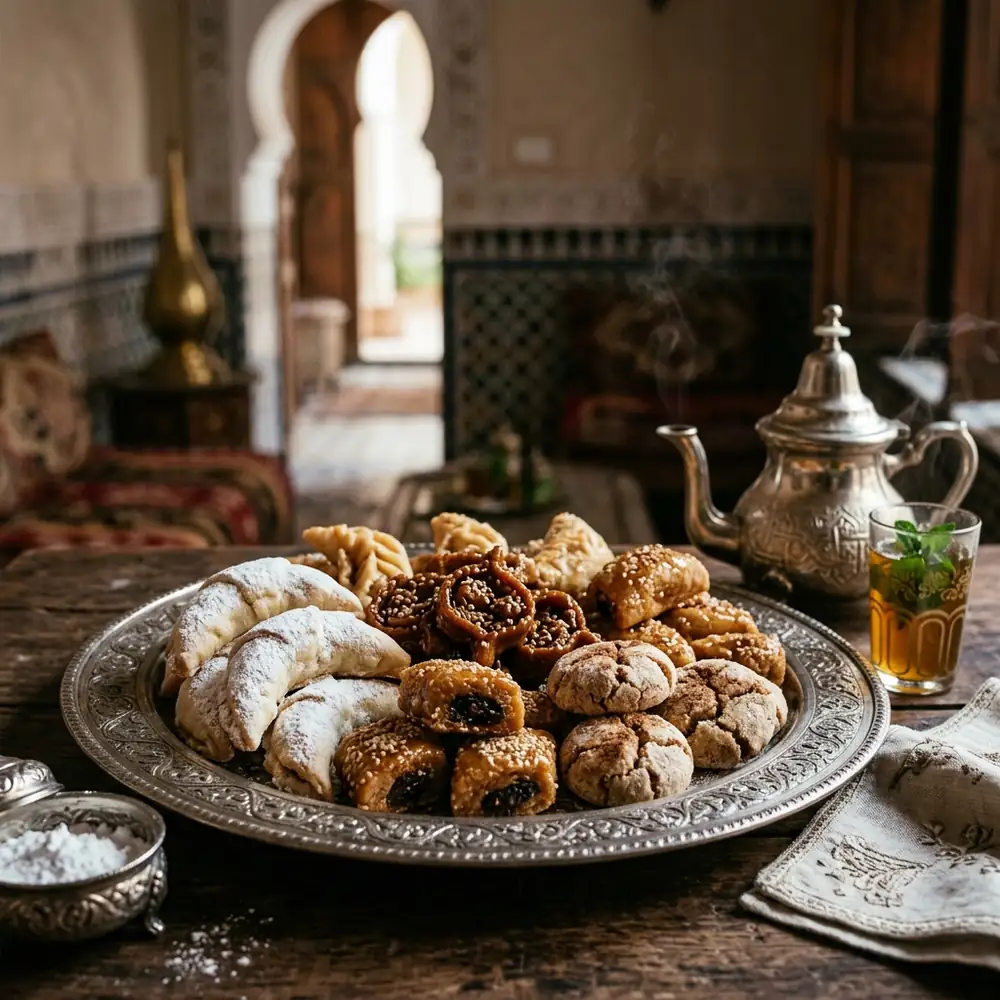
Kaab el-ghzal — "gazelle's ankles" or "gazelle horns," depending on translation — is a crescent-shaped pastry filled with almond paste, with a thin, slightly crisp outer shell of pastry that should break cleanly under pressure and not crumble, and an interior filling that is fragrant with orange blossom water and cinnamon and almond and just enough sugar to balance without overwhelming.
It is associated with Marrakech in the way that Chebakia is associated with Fes — both exist throughout Morocco, but the definitive versions are considered to come from specific cities with specific traditions around them. The Marrakchi kaab el-ghzal uses a higher ratio of almond to sugar in the filling than the versions I have encountered in Casablanca or Rabat, giving it a nuttier, less sweet character that I personally prefer.
The shell pastry is where technique most clearly divides good kaab el-ghzal from mediocre ones. Too thick and the crescent is doughy and heavy. Too thin and it cracks during the shaping before it reaches the oven. The correct thickness — somewhere between one and two millimeters, shaped by hand around the filling — produces a shell that bakes to a very pale gold and shatters slightly when you bite into it, releasing the almond filling in a way that a thicker shell never does.
What Is Sellou and Who Makes It?
Sellou — also called sfouf in some regions — is the most unusual thing in Moroccan pastry because it is not, strictly speaking, a pastry. It is a dense, sweetened paste made from toasted flour, toasted sesame, ground roasted almonds, smen or butter, honey, and cinnamon, mixed together into something that holds its shape when pressed but yields to a spoon. It is served in a bowl and eaten with a small spoon or with bread.
Sellou is specific to Ramadan — it is the energy-dense, shelf-stable food that Moroccan women make in enormous quantities at the start of the fasting month and that keeps for the full thirty days, providing immediate calories at iftar and a sustained energy release through the night eating period. Its composition is essentially engineered for this purpose: the toasted flour provides complex carbohydrates, the almonds provide fat and protein, the honey provides immediate glucose, and the smen provides fat-soluble flavor that mellows the entire mixture into something richer than the sum of its parts.
Making sellou is labor-intensive. The flour must be toasted slowly in a dry pan until it is a deep, even golden brown — this takes forty minutes of constant stirring over low heat and cannot be rushed without burning the outer layer before the interior has colored. The sesame is toasted separately. The almonds are blanched, dried, and roasted. The whole preparation from start to finish takes a full morning, which is why Moroccan women typically make it once at the start of Ramadan in quantities large enough to last, and do not make it again until next year.
The Invisible Invitation
The pastry tray arrives at the table before tea. In Fes it is typically a round silver platter arranged with three or four different pastries in a pattern that is itself a kind of presentation — the kaab el-ghzal in one cluster, the chebakia (if it is Ramadan, or if the family makes it year-round, which some do) in another, a small pyramid of sesame-studded cylindrical pastries in the center, and perhaps some filled briouate at the edge. The tea comes after. The correct order is pastry first, then tea, which cleans the sweetness from your palate and prepares you for more pastry if you want it. Someone will offer more pastry. Say yes at least once.
SEO Meta Description: What are Morocco's traditional pastries? A culinary guide to Chebakia, Kaab el-Ghzal, Sellou, and the regional pastry traditions — techniques, ingredients, and the seasons they belong to.
Experience the true heart of Moroccan heritage through its culinary traditions. Join us in preserving and honoring these ancestral recipes.
What People Are Saying
No comments yet. Be the first — we'd love to hear from you.
Khadija Tahiri
Culturally Verified & Fact-CheckedThe Moroccan Food editorial team brings together native culinary researchers, heritage preservationists, and experienced home cooks across Marrakech, Fes, and Casablanca. Every recipe and cultural guide is reviewed against ancestral oral traditions and authentic regional practices.