Moroccan Pottery: Why Safi and Fes Make Completely Different Things and Both Are Right
Moroccan Pottery: Two Traditions That Look Nothing Like Each Other
The pottery souks in Moroccan cities can be bewildering if you are trying to understand what you are looking at, because the range of styles — from the vivid, geometrically painted pieces of Safi to the fine, blue-and-white work of Fes to the rough, earth-toned functional pieces from Atlas village traditions — suggests either that Moroccan pottery is everything at once, or that there are multiple distinct traditions being sold in the same market context. The second interpretation is correct.
There are genuinely distinct regional pottery traditions in Morocco, each with its own clay sources, its own glaze and decoration vocabulary, its own production methods, and its own historical context. The two most important are the Safi and Fes traditions, and they are different enough that a knowledgeable eye can tell them apart immediately and that the differences tell you something specific about the contexts that produced each.
What Is Safi Pottery and What Defines Its Character?
Safi, the Atlantic coastal city south of Essaouira, has been a center of pottery production for centuries, its workshops organized in the quartier des potiers — the pottery quarter — that sits just outside the medina and has been the city’s principal craft zone since at least the 16th century.
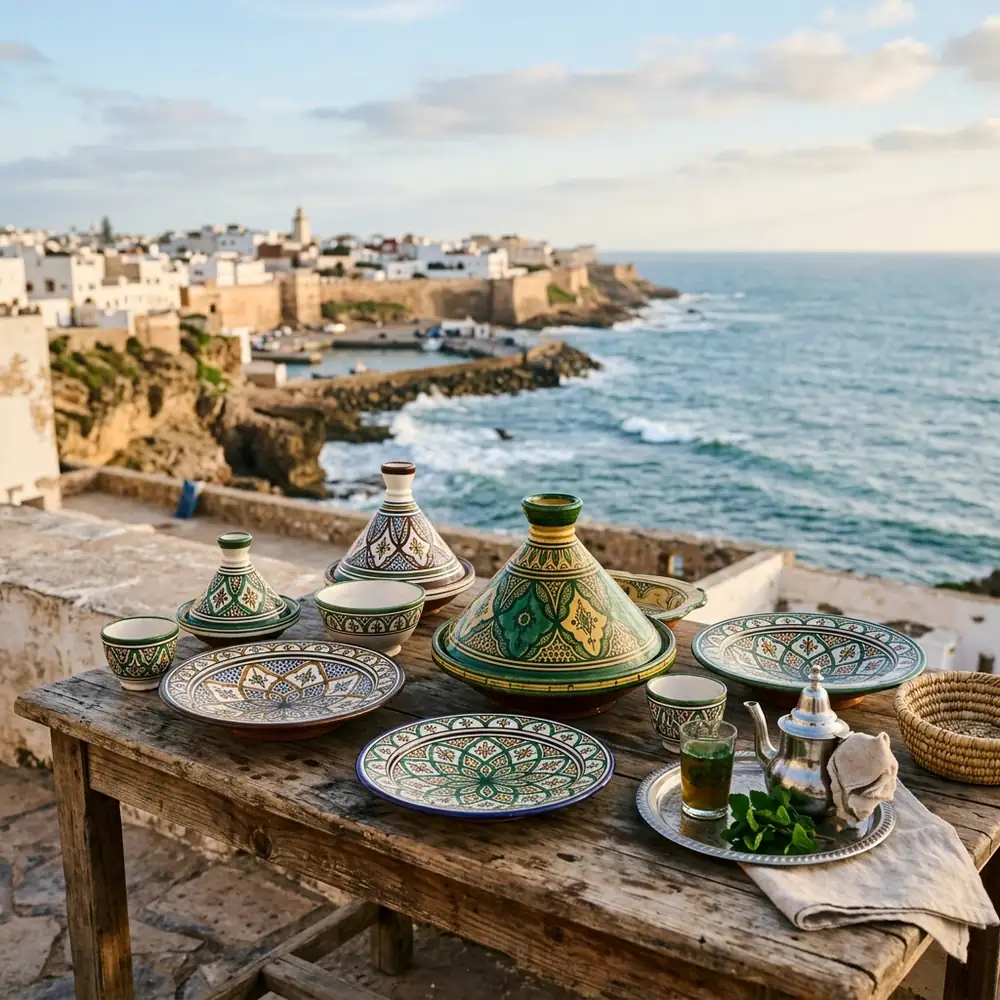
The Safi tradition works with a relatively coarse clay that fires to a terra-cotta base, over which a white tin-glaze slip is applied before painting. The decoration — applied on the unfired white base with metal oxide paints that will fuse with the glaze in the kiln — uses a color palette centered on cobalt blue, copper green, manganese purple, and a warm orange-iron that is specific to this region’s colorant tradition. The designs are bold, relatively large in scale, and typically geometric or floral without the microscopic density of Fes decoration.
The walls of Safi pieces tend to be thicker than Fes pieces — more robust, more practical for the cooking and serving use that much of Safi’s production is designed for. A Safi tagine base, a Safi serving bowl, a Safi platter — all of these are made to be used at the table, to be washed, to survive decades of regular cooking. This functionality is built into their material character.
The firing temperature and kiln type produce a specific glaze quality in Safi work: a tin-glaze with a slightly matte, slightly textured surface rather than the glassy perfection of high-fire ceramics. This surface character is part of the aesthetic — the slight warmth and irregularity of the glaze is the visual fingerprint of the Safi tradition — and pieces that have been machine-produced or industrially glazed to a higher technical standard often look obviously wrong to anyone who knows the genuine article.
What Is Fes Pottery and How Does It Differ?
The Fes pottery tradition works with a much finer, more refined kaolin-rich clay that fires white rather than terra-cotta. The whiteness of the base clay means that the Fes tradition does not need the tin-glaze slip that Safi uses to create a white painting ground — the clay itself provides it. This single material difference produces a cascade of aesthetic consequences.
Because the Fes base clay is finer and fires whiter, the decoration painted on it appears more brilliant and more precisely detailed. The cobalt blue of a Fes piece painted on white clay is more vivid than the same cobalt on a tin-glazed Safi piece. The fine-line painting that is characteristic of the most accomplished Fes pottery — delicate arabesque patterns, fine floral scrollwork, geometric micro-patterns that resolve into larger designs — requires both the white clay base and the skill of painters who have spent years developing fine-line control.
The Fes pieces tend to be thinner-walled and more refined in form than Safi — designed more for display and formal service than for cooking, though cooking vessels are also part of the production. A Fes serving platter with its multi-color floral decoration is a luxury object in a way that a Safi serving bowl, for all its beauty, is not.
The firing in Fes uses wood-burning kilns — still wood-burning in most traditional workshops — which produce temperature fluctuations that are controlled by the kiln master’s experience but that also produce the slight variations in glaze surface and color that distinguish hand-fired Fes pottery from industrially fired imitations. Two pieces from the same Fes workshop, fired in the same kiln load, will have slight color and glaze variations between them. This is not a defect. It is the signature of the process.
What About the Village and Atlas Pottery Traditions?
Beyond the two major urban traditions, there is a range of village pottery practices — particularly in the Rif and Atlas regions — that are produced by women rather than men (the urban traditions are male workshop crafts; the rural traditions are female domestic crafts), use local red or brown clay without white-base treatment, and produce forms designed for domestic functional use: water storage jars, cooking pots, milk vessels.
The Rif and Zerhoun region pottery, produced by Amazigh women using ancient pinch-and-coil techniques rather than the wheel, has geometric painted decoration applied with a manganese-rich natural paint that fires to a dark brown against the red clay. The forms are simple and strong, the decoration bold and geometric. These pieces are increasingly collected as examples of a living folk art tradition that the urban craft markets have largely displaced from functional use, and they deserve to be understood as a third distinct element in Moroccan pottery rather than as a lesser version of the urban traditions.
The Invisible Invitation
In the Safi pottery quarter, the workshops are open and the kilns operate continuously during production periods. You can walk in — not to purchase necessarily, though you will probably purchase something — and watch the process from clay preparation to throwing to painting to loading the kiln. The smell of a working Safi pottery — wet clay, wood fire, the metallic quality of the metal oxide paints — is specific and pleasant. The painters work quickly and without reference to templates, the brush patterns that have been their professional vocabulary since apprenticeship appearing automatically at the speed of a practiced hand. Watch one painter for twenty minutes. Count the strokes. Then look at the finished pattern and try to reconstruct the sequence that produced it. You will not fully reconstruct it. That’s fine. He’s been doing it for fifteen years.
SEO Meta Description: What is Moroccan pottery and how do Safi and Fes traditions differ? Tin glaze vs white clay, bold vs fine decoration, functional vs luxury, and the Atlas village women’s tradition.
Experience the true heart of Moroccan heritage through its culinary traditions. Join us in preserving and honoring these ancestral recipes.
What People Are Saying
No comments yet. Be the first — we'd love to hear from you.
Youssef Amazigh
Culturally Verified & Fact-CheckedThe Moroccan Food editorial team brings together native culinary researchers, heritage preservationists, and experienced home cooks across Marrakech, Fes, and Casablanca. Every recipe and cultural guide is reviewed against ancestral oral traditions and authentic regional practices.