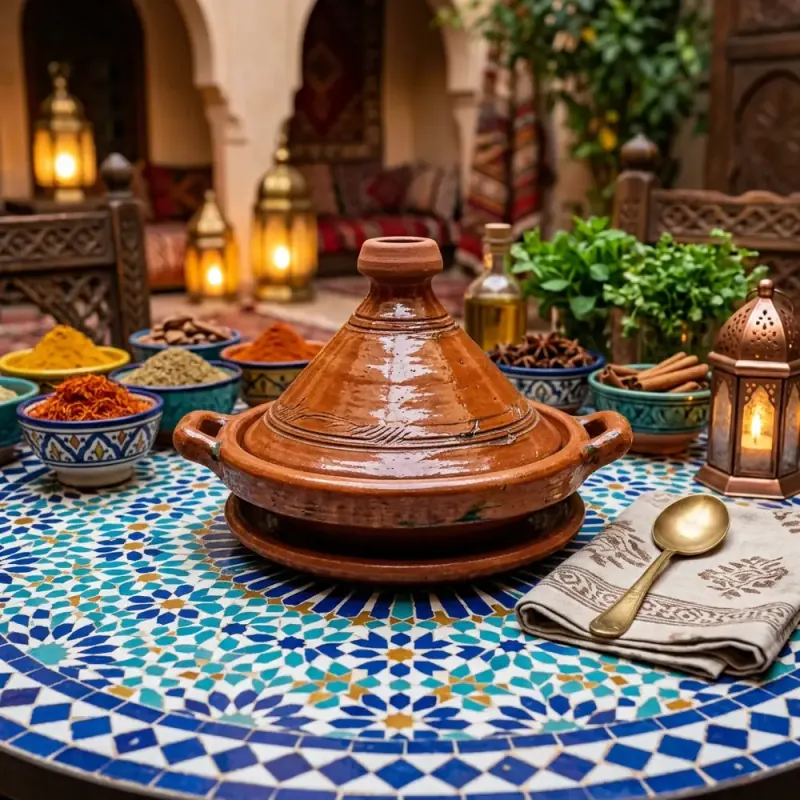
Ras el Hanout: The Moroccan Spice Blend With No Fixed Recipe and Why That Is the Point
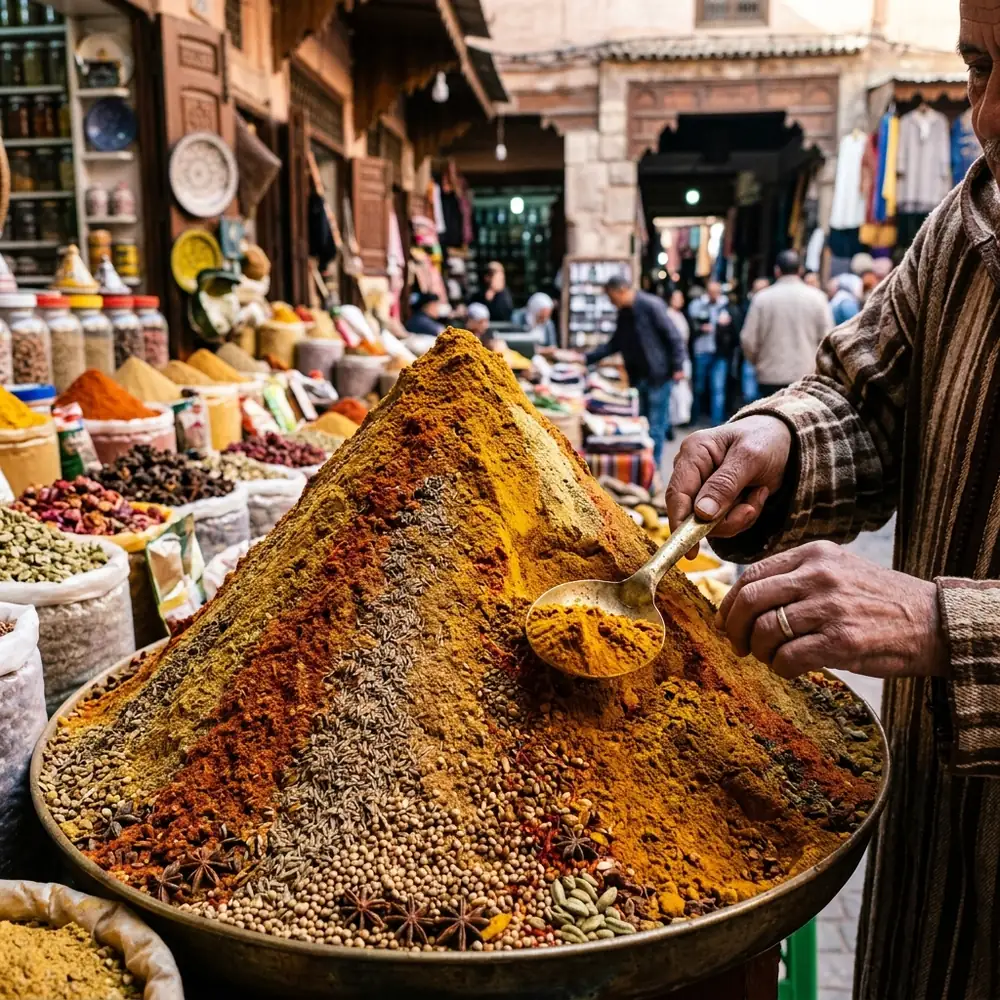
Ras el Hanout: What It Is, Why It Has No Recipe, and How to Recognize a Good One
The name is the explanation: ras el hanout means "head of the shop" — the spice seller's signature blend, the best of what they carry assembled into a single mixture that represents their skill and their stock. Every spice seller's ras el hanout is different, which is why every ras el hanout recipe you find online is an approximation rather than a transcription. There is no original. There are only individual blends, assembled by individual sellers according to their own judgment and their own access to quality ingredients.
This absence of a fixed recipe is not a problem to be solved by standardization. It is the condition that makes ras el hanout what it is. The standardized ras el hanout sold in European and American supermarkets — a fixed blend of perhaps eight to twelve spices, consistent batch after batch — is a useful convenience and a genuine product, but it is not ras el hanout in the way that the Fes or Marrakech spice market version is ras el hanout. The spice market version is the work of a craftsperson who has been developing their specific blend for years and who makes it fresh when you ask. The supermarket version is a product designed for consistency rather than quality. Both are real; they are different things.
What Is Typically in Ras el Hanout and What Does Each Component Do?
The following spices appear in most serious ras el hanout blends, though proportions and some specific inclusions vary:
Cumin: the warm, earthy backbone of most Moroccan spice preparations. In ras el hanout it is one of the more present spices rather than the dominant one, providing foundation that the other spices build on.
Coriander seed: lighter and more citrus-adjacent than cumin, contributing a counterpoint to cumin's earthiness. Together, cumin and coriander form the base of the blend.
Ginger (ground, dried): provides warmth and a slight sharpness. Its presence in Moroccan spice blends reflects the historical Saharan trade routes through which ginger arrived from South Asia.
Cinnamon: sweet, warming, contributing the background note that distinguishes Moroccan spice from Middle Eastern or South Asian spice blends that use the same individual components differently.
Black and white pepper: heat without the direct capsaicin punch of chili, adding complexity to the heat dimension.
Turmeric: color and a slight bitter warmth, contributing the golden hue that ras el hanout imparts to dishes using it.
Cardamom, both green and black varieties: floral and camphorated notes that add the aromatic dimension distinguishing complex ras el hanout from simpler blends.
Mace and nutmeg: warm, slightly sweet, resinous notes. These are the spices that most distinctively separate a serious ras el hanout from a simplified one.
Rose petals (dried): this is the element that most surprises people unfamiliar with the full Moroccan ras el hanout — the inclusion of dried rose petals, which contribute a floral dimension that is entirely unlike the synthetic rose flavoring of European cooking and that is essential to the specific character of Moroccan ras el hanout.
Cubeb pepper, grains of paradise, long pepper: historical spices from the medieval Islamic spice trade that remain in the most complete Moroccan ras el hanout blends but have largely disappeared from European cooking. Their presence or absence distinguishes an old-tradition Moroccan blend from a simplified contemporary one.
Orris root, galangal, rhizome of iris: aromatic roots that provide the specific earthy-floral depth of the most complex blends.
The most elaborate ras el hanout blends contain more than thirty individual ingredients. The simplest usable version might have twelve. Both are valid depending on application.
When Is Ras el Hanout Used and What Does It Do to Food?
Ras el hanout is not a daily-cooking spice in the way that cumin or paprika are daily-cooking spices in Moroccan kitchens. It is a complex blend used in specific preparations that benefit from its complexity — the mrouzia tagine, the seffa couscous topping in some traditions, the spiced lamb preparations of special occasions. Using ras el hanout in a simple weekday tagine would be expensive (a quality blend costs significantly more than its component spices separately) and probably overwhelming — the complexity of the blend needs the complexity of a slow-cooked preparation to resolve into coherence.
What ras el hanout does to a slow-cooked preparation is unify it. A tagine experienced with ras el hanout plus individual additional spices has a different quality from a tagine experienced only with the individual spices in the same quantities — the pre-blending, which allows the volatile aromatic compounds of the different spices to interact before they enter the cooking medium, produces an integrated flavor that post-mixing does not achieve. This is why pre-made blends work in a way that adding the same spices individually does not fully replicate.
How Do You Buy Good Ras el Hanout in Morocco?
In a spice market rather than a supermarket. Ask to smell several blends from different sellers — the variety between sellers' versions is immediately apparent to the nose and will teach you more about ras el hanout in five minutes of comparative smelling than any description can convey.
Ask the seller to grind the blend fresh if possible, or to tell you when the blend was last made. Ras el hanout's volatile aromatic compounds — particularly from the cardamom, rose petals, and cubeb — degrade relatively quickly after grinding, and a blend made three months ago in a sealed container is significantly less aromatic than one made last week.
Tell the seller what you intend to use it for. "Pour mrouzia" or "pour le couscous de fête" will get you a different blend from a knowledgeable seller than a generic request — the traditional blends for specific preparations are calibrated differently, and the spice seller's knowledge of these calibrations is part of what you are buying.
The Invisible Invitation
You are in the Souk des Épices in Marrakech — or the equivalent spice concentration in whatever Moroccan medina you find yourself in. The smell when you enter the souk's lane is overwhelming in the productive sense: a concentrated version of every spice available in Morocco hitting simultaneously, before any individual blend is identified. Walk slowly. Stop at a seller whose display looks well-organized and whose jars are not dusty. Ask to smell the ras el hanout. The seller will open the jar and hold it toward you. Put your nose over the jar — not into it, over it — and breathe in slowly. The first impression is the volatile top notes: the rose petal, the cardamom, something that takes a moment to identify as the cubeb or the galangal if they are present. The second breath is the middle: cumin, coriander, ginger. The third is the base: black pepper, cinnamon, something warm and settled. This is what a good ras el hanout smells like at distance. Take it home. Use it in something slow-cooked. Come back next time for the same seller's newest batch.
SEO Meta Description: What is Moroccan ras el hanout and what's in it? The 12-30 spice blend with no fixed recipe — rose petals, cubeb pepper, galangal explained — when to use it, and how to buy correctly in the spice market.
Experience the true heart of Moroccan heritage through its culinary traditions. Join us in preserving and honoring these ancestral recipes.
What People Are Saying
No comments yet. Be the first — we'd love to hear from you.
Khadija Tahiri
Culturally Verified & Fact-CheckedThe Moroccan Food editorial team brings together native culinary researchers, heritage preservationists, and experienced home cooks across Marrakech, Fes, and Casablanca. Every recipe and cultural guide is reviewed against ancestral oral traditions and authentic regional practices.