How to Shop a Moroccan Souk Like a Local: The Complete Food Market Guide
The first time I walked into the Marrakech spice souk alone — not with a guide, not following a tour group — I got completely turned around within four minutes. I ended up buying a bag of something orange that I could not identify, from a man who spoke no language I spoke, for a price I accepted without understanding whether it was fair. I came out into the sunlight with a kilo of dried rose petals and no idea what had just happened.
That was fifteen years ago. I have been back hundreds of times since, in Marrakech, Fes, Essaouira, Meknes, and a dozen smaller town markets I stumbled into on side roads. Here is everything I wish I had known on day one.
How the Souk Is Actually Organized
Moroccan souks are not random. They look chaotic, especially when you are navigating them for the first time, but they follow a logic that has been in place for centuries. The souk is divided into sections by trade, and once you understand the layout, it becomes as readable as a department store.
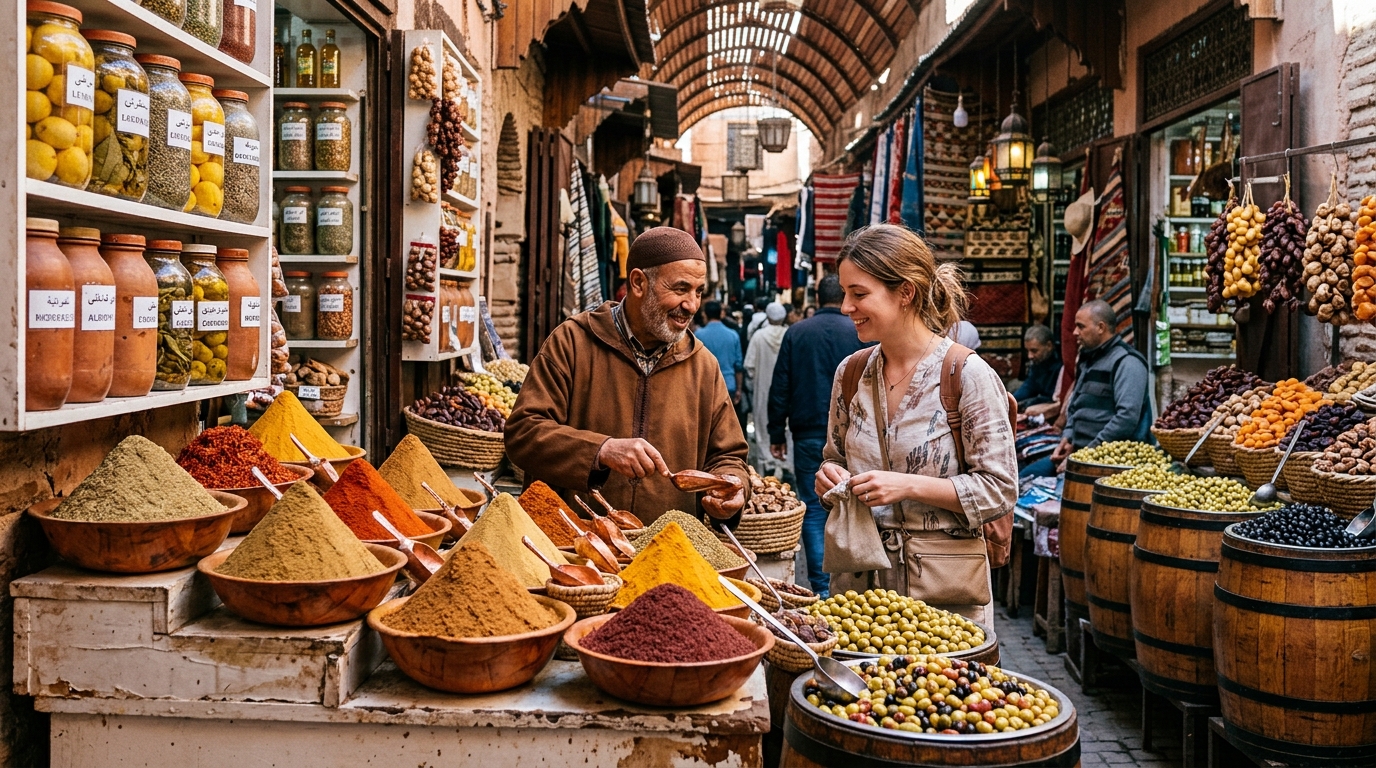
Souk el Attarine is the spice and perfume souk. This is where you buy ras el hanout, dried herbs, orange blossom water, argan oil, and every kind of dried flower, root, and resin that Moroccan cooking relies on. In Fes, the Attarine souk is near the famous Attarine Medersa. In Marrakech, it clusters behind the Djemaa el Fna. The name comes from the Arabic word for perfumers — the original merchants here traded in fragrant goods before food spices became dominant.
The olive souk is one of the great sensory pleasures of any Moroccan market. Enormous earthenware vats and plastic bins hold olives in every variation imaginable: cracked green olives marinated with preserved lemon and harissa, wrinkled black olives cured in salt, large meaty olives in herb oil, tiny olive varieties from specific regions. Moroccan families buy their olives by the kilo, scooped out in front of them. You should do the same.
The meat souk is not for the squeamish and is completely fascinating. Live chickens and freshly slaughtered lamb hang in the same narrow corridor. The butchers work fast and waste almost nothing. If you are buying meat to cook, this is the place — it is fresher than any supermarket by a significant margin. Go in the morning before the heat rises.
The vegetable and fruit souk operates on a different rhythm from the spice section. It is louder, faster, and more crowded. Sellers call out prices in rapid darija. The produce changes by season — in September and October you find the last summer tomatoes alongside the first winter squash, fresh figs and pomegranates, piles of fresh herbs sold by the enormous bunch for almost nothing.
The bread souk is usually tucked near the communal ovens. You can buy khobz, the round Moroccan flatbread, for five dirhams a loaf. Some markets also have sellers of Msemen (layered, griddle-cooked flatbread) and harcha (semolina flatbread), which are eaten at breakfast.
The Single Most Important Rule: You Do Not Bargain for Food
This is not negotiable and it confuses many first-time visitors. In Moroccan markets, food prices are fixed. You do not bargain for spices, olives, bread, meat, fruit, or vegetables. These are staple goods sold at community prices, and trying to negotiate them is considered disrespectful — the equivalent of haggling at a supermarket checkout.
Bargaining is for crafts: leather goods, ceramics, metalwork, rugs, clothing. In those sections of the souk, negotiating is fully expected and is part of the transaction. But the moment you are buying something that a Moroccan family eats — apply the fixed price.
Knowing this removes enormous stress from the shopping experience. You can focus on the food itself rather than worrying about being overcharged, because the prices you see are the same prices the woman buying her weekly olives is paying.
What to Buy and What to Skip
Buy: Preserved Lemons (Hamad M’rakad) Moroccan preserved lemons are one of those ingredients that seem replaceable until you taste the real thing. They are packed in salt and left to ferment for weeks, sometimes months, until the peel softens completely and the bitterness transforms into something floral and complex. Buy them loose from market jars rather than sealed glass jars from tourist shops — the texture is better and the price is a fraction of the boutique version.
Buy: Real Argan Oil Argan oil comes in two forms: roasted (for cooking and dipping) and unroasted (for cosmetic use). In a souk, you are most likely looking for the culinary version. It has a deep, toasty, nutty flavor that is extraordinary on couscous or drizzled over amlou (almond-argan-honey paste). A half-liter of genuine culinary argan oil costs around 100 to 150 dirhams from a market seller. If someone is offering it significantly cheaper, it is almost certainly diluted.
Buy: Ras el Hanout — But Ask What Is In It Ras el hanout is not a single recipe. Every spice merchant blends it differently, and the number of spices can range from twelve to over forty. Ask the seller what the dominant spices are. A good ras el hanout for cooking should have warm, rounded complexity — ginger, cinnamon, coriander, cumin, allspice, sometimes turmeric and black pepper. Be cautious about blends that smell mostly of cheap paprika, which is a sign of cutting corners.
Buy: Saffron from Taliouine Morocco is the world’s second-largest saffron producer, and the saffron from the Taliouine region of the Souss-Massa mountains is exceptional. The challenge is that saffron is also the world’s most frequently faked spice. In Moroccan markets, you will encounter dyed corn silk, safflower petals, and turmeric powder all being sold as “saffron.” Here is how to spot the genuine article:
Real saffron threads are a deep burgundy-red color with slightly orange tips. They have a subtle, distinctive metallic-floral smell — almost like honey and hay. When you steep a few threads in warm water, the water turns a golden-yellow slowly, over several minutes. Fake saffron bleeds color almost immediately, in an unnaturally bright orange-red.
Real saffron is expensive. One gram costs between 30 and 60 dirhams at a reputable market stall. If someone is selling it for ten dirhams a gram, you are not holding saffron.
Buy: Dried Herbs in Bulk The dried herb selection in Moroccan souks is genuinely excellent and ridiculously cheap by any comparison. Dried wild thyme (zaatar), dried sage, dried rose petals, and dried lavender all keep well and are legitimately useful in cooking. Buy small quantities of several things rather than large quantities of one.
Skip: Anything in a Pretty Tin or Box Near a Tourist Attraction The spice shops that face directly onto the main tourist trails — right outside Jemaa el Fna, directly beneath the Bab Bou Jeloud gate in Fes — are designed for one transaction. The packaging is attractive, the English is perfect, and the prices are three to five times what you would pay twenty meters further into the souk. This is not a scam exactly. But it is not the real market experience either.
The Etiquette of Tasting
At olive stalls and dried fruit stalls, tasting before buying is completely normal and expected. Sellers will offer you olives on a small piece of bread, or a date, or a dried fig, without any obligation to buy. This is how they sell. Take the taste, thank them genuinely (shukran), and either buy or move on without awkwardness. There is no social debt incurred by tasting.
At spice stalls, sellers will often grind a small amount of a spice and hold it to your nose. This is a sensory sales technique but also a genuine invitation to engage. Smell everything. Ask questions. The conversation you have at a spice stall, even across a language barrier, is one of the more memorable parts of the souk experience.
The Best Markets by City
Marrakech: The food souks behind and around Jemaa el Fna are the most tourist-trafficked in Morocco, but the Mellah market — the old Jewish quarter market near Place des Ferblantiers — is where Marrakchi families actually shop. It has a covered section with excellent olive and preserved lemon vendors, and a produce section that spills into the surrounding streets.
Fes: The Rcif market, in the low-lying part of the medina, is the main food market and one of the most atmospheric in the country. Early morning is best. The Ain Azliten olive souk, specifically, is worth finding — tiny stalls with more olive varieties than most people have ever seen in one place.
Essaouira: Smaller and slower-paced than Marrakech or Fes. The fish market near the port is the main event — fresh Atlantic catch every morning. There is also a small spice section near the mellah that has excellent goat’s butter and preserved lemon.
What to Pack Your Purchases In
Bring your own cloth bag or a lightweight tote. Many souk vendors use thin plastic bags, which handle olive oil and loose spices poorly. If you are buying argan oil, put it in your checked luggage rather than carry-on to avoid airport security complications. Preserved lemons travel exceptionally well. Saffron, packaged carefully in its paper envelope and placed inside a small sealed bag, makes the journey without issue.
FAQ
Is it safe to eat food samples at souk stalls? Yes, generally. Dried goods like dates, olives, and spices carry very low risk. Use the same judgment you would anywhere: if a stall looks clean and has good turnover, the food is fine. Avoid freshly cut fruit from stalls without refrigeration in hot midday temperatures.
What should I do if a souk guide insists on taking me somewhere specific? Politely decline. Many unsolicited “guides” in medinas earn commission by bringing tourists to specific shops. If you want a guide, hire one through your riad or hotel, or use a licensed guide from the local tourist office.
Can I bring Moroccan food products back to my home country? Dried spices, argan oil, and preserved lemons in sealed jars travel well internationally. Check your country’s customs rules, but generally dried plant products are permitted. Fresh meat and some fresh produce is restricted in many countries.
How do I know if I am in the real market or the tourist section? A reliable signal: if the menu boards or price signs are in English and French only, you are in the tourist section. If they are in Arabic or darija only, or the prices are handwritten on a chalkboard, you are in the working market.
Experience the true heart of Moroccan heritage through its traditions. Join us in preserving these ancestral rituals.
What People Are Saying
No comments yet. Be the first — we'd love to hear from you.
The Moroccan Food
A Moroccan cultural writer dedicated to documenting the authentic voice, history, and heritage of the Kingdom. Writing from within — to share what truly makes Morocco extraordinary.
Our Mission →