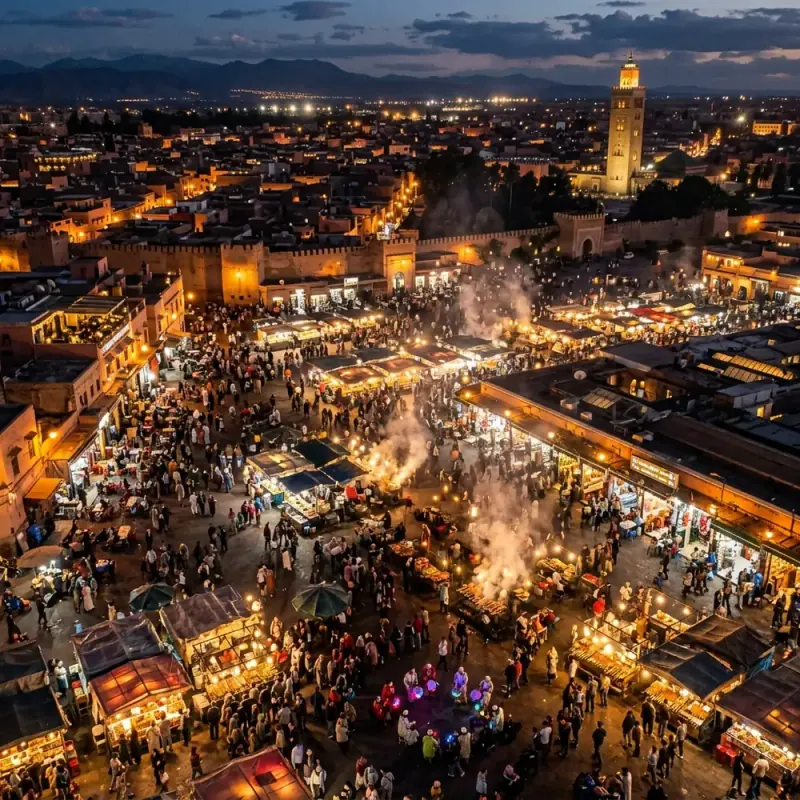
How to Navigate a Moroccan Souk Without Getting Lost, Overcharged, or Overwhelmed
The Moroccan Souk: An Honest Guide for People Who Have Already Been Disappointed Once
Most of what I've read online about navigating a Moroccan souk falls into one of two camps. The first is enthusiastic and useless: "just wander and discover!" No. This advice, followed literally, will result in you paying three hundred dirhams for a keychain and not knowing how you got there. The second is defensive and paranoid: exhaustive lists of scams, warnings about fake guides, detailed instructions for detecting dishonest merchants. This advice, followed literally, will result in you spending your time in a place of genuine beauty and historic significance in a state of low-grade suspicion that prevents you from enjoying any of it.
I want to try something different: honest context. Because the souk operates on principles that, once understood, make the whole experience significantly more navigable and considerably more enjoyable. The problem is not that the souk is inherently adversarial. The problem is that most visitors arrive without a framework and have to improvise their understanding in real time while simultaneously trying not to buy a third carpet.
What Is the Souk's Internal Organization and Why Does It Matter?
Medieval Moroccan souks — and the souks of Fes, Marrakech, and Tetouan still largely follow this organization — are arranged by trade. Not by product category in the modern retail sense, but by specific craft and commercial activity: one alley for the leather tanners, another for the coppersmiths, another for the weavers, another for the spice merchants, another for the woodworkers. The souk el-attarine (spice market), the souk el-cherratine (leather workers), the souk el-haddadine (blacksmiths) — the names indicate the trade and the location simultaneously.
This arrangement is not historical accident. It is a deliberate organizational system with legal, commercial, and quality-control functions. When all the spice merchants are in one place, buyers can compare prices and quality directly without traveling across the city. When the blacksmiths are in their alley, the noise and fire of their work is contained in one area. When the leather workers are near the tanneries, the smell — which is considerable — is similarly contained. The system serves everyone.
For the visitor, understanding this means that getting "lost" in a souk is partially misunderstood. You are not lost in a random maze. You are moving between defined zones. If you walk long enough in one direction in the Fes medina, the smell changes — from spice to leather to food to wood — and you always know roughly where you are by what you're smelling and hearing. The disorientation is real but it is navigable once you have this framework.
How Does Bargaining Actually Work and When Is It Appropriate?
Here is the honest answer: bargaining is appropriate in the souks for craft goods, clothing, carpets, decorative objects, and most artisanal products. It is not appropriate for food staples (bread, vegetables, spices sold by weight), for services (guide fees should be agreed in advance), or in fixed-price shops (which exist in Morocco and which display prices clearly).
The initial asking price in a traditional souk negotiation is not a lie or a trick. It is a known opening position in a recognized dialogue. Both parties know this. The merchant expects negotiation. A customer who pays the first price without responding is either a tourist who doesn't know the system (fine — merchants are human and will occasionally feel guilty about this, though not always) or someone for whom the price is genuinely not important. Neither is an insult. But paying first price consistently in a souk means you are leaving significant money on the table compared to what the same item costs a local buyer.
The standard functional approach: respond to the first price with approximately 40-50% of it. This is not an insult. It is the expected opening counter. The merchant will respond. You negotiate toward a middle point that is roughly fair for both parties. In my experience, the fair price for a genuinely handmade artisanal object in a Moroccan souk is typically somewhere between 50% and 70% of the first asking price, depending on the merchant, the object, and the season. Mass-produced tourist items with very high initial asking prices sometimes settle closer to 30%.
A few things that actually help: knowing roughly what the item costs (research before you go into a specific market category), being genuinely willing to walk away (the willingness to leave is the only real leverage a buyer has), and being pleasant throughout. Moroccan commercial culture is relational. Merchants remember faces. A pleasant negotiation, even one where neither party gets quite what they wanted, creates goodwill that manifests in better prices and better treatment on subsequent visits to the same stall.
What Are the Kinds of People You Will Meet and How Do You Interact With Them?
The unsolicited guide is the most discussed figure in any tourist account of a Moroccan medina. He — almost always male, often young, often dressed casually rather than formally — attaches himself to you in a narrow alley and offers to show you the way, or says something has changed in the medina and you need him as a guide, or simply begins walking in your direction while talking. He expects payment. The interaction is not illegal and it is not necessarily dishonest — some of these men genuinely know the medina and provide useful guidance — but it is also not freely offered help.
The most functional response is direct: "Thank you, I'm fine" and then continuing walking. If he persists, "No thank you" again without engaging further with the conversation. Engaging with the conversation — explaining that you know where you're going, or asking what he wants in return, or getting into any kind of exchange — is how people end up on a two-hour guided tour of carpet shops. The exit from that situation is uncomfortable for everyone.
The genuine shopkeeper who invites you in for tea is a different proposition. This practice — the offer of mint tea as an opening to conversation and potentially to commerce — is real Moroccan hospitality and also, simultaneously, a sales technique. Both things are true at once, and the discomfort that produces in visitors raised to believe that hospitality and commerce should not mix is a cultural rather than a moral discomfort. You are not obligated to buy anything by accepting tea. You are not being dishonest by drinking the tea and then not buying the carpet. You are participating in the acknowledged opening of a transaction that you then decline. This happens constantly in every souk in Morocco. Everyone understands the rules.
The Invisible Invitation
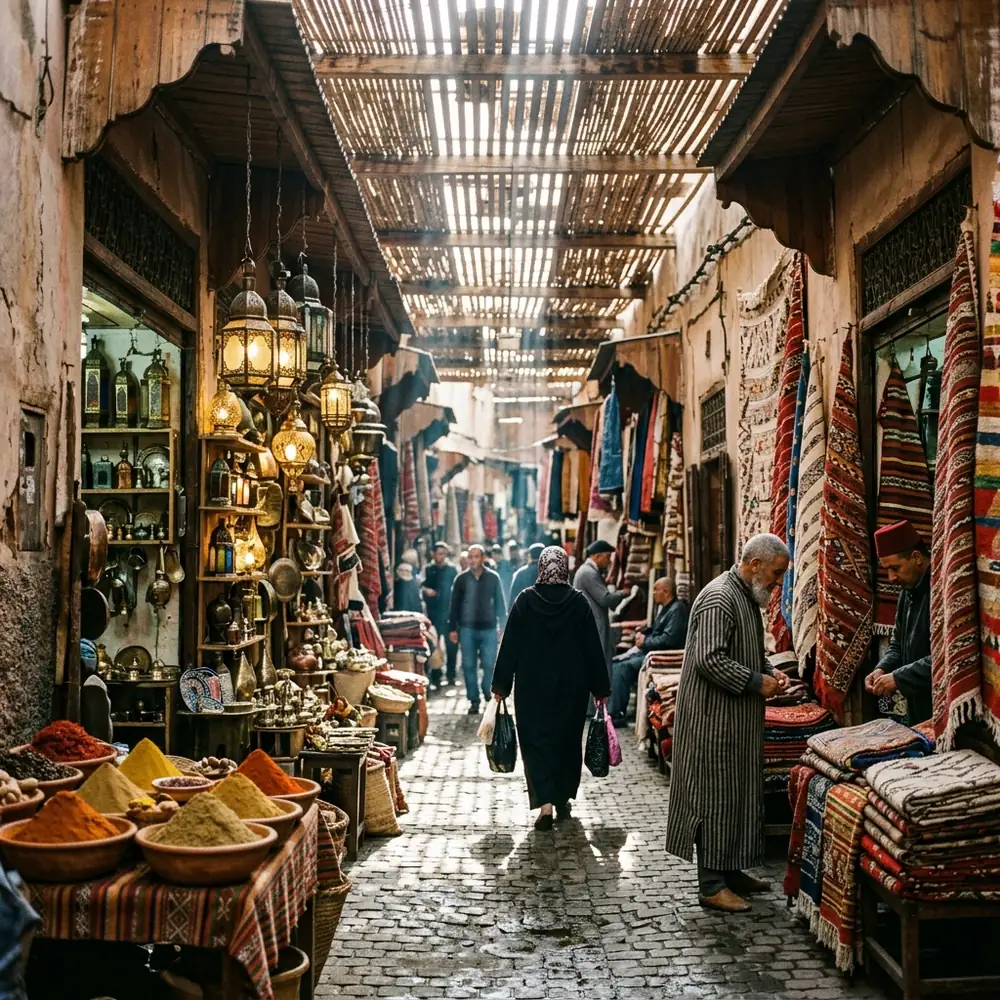
Go at nine in the morning on a weekday before the tour groups arrive. The souk belongs to itself at this hour — the merchants are arranging their goods, the craftsmen are settling into their work, the light through the latticed roofs of the covered sections is gold and slanted and specific to this hour in a way that it isn't at any other time of day. Nobody needs anything from you yet. Sit at a café at the edge of the market with a coffee and watch the alley fill slowly with the morning. You are not lost. You are early. This is the correct approach.
SEO Meta Description: How to navigate a Moroccan souk honestly? A local guide to medina organization, bargaining rules, unsolicited guides, and the cultural logic behind the tea-and-carpet invitation.
Experience the true heart of Moroccan heritage through its culinary traditions. Join us in preserving and honoring these ancestral recipes.
What People Are Saying
No comments yet. Be the first — we'd love to hear from you.
Youssef Amazigh
Culturally Verified & Fact-CheckedThe Moroccan Food editorial team brings together native culinary researchers, heritage preservationists, and experienced home cooks across Marrakech, Fes, and Casablanca. Every recipe and cultural guide is reviewed against ancestral oral traditions and authentic regional practices.