How to Negotiate in a Moroccan Souk: The Darija Phrases That Will Earn You Respect (and Better Prices)
How to Negotiate in a Moroccan Souk: The Darija Phrases That Will Earn You Respect (and Better Prices)
The most common travel advice about Moroccan souks is: “Always bargain! The first price is never the real price!”
This is true. And also completely insufficient as preparation.
Because bargaining in a Moroccan souk is not just about price. It is a social ritual with its own pacing, etiquette, and emotional logic. Getting it right means understanding the whole exchange — not just the numbers.
First: What Bargaining Is Actually About
The souk vendor who quotes you 800 dirhams for a leather bag that might “really” sell for 250 is not trying to deceive you in the way that feels morally straightforward to a tourist.
He is opening a negotiation according to a set of social conventions that are understood by both parties — or should be. The high opening price is an invitation, not a fraud. Your counter-offer is expected. The back-and-forth is the point.
What breaks the social contract:
- Engaging seriously and then walking away without buying or politely concluding. If you sit down, drink tea, and negotiate for 40 minutes, you have implicitly committed to buying if a price agreeable to both sides is reached.
- Aggressive or disrespectful haggling. Negotiation is a conversation, not a battle. Tone matters enormously.
- Making an insulting counter-offer. If someone says 500 MAD and you say 20, you have communicated that you think either the product is worthless or the vendor is an idiot. Neither starts well.
The right frame: think of it as a conversation about value, conducted with mutual respect, where both parties are trying to reach an agreement that feels fair to each of them.
The Practical Mechanics: How Price Movement Works
In most Moroccan souks, the unwritten negotiation range works approximately like this:
- Opening price: Often 2–4x what the vendor expects to actually receive
- Acceptable final price: Typically 40–65% below the opening price for tourist-oriented goods
- Absolute floor: What the vendor paid for the item plus a margin — this is a real number and vendors genuinely do not sell below it
A reasonable opening counter-offer: 50–60% below the asking price, stated warmly and without aggression.
Example:
- Vendor opens at 800 MAD for a leather bag
- You counter with 350 MAD
- He counters with 650 MAD
- You counter with 450 MAD
- He says 550 MAD, “for you, special price”
- You say 480 MAD
- He meets at 500 MAD
- Done
This is not an exact formula. But the rhythm is roughly right.
The Darija Phrases That Change Everything
Making any attempt to speak Moroccan Arabic (Darija) in the souk does two things: it signals genuine interest in Morocco as a culture, not just as a shopping destination, and it creates an immediate human connection that almost always shifts the negotiation atmosphere.
You do not need to be fluent. Even a few phrases deployed correctly will be met with warmth.
Greetings and Basic Connection
“As-salamu alaykum” — The universal Islamic greeting. Always appropriate when entering a shop. Response: “Wa alaykum as-salam.”
“Labas?” — Darija for “Are you well?” / “How are you?” Response: “Labas, al-hamdulillah” (Fine, praise God).
“Mnin nta?” / “Mnin nti?” — “Where are you from?” (masculine/feminine). Often vendors ask this; turning it back on them creates rapport.
During Negotiation
“Bshal hada?” — “How much is this?” (essential opening)
“Ghali bzaf” — “That’s very expensive.” Said with a smile, not accusatorially.
“Makayinsh imkania?” — “Is there no possibility?” A gentle way to ask for flexibility.
“Ana mashi touris” — “I’m not a tourist.” Usually said with a grin. Vendors will laugh. It immediately establishes that you understand the game.
“Safi, khalli” — “Okay, leave it” / “I’ll pass.” Said while beginning to turn away — a classic negotiation move signalling you might walk.
“Allah yjib” — “God will provide” — a polite way to decline a price that does not work for you.
“Wakha” — “Okay / alright / deal.” The closing word. When both sides say wakha, you have an agreement.
For Appreciation
“Zwina bzaf” — “Very beautiful.” Complimenting the craftsmanship before negotiating creates goodwill.
“Shokran bzaf” — “Thank you very much.” Use liberally.
“Bslama” — “Goodbye” (literally “go in peace”). Always use this when leaving a shop, whether you bought anything or not.
The Tea Trap (and Why It Is Not Really a Trap)
You have almost certainly been warned about accepting mint tea in a souk shop. The advice is usually: “If you accept tea, you are obligated to buy.”
This is overstated. Tea in a Moroccan shop is hospitality, not a binding contract. However, accepting tea does signal that you are a genuine potential buyer rather than a casual browser, and vendors will invest more time in you accordingly.
If someone offers tea and you genuinely have no intention of buying anything: politely decline and explain you are just looking (“Ana ghir katferraj”). This is entirely acceptable.
If you accept tea and then decide not to buy: simply express appreciation for the hospitality and leave gracefully. It might be mildly awkward. It is not a moral failing.
Fixed Price vs Negotiable: How to Tell the Difference
Not everything in Morocco is negotiable. This surprises some people.
Generally fixed price:
- Restaurants
- Supermarkets and large shops
- Pharmacies
- Formal boutiques in the modern city quarter (Gueliz in Marrakech, for example)
- Many craft cooperatives (especially women’s cooperatives) where fair trade pricing is the model
Generally negotiable:
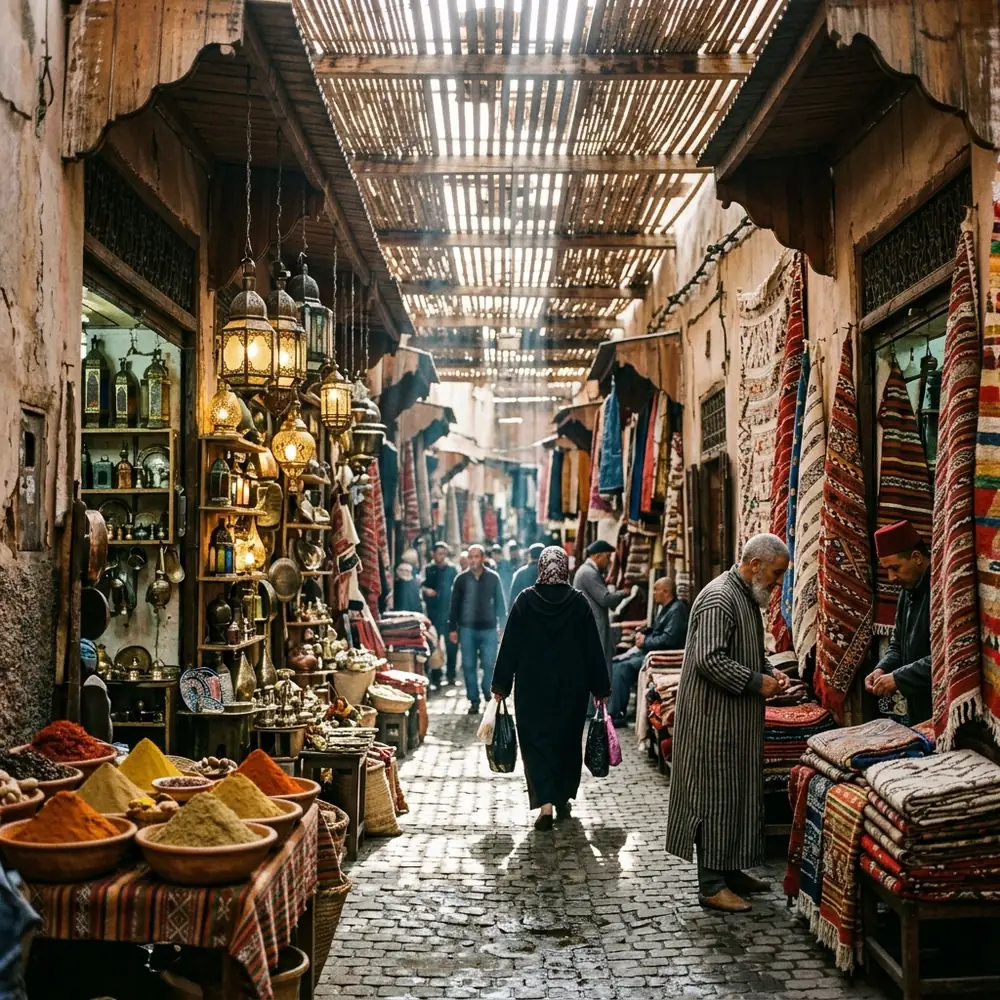
- Most souk stalls and independent merchants in the medina
- Carpets and textiles anywhere
- Leather goods
- Ceramics (partly — some workshops have listed prices)
- Spices (less negotiation here — prices are relatively standardised, but asking does not hurt)
- Grand taxi fares (always)
- Some argan oil sellers (though cooperative prices are usually fixed)
A Note on Carpets: The Special Case
Moroccan carpets deserve their own moment because the carpet-buying experience is its own genre.
If a carpet merchant invites you to sit, tea will appear, carpets will be unrolled, and a significant social and commercial performance will unfold. This can be genuinely enjoyable if you go in knowing:
- The prices quoted for carpets are often 4–6x the final price, not 2x
- You have to be genuinely willing to walk away — several times if necessary
- The “my friend gives you special price” formulation is standard, not a personal favour
- A good Moroccan carpet is worth paying a fair price for — do not be so focused on winning the negotiation that you miss the fact that you are looking at something genuinely beautiful
Frequently Asked Questions
Is bargaining appropriate everywhere in Morocco? No. In restaurants, pharmacies, supermarkets, and formal shops in the modern city areas, prices are fixed. In medina souks and for transport (grand taxis, some petit taxis), negotiation is expected.
What should I do if a vendor becomes aggressive or follows me? A firm, polite “La shokran” (No, thank you) repeated calmly and while walking away is the correct response. Do not engage further. Engaging — even to argue — prolongs the interaction.
How do I know if I paid a fair price? You paid a fair price if both you and the vendor agreed and neither felt coerced. There is no single “correct” price for souk goods. The same item will sell for 200 MAD to one person and 400 MAD to another on the same day.
What is the best attitude to bring to souk shopping? Curiosity, patience, and genuine interest in the craft and the person selling it. The best souk experiences come from treating it as a cultural encounter first and a shopping errand second.
Experience the true heart of Moroccan heritage through its culinary traditions. Join us in preserving and honoring these ancestral recipes.
What People Are Saying
No comments yet. Be the first — we'd love to hear from you.
The Moroccan Editorial Team
Culturally Verified & Fact-CheckedThe Moroccan Food editorial team brings together native culinary researchers, heritage preservationists, and experienced home cooks across Marrakech, Fes, and Casablanca. Every recipe and cultural guide is reviewed against ancestral oral traditions and authentic regional practices.