Medina After Dark: The Crispy Golden Sfenj, Clay-Pot Raïb Beldi, and Winter Street Secrets
Medina After Dark: The Crispy Golden Sfenj, Clay-Pot Raïb Beldi, and Winter Street Secrets
Slug: moroccan-street-comfort-sfenj-raib-winter-medina-treats
Category: Food & Cuisine
Excerpt: When the evening air turns crisp in the alleys of Fez and Rabat: airy, oil-bubbling sfenj doughnuts strung on palm fronds, cool earthenware bowls of wild-cardoon curdled Raïb, and roasted mountain chickpeas.
Step with me into the labyrinth after the sun dips behind the minarets of the Koutoubia and the centuries-old mudbrick ramparts of Fez el-Bali.
As the dusk call to prayer fades into the indigo sky, a cool, mountain-fed mist descends through the narrow alleyways. The midday tourists have retreated to their riads, the wooden shutters of the textile merchants are clattering shut, and suddenly, the true soul of the medina awakens.
Listen closely: you will hear the rhythmic slap-slap of wet dough on a wooden board, the violent hiss of bubbling oil in massive cast-iron cauldrons, the metallic clatter of brass ladles against steaming copper pots, and the calling of street masters whose families have fed night wanderers for three hundred years.
In Morocco, when the winter chill sets into the stone, the street is not a place of rushed fast food—it is an open-air sanctuary of warmth, artisan mastery, and ancestral comfort. From the airy, crackling rings of Sfenj strung on wild palm fronds to the velvety, cardoon-blessed earthenware pots of Raïb Beldi, let me guide you through the secret nocturnal kitchen of our kingdom.
1. The Alchemy of the Maâlem Sfenji: The Master of Fire and High Hydration
To call a Moroccan Sfenj (plural: Sfenjat) a "doughnut" is to commit a grave linguistic injustice. A Western doughnut is cake-like, sweet, and heavy with fat. A true Moroccan Sfenj is an airy, blistered, sourdough miracle—a ring of hot, crispy glass on the outside, sheltering an interior that is as light and webbed as a sea sponge (Sfenj takes its name directly from the Arabic word for sponge, Isfenj).
ANATOMY OF A MASTER SFENJBlistered, Glass-Crisp Crust . - ~ ~ ~ - . . ' ' . / O O O O O O O O \ <── Large Starch : O O : Alveoli (Air Pockets) : O HOLE FORMED O : \ O MID-AIR O / . ' O O O O O O O ' . ' - ~ ~ ~ - ' Chewy, Custardy Sourdough Webbing
The Physics of 85% Hydration
The magic of the Sfenj begins long before it touches the oil. In a tiny, soot-blackened stall dominated by a roaring burner, the Maâlem Sfenji works with a dough that would terrify a modern baker.
This dough is made simply of soft white flour, a touch of semolina, water, sea salt, and a pinch of fermented sourdough starter (Khmira Beldiya). But its hydration is astronomical—often exceeding 85% to 90% water-to-flour ratio. The dough is not kneaded in the conventional sense; it is vigorously slapped, whipped against the sides of a deep earthenware bowl, and pulled upward to incorporate massive pockets of ambient air, creating an ultra-extensible gluten matrix.
┌─────────────────────────────────────────────────────────────┐
│                 THE SFENJI'S DUAL-ZONE VAT                  │
├──────────────────────────────┬──────────────────────────────┤
│ 1. THE SHALLOW TILT (WARM)   │ 2. THE DEEP POOL (SCORCHING) │
├──────────────────────────────┼──────────────────────────────┤
│ Temperature: ~150°C (300°F)  │ Temperature: ~190°C (375°F)  │
│ Dough rests on shallow edge  │ Dough is shoved into the     │
│ Steam expands air pockets    │ bubbling center              │
│ Dough rises into puffy crown │ Crust blisters into shatter- │
│                              │ ing golden glass             │
└──────────────────────────────┴──────────────────────────────┘
The Two-Stage Fry
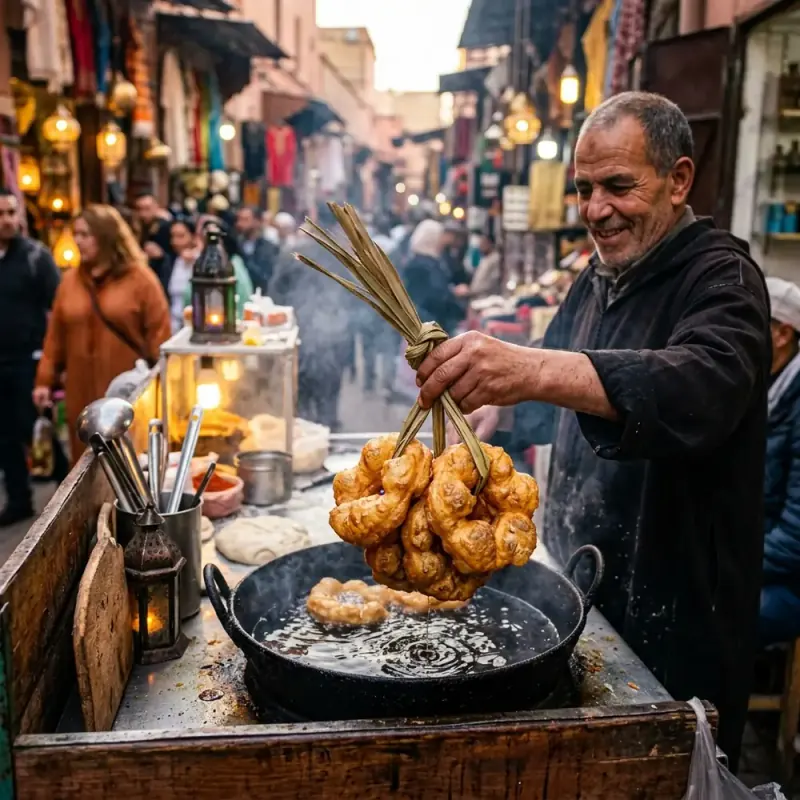
Watch the Maâlem’s hands. He dips his fingers in cold water to keep the sticky batter from clinging to his skin, tears off a fist-sized ball of wet dough, and with a flick of his thumbs, spins a hole right through the center in mid-air.
He drops the ring into the Maqla—a specialized, tilted cast-iron cauldron containing two distinct heat zones:
- The Gentle Rise: The dough first lands in a shallow, moderately hot pool of oil along the raised lip of the pan. Here, the water inside instantly vaporizes into steam, expanding the gluten webbing into hundreds of cavernous bubbles without burning the exterior.
- The Golden Crisp: Once the ring has puffed into a buoyant cloud, the Maâlem uses a long metal rod (Mikhraz) to nudge it into the deep, scorching center of the vat. The exterior caramelizes in seconds, developing thousands of tiny, crunchy blisters that shatter between your teeth.
       [Raw Wet Dough] ──> [Two-Finger Mid-Air Spin]
                                  │
                                  ▼
      [Shallow Warm Pan Lip] ──(Steam Expansion)──> [Puffy Ring]
                                  │
                                  ▼
      [Deep Hot Oil Core] ────(Flash Frying)─────> [Crispy Gold Sfenj]
                                  │
                                  ▼
      [Threaded on Wild Palm Fronds (Doum)] ─────> [Steaming To Go]
The Palm Frond Ritual (Doum)
When you buy half a dozen steaming Sfenjat to take home on a freezing evening, the Sfenji does not hand them to you in a plastic bag—plastic would trap the steam and destroy that magnificent crispy crust.
Instead, he takes a slender, fresh split frond of the wild dwarf palm (Doum), strings the smoking doughnuts through their center holes like golden beads on a necklace, knots the top into a loop, and hands you a fragrant, crackling wreath. You walk through the chilly medina holding this warm garland, tearing off pieces that burn your fingertips with joy.
2. Raïb Beldi: The Earthenware Miracle and the Wild Cardoon Flower
At the complete opposite end of the sensory spectrum from the sizzling oil of the Sfenji lies the Mahbata—the serene, tile-lined dairy shop where rows of terracotta pots rest under glass counters.
This is the home of Raïb Beldi, Morocco’s ancestral clabbered milk custard.
THE RAÏB BELDI POT (ZLAFA)Smooth Glaze Lip ┌─────────────────┐ │ . - ~ ~ ~ - . │ <── Pure Unskimmed Cow Milk │ : VELVETY : │ │ : SET CURD : │ <── Cleaved by Cardosin Enzymes │ . - ~ ~ ~ - . │ (From Wild Cardoon) │ │ │ UNGLAZED │ <── Porous Terracotta │ TERRACOTTA │ Cools via Evaporation └─────────────────┘
The Botanical Secret: Wild Cardoon Rennet (Nawara del Kharchof)
If you taste authentic Raïb Beldi in the countryside of the Chaouia region or in the medina of Meknes, you will immediately notice that it tastes nothing like yogurt. It has zero sour sharpness or yogurt acidity; it is delicately sweet, floral, trembling like a panna cotta, and rich with the grass-fed cream of local cows.
Its secret is botanical. For hundreds of years before commercial microbial rennet existed, Moroccan country women curdled their evening milk using the dried purple flowers of the wild artichoke and cardoon (Cynara cardunculus), known locally as Chouk el-Hemir or Nawara del Kharchof.
┌─────────────────────────────────────────────────────────────┐
│                 THE BIOCHEMISTRY OF RAÏB                   │
├──────────────────────────────┬──────────────────────────────┤
│ COMMERCIAL YOGURT            │ TRADITIONAL RAÏB BELDI       │
├──────────────────────────────┼──────────────────────────────┤
│ Bacterial Acid Fermentation  │ Enzymatic Cleavage (Cardosin)│
│ High Lactic Acid (Sour/Tart) │ Neutral pH (Sweet & Creamy)  │
│ Dense, strained or gelatinized│ Delicate, trembling custard │
│ Incubated at high heat (42°C)│ Set at gentle ambient room   │
│                              │ temperature in clay pots     │
└──────────────────────────────┴──────────────────────────────┘
The pistils of the dried cardoon flower contain natural vegetable enzymes called cardosins and cyprosins. When steeped in a little warm water and strained into lukewarm, raw, unpasteurized milk, these enzymes cleanly snip the kappa-casein proteins in the milk. The milk sets into a pure, porcelain-smooth curd in just a few hours without producing lactic acid.
The Clay Pot Physics (Zlafet Tin)
Authentic Raïb is always poured into individual unglazed or semi-glazed terracotta bowls (Zlafet Tin).
Terracotta is porous. As the Raïb sets in the cool night air, microscopic amounts of moisture seep through the clay walls and evaporate from the exterior, naturally chilling the custard by several degrees through evaporative thermodynamics.
When you scoop a spoon into the earthenware pot, the Raïb yields like silk. In the medina, you eat it crowned with:
- A drizzle of dark, amber mountain thyme honey (Asel Zaatar)
- A splash of orange blossom water (Ma Zhar)
- Or in autumn, a handful of ruby-red pomegranate seeds (Habb Roman) that burst with tart sweetness against the soothing dairy cream.
3. The Steaming Street Cauldrons: Homs Kamoun and Babouch
As night deepens and the cold mountain wind sweeps down from the Atlas, the street food of the medina shifts from snacks to deep, medicinal nourishment.
                    MEDINA NIGHT CART SPECIALTIES
┌──────────────────────────────┬──────────────────────────────┐
│ HOMS KAMOUN (TAYEB OU HARI)  │ BABOUCH (L-HLOUL BROTH)      │
├──────────────────────────────┼──────────────────────────────┤
│ • Gigantic mountain chickpeas│ • Wild Atlas mountain snails │
│ • 8-hour copper pot braise   │ • Simmered in 15+ dry herbs  │
│ • Seasoned with sea salt &   │ • Licorice, pennyroyal, anise│
│   freshly crushed Alnif cumin│ • Medicinal winter panacea   │
│ • Served piping hot in glass │ • Drunk from steaming bowls  │
└──────────────────────────────┴──────────────────────────────┘
Homs Kamoun (Tayeb ou Hari)
On street corners throughout northern and central Morocco, you will spot two-wheeled wooden handcarts carrying a gigantic, gleaming copper cauldron heated by glowing charcoal embers. This is the stall of Tayeb ou Hari ("cooked and meltingly soft").
Inside the cauldron, thousands of giant mountain chickpeas have been simmering gently for eight to ten hours in water infused with bay leaves, crushed garlic, and olive oil until their skins are translucent and their centers melt like butter.
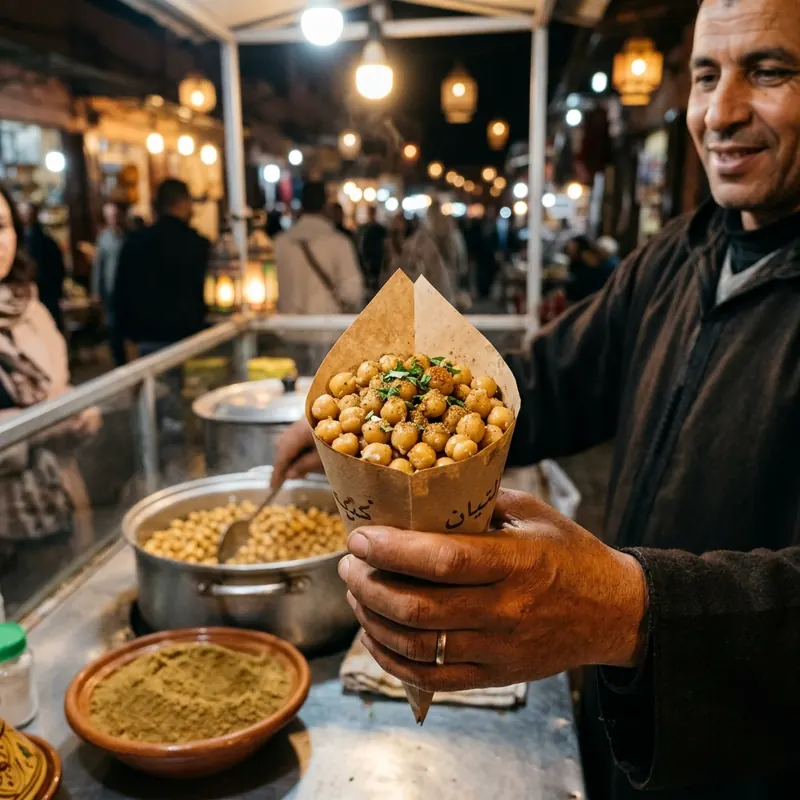
The vendor scoops a steaming ladleful of chickpeas and their rich broth into a heavy glass tumbler. With a flick of his wrist, he coats the top with a generous pinch of sea salt, a fiery dash of cayenne pepper (Felfla Sudaniya), and a dark cloud of stone-ground wild cumin (Kamoun Beldi). You drink the piping hot spiced broth straight from the glass, then use a small wooden spoon to eat the buttery chickpeas, feeling the warmth spread through your chest down to your toes.
Babouch: The 15-Herb Snail Broth
Follow the trail of fragrant, herbal steam down the dark arches of the spice market, and you will find the snail vendors (Moul Babouch).
Moroccan snails are harvested wild from the thyme-covered hillsides of the Atlas Mountains. Before cooking, they are purged on a diet of semolina, bran, and wild rosemary. They are then placed into a massive bubbling cauldron infused with a legendary medicinal herbal mixture (L-Khlita) that includes:
- Licorice Root (Erq Sous): Imparts natural sweetness and coats the throat.
- Wild Pennyroyal (Flliyou): The North African wild mint that opens congested lungs.
- Bitter Orange Peel (Qshour L-Limon): Adds deep aromatic citrus oils.
- Thyme (Zaatar) & Anise Seed (Nafa'a): Provides warming antimicrobial defense.
- Grains of Paradise & Dried Ginger: Delivers deep internal heat.
       [Wild Snails + Purge] ──> [15-Herb Medicinal Decoction]
                                        │
             ┌──────────────────────────┴──────────────────────────┐
             ▼                                                     ▼
    [Snails Extracted with Toothpick]                  [Steaming Bowl of Broth]
     Eaten for earthy texture & spice                   Drunk for lung & chest warmth
Locals sit on wooden benches, using a sharp orange-tree thorn or toothpick to deftly extract the tender snail meat from its spiral shell. But the true treasure is the broth (L-Hloul). After finishing the snails, you lift the steaming terracotta bowl with both hands and drink every last drop of the spicy, herbal elixir. It is Morocco’s ultimate ancestral cure for winter chills, fatigue, and head colds.
4. The Northern Nocturnal Treasure: Kalinti (Karane)
If you find yourself wandering the windswept night streets of Tangier, Tetouan, or Oujda, you will encounter one of the greatest street food relics of Morocco’s shared Mediterranean history: Kalinti (known in Oujda as Karane).
Born from the historic convergence of Sephardic Jewish, Spanish, and Moroccan traditions in the northern coastal cities, Kalinti is a savory flan made from stone-ground chickpea flour (Dqiq d-Homs), water, olive oil, eggs, and salt.
THE KALINTI SHEET PANBlistered, Caramelized Skin ┌─────────────────────────────────┐ │ ▒▒▒▒▒▒▒▒▒▒▒▒▒▒▒▒▒▒▒▒▒▒▒▒▒▒▒▒▒▒▒ │ <── Top Layer: Crusty & Broiled │ ░░░░░░░░░░░░░░░░░░░░░░░░░░░░░░░ │ <── Middle: Creamy Chickpea Flan │ ~~~~~~~~~~~~~~~~~~~~~~~~~~~~~~~ │ <── Bottom: Custardy & Soft └─────────────────────────────────┘ Baked in Giant Circular Sheet Pans in Communal Wood Ovens
The batter is whisked until frothy and poured into massive, round, shallow tinned-copper sheet pans. It is baked in communal, wood-fired bread ovens (Ferran) at blistering temperatures.
The result is a culinary masterpiece of texture:
- A top skin that is deeply blistered, charred, and caramelized.
- An interior that is silky, creamy, and custard-like.
- A base that is firm and nutty.
The vendor uses a broad spatula to slice a steaming, golden slab of Kalinti, slides it into a freshly baked, crusty baguette, and asks the famous question: "Kamoun oela Sudaniya?" (Cumin or chili powder?). You answer "Bjouj!" (Both!), and he showers the steaming slice with fragrant cumin and fiery red chili. It is rich, comforting, protein-packed, and costs mere pennies.
5. The Midnight Sip: Qahwa Mchermla and Warm Herb Infusions
Before the medina finally sleeps, one last ritual remains: the warming midnight beverage.
┌─────────────────────────────────────────────────────────────┐
│                 NIGHT MEDINA DRINK ELIXIRS                  │
├──────────────────────────────┬──────────────────────────────┤
│ QAHWA MCHERMLA (SPICED JAVA) │ HLIB BI LOUIZA (VERBENA MILK)│
├──────────────────────────────┼──────────────────────────────┤
│ • Dark roasted Arabica beans │ • Whole rich farm milk       │
│ • Ground with cinnamon bark, │ • Steeped with dried lemon   │
│   cardamom, nutmeg, cloves,  │   verbena leaves (*Louiza*)  │
│   sesame, and black pepper   │ • Infused with Taliouine     │
│ • Brewed in long-spouted pots│   saffron and wild honey     │
│ • Fiery, invigorating warmth │ • Induces deep, restful sleep│
└──────────────────────────────┴──────────────────────────────┘
Qahwa Mchermla: The Alchemist’s Coffee
In traditional night stalls, coffee is not an espresso pulled from a machine. It is Qahwa Mchermla—dark roasted coffee beans stone-ground together with a dozen whole spices: cinnamon, black peppercorns, green cardamom pods, cloves, nutmeg, sesame seeds, and dried ginger root.
Brewed slowly over charcoal braziers in brass pots, this coffee is served in small glasses with a spoonful of raw sugar. It is thick, aromatic, and possesses a spicy, throat-warming kick that keeps the night watchmen and artisans alert in the crisp mountain air.
Hlib bi Louiza wa Zaafran: The Sleep of Kings
For those heading home to their beds, the herbalist stall offers the ultimate nightcap: whole farm milk heated gently in a saucepan, steeped with a generous handful of dried Louiza (organic lemon verbena leaves harvested from the Skoura oasis) and three threads of Taliouine saffron.
The verbena releases soothing essential oils that calm the nervous system, while the saffron imparts a pale golden color and a honeyed, floral finish. One warm glass of this golden milk, sipped under the stars in a quiet courtyard, will give you the most peaceful, restorative sleep of your life.
6. Grandmother's Secrets: Recreating Medina Street Magic at Home
Bringing the nocturnal magic of the Moroccan street into your home kitchen requires mastering a few precise culinary techniques:
- The High-Hydration Sfenj Secret: When making Sfenj at home, do not use a rolling pin or try to shape the dough on a floured counter. Keep a bowl of salted water next to your stove. Dip your fingers in the water before touching the sticky dough; the moisture prevents sticking and creates steam bubbles when the dough hits the oil.
- The Double-Fry Temperature Control: If you don't have a specialized tilted Sfenj pan, use two separate skillets. Heat the first skillet with 1 inch of oil to 160°C (320°F) to let the Sfenj rise and expand. Transfer the puffed doughnut to a second skillet with deeper oil heated to 190°C (375°F) for 45 seconds to achieve that signature shatteringly crisp crust.
- The 10-Minute Chickpea Broth: To replicate the rich Homs Kamoun broth at home, lightly mash 1/4 cup of your cooked chickpeas with the back of a fork in the cooking liquid. The released starches will emulsify with the olive oil and garlic, transforming thin water into a luscious, velvety broth.
- The Cardoon Substitute for Raïb: If you cannot forage wild cardoon flowers, you can make an authentic raw-milk Raïb using high-quality liquid vegetable rennet (derived from Cynara enzymes). Heat raw whole milk to exactly 32°C (90°F)—never hotter, or you will kill the delicate enzymes—stir in the rennet, pour into unglazed clay cups, and let it sit undisturbed in a warm, draft-free oven for 4 hours.
- The Cumin Blooming Trick: Never buy pre-ground cumin for street-style snacks. Buy whole organic cumin seeds, gently toast them in a dry, ungreased cast-iron skillet for 90 seconds until fragrant, and grind them in a mortar immediately before sprinkling over your dishes. The difference in aroma is like night and day.
- The Perfect Kalinti Crust: To get that iconic charred, blistered top on homemade Kalinti without overcooking the custardy center, bake the chickpea batter on the lowest rack of your oven at 220°C (425°F) until set, then switch the oven to high broil for the final 4 minutes to caramelize the top skin.
7. Frequently Asked Questions (FAQ)
Is it safe to eat street food in the Moroccan medinas?
Yes, absolutely—provided you follow the universal golden rule of local street dining: eat where there is a crowd of locals and high turnover. The stalls specializing in Sfenj, Raïb, Homs Kamoun, and Babouch have survived for decades because their ingredients are fresh daily. The high frying temperatures for Sfenj and the long boiling times for chickpeas and snail broths ensure complete safety.
What is the best time of evening to find fresh, hot Sfenj?
The prime window for fresh Sfenj is between 4:30 PM and 7:30 PM (Kaskrout / Moroccan afternoon tea time), and again early in the morning from 6:30 AM to 8:30 AM for breakfast. If you visit a Sfenji during these peak hours, you are guaranteed doughnuts pulled straight from the bubbling cauldron onto the palm frond string.
Can Raïb Beldi be made with pasteurized supermarket milk?
While you can make Raïb with whole pasteurized milk, it will never develop the same complex creaminess or dense curd as raw, unpasteurized, grass-fed milk. If using pasteurized milk, ensure it is not ultra-pasteurized (UHT), as the high heat processing alters the milk proteins and prevents the cardoon or vegetable rennet from setting the curd properly.
Are snails in Morocco halal and clean to consume?
Yes, snails (Babouch) are widely considered halal in the Maliki school of Islamic jurisprudence prevalent in Morocco. They are meticulously purged on clean semolina, bran, and herbs for several days before preparation, thoroughly washed multiple times in salted water, and cooked with sacred invocations in a medicinal herbal broth.
8. Visualizing the Night Medina: High-Resolution Photographic Prompts
Image Prompt 1
- Subject: Atmospheric close-up shot of a Maâlem Sfenji in a rustic, tile-lined medina stall at night. His muscular, flour-dusted hands are pulling a loop of wet, blistered dough from a smoking, tilted cast-iron cauldron of bubbling golden oil. In the foreground, a wreath of five freshly fried, golden-brown Sfenj doughnuts is threaded onto a fresh wild green palm frond (Doum).
- Vibe: Artisan craftsmanship, nocturnal warmth, sizzling kinetic energy.
- Style: Cinematic street photography, dramatic side-lighting from incandescent bulbs, steam and light smoke catching golden highlights.
- Format: 35mm f/1.8 lens, sharp focus on the shimmering oil bubbles and crispy doughnut blisters, moody dark background.
Image Prompt 2
- Subject: A collection of small, unglazed rustic terracotta bowls (Zlafet Tin) filled with silky, porcelain-smooth Raïb Beldi custard resting on an antique hand-painted ceramic mosaic (Zellige) counter. One bowl is drizzled with glistening dark wild thyme honey and topped with ruby-red pomegranate seeds, with an ornate antique silver spoon resting across the rim.
- Vibe: Serene, artisanal, pure, cooling contrast to the night heat.
- Style: Clean editorial food photography, soft ambient lantern lighting, shallow depth of field highlighting the delicate trembling texture of the curd.
- Format: 85mm macro lens, rich earthy tones, high-resolution texture on clay pottery.
Image Prompt 3
- Subject: A lively street cart in the Marrakech medina at twilight with a gigantic, polished copper cauldron of Homs Kamoun. Giant, plump, steaming chickpeas are being ladled into a heavy glass tumbler. Steam rises into the cool evening air, and a wooden spice shaker is mid-action, dusting red cayenne pepper and dark cumin over the glass.
- Vibe: Street food authenticity, comforting warmth, vibrant spice market atmosphere.
- Style: Documentary food travel photography, dynamic motion blur on rising steam, warm golden-hour to twilight color palette.
- Format: 50mm lens, medium format digital, vivid natural colors and high dynamic range.
Image Prompt 4
- Subject: A traditional Moroccan snail vendor stall (Moul Babouch) under an ancient stone archway at night. A huge bubbling cauldron filled with wild mountain snails and dark, aromatic herbal broth surrounded by bundles of dried herbs (pennyroyal, licorice root, thyme). A customer holds a steaming terracotta bowl of herbal broth in two hands, with steam curling past a smiling face.
- Vibe: Ancient remedy, mysterious herbal alchemy, cozy medina nightlife.
- Style: Moody chiaroscuro, rich amber and deep emerald tones, warm glow from hanging metal lanterns.
- Format: 35mm film aesthetic, subtle grain, exceptional shadow detail.
Image Prompt 5
- Subject: A wide rectangular slice of golden, blistered Kalinti (chickpea flan) sliding out of a giant circular tinned-copper pan from a wood-fired brick oven. The baker, with a flour-streaked apron, uses a wide brass spatula to tuck the creamy slice into a split crusty Moroccan baguette, while an antique tin shaker sprinkles cumin over the top.
- Vibe: Mediterranean heritage, rustic baking mastery, irresistible street comfort.
- Style: Warm documentary culinary photography, glowing orange coals from the oven casting deep shadows.
- Format: 50mm f/1.4 lens, crisp textural focus on the charred blistered crust and creamy interior.
Experience the true heart of Moroccan heritage through its culinary traditions. Join us in preserving and honoring these ancestral recipes.
What People Are Saying
No comments yet. Be the first — we'd love to hear from you.
Lalla Fatima & The Medina Culinary Guild
Culturally Verified & Fact-CheckedThe Moroccan Food editorial team brings together native culinary researchers, heritage preservationists, and experienced home cooks across Marrakech, Fes, and Casablanca. Every recipe and cultural guide is reviewed against ancestral oral traditions and authentic regional practices.