Moroccan Street Food in Marrakech: 15 Essential Bites in Jemaa el-Fna and Beyond
Moroccan Street Food in Marrakech: 15 Essential Bites in Jemaa el-Fna and Beyond
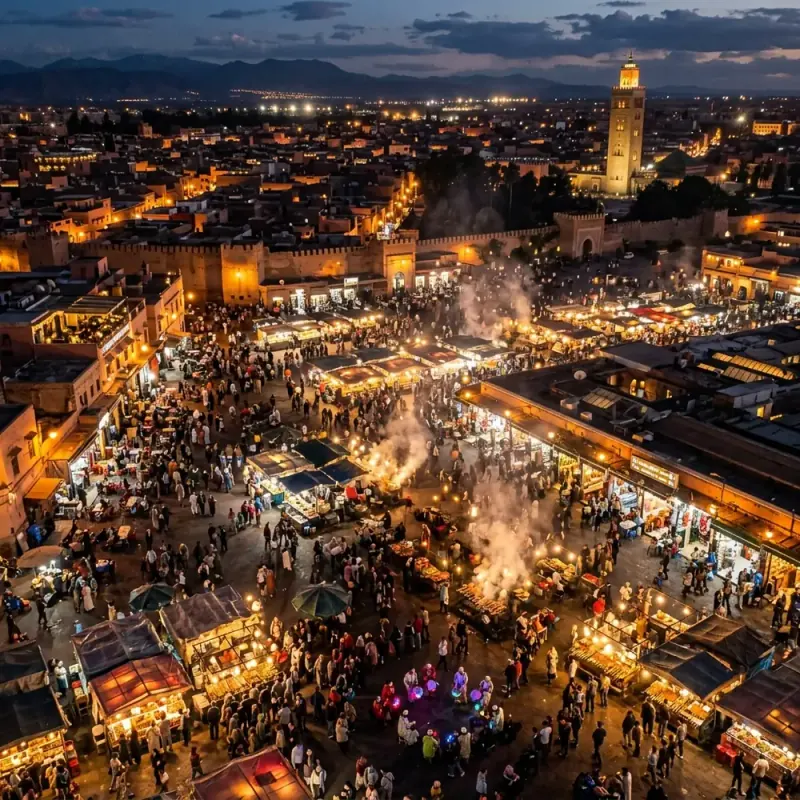
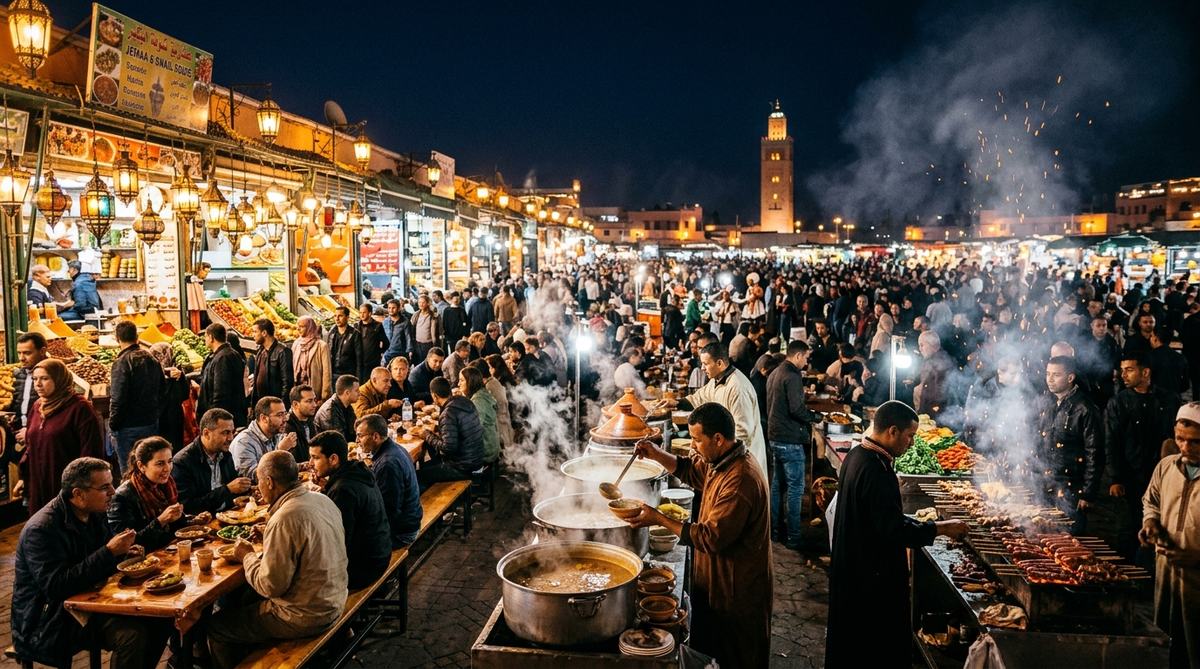
There is a moment—if you stand still long enough in Jemaa el-Fna as the sun drops behind the Koutoubia minaret—when the square transforms. The snake charmers pack up their baskets, the acrobats take their final bows, and suddenly the smoke rises. Dozens of charcoal grills ignite at once, the air thickens with cumin and char, and what was a circus becomes the greatest open-air kitchen in the world. I have seen this happen hundreds of times, and it never stops making my heart beat a little faster.
This square—its name means “assembly of the dead” in classical Arabic, though locals simply call it Jemaa (the gathering)—has been Marrakech’s social and commercial heart for nearly a thousand years. It is listed as a UNESCO Intangible Cultural Heritage of Humanity, and rightly so. But no heritage certificate captures the real experience: a grandmother ladling harira from a clay pot the size of your torso, a teenager flipping msemen on a iron griddle blackened by decades of use, an old man who has sold orange juice from the same corner for forty years and knows every repeat customer by name.
This is my guide to eating here properly—not as a tourist who gets pointed to the most photogenic stall, but as someone who grew up watching their mother navigate these crowds and knows where the real food lives.
The History and Theater of Jemaa el-Fna
The square dates to the founding of the Almoravid dynasty in the eleventh century. Over the centuries it served as a marketplace, an execution ground (hence the name), a royal processional space, and always—always—a place where people ate together. The food stalls (hawanet, singular hawanit) have existed in some form since at least the sixteenth century, when travelers on the trans-Saharan trade route stopped here to eat before crossing into sub-Saharan Africa or continuing north to Fes.
What you see today is the living descendant of that tradition. The stalls are numbered, the vendors hold licenses, and there is a municipal organization that sets operating hours. But the spirit is ancient. When you sit on a plastic stool at a numbered table and accept a bowl of harira from a man who learned the recipe from his father, you are participating in something that pre-dates the nation-state itself.
The 15 Essential Street Foods of Marrakech
1. Harira — The Soup That Holds Everything Together
Harira is Morocco’s national soup: a thick, tomato-and-lemon-soured broth enriched with chickpeas, lentils, vermicelli, fresh coriander (qzbur) and a spice base of ginger, turmeric and white pepper. In Jemaa el-Fna, it arrives in a heavy clay bowl (qsaa) with a sheaf of chebakia pastry and a wedge of lemon on the side. The proper way to eat it: squeeze the lemon in first, dip the chebakia to soften it slightly, eat it between sips. A bowl costs ten to fifteen dirhams from a local stall—if someone is charging you forty, you are at a tourist stall.
2. Babbouche — Snail Soup You Cannot Miss
The snail vendors push small wheeled carts and announce themselves by clicking their ladles against the rim of their enormous pots. Babbouche (from the Darija word for snails) is a broth simmered for hours with seventeen different herbs and spices—pennyroyal (fliyou), thyme, anise, liquorice root, gum arabic—that is simultaneously medicinal and deeply delicious. You get a small bowl, a toothpick to extract the snails from their shells, and you drink the broth when you are done. Moroccans eat it for colds, hangovers, and general fortification.
3. Tangia — The Bachelor’s Slow-Cooked Lamb
Tangia is Marrakech’s signature dish and it has almost no parallel anywhere else in Morocco. The clay amphora-shaped pot (also called a tangia) is stuffed with lamb or beef, preserved lemon (hamd m’rakad), cumin, garlic, and smen (aged fermented butter), sealed with parchment paper and cord, and carried to the ferran—the communal bread oven—to cook in the dying embers for six to eight hours. The result is meat that has essentially dissolved into velvet. In Jemaa el-Fna, small restaurants around the square’s edges serve tangia by the portion. It is traditionally a dish made by men—bachelors and tannery workers who had no one to cook for them—which gives it an endearing origin story.
4. Brochettes — Charcoal Skewers Over Hot Fire
The smoke you smell from two streets away comes from the brochette grills: long metal skewers of marinated lamb or beef fat-and-lean (kbda w-lahm) held over charcoal fans by men who have spent years perfecting the ten-second rotation that produces a crust outside and pink inside. They arrive on a sheet of flatbread with a sprinkle of cumin, salt, and crushed dried chili (harissa). Simple, perfect.
5. Merguez — The Spiced Lamb Sausage
Merguez (from the Amazigh word for sausage) are thin lamb sausages seasoned with harissa, cumin, and garlic, grilled until they blister and spit fat. Eaten in a half-round of khobz (Moroccan flatbread) with a drizzle of olive oil, they are one of the most satisfying three-dirham bites in the city.
6. Kefta Sandwiches in Khobz
Kefta is spiced ground beef or lamb mixed with onion, parsley, cumin, sweet paprika and a whisper of cinnamon. It is shaped onto skewers, grilled, then swept into a piece of warm khobz with chopped tomato. The bread absorbs the fat from the kefta and becomes something transcendent.
7. Msemen with Honey and Argan Oil
Msemen is a square, layered flatbread made by folding and folding semolina dough until it builds up multiple flaky sheets, then griddle-fried in butter. Eaten hot from the pan with a pour of pale Moroccan honey (asel) and a drizzle of argan oil, it is one of the great breakfasts of the world. In Jemaa el-Fna it appears in the morning when the café stalls fire up, and again late at night.
8. Fresh-Squeezed Orange Juice — The Eternal Classic
The orange juice stalls are the most photographed spot in all of Marrakech. Bags of blood oranges and navels are pyramided in towers of color, and for four dirhams (locals negotiate; the posted tourist price is sometimes fifteen), you get a tall glass squeezed to order. The oranges come from the Souss valley to the south and the Gharb plain to the north—two of the finest orange-growing regions on earth. Drink it immediately.
9. Roasted Almonds and Argan Nut Vendors
Walking vendors sell paper cones of warm roasted almonds (louz), peanuts, and—occasionally—roasted argan nuts (argane), which taste like a toasted hazelnut crossed with cocoa. A paper cone costs five dirhams and it is something to chew between stops.
10. Bissara — Fava Bean Soup for Working People
Bissara is the working-class breakfast of northern Morocco, but Marrakech has adopted it completely. Split dried fava beans are cooked until they collapse into a thick, velvety soup, finished with olive oil, cumin, paprika, and dried chili. A bowl with bread costs eight dirhams and will keep you full until the afternoon. It is sold from dawn until midmorning from small carts near the square’s edges.
11. Maakouda — Potato Fritters Fried to Gold
Maakouda are potato fritters mixed with cumin, garlic, egg, parsley and turmeric, shaped into rounds and fried in a shallow pan until the outside crisps dark gold. Eaten hot in a bread roll, they are Morocco’s answer to a potato croquette, but with more character. Look for the vendors frying to order—the ones with a line of local workers waiting are your best signal.
12. Grilled Corn — Lkbal in Dialect
Lkbal (corn cobs) are grilled slowly over embers, rubbed with butter and salt, and sold from small braziers around the square’s perimeter in summer and autumn. Simple, smoky, and genuinely good on a cool Marrakech evening.
13. Sheep’s Head Mechoui — Not for the Faint-Hearted
Around the edges of the medina, particularly near the mechoui alley (ask any local, they will point you to Rue Bab Ftouh area), whole sheep heads are slow-roasted in traditional ovens until the skin crisps and the meat falls from the bone. You point to what you want—cheek, tongue, brain—it is carved off, seasoned with cumin and salt, and wrapped in paper. It costs almost nothing and tastes of everything that is honest about Moroccan cooking.
14. Pastilla — Sweet-Savory Pigeon Pie in Phyllo
Pastilla (also spelled bastila or b’stilla) is one of Morocco’s most extraordinary creations: shredded slow-cooked pigeon or chicken, caramelized onion, toasted almonds and egg, wrapped in gossamer-thin warqa pastry, baked until golden, then dusted with powdered sugar and cinnamon. The combination of savory meat, sweet sugar, and the crunch of the pastry represents the Andalusian-Moroccan sweet-savory principle at its most formal. In the square, small restaurants serve it as a starter. Order it.
15. Chebakia — The Sesame Honey Pastry
Chebakia are flower-shaped pastries made from a dough of flour, sesame, anise, cinnamon, and vinegar, deep-fried then soaked in honey and rolled in toasted sesame seeds. They are eaten during Ramadan constantly—alongside harira at the ftour (breaking of the fast)—but available in Jemaa el-Fna year-round. One piece is enough to understand everything about Moroccan pastry philosophy: complex, dense, not too sweet, and built to sustain.
How to Navigate the Stalls Safely
Use the numbered stalls, but be selective. The numbered stalls in Jemaa el-Fna’s evening food court are licensed, inspected, and generally safe. However, not all are equal. The stalls with the longest lines of Marrakshis (Marrakech locals) are consistently better. If everyone sitting at a stall appears to be a foreign tourist, keep walking.
Watch the ingredient freshness. Arrive before 8:00 PM when the food is freshest. By 10:30 PM some proteins have been sitting for hours. The soup vendors and juice vendors are always turning over stock quickly; the brochette grills usually are too.
Agree on prices before you sit. The menus have prices on them. Read them before you order and confirm verbally. Being clear about what you are paying before you eat avoids the uncomfortable moment of a bill that has doubled.
Carry small bills. Ten-dirham and twenty-dirham notes make payment easier and eliminate the “no change” argument.
Tourist Stalls Versus Local Favorites
The stalls nearest the center of the square and most aggressive with their touts are generally the most tourist-oriented. To find the stalls locals actually use, drift to the edges of the food court area and look for:
- Stools instead of proper chairs (chairs are a tourist indicator)
- Arabic-only menus or menus that list prices in round numbers
- Staff who do not call out to passersby in English, French, or Spanish
- Vendors who look mildly surprised to see you
Best Time to Visit
The food stalls operate from approximately sunset to midnight. The best window is 7:00–9:00 PM: the light is golden, the grills are freshest, and the full theater of the square is alive. If you visit at midday, the square is quiet and hot and mostly tourist-focused cafés. The magic is nocturnal.
Beyond Jemaa el-Fna: Two Neighborhoods Worth Knowing
Bab Doukkala is a working-class neighborhood at the northwestern gate of the medina where local Marrakshis eat every day. The street food here—bissara carts, msemen women cooking in doorways, grilled merguez from unlicensed braziers—is cheaper, less curated, and often more delicious than anything in Jemaa el-Fna.
Gueliz, the French-built new town west of the medina, has a growing food scene with Moroccan sandwich shops, juice bars, and modern takes on traditional street food. It is particularly good for baghrir (spongy semolina pancakes) with coffee in the morning and maakouda sandwiches at lunch.
Frequently Asked Questions
Is the street food in Jemaa el-Fna safe to eat?
Generally yes, particularly from licensed numbered stalls inspected by the municipality. Apply common sense: choose food that is cooked to order and served hot, avoid dishes that have been sitting out for visible time, and stick to cooked items rather than raw salads. The juice is made fresh in front of you and is very safe.
How much should I budget for a full street food evening in Jemaa el-Fna?
A thorough tasting of six to eight items—harira, babbouche, brochettes, orange juice, msemen, and pastilla—costs between 80 and 150 dirhams (roughly $8–$15 USD) per person if you eat at local-priced stalls. Tourist stalls can double that for the same food.
Can vegetarians eat well in Jemaa el-Fna?
Absolutely. Bissara, maakouda, msemen with honey, orange juice, harira (ask if made without meat stock—some versions are), roasted corn, roasted almonds, and chebakia are all vegetarian. The square is more vegetarian-friendly than it first appears.
What is the best single dish to try if I only have time for one thing?
Tangia. It is Marrakech’s most distinctive dish, made nowhere else in exactly the same way, and the slow-cooked clay-pot lamb is an education in patience and flavor that will make you understand Moroccan cooking philosophy in a single bite.
Experience the true heart of Moroccan heritage through its culinary traditions. Join us in preserving and honoring these ancestral recipes.
What People Are Saying
No comments yet. Be the first — we'd love to hear from you.
The Moroccan Food
Culturally Verified & Fact-CheckedThe Moroccan Food editorial team brings together native culinary researchers, heritage preservationists, and experienced home cooks across Marrakech, Fes, and Casablanca. Every recipe and cultural guide is reviewed against ancestral oral traditions and authentic regional practices.