Moroccan Medina Nougat & Toasted Caramelized Nuts: The Sweet Cart Craft
Moroccan Medina Nougat & Toasted Caramelized Nuts: The Sweet Cart Craft
As dusk falls across the ancient gateways of Morocco’s imperial cities—outside Bab Boujloud in Fes, Bab El Had in Rabat, and Bab Doukkala in Marrakech—a seductive, unmistakable aroma drifts through the evening chill. It is the warm, nutty scent of roasting peanuts and Atlas almonds mingled with caramelizing sugar, cracked cinnamon, and a sweet breath of orange blossom water.
Follow that toasty perfume and you will discover one of Morocco’s most enduring sidewalk spectacles: the traditional street confiseur cart.
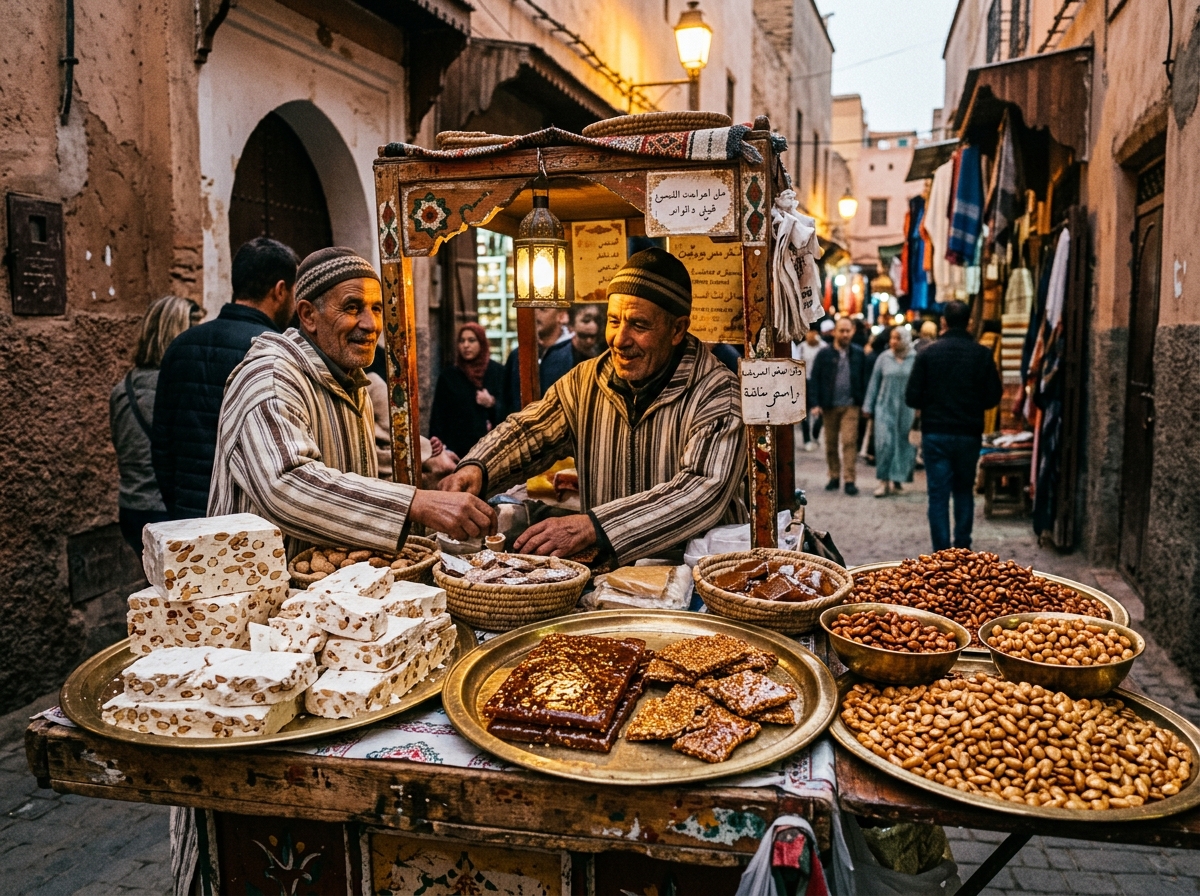
Protected by polished glass partitions and illuminated by warm lamps, these handcrafted wooden carts are open-air jewelry boxes of Moroccan sweetness. On one side rest colossal, chalk-white boulders of nougat studded with whole emerald pistachios, amber almonds, and sesame seeds. On the other side sits a smoking, hammered copper cauldron mounted over a roaring gas flame, where whole peanuts churn in a bubbling sea of dark golden syrup.
In an age of pre-packaged factory candies and supermarket snack bars, Morocco’s medina nut and nougat artisans keep alive a century-old craft of confectionery. Their sweets are made fresh daily by hand, cut to order with heavy steel cleavers, and served warm in paper cones that perfume the night air.
The White Boulders: The Art of Medina Nougat
Moroccan street nougat—known in different regions as Nougat Beldi or Nougat Chamali—is a direct descendant of medieval Arab-Andalusian confectionery traditions that traveled across North Africa centuries ago.
Unlike soft, chewy French Montélimar nougat or hard Italian torrone, traditional Moroccan medina nougat strikes a balance between snap and chew. It is dense, toothsome, and deeply fragrant with honey and floral essences.
The artisan begins by heating pure mountain wildflower honey and sugar syrup in a deep copper basin until it reaches the precise “hard crack” stage. In a separate wooden bowl, egg whites are whipped by hand with a wire whisk until they form stiff, glossy peaks.
The boiling honey syrup is slowly drizzled into the whipped whites in a steady stream, beating continuously until the mixture transforms into a brilliant white, velvety foam.
Now comes the signature Moroccan touch:
- Pounded Mastic Tears (Meska Horra): Ground with a pinch of sugar to lend an aromatic, pine-like resinous note.
- Orange Blossom Water (Ma Zhar) or Rosewater: Splash-distilled to lift the intense sweetness of the honey.
- Toasted Nuts: Whole blanched Atlas almonds, toasted sesame seeds (zenjlane), and vivid green pistachios are folded into the warm mixture until the candy is packed with crunchy texture.
The molten nougat is turned out into rectangular wooden frames lined with parchment and edible starch wafer paper, then compressed under heavy marble slabs. Once cooled, it forms giant, stone-hard white blocks weighing up to twenty kilograms.
When you order, the vendor does not hand you a pre-wrapped bar. He takes a heavy butcher knife, rests the blade across the chalky block, strikes the spine with a wooden mallet, and carves off jagged, crystalline chunks. He weighs your portion on a traditional brass balance scale, wrapping the sweet morsels in wax paper with a generous smile.
Smoking Copper: The Theater of Caramelized Nuts
If the white nougat is the visual centerpiece of the cart, the caramelized nuts are its beating heart and performance theater.
The artisan works over a heavy, wide-mouthed copper vat called a tanjra d-n’hass. Copper is essential; it distributes heat evenly across the curved bottom, preventing the delicate sugar crystals from scorching while roasting the nuts through to their oily cores.
The process is hypnotic to watch:
1. The Raw Batch
The confiseur dumps two kilograms of raw, plump local peanuts (kawkaw) or sweet blanched almonds (louz) into the dry, heated copper vat. He roasts the nuts gently, turning them with a flat wooden paddle until their papery skins crackle and release their fragrant natural oils.
2. The Sugar and Blossom Bath
Once the nuts are hot, he pours in pure granulated sugar, a splash of water, and a generous measure of orange blossom water. The mixture roars and bubbles violently, releasing dense clouds of sweet steam that curl into the medina alleyways.
3. The Crystallization Phase
As the water boils off, the sugar turns into a dry, chalky white coating that clings to every nut. An amateur would panic and pull the pot from the fire. The master artisan smiles and keeps stirring. He knows this chalky sand is merely a transition.
4. The Amber Transformation
With steady heat and relentless stirring, the dry sugar melts a second time. This time, it transforms into a glossy, dark amber liquid caramel. The artisan adds a dash of ground cinnamon and a pinch of fine sea salt.
The salt is crucial—it cuts through the caramel’s sweetness, creating a complex, craveable contrast. With a final flourish of his paddle, he empties the smoking nuts onto a cool zinc tray, separating the clusters with two wooden spatulas before the caramel sets into a brittle, glass-like shell.
The Paper Cone Ritual: Street Comfort in the Hand
Eating caramelized nuts in Morocco is tied to a specific street vessel: the gurta.
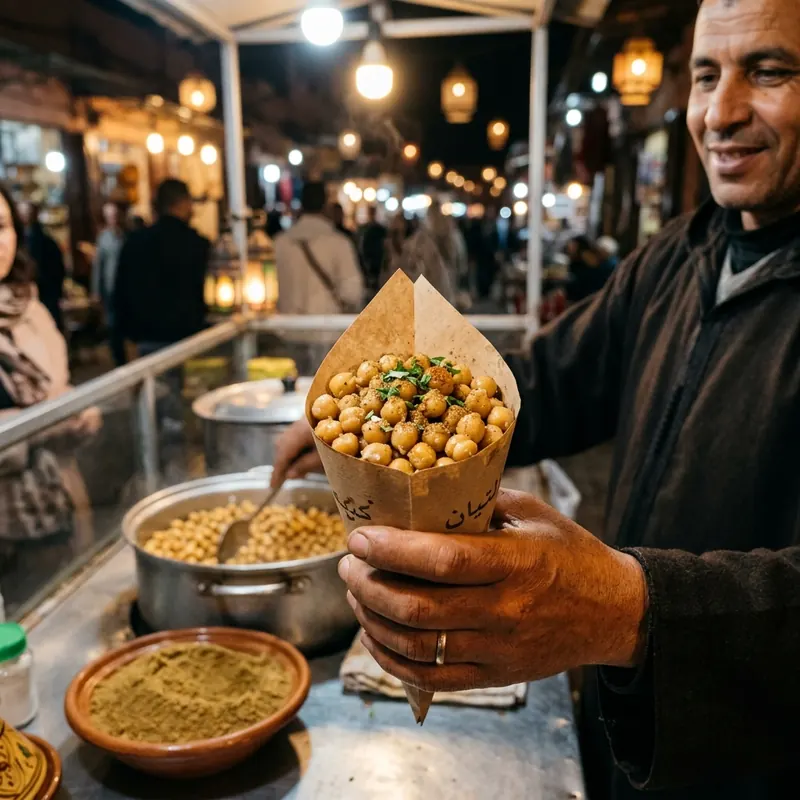
A gurta is a simple sheet of brown butcher paper or clean newsprint deftly twisted with a flick of the wrist into a tight conical funnel. The vendor scoops the warm, freshly caramelized nuts directly from the tray into the cone, folds the tip over, and hands it to you.
The warm paper radiates heat directly into your chilled palms on an autumn evening. As you stroll along the medina ramparts, you pop the warm nuts into your mouth one by one:
- First comes the crackling crunch of the hard amber caramel shell.
- Next comes the burst of roasted peanut oil and nutty warmth.
- Finally, the delicate perfume of orange blossom and cinnamon lingers on your palate, rounded out by a faint whisper of sea salt.
At five dirhams for a small cone and ten dirhams for a large, it is one of the most democratic pleasures in Morocco. Young couples share a cone on evening walks; fathers buy cones for children after school; and elders enjoy a handful while debating the day’s news outside the neighborhood mosque.
Deep History: Morocco’s Ancient Sugar Heritage
The presence of sweet confection carts outside Moroccan medina gates is not an accidental street trend. It is rooted in Morocco’s historic status as a world capital of sugar production.
During the sixteenth century under the Saadian dynasty, Morocco was the Mediterranean’s dominant producer and exporter of refined white cane sugar. The fertile plains of the Souss Valley around Taroudant and Chichaoua were covered in vast sugarcane plantations, fed by sophisticated stone aqueducts and crushed in monumental stone sugar mills (ma’asara).
Moroccan sugar was so pure and prized that Saadian sultans traded it pound-for-pound with Italian merchants for Carrara marble to build the lavish El Badi Palace in Marrakech.
This abundance of sugar, combined with North Africa’s rich harvests of wild mountain honey and sweet Atlas almonds, gave rise to a sophisticated culture of confectionery. The street cart artisans who roast kawkaw m’assel and slice nougat beldi outside modern city walls are the living heirs of that historic imperial trade.
Frequently Asked Questions
What ingredients are used in traditional Moroccan street nougat?
Traditional Moroccan street nougat (Nougat Beldi) is made from pure mountain honey, boiled sugar syrup, whipped egg whites, pounded mastic resin (meska horra), and orange blossom water, packed with roasted blanched almonds, pistachios, or sesame seeds. It contains no artificial preservatives or corn syrup.
How are Moroccan caramelized nuts made without sticking together into a clump?
The vendor stirs the nuts constantly in a hot copper vat until the sugar crystallizes, melts into amber caramel, and coats each nut individually. When poured onto the cooling tray, the artisan rapidly separates the hot nuts with wooden spatulas while warm so they cool into individual crunchy gems rather than one solid block.
What is the difference between kawkaw m’assel and louz m’qarmach?
Kawkaw m’assel is made with local roasted peanuts coated in spiced caramel, offering an earthy, hearty flavor and an affordable price. Louz m’qarmach is made with premium blanched Atlas almonds, delivering a lighter, sweeter crunch favored for special celebrations.
How should you store medina nougat and caramelized nuts to keep them fresh?
Store caramelized nuts in a clean, airtight glass jar at room temperature away from direct sunlight and humidity; moisture will soften their caramel shells. Nougat should be wrapped in greaseproof parchment paper and kept in an airtight container in a cool pantry, where it will maintain its delicate chew for several weeks.
Experience the true heart of Moroccan heritage through its culinary traditions. Join us in preserving and honoring these ancestral recipes.
What People Are Saying
No comments yet. Be the first — we'd love to hear from you.
The Moroccan Food
Culturally Verified & Fact-CheckedThe Moroccan Food editorial team brings together native culinary researchers, heritage preservationists, and experienced home cooks across Marrakech, Fes, and Casablanca. Every recipe and cultural guide is reviewed against ancestral oral traditions and authentic regional practices.