Moroccan Sweets: 18 Traditional Confections That Tell the Story of a Sweet Nation
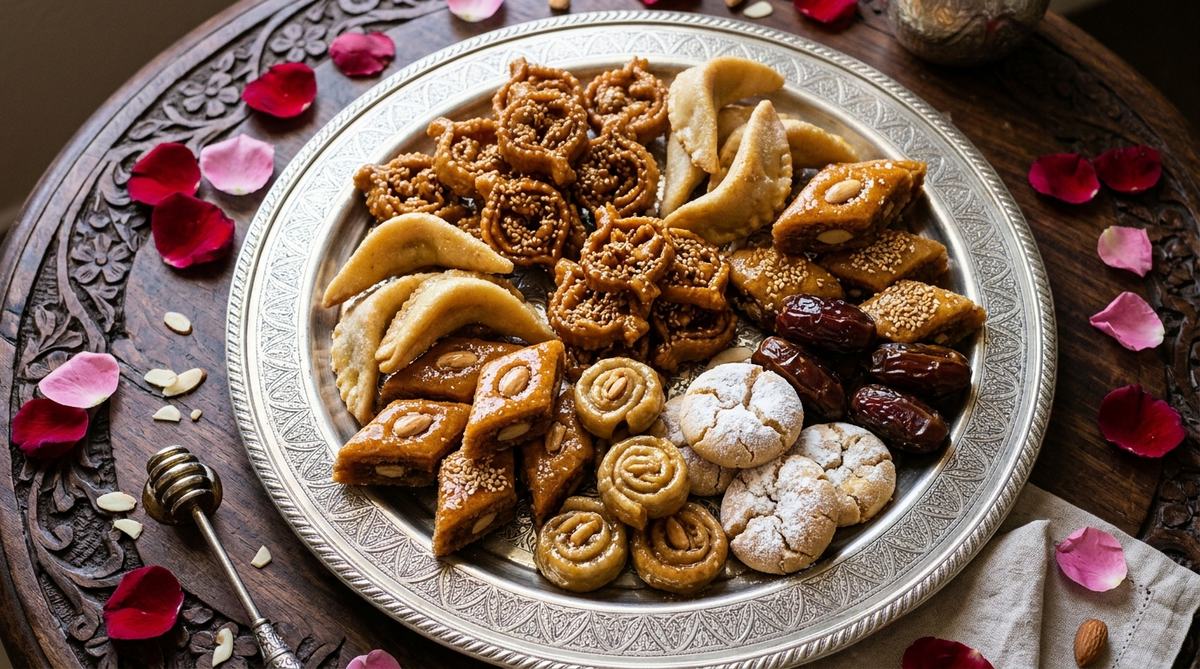
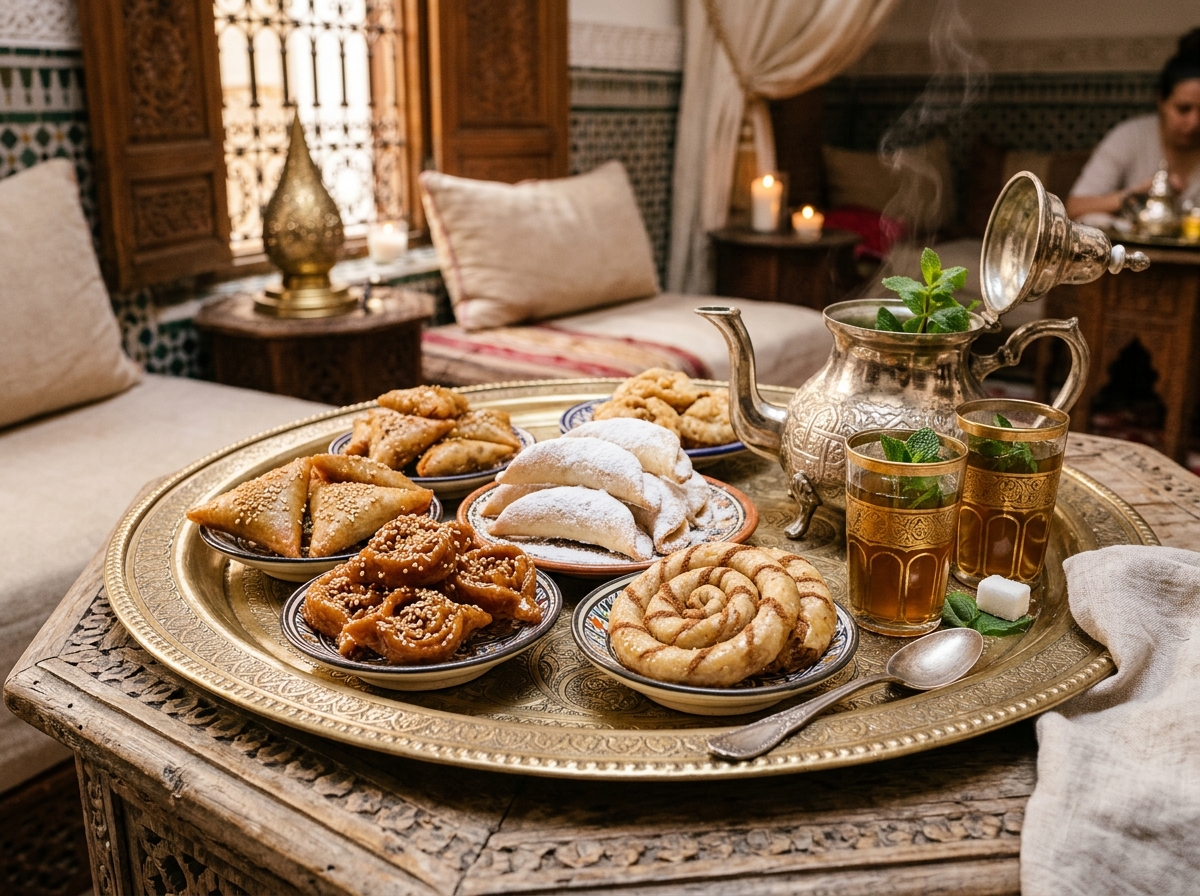
Ask anyone who has sat down to a Moroccan tea table and they will tell you the same thing: it is impossible to eat just one. The sweets arrive on a round silver or painted cedarwood tray — siniya — arranged with a precision that feels almost architectural. There will be at least five varieties. Often there will be ten or fifteen. The atay (mint tea) arrives in its theatrical pour from height, and the conversation begins, and two hours disappear before anyone notices.
What makes Moroccan sweets genuinely distinct from other confectionery traditions of the Arab world is the restraint of the sweetness and the prominence of specific, high-quality ingredients. Where Levantine sweets tend to rely on heavy sugar syrups and dense dairy cream, Moroccan confections are built around almonds, orange blossom water (ma’ al-zahar), argan oil, honey, sesame, and semolina. The sweetness comes through layering and balance rather than volume. A well-made kaab el ghazal is about the texture of the almond paste inside, the fragrant orange blossom in the pastry shell, and the paper-thin crispness of the exterior — not about how much sugar you can detect in a single bite.
This tradition has deep historical roots. The Andalusian influence brought to Morocco after 1492 transformed the country’s culinary culture, and nowhere more than in its confectionery. The displaced Moorish families who settled in Fez, Tétouan, Chefchaouen, and Salé brought with them pastry techniques that blended Arab-Islamic tradition with Iberian almond culture, and the results were extraordinary. Many of the sweets on this list carry that heritage directly.
The 18 Essential Moroccan Sweets
1. Kaab el Ghazal (Gazelle Horns)
Kaab el ghazal — literally “heel of the gazelle” or more poetically “gazelle horns” — is arguably the most iconic of all Moroccan sweets and the one most likely to be served at weddings, engagement parties, and important family occasions. A crescent of wafer-thin pastry encloses a cylinder of amande (almond paste) perfumed with orange blossom water and sometimes a whisper of cinnamon. The pastry is never deep-fried; it is baked or air-dried until just firm, and the exterior sometimes dusted with icing sugar or left completely plain. A properly made gazelle horn is delicate enough to show the almond filling through the pastry like a shadow.
Best occasion: Weddings, khutba (engagement celebrations), Eid al-Fitr.
2. Chebakia (Sesame and Honey Fried Pastry)
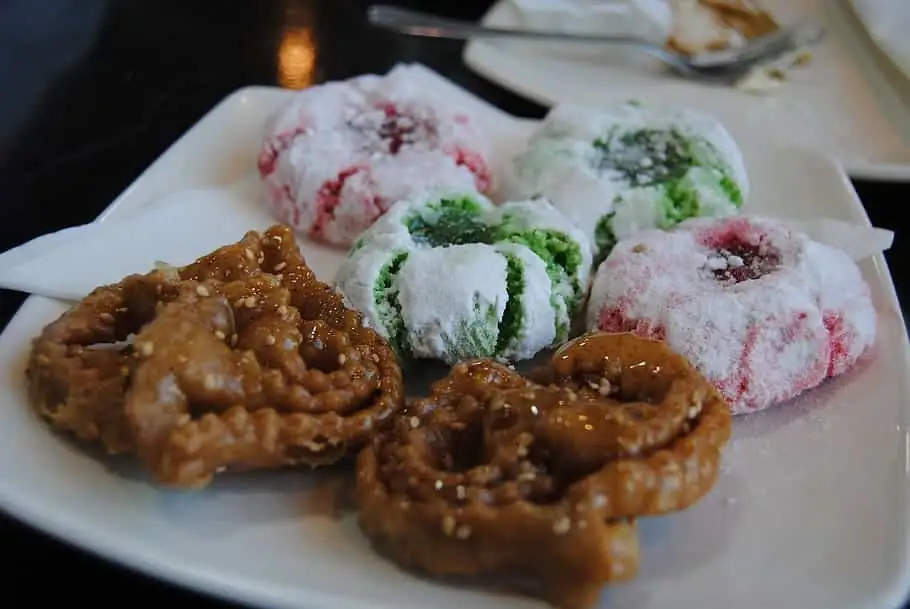
Chebakia is inseparable from Ramadan in Morocco. These hand-shaped pastries — folded and pressed into a flower-like form — are deep-fried until golden, then immediately submerged in a bath of hot honey and orange blossom water. They emerge glossy, intensely sweet, and covered in toasted sesame seeds. The smell of chebakia frying in a traditional kitchen is one of those completely specific sensory experiences that Moroccans abroad consistently describe as homesickness made edible. The dough itself contains sesame paste (jenjlan), anise, cinnamon, vinegar, and saffron — a complex blend that gives each bite extraordinary depth beneath the honey glaze.
Best occasion: Ramadan specifically; they are made in enormous batches to last the entire month.
3. Briouates bi Louz (Almond-Filled Triangles)
Briouates (also spelled briouat) are small triangular or cylindrical pastries made from warqa — Morocco’s answer to filo pastry, but made by hand on a hot griddle and thinner than any commercially available filo. Sweet briouates are filled with a mixture of ground almonds, honey, orange blossom water, and cinnamon, fried until golden, and drizzled with more honey. They shatter at the first bite and the filling practically flows. Making warqa by hand is considered a benchmark skill for Moroccan home cooks, and the sound of the thin dough slapping rhythmically onto the hot tobsil (griddle) is a characteristic sound of traditional kitchens.
Best occasion: Eid celebrations, Ramadan iftar tables, festive gatherings.
4. M’hancha (Serpent Pastry)
M’hancha means “the serpent” in Darija, and the name is apt: this spectacular pastry is a coil of warqa filled with almond paste, shaped into a tight spiral and baked until golden, then dusted with icing sugar and decorated with a spiral of cinnamon powder. Cut into wedges at the table, it reveals a cross-section of pale green almond cream inside flaky pastry. It is the centrepiece of any serious sweet tray and the sort of pastry that elicits genuine admiration from guests who have not encountered it before. The almond filling here is typically made with toasted almonds, giving it a slightly deeper, more complex flavour than the filling used in gazelle horns.
Best occasion: Major family celebrations, wedding receptions, special guest occasions.
5. Sellou / Sfouf (Energy Balls)
Sellou (called sfouf in some regions) is Moroccan confectionery at its most primal and nourishing. Made from roasted flour, ground toasted almonds, honey, sesame, anise, cinnamon, and sometimes a little butter, it has the texture of slightly crumbly marzipan and the aroma of a spice market. Traditionally made during Ramadan (when the body needs sustained energy through long fasting hours), for new mothers in the weeks following birth, and for Achoura (the Islamic new year celebrations). It keeps for weeks without refrigeration and was historically an important food for long journeys. Eaten by the spoonful straight from the bowl, or pressed into small balls.
Best occasion: Ramadan, postpartum recovery, Achoura.
6. Ghoriba Bahla (Crumbly Sesame Cookies)
Ghoriba bahla means “simple ghoriba” in Darija — a self-deprecating name for a cookie that is anything but simple to make well. These round, cracked-surface cookies are made with sesame seeds, flour, butter, and sugar, and have a texture that is simultaneously sandy and melt-in-the-mouth. They are quintessential tea-table cookies, appearing daily in Moroccan homes and in every bakery in the country. The key to their characteristic cracked top is a resting period before baking that allows the surface to dry slightly.
Best occasion: Daily tea, casual family visits.
7. Ghoriba d’Louz (Almond Macaroon)
If you have eaten a French macaron and found it impressive, a Moroccan ghoriba d’louz will recalibrate your reference point. Made primarily from ground almonds, sugar, and egg white with a few drops of orange blossom water, these are chewy, intensely almond-flavoured, and covered in a dusting of icing sugar that clings to the slightly sticky surface. They are gluten-free by nature. Every region of Morocco has its own version: Fez tends towards a purer almond paste; Marrakech versions sometimes add a little orange zest; coastal versions occasionally include ground dried figs.
Best occasion: Tea time, Eid al-Fitr, gift trays.
8. Fekkas (Anise and Sesame Biscotti)
Fekkas are Morocco’s answer to Italian biscotti: twice-baked oblong cookies studded with almonds, sesame seeds, anise seeds, raisins, and sometimes dried cranberries or orange peel. The first bake is as a loaf; the loaf is then sliced and returned to the oven to dry and crisp. They are meant to be dunked in tea and will survive the dunking without immediately disintegrating — a critical feature. The anise (habba hlawa) gives fekkas their distinctive perfumed quality, and the combination of textures (crisp exterior, slightly chewy dried fruit, crunchy nut) makes them completely addictive.
Best occasion: Tea time, long journeys, packed lunches.
9. Makrout (Semolina Date Pastry)
Makrout is beloved from Morocco across the entire Maghreb into Tunisia and Algeria, where regional variations flourish. The Moroccan version uses a semolina and olive oil dough wrapped around a filling of crushed dates, cinnamon, and orange blossom water. The dough is shaped into small elongated diamonds, deep-fried until golden, and dunked in warm honey. The contrast between the grainy, slightly crunchy semolina exterior and the dark, fragrant date filling is deeply satisfying. They are best eaten warm, when the honey is still liquid and the date filling is soft.
Best occasion: Eid al-Adha, Ramadan, tea with guests.
10. Meskouta (Orange and Yogurt Cake)
Meskouta is the everyday home cake of Morocco — the thing a Moroccan mother makes on a regular afternoon, not for a special occasion but simply because there is tea to drink and people to feed. Made with fresh orange juice, orange zest, yogurt, eggs, and oil rather than butter, it is remarkably light and moist, with a citrus fragrance that fills the kitchen during baking. Some versions add a tablespoon of orange blossom water to the batter. It is nothing like the heavy, layered cakes of European tradition — meskouta is humble, honest, and far better than it has any right to be.
Best occasion: Everyday tea, school snacks, casual family breakfasts.
11. Baklawa (Layered Almond and Honey Pastry)
Moroccan baklawa differs from its Turkish and Lebanese cousins in a few important ways: the filling is typically made from blanched whole or roughly chopped almonds rather than pistachios or walnuts, and the sweetness comes from a honey-based syrup rather than a pure sugar syrup, giving it a more complex, slightly floral aftertaste. The layers of pastry are also typically thicker and more substantial than in the Levantine version. Moroccan baklawa tends to be cut into diamond shapes and dusted with ground almonds after syruping.
Best occasion: Weddings, Eid, formal dinner finales.
12. Choumicha (Layered Almond Cream Pastry)
Named after Morocco’s most famous television chef, choumicha in its confectionery form refers to a layered pastry of warqa sheets alternated with almond cream, honey, and sometimes a thin layer of m’semen (Moroccan flatbread). The result is somewhere between a mille-feuille and a baklava — crispy, creamy, and deeply aromatic. It is a more elaborate modern confection than many on this list, and the kind of thing you are most likely to find in a high-end Marrakchi patisserie.
Best occasion: Special celebrations, upscale dinner parties.
13. Sfenj (Moroccan Doughnut)
Sfenj are irregular, chewy, yeast-leavened doughnuts — nothing like the uniform glazed rings of American tradition. The dough is made simply from flour, water, yeast, and salt, and the irregular holes and edges that result from pulling the wet dough into rings and dropping them into hot oil are exactly the point. They are best eaten within minutes of frying, dunked in honey or spread with amlou (the argan oil, honey, and almond paste spread). In cities across Morocco, sfenj vendors operate in the early morning, often threading the hot doughnuts onto a palmetto grass ring for customers to carry through the street.
Best occasion: Sunday morning breakfast, early market visits.
14. Brioches Marocaines
Moroccan brioches are softer, slightly less rich than French brioche, often flavoured with sesame seeds (jenjlan) and anise, and glazed with egg wash before baking. They appear on the Moroccan breakfast table alongside olive oil, cheese, honey, and confiture (jam). The soft, pull-apart interior and fragrant anise note make them unlike any European bread roll. Regional variations in Fez tend towards a sweeter, more enriched dough; Casablanca versions are often made into long oval loaves.
Best occasion: Breakfast, particularly on weekends and family mornings.
15. Ktefa (Cream and Warqa Pastry)
Ktefa (also written ktifa) is a deconstructed layered dessert of fried warqa wafers, custard cream or whipped cream, toasted almonds, and cinnamon, assembled just before serving so that the warqa stays crisp. It is one of the most elegant Moroccan desserts — the kind served at the end of a Fassi (Fez-style) banquet when the main courses are done and the conversation has reached the stage of stories and laughter. The cream is often flavoured with orange blossom water; the almonds are toasted in butter until they smell extraordinary.
Best occasion: Grand family dinners, weddings, formal celebration meals.
16. Coconut Balls
Simple, modern, and universally loved, Moroccan coconut balls are made from desiccated coconut, condensed milk, butter, and vanilla, rolled into balls and dusted in more coconut. They appear on sweet trays alongside the more elaborate ancient confections without apology. Children love them; adults eat far more of them than they intend to. Some versions are dipped in dark chocolate; others add a glacé cherry pressed into the top.
Best occasion: Children’s parties, everyday tea trays, gift boxes.
17. Stuffed Medjool Dates with Almond Paste
The Medjool date (tmar majhoul) is one of Morocco’s great agricultural gifts, grown in the Tafilalt oasis region of the southeast. Stuffed with a cylinder of almond paste (marzipan) tinted pale green with a few drops of green colouring, finished with a whole almond or walnut pressed into the top, and sometimes decorated with edible gold leaf or rolled in desiccated coconut, these are the simplest and most perfect single-bite sweet in Moroccan cuisine. They require no cooking, are improved by resting in the fridge for a few hours, and are genuinely difficult to stop eating.
Best occasion: Eid, Ramadan, formal gift giving, digestif courses.
18. M’semen with Honey and Argan
Strictly speaking, m’semen is a flatbread — a layered, square, pan-cooked bread made from semolina and plain flour folded with butter and smen (aged clarified butter). But when it arrives hot from the griddle at the breakfast table, drizzled with raw Atlas honey and cold-pressed argan oil, it crosses into the territory of a sweet worth discussing on its own terms. The slightly crispy exterior gives way to layered, chewy interior; the honey runs into the layers; the argan oil adds its nutty, distinctive note. This combination is breakfast and dessert and comfort simultaneously.
Best occasion: Weekend breakfast, farmhouse stays, Atlas mountain guesthouses.
How to Buy Versus Make at Home
Most of these sweets can be found in Moroccan patisseries (look for shops labelled halawiyat — sweets — rather than generic bakeries). Kaab el ghazal, m’hancha, and chebakia are widely available ready-made from good patisseries. For the home cook, meskouta, ghoriba bahla, stuffed dates, and coconut balls are the most approachable starting points.
Storage tip: Most Moroccan sweets keep best in a sealed tin at room temperature, layered with parchment. Honey-coated sweets like chebakia and makrout will become sticky in high humidity; store them in a cool, dry place. M’hancha and ktefa should be consumed within 48 hours of making.
Pairing with Moroccan Mint Tea
The function of Moroccan mint tea (atay bi naana) alongside sweets is not simply sweetness-on-sweetness. The tannins in the gunpowder green tea (tay ahdar) and the freshness of the mint cut cleanly through the richness of almond and honey, resetting the palate between bites. This is why Moroccan sweets, which might seem overwhelming eaten alone, are perfectly calibrated when eaten with tea. The third glass — always poured and drunk — is the one where the flavours fully open.
Frequently Asked Questions
What is the difference between Moroccan and Lebanese sweets? The most fundamental difference is the sweetening agent and primary nut. Lebanese and Levantine sweets rely heavily on pure sugar syrup, pistachios, and dairy (cheese, cream). Moroccan sweets use honey and orange blossom water more than sugar syrup, almonds as the dominant nut, and very little dairy in the confectionery tradition (with exceptions like ktefa). Moroccan sweets also tend to be smaller and less visually ornate, with the craft expressed through technique rather than decoration.
Where can I buy authentic Moroccan sweets outside Morocco? Moroccan communities in France (particularly Paris, Lyon, and Marseille), the Netherlands (Rotterdam), Belgium (Brussels), and the United Kingdom (London, Birmingham, Manchester) have well-established patisseries making these sweets to traditional standards. Many cities also have Moroccan grocery shops that stock packaged chebakia, fekkas, and ghoriba imported directly from Morocco. Online, several Moroccan food businesses ship refrigerated sweet trays internationally.
Are Moroccan sweets halal? Almost without exception, yes. The traditional Moroccan confectionery tradition predates any question of halal certification because pork products and alcohol have never been ingredients in the Moroccan sweet kitchen. The only sweets to check carefully are modern variations involving chocolate, which can occasionally contain traces of alcohol-based flavourings. Traditional versions of all 18 sweets listed here are halal.
How much mint tea should I drink with Moroccan sweets? The traditional answer in Morocco is always: three glasses. Moroccan wisdom holds that one glass is for the guest who hesitates, two is for the guest who is satisfied, and three is for the guest who truly understands. Practically speaking, three small glasses of gunpowder mint tea pair perfectly with a sweet tray, the tannins and sweetness reaching a pleasant equilibrium by the third pour. Refusing the third glass is considered, in some households, a mild social slight — the safest approach is simply to drink it.
Experience the true heart of Moroccan heritage through its culinary traditions. Join us in preserving and honoring these ancestral recipes.
What People Are Saying
No comments yet. Be the first — we'd love to hear from you.
The Moroccan Food
Culturally Verified & Fact-CheckedThe Moroccan Food editorial team brings together native culinary researchers, heritage preservationists, and experienced home cooks across Marrakech, Fes, and Casablanca. Every recipe and cultural guide is reviewed against ancestral oral traditions and authentic regional practices.