Tadelakt: The Waterproof Moroccan Lime Plaster That Takes a Week to Make and Lasts a Century
Tadelakt: The Plaster That Becomes Waterproof Through Effort Rather Than Chemicals
There is a category of traditional craft technique that survives into the present not because it is the cheapest or the fastest method available but because it produces a result that alternative methods cannot fully replicate — where the long process and the skilled human labor are not inefficiencies to be optimized away but the direct cause of the quality. Tadelakt is in this category, and understanding why requires understanding what happens chemically during the polishing and burnishing process.
Tadelakt is a traditional Moroccan lime plaster finish made from jedid limestone, which is quarried primarily around Marrakech. This specific limestone has a particular chemical composition and crystal structure that, when calcined (burned at high temperature), produces lime that behaves differently from standard construction lime — more elastic when applied, more responsive to the polishing process, capable of achieving the specific waterproof surface that is tadelakt's defining characteristic.
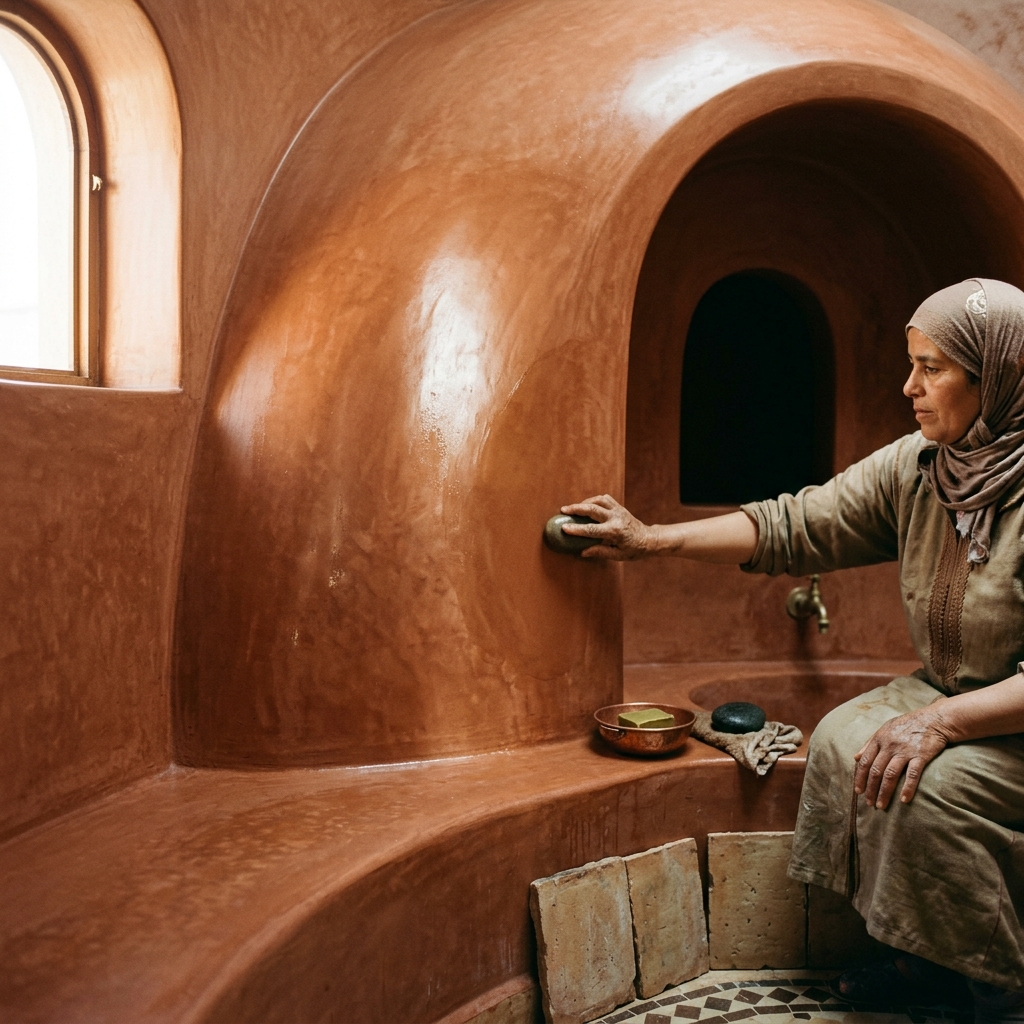
The waterproofing is not applied from outside — there is no sealer, no coating, no chemical treatment after the fact. The waterproofing occurs during the polishing process itself. As the craftsman works the lime surface with a smooth river stone while it is in a specific stage of curing — neither too soft nor too hard — the mechanical pressure of the polishing causes the calcium carbonate crystals in the surface to realign into a denser, more ordered structure. Simultaneously, the olive oil soap used in the final burnishing stage is incorporated into the surface layer, filling the microscopic pores that water would otherwise penetrate.
The result is a plaster surface that is genuinely waterproof — water beads on a correctly made tadelakt surface exactly as it beads on wax — without any coating. The waterproofing is in the material itself, created by the physical and chemical processes of its application.
What Does the Tadelakt Application Process Involve?
A complete tadelakt application involves multiple stages over approximately a week, each with its own timing and its own skill requirements.
The base coat — a rough, thick layer of lime plaster — is applied to the prepared wall surface and allowed to cure for one to two days. This base coat must be even and structurally sound; any surface irregularities in the base will appear in the finished surface.
The tadelakt layer — the jedid lime mixed with natural pigments if color is desired, applied at the correct consistency — goes over the cured base in a thin, even coat worked with a steel trowel. The application itself requires skill: the layer must be of consistent thickness across the entire surface, with no trowel marks, overlaps, or thin spots. The craftsman works quickly because the window for application is relatively short — the lime sets faster than most plaster materials and must be worked while it is still workable.
Then the polishing begins. While the tadelakt layer is in the middle stage of its cure — firm enough to hold its shape, soft enough to respond to pressure — the craftsman works the surface with a smooth, oval river stone, applying firm circular pressure. This polishing closes the surface, begins the crystal realignment process, and removes any minor surface irregularities. It continues for hours.
The timing judgment required here — knowing exactly when the lime is in the correct stage for polishing, neither too soft nor too hard — is the expertise that takes years to develop and that cannot be reduced to a formula. The craftsman is working by feel: pressing the stone against the surface and feeling whether the lime responds correctly to the pressure. When it does — when it compresses and closes and begins to take a slight sheen — the work is proceeding correctly.
The olive oil soap — traditional Moroccan savon baladi, the same soap used in the hammam — is rubbed into the polished surface during the final burnishing stage with a cloth. The soap's saponified olive oil penetrates the microscopic pores of the still-curing lime surface and bonds with the calcium during the final cure. This is the step that completes the waterproofing.
Where Is Tadelakt Used and Why Is It Correct for Those Applications?
The traditional applications are hammam walls and pools — specifically the environments where durable, waterproof surfaces are required without the use of modern chemical sealants — and the interior walls of riads. Both of these are environments where a material that gets better with age rather than worse is specifically valuable: tadelakt, unlike modern bathroom coatings that chip and peel and require periodic reapplication, develops a patina as it ages and the polished surface accumulates the evidence of use — slight color deepening, the particular sheen of a surface that has been touched many times — that makes old tadelakt more beautiful than new tadelakt in the way that old leather is more beautiful than new.
This aging quality is one reason that designers in Europe and North America became interested in tadelakt in the 1990s and 2000s — the material behaved in a direction opposite to most modern finishes, improving rather than degrading over time. There is now a significant international market for tadelakt applications in contemporary interiors, served by Moroccan craftsmen who travel to France, the United Kingdom, and the United States to apply the material.
The challenge in international applications is material: the jedid limestone that makes Moroccan tadelakt what it is is not available outside Morocco, and substitute limes produce finishes that approximate tadelakt's appearance but do not achieve its full waterproofing or its aging character.
The Invisible Invitation
The hammam wall, after five years of use, is a dark terracotta — natural red pigment, deepened by the steam and the touch of many hands and the regular application of savon beldi during bathing. Run your hand along it. The surface is smooth in a way that no tile can be — not the hard, mechanical smoothness of glazed ceramic but the particular smoothness of something made by a polishing stone in a human hand over many hours, with microscopic irregularities that make it feel continuous rather than perfectly uniform. The wall is waterproof and has been for five years. It will be waterproof in fifty more. The craftsman who made it is gone — he works in Paris now, applying tadelakt to a boutique hotel bathroom — and the wall remains and will outlast the building's current function and probably the building's current ownership. Things made correctly last. This is the proposition that traditional craft makes and that, in the case of tadelakt, is demonstrably true.
SEO Meta Description: What is Moroccan tadelakt and how is it made? The lime plaster technique — jedid limestone, river stone polishing, olive soap waterproofing, and why it lasts a century without chemical sealants.
Experience the true heart of Moroccan heritage through its culinary traditions. Join us in preserving and honoring these ancestral recipes.
What People Are Saying
No comments yet. Be the first — we'd love to hear from you.
Youssef Amazigh
Culturally Verified & Fact-CheckedThe Moroccan Food editorial team brings together native culinary researchers, heritage preservationists, and experienced home cooks across Marrakech, Fes, and Casablanca. Every recipe and cultural guide is reviewed against ancestral oral traditions and authentic regional practices.