Forget the Meat Substitutes: How Moroccan Cuisine Has Been Brilliantly Plant-Based for Centuries
The Plant-Based Tradition That Has Been There All Along
My cousin went vegan two years ago and immediately assumed she could no longer eat Moroccan food. When I served her Zaalouk, Taktouka, Bissara, Chermoula-dressed chickpeas with preserved lemon, and a fennel-orange salad with argan oil at the same meal, she looked at her plate for a long moment and said: "This is just... regular Moroccan food, isn't it."
Yes. It is. It always has been.
The plant-based movement has a tendency to imagine itself as an invention — a sophisticated modern response to industrial meat production that requires high-tech substitutes and creative workarounds. The truth is considerably less dramatic and considerably more delicious. Numerous food cultures around the world, including Moroccan cuisine at its core, developed elaborate, satisfying, nutritionally complete plant-based eating traditions long before the concept existed. Not as deprivation. As abundance.
Zaalouk: The Dish That Doesn't Need Reinventing
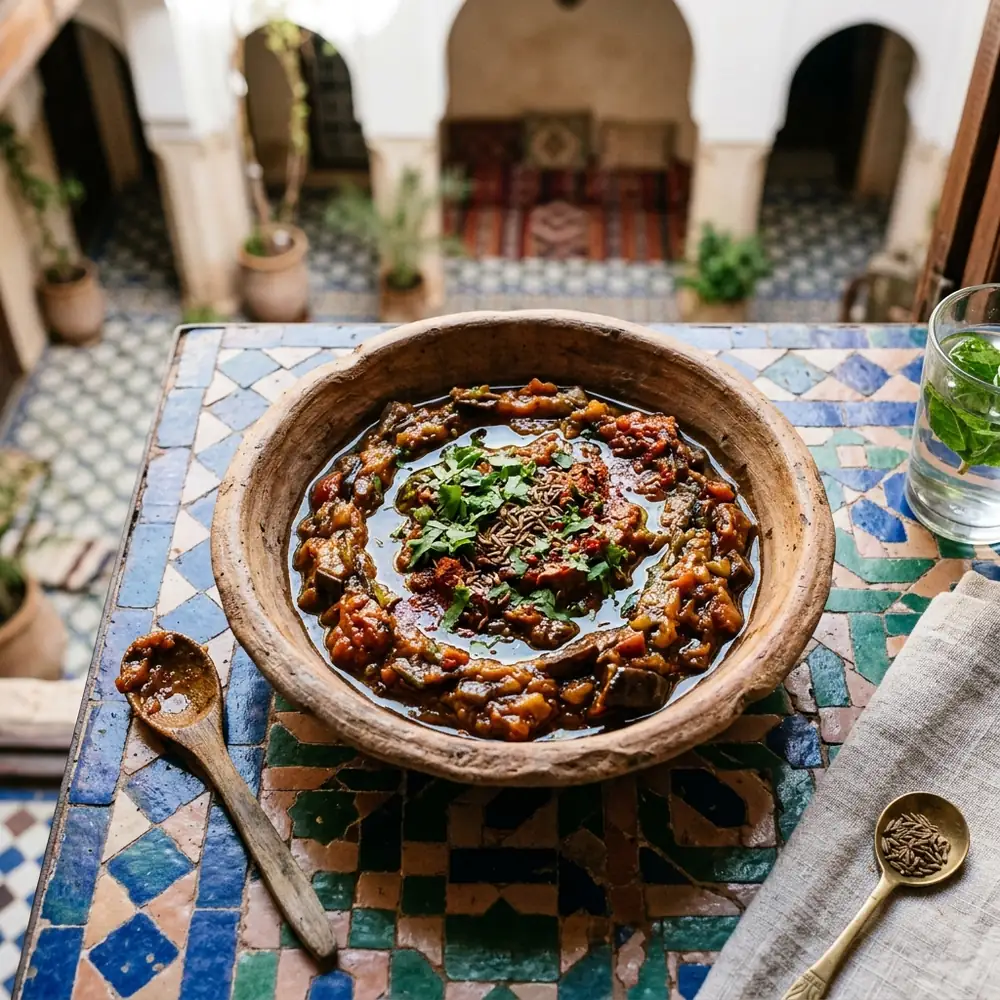
Zaalouk is a cooked eggplant and tomato salad — though "salad" undersells it significantly. You char the eggplants directly over a gas flame or under a very hot grill until the skins are blackened and the interior has collapsed entirely into a smoky, silky mass. You roast the tomatoes separately until they're concentrated and deep. Then everything comes together in the pan with garlic, cumin, paprika, coriander, preserved lemon, and a generous pour of olive oil, cooked down until it's dense and aromatic and the oil has separated slightly at the edges — the way it's supposed to.
The texture, from the collapsed eggplant, is uncanny. Rich. Almost meaty. Not because anyone is trying to simulate meat — the concept would be bizarre to the person who invented this — but because eggplant, charred and cooked slowly, develops a depth of flavor and a silkiness that simply doesn't require anything else.
Served at room temperature with warm bread for scooping. That's it. Nothing missing.
The Seven Vegetables of the Friday Couscous
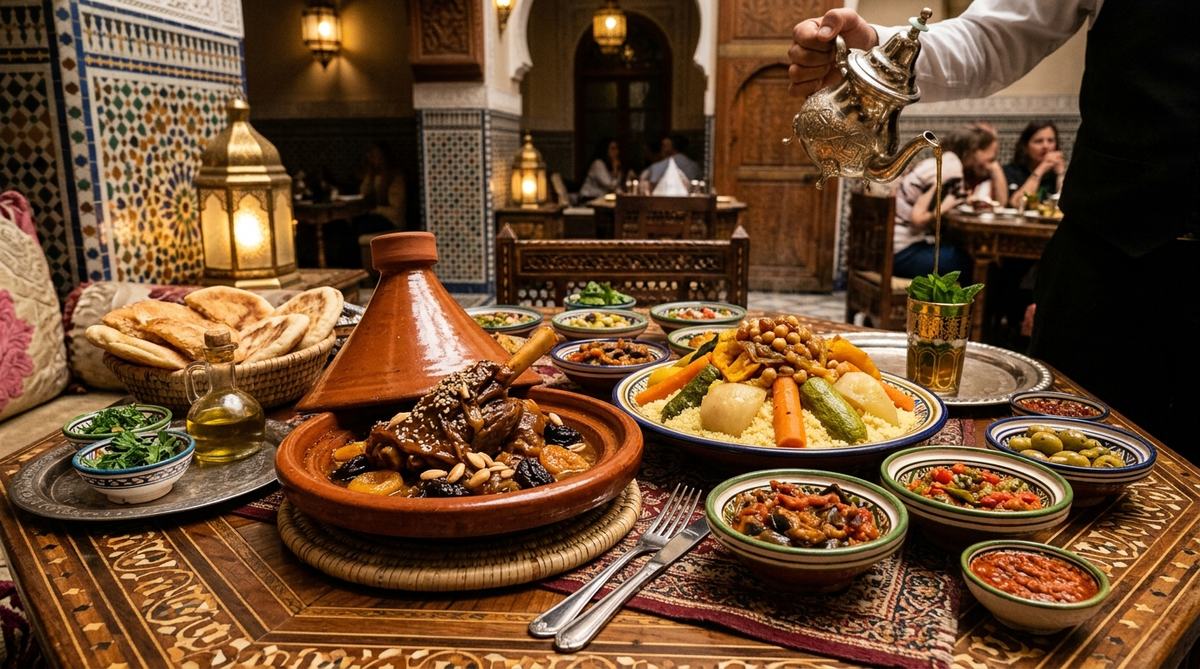
Friday couscous — the version served for the communal weekly meal — typically contains meat. But there is a vegetable couscous tradition that is entirely separate, not a "vegetarian alternative" but a full dish in its own right, built on the principle that seven vegetables cooked together in spiced broth, their flavors mingling and deepening over a long, slow steam, produce a complexity that needs no supplementation.
The standard seven: pumpkin or butternut squash, turnip, carrot, zucchini, cabbage, onion, and tomato — though "standard" is misleading since every household has its own version and the number seven is more traditional than strictly observed. The couscous is steamed above the vegetable broth, absorbing the steam and its flavors through two or three separate steamings. The broth is finished with a handful of chickpeas and experienced with saffron, ginger, and preserved lemon.
This is not a meal that apologizes for anything.
Bissara: The Soup That Costs Almost Nothing and Tastes Like Everything
Bissara is dried fava bean or split pea soup, blended smooth, finished with an aggressive pour of argan or olive oil, sprinkled with cumin and sweet paprika, served with bread for dunking. It is the traditional breakfast of northern Morocco, sold from enormous pots by street vendors who set up before dawn and are sold out by mid-morning.
Nutritionally, it is remarkable — high in protein from the legumes, high in healthy fats from the finishing oil, complex carbohydrate from the bread. Cost: almost nothing. The ingredients are among the cheapest in the Moroccan market. Which is precisely why bissara is the food of morning workers, of people going to the port, of students, of the kind of eaters who need to be fed properly before a long physical day and don't have time or money for anything elaborate.
The health food industry has discovered legume soups and sells them at considerable markup in jars. Bissara has been doing this, in the street, for centuries, for a fraction of the cost, with better flavor.
Which Moroccan Dishes Are Naturally Vegan, Without Modification?
- Zaalouk — smoked eggplant and tomato
- Taktouka — roasted pepper and tomato
- Chermoula vegetables — any vegetable marinated and roasted in the herb-citrus-spice paste
- Bissara — fava bean or split pea soup
- Vegetable couscous — seven-vegetable version
- Loubia — white bean stew in tomato and cumin
- Lentil soup — harira without the lamb, which exists and is its own thing
- Argan amlou — the almond, argan oil, and honey paste that is breakfast in the Souss
- Sfenj — the fried dough rings sold at morning markets, made from flour, water, yeast, and salt
A Note on the Word "Vegan"
The Moroccan cook who makes Zaalouk three times a week has never used the word vegan. She doesn't need to. The dish is what it is — complete, delicious, traditional — without requiring an ideological label. This is, in a sense, the most natural form of plant-based eating: not a category imposed from outside, but simply the food that has always been there, made from what the land produces, experienced with what the spice market sells, eaten because it is good.
The rest — the labels, the substitutes, the marketing — is noise around something that was already perfect.
Experience the true heart of Moroccan heritage through its culinary traditions. Join us in preserving and honoring these ancestral recipes.
What People Are Saying
No comments yet. Be the first — we'd love to hear from you.
Fatima Ziani
Culturally Verified & Fact-CheckedThe Moroccan Food editorial team brings together native culinary researchers, heritage preservationists, and experienced home cooks across Marrakech, Fes, and Casablanca. Every recipe and cultural guide is reviewed against ancestral oral traditions and authentic regional practices.