The Lost Geometry of Warqa: The High Art of Moroccan Pastilla Pastry Slapped on Copper
The Lost Geometry of Warqa: The High Art of Moroccan Pastilla Pastry Slapped on Copper
Slug: moroccan-warqa-pastilla-geometry-pastry-art
Category: Food & Cuisine
Excerpt: Watch the maâlma slap elastic dough onto scorching tin-plated copper domes in the dark alleys of Fes: the physics, history, and delicate assembly of the world's most sophisticated sweet-and-savory pastry.
Marhaba, my dear friend. Step inside, close the heavy cedar door against the noisy chatter of the souk, and come stand beside me in my kitchen. Listen closely. Do you hear that?
Slap. Tap-tap. Swish. Lift.
It is a rhythmic, almost hypnotic cadence that has echoed through the covered alleys of Fes el-Bali, Marrakech, and Tetouan for over eight hundred years. It is the sound of a master craftswoman—a Maâlma Warrâqa—performing one of the most astonishing feats in global pastry making: creating authentic Moroccan Warqa.
If you have ever had the privilege of dining at a grand Moroccan celebration, you have undoubtedly encountered Pastilla (or B’stilla). You remember the first bite: the explosive, shatteringly crisp crunch of dozens of translucent pastry leaves giving way to tender, saffron-braised poultry, rich caramelized onion-egg reduction (dghmira), and the nutty, cinnamon-dusted crunch of toasted almonds perfumed with orange blossom water.
Most people believe the magic of Pastilla lies solely in its audaciously balanced sweet-and-savory filling. But let me tell you an open secret: a Pastilla is only as magnificent as the pastry that encloses it. And real Moroccan warqa is not Greek phyllo, it is not French puff pastry, and it is certainly not spring roll wrappers. It is an edible miracle of physics, geometry, and artisan mastery. Let us uncover the ancient art of the copper dome.
The Imperial Inheritance: From Moorish Al-Andalus to the Palaces of Fes
To understand the soul of warqa (which translates literally from Arabic as "leaf" or "paper"), we must trace the migration of royal culinary techniques across the Mediterranean.
Following the fall of Islamic Granada in 1492, hundreds of thousands of Andalusian Muslims and Sephardic Jewish artisans crossed the Strait of Gibraltar to seek refuge in the imperial cities of Morocco—most notably Fes, Tetouan, and Rabat. They brought with them refined courtly traditions, sophisticated poetry, intricate zellige tile geometries, and an extraordinary culinary legacy that merged Arab-Persian spice philosophy with the refined pastry crafts of the Iberian courts.
                  THE HISTORICAL MIGRATION OF WARQA
  [ Moorish Al-Andalus (Granada/Cordoba) ] - Pre-1492 Royal Court Pastry
                     |
                     | (The Great Andalusian Diaspora)
                     v
  [ Imperial Cities of Morocco (Fes, Tetouan, Rabat) ]
                     |
       +-------------+-------------+
       |                           |
[ The Fassi Female Guilds ]  [ Royal Palace Kitchens (Dar el-Makhzen) ]
Preservation of the        - Refinement of Sweet-Savory Pastilla
Hand-Slapped Technique     - Invention of Multi-Layered Pigeon Pies
In the ancient imperial capital of Fes, this pastry technique was embraced and guarded by exclusive female guild dynasties (Maâlmat). In the dim, cavernous ground floors of traditional riads, mothers taught their daughters the exacting tactile feel of the dough. Making warqa was never an industrial trade; it was a high art form practiced by women who supplied the imperial palaces, grand aristocratic weddings, and neighborhood celebrations.
A true Fassi maâlma commanded immense respect. She could assess the ambient humidity of the medina air with a wave of her hand, adjust the water content of her dough by a single drop, and produce hundreds of paper-thin, gossamer-delicate sheets without scorching a single fingertip or tearing a single microscopic fiber of gluten.
The Physics of the Slap: Hydration, Gluten, and the Scorching Copper Dome
How does a solid ball of dough transform into a translucent sheet of pastry so thin you can read a manuscript through it? The secret lies in a fascinating interplay of biochemistry, thermal conductivity, and sheer kinetic technique known in Moroccan Darija as Drib dial L'Ajina (the slapping of the dough).
+----------------------------------------------------------------------------------------------------+
|                               THE BIOCHEMISTRY OF WARQA DOUGH                                      |
+----------------------------------------------------------------------------------------------------+
| 1. High-Gluten Durum Wheat (*Farina Finou*) + Soft White Wheat Flour = Elastic Protein Matrix      |
| 2. Extreme Hydration Rate (~65-72%) = Semi-Fluid, Viscoelastic Dough Network                       |
| 3. Kinetic Kneading (45 min) = Alignment of Gliadin (Extensibility) & Glutenin (Elasticity)       |
| 4. Thermal Shock (0.3 sec contact on 110°C Tin-Plated Copper) = Flash Starch Gelatinization        |
+----------------------------------------------------------------------------------------------------+
The Dough Alchemy
Traditional warqa dough is surprisingly simple in ingredients, yet unforgiving in execution:
- High-grade hard durum wheat flour (Farina Finou or extra-fine semolina flour)
- Low-ash all-purpose soft wheat flour
- Tepid spring water
- A precise pinch of fine sea salt
The ratio of water to flour is extraordinarily high—often reaching 65% to 72% hydration. The dough is kneaded vigorously by hand against a smooth ceramic or wooden basin for nearly forty-five minutes. The baker stretches, lifts, beats, and slaps the mass until the glutenin and gliadin proteins form an elastic, glossy, viscoelastic web.
When finished, the dough is not a firm bread dough; it is a soft, flowing, elastic mass that clings to the baker’s palm like wet silk. It must rest in a cool, covered bowl for at least two hours to allow the gluten network to fully relax.
THE THERMAL CONTACT DYNAMICS (0.3 SECONDS)[ Elastic Dough Ball held in Maâlma's Palm ] | v (Rhythmic Kinetic Slap) +----------------------------------------------------+ | HOT CONVEX TIN-PLATED COPPER DOME (*SINIYA*) | <- Constant 105°C-115°C +----------------------------------------------------+ | v (Instant Starch Gelatinization) [ Microscopic Thin Film Coagulates on Metal Surface ] | v (Immediate Hand Pullback) [ Excess Dough Retracts Cleanly; Ultra-Thin Film Remains ] | v (12-Second Steam Drying) [ Translucent Warqa Sheet Peels Off Intact ]
The Tool: The Tin-Plated Copper Dome (Siniya dial Nhas)
Warqa is never cooked in a flat cast-iron skillet. It is prepared over a specialized convex, dome-shaped copper pan (Siniya dial Nhas) that has been heavily lined with pure molten tin. Copper is chosen for its lightning-fast, uniform thermal conductivity; the tin plating prevents the dough from sticking or reacting with acidic copper oxides.
This convex dome is placed atop a boiling pot of water (a double-boiler or Bain-Marie setup) or balanced over a carefully regulated bed of glowing, ash-covered charcoal embers. The surface temperature must remain strictly between 105°C and 115°C. If the pan is too cold, the dough will stick and tear; if it is too hot, the dough will blister, bubble, and turn into brittle parchment.
The Kinetic Slap Technique (Drib o Qla'a)
- The Gathering: The maâlma dips her right hand into the bowl and scoops up a ball of elastic dough the size of a small orange.
- The Slap (El-Drib): With a swift, circular flick of her wrist, she slaps the bottom of the dough ball onto the scorching convex copper surface.
- The Micro-Contact: In a fraction of a second (roughly 0.2 to 0.4 seconds), the intense heat flash-gelatinizes a microscopic layer of starch on the copper.
- The Retraction: Before the entire dough ball can stick or cook through, she yanks her hand backward with a rhythmic snap. The bulk of the raw dough pulls away cleanly, leaving behind an impossibly thin, perfectly round, transparent film of dough on the metal.
- *The Patching (Tergui'):* With rapid, feather-light taps of her dough ball, she instantly fills any tiny pinholes or gaps across the dome's surface.
- The Peeling (El-Qla'a): Within ten to twelve seconds, the edges of the translucent sheet dry, turn opaque white, and gently curl upward away from the metal. The maâlma takes the edge between her thumb and forefinger, lifts the entire fragile disk in one smooth, sweeping motion, and lays it onto a clean cotton towel.
- The Oil Shield: Instantly, using a soft goat-hair brush or the palm of her hand, she brushes the warm sheet with a light sheen of neutral oil or melted clarified butter (smen or zbda mseffya) before laying the next sheet directly on top. Without this oil barrier, the moisture from the hot sheets would fuse them together into an unusable block of gummy dough.
       TRADITIONAL WARQA vs. COMMERCIAL PHYLLO vs. BRICK
+-------------------+-------------------+-------------------+-------------------+
| METRIC            | MOROCCAN WARQA    | GREEK PHYLLO      | TUNISIAN BRICK    |
+-------------------+-------------------+-------------------+-------------------+
| Production Method | Hand-slapped / Pan| Mechanically rolled| Extruded / Brushed|
| Base Texture      | Elastic, resilient| Brittle, dry, powdery| Stiff, porous   |
| Moisture Defense  | Extremely high    | Low (soggies fast)| Moderate          |
| Post-Bake Crunch  | Shatteringly crisp| Flaky, fragile    | Hard, crackling   |
| Sweet/Savory Hold | Superior (Pastilla)| Best for Baklava  | Best for Deep Fry |
+-------------------+-------------------+-------------------+-------------------+
The Architectural Anatomy of a Royal Fassi Pastilla
Now that our delicate warqa sheets are stacked, supple, and glowing with clarified butter, we enter the world of culinary architecture. Building a grand Moroccan Pastilla is not merely assembling a pie; it is a multi-tiered construction project designed to manage moisture, heat transfer, and structural tension.
                     EXPLODED CROSS-SECTION OF ROYAL PASTILLA
[ Crown Dusted with Icing Sugar & Geometric Cinnamon Lines ]
============================================================  <- Top Sealing Warqa (Teghtiya)
[ LAYER 3: Crushed Fried Almonds + Orange Blossom + Mastic ]
------------------------------------------------------------  <- Separator Warqa Sheet
[ LAYER 2: Dghmira (Caramelized Onion-Egg Reduction) ]
------------------------------------------------------------  <- Separator Warqa Sheet
[ LAYER 1: Saffron-Braised Hand-Shredded Poultry & Smen ]
============================================================  <- Interlocking Radial Base (El-Qa’ida)
[ Bottom Heavy-Gauge Round Copper Baking Pan (Tbsil dial Pastilla) ]
1. The Foundation: The Radial Sunburst (El-Qa’ida)
A traditional round, low-rimmed tinned copper baking dish (tbsil dial pastilla) is generously brushed with clarified butter.
The cook lays five to six large sheets of warqa in a radial sunburst pattern: the inner half of each sheet covers the center of the pan, while the outer half hangs over the high rim. A final sheet is placed dead-center to reinforce the core. Every single leaf is systematically brushed with melted clarified butter. This radial arrangement creates an interlocking, flexible lattice capable of supporting kilograms of dense filling without breaking when inverted.
RADIAL BASE GEOMETRY (TOP-DOWN)[Overhang] | /-------\ /---| 1 |---\ / \-------/ \ [Overhang] [Overhang] | | /-----\ /-----\ /-----\ | 4 |-----|CTR 5|----| 2 | \-----/ \-----/ \-----/ | | [Overhang] [Overhang] \ /-------\ / \---| 3 |---/ \-------/ | [Overhang]
2. Layer One: The Braised Poultry Foundation (El-Djej Mqalli)
The lowest tier consists of tender young pigeon (squab) or free-range farmhouse chicken (Djej Beldi). The meat has been gently poached in a rich broth of smen, grated sweet onions, bruised saffron threads from Taliouine, pure ginger, white pepper, and cracked cinnamon sticks.
Once cooked to melting tenderness, the meat is removed, cooled, deboned, and shredded by hand into bite-sized ribbons. It is spread evenly over the base warqa lattice. It provides the heavy, savory, protein-dense anchor for the pie.
3. Layer Two: The Dghmira Custard (The Great Moisture Battle)
The cooking liquid remaining in the braising pot—packed with kilograms of melted, sweet Moroccan onions—is returned to a high flame. It is reduced relentlessly until the water completely evaporates and the onions caramelize into a glossy, amber jam.
At this precise moment, dozens of farm-fresh egg yolks and whites are whisked into the bubbling onion reduction. The heat is dropped to low, and the cook stirs continuously with a flat wooden paddle. The eggs cook gently in the onion-saffron fat, forming a rich, silky, savory-sweet curd known as Dghmira.
[!IMPORTANT] The dghmira must be dumped into large stainless-steel colanders and left to drain under gentle pressure for at least two hours! If even a tablespoon of watery onion liquid remains in the mixture, it will turn the delicate warqa bottom soggy during baking. Only pure, aromatic onion-egg fat must remain.
4. Layer Three: The Toasted Almond Mosaic (El-Louz Mharrech)
The crowning internal tier is pure texture. Sweet Moroccan almonds are blanched in boiling water, slipped from their skins, thoroughly air-dried, and fried in cold sunflower oil until they reach a deep, golden hazelnut hue.
Once cool, the almonds are coarsely crushed in a stone mortar (never pulverized into a fine flour—the pastilla demands a satisfying, toothsome crunch). The crushed almonds are tossed with powdered sugar, freshly ground Ceylon cinnamon, a pinch of crushed mastic resin (Meskah Hora), and a few droplets of triple-distilled orange blossom water (Ma Zhar).
A separator sheet of buttered warqa is laid over the dghmira layer, and the spiced almond mosaic is spread across the top.
5. The Royal Seal: Origami Folding (Lammata)
Now comes the delicate engineering closure:
- The overhanging outer flaps of the base warqa sheets are folded inward over the almond layer, pleated tightly like the folds of a silk dress.
- A generous brushing of whisked egg yolk is applied across the folded flaps to act as edible culinary glue.
- Three fresh sheets of buttered warqa are laid over the top, their edges tucked gently and deeply underneath the entire pastilla base, exactly as one tucks crisp bedsheets beneath a mattress. This wrapping action is called El-Lammata.
- The entire surface is given a final golden glaze of egg yolk and clarified butter.
The Chemistry of the Crunch: Clarified Butter, Steam Pockets, and Baking Physics
Why does Pastilla possess that legendary, unforgettable, acoustic crackle when sliced with a sharp knife? The secret lies in the interaction between clarified butter (Zbda Mseffya) and the multi-layered warqa envelope.
             THE LAMINATION & STEAM MICRO-EXPANSION PROCESS
[ Layer N: Buttered Warqa ]  ================================
~~~ Evaporating Steam Pockets ~~~
[ Layer N-1: Buttered Warqa] ================================
~~~ Evaporating Steam Pockets ~~~
[ Layer N-2: Buttered Warqa] ================================
- Clarified butter (zero water, 100% lipid) prevents gluten from dissolving.
- Trapped moisture flashes to steam, pushing ultra-thin leaves apart.
Result: Dozens of separate, shatteringly crisp, golden micro-wafers.
When you use ordinary table butter, it contains approximately 16% to 18% water and milk solids. In an oven, that water creates steam that turns warqa into a chewy, rubbery pancake, while the milk solids burn into bitter black flecks at high heat.
Master Moroccan cooks always clarify their butter: melting it slowly over low heat, skimming off the white casein foam, and pouring off the pure golden lipid fat, leaving the watery whey behind.
When pure clarified butter is brushed between every microscopic leaf of warqa, it creates a hydrophobic barrier. As the Pastilla bakes in a moderate 180°C (350°F) oven for forty-five minutes, the natural moisture within the dough sheets flashes into steam. Because the butter prevents the sheets from fusing together, the steam expands and pushes the paper-thin leaves apart. Each leaf fries independently in its microscopic envelope of golden butter, yielding a golden, towering, multi-layered pastry that shatters like autumn leaves under the slightest pressure.
The Finishing Geometry: Sugar, Cinnamon Stencils, and Damask Roses
A Moroccan pastilla is never presented naked from the oven. The presentation is an ancient geometric ritual reflecting Islamic architectural motifs found on the stucco friezes of the Bou Inania Medersa in Fes.
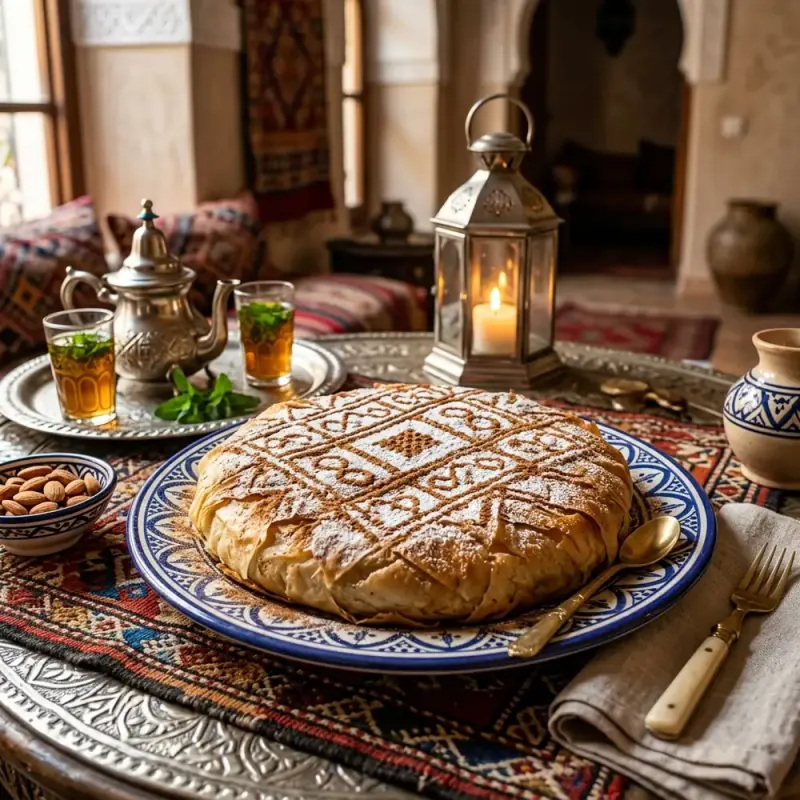
THE CLASSIC ROYAL PASTILLA TOPOGRAPHY/ \ / * \ <- (Dried Damask Rosebud) / / \ \ / / * \ \ / / / \ \ \ | | | * | | | <- (Burnt Cassia Cinnamon Diamond Stencil) \ \ \ / / / \ \ * / / \ \ / / <- (Toasted Slivered Almonds / Fried Briouat) \ * / \ / [ Pure White Powdered Sugar Canvas Dusted Over Golden Warqa ]
As soon as the pastilla emerges from the oven—glistening, golden amber, and singing with bubbling butter—it is rested for five minutes to allow the interior juices to settle.
- The Sugar Canvas: The entire golden dome is dusted generously with a pure, snow-white layer of sifted powdered icing sugar.
- The Cinnamon Lattice: Using a long wooden ruler or a steady artisan hand, lines of finely ground, fragrant cinnamon are sifted across the sugar, creating a striking geometric diamond grid (chbika) or eight-pointed star pattern.
- The Textural Accents: In modern imperial presentations, the points of the diamond grid are crowned with whole toasted almonds, clusters of edible dried damask rosebuds (Ward Beldi), or tiny sweet almond-filled triangular pastries (Briouats) glazed with wild honey.
When the pastilla is brought to the table, there are no individual portions pre-cut in the kitchen. It is placed in the center of the communal round table on a grand silver platter. The host or eldest guest makes the first incision with a heavy, razor-sharp knife: the room fills with an audible CRACK, followed immediately by an intoxicating plume of steam scented with saffron, roasted poultry, cinnamon, and warm orange blossom water.
Modern Kitchen Adaptations: Can Warqa Be Recreated at Home?
For home cooks living outside Morocco who cannot purchase fresh warqa from the medina market, all hope is not lost. You do not need an antique convex copper dome to experience the joy of homemade Moroccan pastry.
The Modern Paintbrush Technique (Warqa bel Chita)
You can achieve astonishingly close results using a heavy non-stick 10-inch crepe pan and a wide, soft silicone or natural bristle pastry brush over a water bath.
MODERN WATER-BATH PAINTBRUSH SETUP (*WARQA BEL CHITA*)[ Soft Natural Bristle Brush (Painting Dough Lattice) ] | v +-----------------------------------------------------+ | 10-INCH NON-STICK CREPE PAN (*Tfal*) | +-----------------------------------------------------+ | POT OF GENTLY SIMMERING WATER (BAIN-MARIE) | +-----------------------------------------------------+ | v [ Gentle, Regulated Steam Heat Prevents Pan Overheating ]
- The Batter: Prepare a high-hydration batter by blending 200g of all-purpose flour, 50g of fine cornstarch, 1/2 teaspoon of salt, and 280ml of cold water in a high-speed blender until silky smooth. Strain through a fine mesh sieve to eliminate all lumps.
- The Steam Pan Setup: Place your non-stick skillet over a pot of gently simmering water. The steam heat ensures the pan never exceeds 100°C, giving you total control.
- The Painting: Dip your wide pastry brush into the batter and quickly paint a thin, even layer across the warm skillet, overlapping strokes in a cross-hatch pattern to ensure no bare spots remain.
- The Peel: Within 60 seconds, as the water evaporates, the translucent sheet will pull away from the pan’s edges. Gently peel it off with your fingers, place it on a towel, and brush immediately with oil.
Grandmother’s Secrets for Flawless Pastilla Mastery
Here are four golden rules whispered from grandmother to granddaughter in the riads of Fes:
+------------------------------------+-------------------------------------------------------------------------+
| GRANDMOTHER'S SECRET RULE          | CRITICAL CULINARY RATIONALE                                             |
+------------------------------------+-------------------------------------------------------------------------+
| The 2-Hour Colander Press          | Dghmira must be 100% dry; water ruins warqa lamination instantly.      |
| Cold Almond Oil Start              | Frying almonds from cold oil guarantees core crunch without burnt skins.|
| The Double-Sheet Base Shield       | Reinforces bottom floor against juicy poultry weight during lifting.    |
| The 30-Minute Rest Before Oven     | Allows butter to crystallize and sets structural origami folds.         |
+------------------------------------+-------------------------------------------------------------------------+
Secret 1: The Two-Hour Colander Press
Never rush your Dghmira (onion-egg reduction). After cooking, transfer the mixture into a stainless-steel colander set over a deep bowl. Place a small plate on top weighted with a clean, heavy jar. Let it drain for at least two full hours. The clear golden oil that drips through can be used to brush your pastry sheets; the dry, velvety onion-egg curd left in the colander will keep your pastilla crisp for hours without a single hint of sogginess.
Secret 2: Fry Almonds from Cold Oil
Never drop raw blanched almonds into hot oil! If you do, the exterior will brown in seconds while the inside remains rubbery and moist. Always place your blanched, bone-dry almonds into a pot of cold oil, then turn the flame to medium. As the oil heats gradually, it draws moisture out of the center of the nuts. When they turn golden blonde, remove them immediately—they will continue to cook in their residual heat to a perfect, shatteringly crisp crunch.
Secret 3: The Double-Sheet Base Shield
When laying your foundation sheets in the pan, always place two full sheets of warqa across the bottom floor, brushing clarified butter generously between them, before adding your chicken filling. This double-layer shield acts as a thermal and moisture barrier, ensuring that even the bottom crust of your pastilla stays golden and crunchy when served onto the platter.
Secret 4: Rest Before Baking
Once your pastilla is completely assembled, folded, and sealed with egg yolk, do not rush it straight into a blazing oven! Let the assembled pie rest on the counter in a cool room for thirty minutes. This brief resting period allows the clarified butter between the warqa leaves to firm up slightly, relaxing the gluten tension in the folds and ensuring the pastilla holds its tight, smooth, domed shape throughout the baking process.
Frequently Asked Questions (FAQ)
1. Can I use store-bought Greek phyllo dough if I cannot find authentic Moroccan warqa?
Yes, you can substitute store-bought phyllo dough, but you must treat it with special care. Commercial phyllo is machine-rolled, drier, and far more brittle than hand-crafted warqa. Because phyllo sheets are thinner and lack warqa's elastic moisture-resistance, you will need to double the number of layers (using 8 to 10 sheets for the base) and brush each sheet extremely generously with melted clarified butter. The resulting pastilla will be pleasantly flaky, though it will have a lighter, more delicate crumb rather than the robust, distinct crunch of true warqa.
2. Why did the bottom of my pastilla turn out soggy after baking?
A soggy bottom is almost always caused by excess moisture trapped within the onion-egg reduction (dghmira) or under-cooked chicken meat. If the onions are not reduced until the water has completely boiled off, or if the cooked eggs are not thoroughly strained in a colander, that trapped water will seep downward into the bottom pastry layers during baking. Always ensure your fillings are thoroughly chilled and drained of all water-based liquids before assembling.
3. What is the difference between Fassi (Fes) Pastilla and Tetouani Pastilla?
While both are masterpieces of Moroccan gastronomy, their fillings and seasonings differ. The classic Fassi Pastilla is the world-famous sweet-and-savory triumph featuring pigeon or chicken, rich egg-onion dghmira, and cinnamon-spiced crushed almonds dusted with sugar. The northern Tetouani Pastilla (heavily influenced by coastal Andalusia) is often prepared with fresh seafood—tender white fish, calamari, and spiced shrimp tossed with thin vermicelli noodles, preserved lemon rind, and fiery red charmoula paste, wrapped in warqa and baked without sugar or cinnamon.
4. Can I assemble a Pastilla in advance and bake it later?
Yes, pastilla is an exceptional make-ahead dish for dinner parties. You can fully assemble, wrap, and seal the pastilla in its baking tin up to 24 hours in advance. Wrap the entire tin tightly in plastic wrap and store it in the refrigerator. When ready to serve, remove the plastic wrap, brush the top surface with a fresh layer of melted clarified butter, and bake directly from the refrigerator, adding roughly 10 minutes to the total baking time. You can even freeze an unbaked pastilla for up to two months.
5. Why is clarified butter (smen or ghee) preferred over regular butter?
Regular butter contains roughly 16% to 18% water and milk solids (casein and whey). When brushed onto delicate warqa, that water introduces unwanted moisture that softens the dough and prevents crisp lamination. also, the milk solids scorch and turn bitter at normal baking temperatures (180°C / 350°F). Clarified butter is 100% pure lipid fat; it coats each pastry leaf completely, allowing the dough to flash-fry into dozens of separate, feather-light, golden-crisp wafers without burning.
Visualizing the Art of Warqa: Image Prompts
Image 1: The Maâlma at the Scorching Copper Dome
- Subject: An atmospheric, close-up dynamic shot of an elderly Moroccan female master baker (Maâlma) seated beside an ancient glowing charcoal hearth in a whitewashed medina kitchen. Her hands are frozen in motion: her right hand holds a glossy ball of elastic dough, pulling it upward away from a polished, convex tin-plated copper dome (siniya). On the dome’s surface rests an impossibly thin, translucent, white-hot film of warqa pastry just beginning to curl at the edges.
- Vibe: Masterful, timeless, culinary physics, ancient guild heritage.
- Style: Cinematic artisan documentary photography, low-key warm lighting with glowing embers casting orange highlights on the polished copper and weathered hands, high shutter speed freezing the motion of the dough.
- Format: 16:9 widescreen
Image 2: The Slicing of the Royal Pastilla
- Subject: A dramatic, mouth-watering macro shot of a freshly baked, towering golden royal pastilla resting on an antique engraved silver Moroccan platter. A large silver knife has just sliced a triangular wedge, revealing the distinct internal layers: glistening saffron-shredded chicken, velvety golden-amber onion-egg custard (dghmira), and coarse toasted almonds. Delicate wisps of aromatic steam rise from the opening. The shatteringly crisp top crust is dusted with white sugar and dark cinnamon lines.
- Vibe: Decadent, luxurious, mouth-watering, imperial feast.
- Style: High-end culinary editorial food photography, shallow depth of field focusing on the crisp layered cross-section, natural soft directional light, rich textures of pastry flakes scattering on the silver.
- Format: 4:3
Image 3: The Assembly and Geometry of the Radial Base
- Subject: An overhead (flatlay) view of a heavy round tinned-copper baking dish halfway through the assembly process. Five translucent leaves of butter-glistening warqa are arranged in a perfect radial sunburst pattern over the rim. In the center, a generous layer of rich, golden-yellow saffron chicken and caramelized onion reduction has been placed. Nearby sit small hand-painted ceramic bowls filled with blanched golden fried almonds, cinnamon bark sticks, and a brass pot of melted clarified butter with a pastry brush.
- Vibe: Educational, artistic, geometric precision, culinary craftsmanship.
- Style: Bright, clean artisan kitchen still-life, balanced geometric composition, diffused daylight illuminating the gossamer transparency of the pastry sheets and colorful spices.
- Format: 1:1 square
Image 4: The Medersa Geometry of the Cinnamon Stencil
- Subject: A top-down, graphic close-up of the finished crown of a grand Fassi pastilla. The golden, blistered warqa dome is fully coated in a smooth canvas of snowy icing sugar. Across the sugar, crisp, dark brown lines of freshly ground cinnamon form a flawless Islamic geometric eight-pointed star and diamond lattice. In the center of each diamond rests an edible dried deep-pink damask rosebud and a single toasted golden almond.
- Vibe: Regal, artistic, sacred geometry, imperial Moroccan elegance.
- Style: Fine art food photography, soft diffused overhead lighting, razor-sharp focus on the powdery texture of the sugar and intricate geometric spice lines.
- Format: 16:9 widescreen
Image 5: The Stacking of the Translucent Warqa Leaves
- Subject: A close-up side-angle shot of a towering stack of dozens of freshly made, translucent Moroccan warqa leaves resting on a clean blue-and-white checkered linen cloth. A female hand with delicate henna patterns is lifting the topmost sheet, demonstrating its sheer, paper-thin, fabric-like transparency as warm morning light shines directly through the pastry leaf. Tiny droplets of golden oil glisten across the surface.
- Vibe: Delicate, ethereal, gossamer, artisan perfection.
- Style: Editorial travel and food photography, back-lit natural window light accentuating the transparency of the pastry, soft warm background with copper cookware hanging in soft focus.
- Format: 3:2
Experience the true heart of Moroccan heritage through its culinary traditions. Join us in preserving and honoring these ancestral recipes.
What People Are Saying
No comments yet. Be the first — we'd love to hear from you.
Lalla Fatima & The Medina Culinary Guild
Culturally Verified & Fact-CheckedThe Moroccan Food editorial team brings together native culinary researchers, heritage preservationists, and experienced home cooks across Marrakech, Fes, and Casablanca. Every recipe and cultural guide is reviewed against ancestral oral traditions and authentic regional practices.