Moroccan Wedding Traditions: The Full Week of Ceremonies Nobody Tells Tourists About
The Moroccan Wedding Week: What Actually Happens and Why Each Day Is Different
When I was growing up, every significant wedding in my extended family and neighborhood involved at minimum four days of activity, and the full traditional sequence runs to seven. This is not extravagance for its own sake — each ceremony in the traditional Moroccan wedding week has a distinct function, a distinct emotional register, and a distinct ritual logic that makes its position in the sequence meaningful. Remove one and the story has a gap. Compress everything into a single evening and you have a party, not a wedding in the traditional sense.
I want to describe the full sequence as I know it — primarily the Fassi urban tradition, which I am most familiar with, acknowledging that regional variations are significant and that Amazigh, Sahrawi, Rif, and various urban traditions differ from each other in important ways that a single account cannot fully represent.
What Happens in the Days Before the Main Wedding Night?
The preparations begin weeks before the wedding itself, but the ceremonial sequence typically opens three to five days before the wedding night.
The Hammam Day — almost always reserved for women — is the first public ceremonial event. The bride, accompanied by her female family members and close friends, goes to the traditional public bathhouse for a ritual bathing that is simultaneously a social gathering, a beauty preparation, and a cleansing rite marking the transition out of the unmarried state. The hammam is rented for the group for a morning or afternoon; the senior women of the family oversee the preparations; there is music, food brought in baskets, considerable noise, and a specific happiness that is different from the happiness of the wedding itself — more intimate, more female, more about the community of women around the bride than about the bride as a public figure.
The Negafa — the professional bridal dresser, an indispensable figure in urban Moroccan weddings — enters the process at this stage. She will dress the bride for each of the ceremonial changes across the wedding week, assist with hair and jewelry, and manage the enormous logistical operation of seven complete ensembles in the correct sequence.
The Leilat al-Henna — the henna night, typically held two evenings before the wedding — is the ceremony where the bride receives her bridal henna from the neqqasha (henna artist) while surrounded by her female family and friends. The groom has a parallel ceremony at his family’s home. The two events happen simultaneously in different houses, which is a feature of the traditional structure that I find architecturally interesting — the wedding begins as two separate, parallel events before it becomes one shared one.
What Is the Wedding Night Itself and What Happens During It?
The Leilat al-Arous — the wedding night proper — is what visitors sometimes attend and what photographs show. But understanding it requires knowing that by this point, everyone present has already been through several days of ceremonies. The emotional state of the family and the community is one of accumulated intensity, not single-evening festivity.
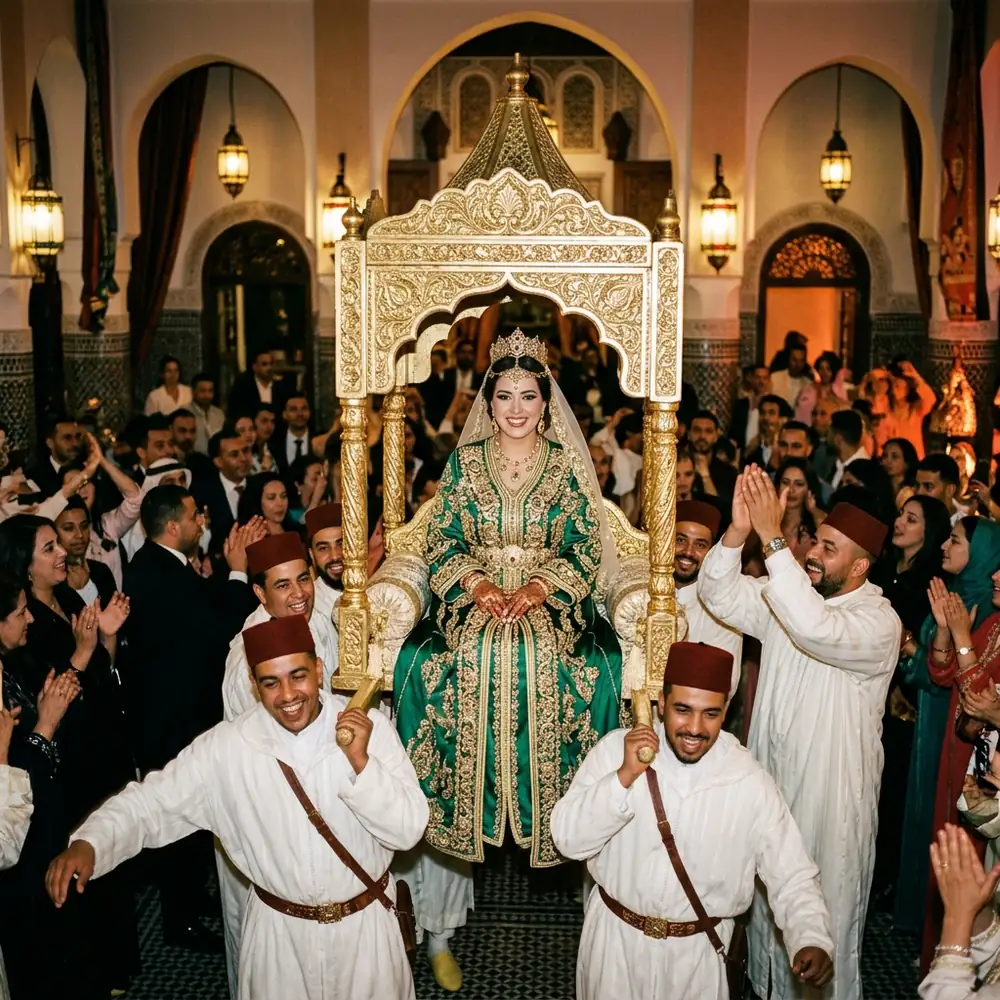
The bride arrives in her first caftan after the guests have gathered — the entrance is announced, she is carried or escorted to a decorated platform or sedan chair (amariya) in the center of the celebration room, and she sits there in formal stillness while the guests observe, photograph, and celebrate around her. The negafa manages the transitions between caftan changes, which happen at intervals throughout the evening.
The specific number of caftan changes varies by family wealth, regional tradition, and the bride’s own preference, but seven is the traditional Fassi number for a formal celebration. Each change represents a different hour of the night and a different emotional register — from the formal entry ensemble to the playful later-evening change, from the heaviest traditional embroidery to the lighter modern pieces if the bride is mixing traditional and contemporary styles.
The groom’s entry — typically later in the evening than the bride’s — is its own theatrical moment. In the Fassi tradition, he arrives in formal dress, sometimes on a white horse led through the medina streets, with music and celebration accompanying his progress from his family home to the wedding venue. The moment of his sitting beside the bride for the first time in the public ceremony — both of them on the amariya, both in formal dress, both being photographed from every direction — is the ceremonial center of the wedding night.
Food is served throughout: a full Moroccan formal dinner including bastilla, tagines, couscous, and the pastry service, but consumed in sections around the ceremony rather than in a formal seated dinner sequence.
What Happens the Morning After and in the Days Following?
This is where the traditional structure diverges most significantly from what visitors understand of Moroccan weddings, because the Sbaa — the seventh-day ceremony — is often more emotionally significant for the family than the wedding night itself.
The morning after the wedding night, the bride’s mother and senior female relatives visit the couple — this is the Sbaah, the morning visit — and there are specific traditional rituals around this visit that vary considerably between communities and that I will not describe in detail here out of respect for their private nature.
The Sbaa — seventh-day celebration — is a gathering of close family to welcome the couple as an established unit. This ceremony is smaller, more intimate, and in many families more emotionally resonant than the main wedding night. It marks the actual integration rather than the celebrated beginning. The food for the Sbaa is specific: couscous is typically central, prepared by the senior women of the family in the quantities and style that signal permanence and nourishment rather than celebration and display.
The Invisible Invitation
It is the second day of the wedding week — not the wedding night, but the day before it — and the women of the family are at the bride’s parents’ house sorting through the seven caftan bags, checking each ensemble, laying out jewelry, making decisions about the order of the evening. The negafa is there advising. The bride is sitting in the center of this activity looking simultaneously terrified and elated, which is the correct emotional state for someone about to be the focal point of a major public ceremony for the first time in their life. Her grandmother is sewing a small repair in the hem of the fourth caftan. Her youngest cousin is trying on jewelry without asking permission. The kitchen is making harira for everyone’s lunch. This is also the wedding. All of this is also the wedding.
SEO Meta Description: What is a traditional Moroccan wedding week? The full sequence — hammam day, henna night, seven caftan changes, groom’s entry, and the seventh-day Sbaa ceremony explained.
Experience the true heart of Moroccan heritage through its culinary traditions. Join us in preserving and honoring these ancestral recipes.
What People Are Saying
No comments yet. Be the first — we'd love to hear from you.
Youssef Amazigh
Culturally Verified & Fact-CheckedThe Moroccan Food editorial team brings together native culinary researchers, heritage preservationists, and experienced home cooks across Marrakech, Fes, and Casablanca. Every recipe and cultural guide is reviewed against ancestral oral traditions and authentic regional practices.