Moroccan Weddings Through a Local Lens: Traditions, Music, and Modern Changes
Moroccan Weddings Through a Local Lens: Traditions, Music, and Modern Changes
If you happen to be staying in a medina during the summer — the traditional wedding season in Morocco — you will eventually be woken up at 3:00 AM by the sound of drums, the reedy blast of a ghaita (a traditional oboe), and the high-pitched trill of women’s ululations. This is the dakhla, the grand entrance of the bride and groom. And at 3:00 AM, the party is just getting started.
A Moroccan wedding is one of the most spectacular, exhausting, and culturally dense celebrations on earth. It is a synthesis of everything Morocco values: generosity, family, music, intricate craftsmanship, and food. But the weddings of 2026 are not exactly the same as the weddings of 1996. The core remains, but the details are shifting.
Here is a look inside the modern Moroccan wedding marathon.
The Anatomy of the Celebration
Traditionally, a Moroccan wedding could last up to seven days. Today, primarily for economic and logistical reasons, the celebration is usually compressed into two or three intense days.
Day 1: The Hammam and the Henna
The process begins with purification. The bride, accompanied by her female relatives and close friends, rents out a neighborhood hammam. This is a day of singing, scrubbing, and female solidarity.
The following evening is the Henna party. A Nekacha (a professional henna artist) applies intricate, lace-like geometric and floral patterns to the bride’s hands and feet. In Moroccan tradition, henna is not just decorative; it contains baraka (blessing and protective power) to ward off the evil eye and ensure fertility and happiness in the marriage. The atmosphere here is intimate, emotional, and exclusively female.
Day 2: The Grand Celebration (Al-Urs)
This is the main event. It rarely starts before 9:00 PM. Guests arrive in their finest traditional clothing — women in heavily embroidered, jeweled takshetas (a two-piece caftan) and men in sharp suits or traditional djellabas.
The most distinctive element of a Moroccan wedding is the role of the Negafa. The Negafa is the master of ceremonies, the head stylist, and the guardian of tradition. She provides the multiple outfits the bride will wear throughout the night and coordinates her every movement.
The Marathon of Dresses
In a traditional wedding, the bride will change her outfit up to seven times throughout the night. Each dress represents a different region of Morocco, symbolizing the unity of the country’s diverse cultures.
- The Green Caftan: Usually worn during the henna ceremony.
- The Takhlila (Fassi Dress): A spectacularly heavy, jewel-encrusted dress originating from Fes, often worn with an elaborate headdress.
- The Chelha (Amazigh/Berber Dress): Representing the indigenous cultures of the mountains and the south, accompanied by heavy silver and amber jewelry.
- The Sahraouia: A flowing fabric draped over the body, representing the Saharan south.
- The Chamalia: Representing the northern Rif region.
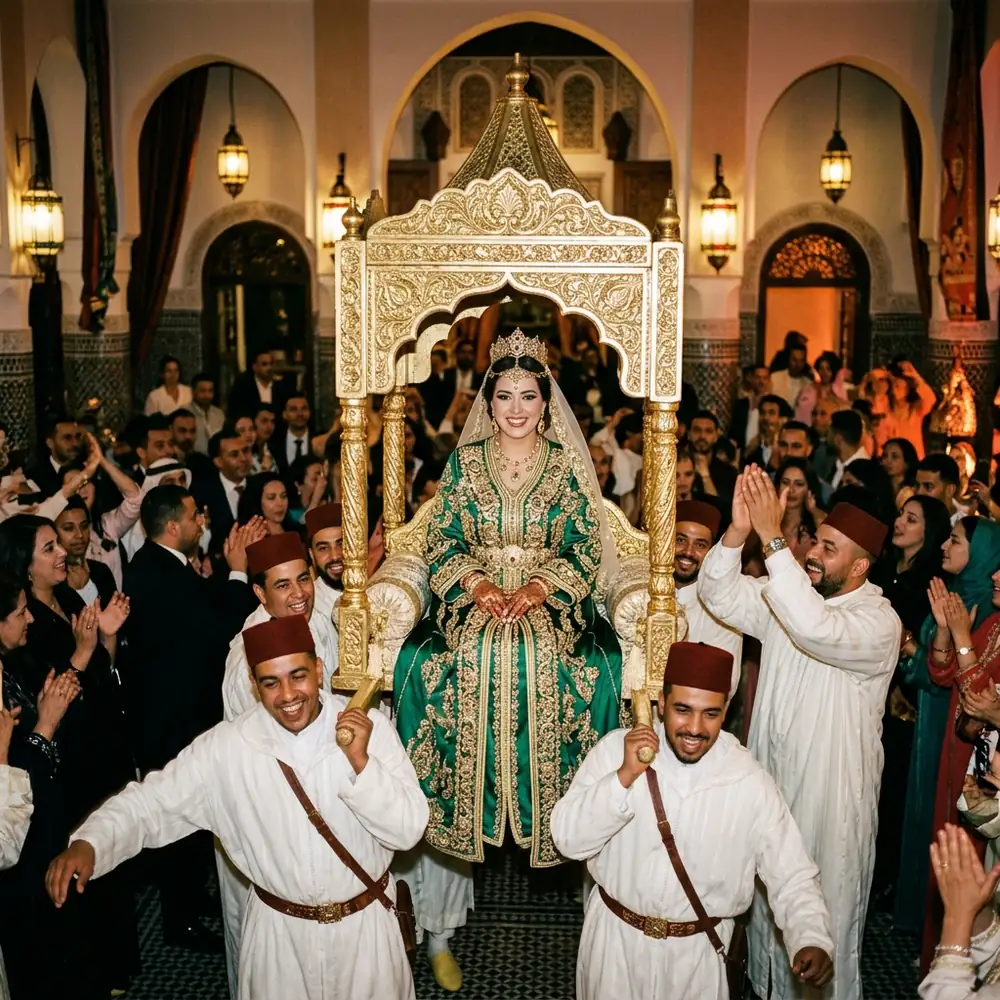
The most dramatic moment of the night is when the bride is carried into the hall on an Amaria (an ornate, roofed palanquin) and later on a Mida (an open circular platform), lifted by four men dancing to the music. The groom is also lifted. It is a moment of absolute royal treatment.
The Music and the Food
You cannot have a Moroccan wedding without an orchestra. The music usually starts with classical Andalusian or Malhun, moving into popular Chaabi (which gets everyone on the dance floor) as the night progresses. In the south, you will hear Amazigh rhythms; in the north, perhaps some Reggada.
The food is designed to demonstrate overwhelming generosity. It is served very late — often dinner doesn’t begin until 1:00 AM or 2:00 AM.
The standard progression:
- Pastilla: A savory-sweet pie made of thin pastry (warka) filled with either pigeon/chicken and almonds, or seafood and vermicelli.
- Mechoui or Tagine: Slow-roasted lamb (mechoui) or a massive tagine of beef with prunes and almonds.
- Fruit and Mint Tea: Huge platters of seasonal fruit, followed by Moroccan pastries (cornes de gazelle, chebakia) and tea.
How Weddings are Changing in 2026
While the core traditions remain fiercely protected, modern Moroccan youth are reshaping the celebration.
The White Dress: At the very end of the night (usually around 5:00 AM), it is now standard for the bride to change into a Western-style white wedding dress to cut the cake before leaving. This was rare thirty years ago.
The Cost and the Scale: Weddings are enormously expensive. A middle-class wedding can easily cost the equivalent of a year’s salary. In 2026, there is a growing movement among young urban Moroccans to reject the financial pressure of the seven-dress marathon, opting instead for a smaller, one-day event with one or two outfits, focusing the budget on buying an apartment or a honeymoon.
Mixed Seating: In highly conservative families, men and women celebrate in separate rooms. In modern urban weddings, the celebration is entirely mixed, with men and women dancing together to the Chaabi bands.
If You Are Invited
If you are a foreigner living in or visiting Morocco and you are invited to a wedding, you must go.
What to wear? For women, you can wear a formal Western evening dress, but if you want to truly honor the occasion, rent or buy a takchita. Your Moroccan friends will be thrilled to help you find one. For men, a dark suit is perfectly acceptable.
When to arrive? If the invitation says 8:00 PM, do not arrive before 9:30 PM.
When to leave? Whenever you can no longer keep your eyes open. But if you can make it to the breakfast of harira soup served at 6:00 AM as the sun comes up, you will have experienced the true stamina of Moroccan joy.
Experience the true heart of Moroccan heritage through its culinary traditions. Join us in preserving and honoring these ancestral recipes.
What People Are Saying
No comments yet. Be the first — we'd love to hear from you.
Yasmine Belkadi
Culturally Verified & Fact-CheckedThe Moroccan Food editorial team brings together native culinary researchers, heritage preservationists, and experienced home cooks across Marrakech, Fes, and Casablanca. Every recipe and cultural guide is reviewed against ancestral oral traditions and authentic regional practices.