Nothing is Wasted: How the Moroccan Kitchen Perfected Zero-Waste Cooking Centuries Before the Term Existed
Rien ne se perd: The Moroccan Kitchen's Complete System
I used to throw away stale bread. Before I understood what Rfissa was, before I understood the whole logic of the Moroccan kitchen, I would look at the dry khobz from two days ago and see a problem. Now I see a dish.
The Moroccan culinary tradition has no category for "waste" in the sense we currently use the word. Not because the culture is ideologically committed to sustainability in the modern sense, but because the tradition developed in conditions of genuine material constraint and produced, over centuries, a complete system for extracting value from everything. A system so efficient that it doesn't look like a system at all — it just looks like how cooking works.
What Happens to Stale Bread in the Moroccan Kitchen
Khobz — the round flatbread that accompanies virtually every Moroccan meal — goes stale quickly in the dry climate of much of the country. The Moroccan kitchen has solutions for every stage of staleness.
Day-old bread: Warmed briefly in the oven or directly over a flame and eaten as normal. The structure holds.
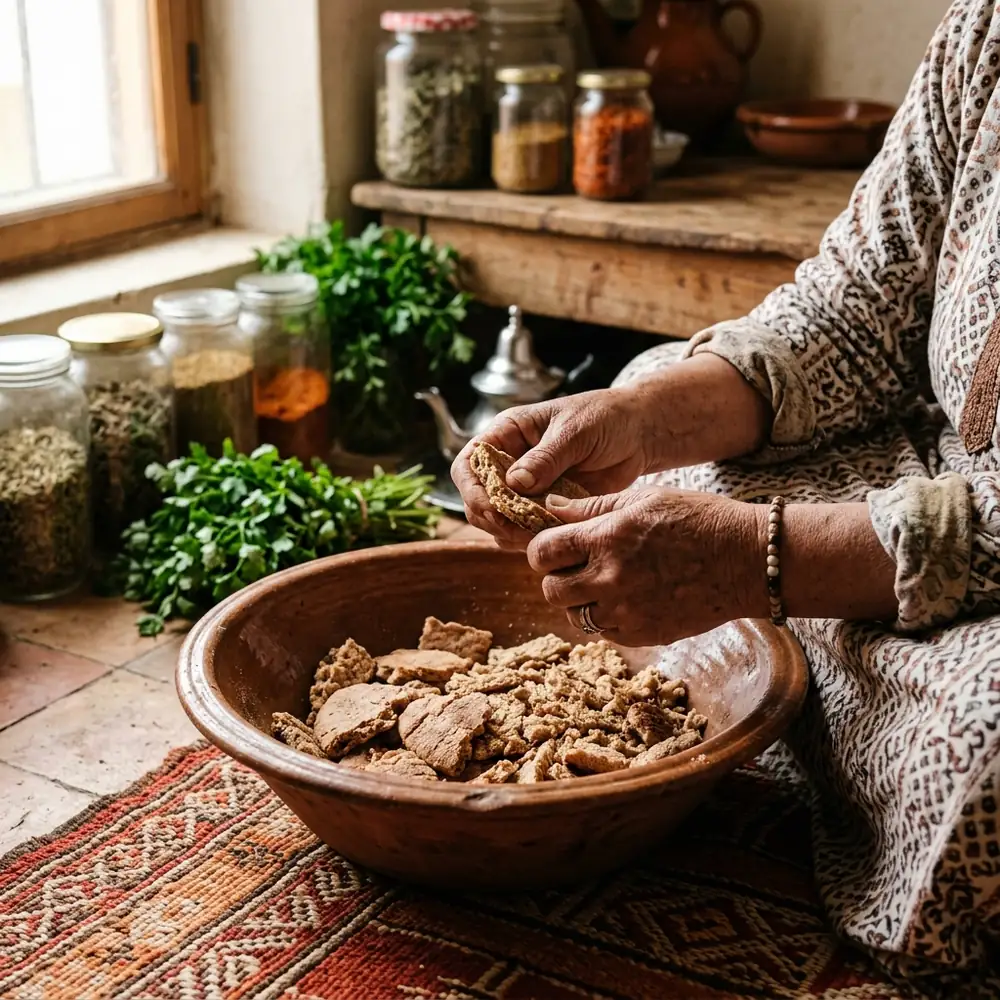
Two-day bread: Torn into pieces for Rfissa — the postpartum celebration dish where dried bread is layered with slow-cooked chicken and fenugreek broth, rehydrating and absorbing the rich cooking liquid until it becomes something entirely different from its original form.
Fully dry, hard bread: Ground coarse and used as breadcrumbs for coating — or cooked with oil and sugar as hssoua, a sweet paste that is breakfast when nothing else is available, and which is excellent.
No bread is thrown away. The kitchen knows what each state of the bread is for.
The Complete Animal: Festival and Daily Practice
The Eid al-Adha sacrifice — the annual sheep slaughter that is the primary religious celebration for the majority of Moroccan households — is the most visible expression of what complete-animal cooking looks like in practice.
The sequence over the three days of Eid is a lesson in systematic use:
- Day 1, immediately: The liver, heart, and lungs are grilled directly over charcoal and eaten at the celebration. These organs do not preserve and are cooked first.
- Day 1, later: The head is split and cooked — the brain, the cheeks, the tongue, the eyes. In some households, the head is made into a spiced preparation; in others, it is grilled whole.
- Day 2: The feet (kria) are slow-cooked with spices until the collagen has completely dissolved and the skin has become silky and the small bones have yielded all their gelatin to the cooking broth.
- Days 2-3: The major cuts — shoulder, ribs, leg — are divided between immediate cooking and preservation as Khlii or Khlea (the Moroccan version of confit: meat cooked in its own fat with spices and then stored in rendered fat, where it will keep for months at room temperature).
- The fat: Nothing. Every part of the rendered fat is used — for cooking, for the Khlii preservation process, for the oiled flatbreads that appear in the days following Eid.
- The bones: Simmered for hours to make the broth base for harira and other soups in the weeks following.
The entire animal, used completely, over four days of meals that feed the family, the neighbors, and the extended household. This is not a sustainability project. This is the normal operation of a kitchen that cannot afford to waste and has organized itself, over generations, to not waste.
Citrus: The Bitter Oranges That Line Every Medina Street
The bitter orange trees (bigarade) planted throughout Moroccan medinas — their fruit inedible raw, their flowers intensely fragrant — are a zero-waste system that serves multiple purposes simultaneously:
- The flowers are harvested and steam-distilled to produce ma' zahar (orange blossom water), used in pastries, drinks, and rituals
- The peel is dried and used in spice blends, particularly in certain versions of ras el hanout
- The peel is candied and used in pastries
- The dried peel, burned on coals, functions as a natural air freshener in homes
- The juice, despite being too bitter to drink, is used in certain cleaning preparations
A tree that produces inedible fruit has been made, over centuries of practical observation, into a resource that serves the kitchen, the perfumery, the medicine cabinet, and the home in six different ways. This is zero-waste not as ideology but as accumulated practical intelligence.
The Modern Application: What This System Can Teach Us
The principle is not complicated. It requires, primarily, a different relationship with ingredients — seeing them not as single-use resources with a fixed function but as materials with multiple potential uses at different stages of their life.
Practical translations:
- Save your cooking liquid. Every liquid in which meat or vegetables cooked has value. It is the base of the next soup, the liquid for the next braise.
- Buy whole animals or large cuts rather than processed portions. The bones, fat, and secondary cuts pay back the initial cost multiple times over.
- Learn two or three specific uses for each ingredient in its various states: fresh, day-old, dried, cooked, overcooked. The Moroccan kitchen has answers for all of these.
The zero-waste kitchen is not a new invention. It is a very old one. The Moroccan version of it is simply better documented, more systematically developed, and more delicious than most.
Experience the true heart of Moroccan heritage through its culinary traditions. Join us in preserving and honoring these ancestral recipes.
What People Are Saying
No comments yet. Be the first — we'd love to hear from you.
Fatima Ziani
Culturally Verified & Fact-CheckedThe Moroccan Food editorial team brings together native culinary researchers, heritage preservationists, and experienced home cooks across Marrakech, Fes, and Casablanca. Every recipe and cultural guide is reviewed against ancestral oral traditions and authentic regional practices.