The Perfect 7-Day Morocco Itinerary: How to See the Country Without Running the Whole Time
The Perfect 7-Day Morocco Itinerary: How to See the Country Without Running the Whole Time
Most “Morocco in 7 days” itineraries try to cover five cities and the Sahara. The result is a week of sitting on buses, arriving at places too tired to appreciate them, and leaving before you have understood anything.
This itinerary is built differently. It makes choices. It goes deep in fewer places rather than shallow in many. And it leaves room for the thing that makes Morocco worth visiting in the first place: the unplanned encounter, the wrong turn into a beautiful alley, the afternoon you spend doing absolutely nothing in a rooftop café.
Before We Start: Two Route Options
Morocco has two logical 7-day circuits for first-time visitors:
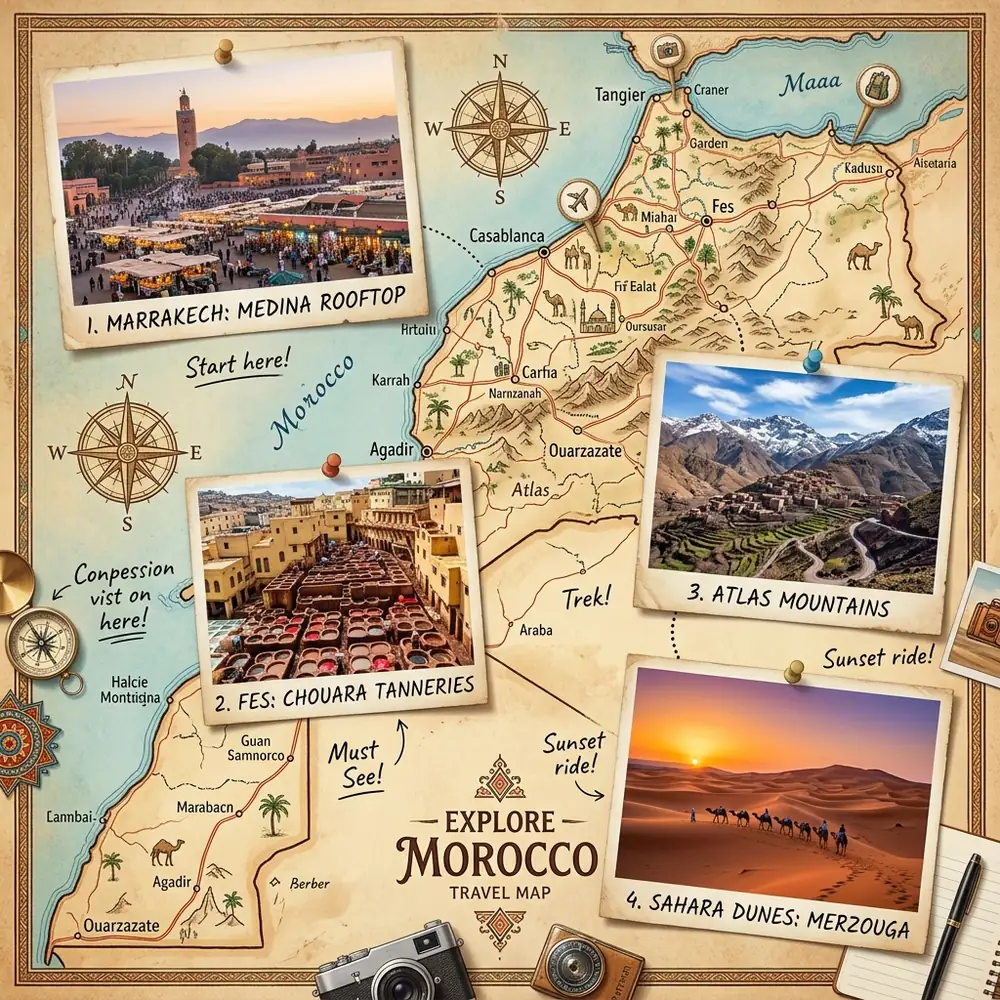
The Imperial Cities Route: Marrakech → Fes, covering culture, medinas, and mountains. Best for history lovers and those who want the full medina immersion.
The South and Desert Route: Marrakech → Ouarzazate → Sahara → back. Best for landscape, photography, and people who prioritise the visual drama of Morocco over its urban complexity.
The itinerary below is the Imperial Cities Route, which most travellers find more varied and memorable. A desert extension note is included at the end.
Day 1: Arrive in Marrakech — Do Absolutely Nothing Useful
Your flight lands. You get to your riad. The medina makes no sense yet. The alleys are dark and narrow and seemingly random.
Perfect. Stay in them.
Do not try to see Djemaa el-Fna immediately with all your energy. Do not attempt to navigate to the Bahia Palace on your first afternoon. Instead: drop your bags, have a coffee on your rooftop terrace if your riad has one, and walk with no purpose for two hours.
Get lost. Eat something from the first stall that smells good. Buy nothing yet — the souks will still be there tomorrow and you will negotiate better when you are rested.
Where to sleep: A riad in the medina for the first nights is worth spending a bit more on. The atmosphere is a genuine part of the experience. Riads with rooftop terraces give you the evening view over the city that no hotel balcony replicates.
Day 2: Marrakech Medina — The Important Places
Now explore with intention.
Morning (unhurried):
- Bahia Palace (arrive early, before the tour groups): 70 MAD entry. The cedar carved ceilings and the garden make it worth every dirham.
- Mellah (Jewish Quarter): Walk through. The synagogues are small and often open on request. The market here is less touristy than the main souks.
Afternoon:
- The Souks: The leather district (Souk des Tanneurs), the spice market, the lantern souk, the musical instrument section. Give yourself three hours minimum and go without a “guide” who approaches you at the entrance — they are commission agents, not guides.
- Ben Youssef Madrasa: 100 MAD entry. One of the most beautiful interiors in Islamic architecture. Worth it.
Evening:
- Djemaa el-Fna at dusk: The snake charmers, the storytellers, the Gnawa musicians, the food stalls setting up for the evening service. Sit at a café terrace with a mint tea and watch it all.
Day 3: Day Trip to the Atlas Mountains
Marrakech sits at the foot of the High Atlas. This is a geography that most visitors underuse.
Option A: Imlil and the Toubkal foothills A 1.5-hour drive from Marrakech. A Berber village at 1,740m altitude. You can hike to Toubkal base camp (3,207m) as a challenging day walk, or simply walk the valley trails for 2–3 hours.
Option B: Ourika Valley Closer (45 minutes), easier, and beautiful. The road follows a river through increasingly rural Amazigh villages. There are waterfalls at the end. Market day in Tnine Ourika on Mondays is worth timing your visit around.
Both options can be done independently with a rental car or by hiring a grand taxi from Marrakech (negotiate a full-day rate — around 400–600 MAD is fair).
Day 4: Travel Day — Marrakech to Fes
This is the longest transit of the week. Two options:
By CTM bus: Approximately 7 hours, 165 MAD. Buses are comfortable, air-conditioned, and direct. Leave early morning.
By car: 5.5–6 hours if you drive direct via the A3 motorway. More interesting via the Ziz Valley route but adds 2+ hours.
By plane: Royal Air Maroc flies Marrakech–Fes in 55 minutes. In peak season this can cost 300–600 MAD one-way. Worth it if time is precious to you.
When you arrive in Fes, check in and sleep. Fes requires a full day.
Stay near: Bab Bou Jeloud (the main medina gate). Riads inside Fes el-Bali are more atmospheric than anything outside it.
Day 5: Full Day in Fes el-Bali
Fes’s medina is UNESCO listed, contains approximately 9,400 streets and alleys, and has been continuously inhabited since the 9th century. It is also completely disorienting in the best possible way.
Do not navigate without help on your first day. Not because it is dangerous — it is not — but because the spatial logic of the medina is not Cartesian and you will waste half your day frustrated rather than exploring.
Book a licensed guide for the morning (ask your riad; 400–600 MAD for 3 hours is fair). Have them show you:
- Chouara Tanneries: The most famous sight in Fes. Watch from the leather shop balconies above. Afternoon light hits better, but mornings are less crowded. Buy a sprig of mint — the smell is honest.
- Al-Qarawiyyin University and Mosque: The oldest operating university in the world, founded in 859 CE. Non-Muslims cannot enter the mosque, but the courtyard view from the street and the adjacent library (open to researchers) are visible.
- Bou Inania Madrasa: Open to non-Muslims. 14th-century Islamic architecture at its absolute finest.
Afternoon: The guide departs and you wander freely. Get lost again. It is the point.
Day 6: Meknes and Volubilis — Day Trip from Fes
Meknes is 60km from Fes. Volubilis is 30km beyond that. Both in one day is manageable.
Volubilis (Roman ruins): The best-preserved Roman site in Morocco. Second-century mosaics still visible in situ. The site is large — plan 2.5 hours minimum. Entry: 70 MAD.
Meknes: The city that Moulay Ismail built between 1672 and 1727, using, by various historical accounts, tens of thousands of enslaved labourers. The Bab Mansour gate is one of the most theatrically impressive city gates in North Africa. The former imperial stables (écuries de Moulay Ismail) can hold 12,000 horses. The sense of scale is genuinely staggering.
Have lunch in Meknes (try mrouzia or bastilla at a local restaurant near the medina square) and return to Fes by late afternoon.
Day 7: Morning in Fes, Departure
Your last morning. Two options:
Option A: Return to the medina for anything you missed. The souks in the morning — before the tour groups arrive around 10am — are a different experience.
Option B: The ceramics quarter (quarter des potiers) is east of the medina and largely missed by tourists. The traditional blue-and-white Fassi pottery comes from here. Watching potters work is free.
Fly home from Fes-Saïss Airport or take a train/bus back to Casablanca for international connections.
If You Want the Desert: The Alternative Day 4–6
Skip Fes and instead on Day 4 drive south from Marrakech:
- Day 4: Marrakech → Ouarzazate → Draa Valley
- Day 5: Into the dunes at Merzouga (Erg Chebbi). Sunset camel ride. Night in desert camp.
- Day 6: Sunrise, drive back via the Todra Gorge
This requires a car or an organised tour. It is stunning. The trade-off is you do not see Fes at all. Both choices are valid.
Frequently Asked Questions
Is 7 days in Morocco enough? For a first visit: yes, if you make deliberate choices. You will want to come back, which is fine — most people do.
What is the best time of year to visit Morocco? Spring (March–May) and autumn (September–November) offer the most comfortable temperatures across the country. Summer (June–August) is extremely hot inland but manageable on the coast. Winter is mild in the south and Atlas regions.
Do I need to book accommodation far in advance? In Marrakech and Fes: yes, especially for April–May and October–November. Popular riads in the medina sell out weeks in advance in peak season.
Is Morocco safe for solo female travellers? Yes, with standard urban awareness. The medinas can involve persistent attention from vendors and occasionally uninvited “guides.” A confident, direct manner works best. Many solo female travellers visit Morocco without any difficulty.
Experience the true heart of Moroccan heritage through its culinary traditions. Join us in preserving and honoring these ancestral recipes.
What People Are Saying
No comments yet. Be the first — we'd love to hear from you.
The Moroccan Editorial Team
Culturally Verified & Fact-CheckedThe Moroccan Food editorial team brings together native culinary researchers, heritage preservationists, and experienced home cooks across Marrakech, Fes, and Casablanca. Every recipe and cultural guide is reviewed against ancestral oral traditions and authentic regional practices.