Morocco's Economy in 2026: Automotive Industry, Green Hydrogen, Phosphates, and What It Means for Visitors and Expats
Morocco’s Economy in 2026: Automotive Industry, Green Hydrogen, Phosphates, and What It Means for Visitors and Expats
When people ask me what has changed most visibly in Morocco over the past decade, I don’t mention the new riads in Marrakech or the improved airport terminals. I mention driving on the highway from Casablanca to Tangier. In 2005, that adventure took most of a day. Today, on the A1 motorway, it takes about four hours. The landscape outside the window has changed too: enormous factory complexes, wind turbines on the ridgelines, solar panels spreading across the plains near Ouarzazate, the Tanger Med port cranes visible from ten kilometers away.
Morocco’s economic transformation over the past twenty years has been fast enough to feel disorienting if you knew the country before and are encountering it fresh. This isn’t cosmetic development. It’s structural change, driven by deliberate industrial policy, massive infrastructure investment, and a strategic positioning of Morocco as the gateway between Europe and Africa that is now paying significant dividends.
The Phosphate Foundation: Morocco’s Strategic Commodity
Morocco controls somewhere between 70% and 75% of the world’s known phosphate reserves. This is not a minor detail — phosphate is essential to fertilizer production, and fertilizer is essential to feeding the world. Without phosphate, modern agricultural yields collapse.
The Office Chérifien des Phosphates (OCP Group), based in Khouribga, is the world’s largest phosphate exporter and one of Africa’s most significant corporations. In 2022, as global food security concerns spiked following the Russian invasion of Ukraine (Russia and Belarus being major potash and fertilizer producers), Morocco’s strategic importance was dramatically highlighted. OCP’s revenues jumped to record levels, generating foreign exchange and government income that directly funded social protection expansions.
The OCP is also driving Morocco’s most ambitious economic diversification project: the conversion of phosphate processing into a fully integrated fertilizer industry, with new plants in Jorf Lasfar near El Jadida producing nitrogen-phosphate fertilizers destined for African markets. The ambition — to help feed Africa from Moroccan phosphate with Moroccan-produced fertilizer — is genuinely bold.
The Automotive Revolution in Tangier and Kenitra
The transformation of northern Morocco into a major automotive manufacturing hub is perhaps the most dramatic example of Morocco’s industrial policy success.
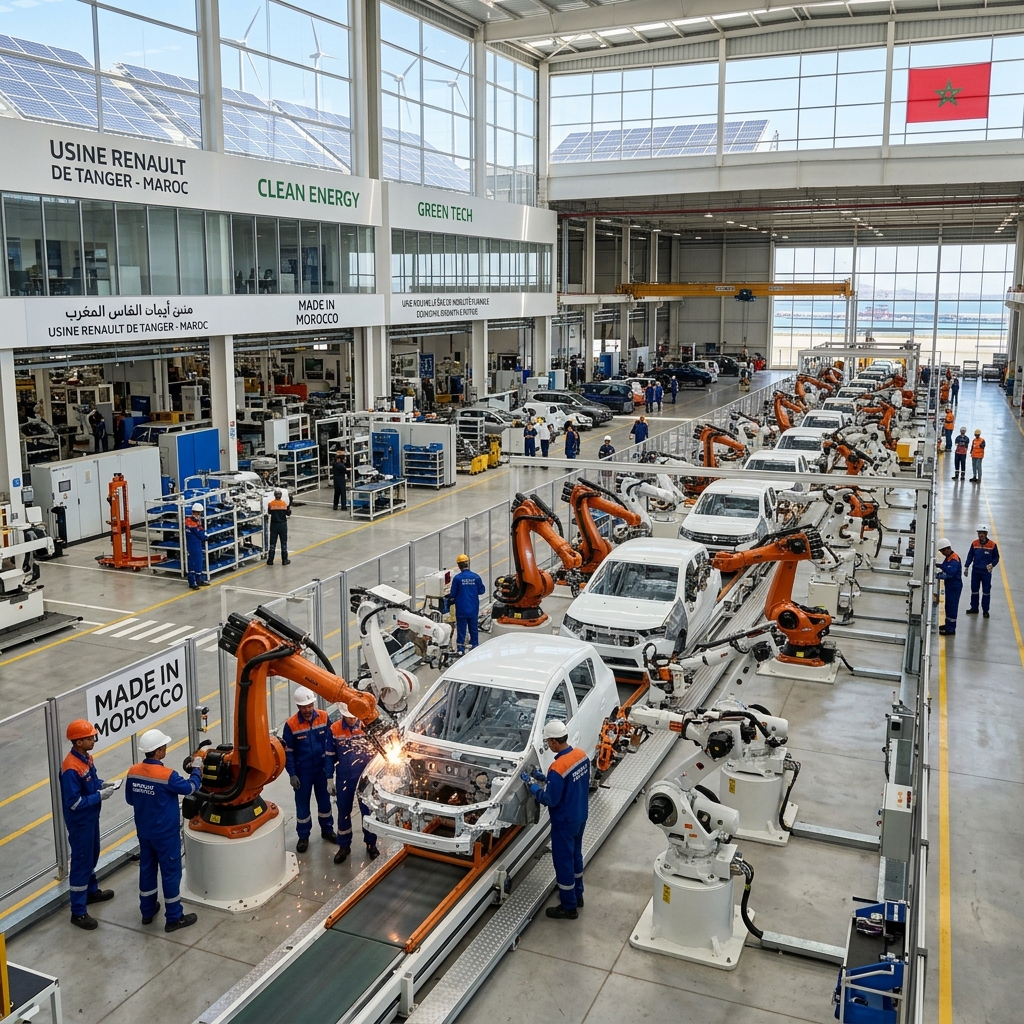
Renault opened its Tangier factory in 2012, with an annual production capacity of 400,000 vehicles. At the time, it was Renault’s largest factory in the world. The initial skepticism — could Morocco build cars? — dissolved within the first years of production when quality metrics met European standards from the outset.
Stelantis (the Peugeot-Citroën-Fiat group) followed with a factory in Kenitra that opened in 2019, adding another 200,000 units of annual capacity. Smaller tier-one and tier-two automotive suppliers have clustered around both sites, creating an automotive ecosystem that now employs over 100,000 Moroccans directly and supports several times that indirectly.
The competitive advantages Morocco offers are straightforward: geographical proximity to European markets (Tanger Med to Algeciras is a ninety-minute ferry crossing), well-developed port and rail infrastructure, a young and increasingly well-educated workforce, political stability by regional standards, and free trade agreements with both the EU and the United States.
In 2025, Morocco announced agreements with Chinese EV manufacturers — including BYD and Chery — to establish EV assembly facilities in Morocco, positioning the country to participate in the transition to electric vehicles rather than being left behind by it.
Green Hydrogen: The Next Bet
Morocco has committed to becoming a major green hydrogen producer and exporter by 2030. The logic is compelling and the assets are real: enormous solar irradiation in the southern desert, strong Atlantic winds on the coast, existing phosphate infrastructure that could be repurposed for hydrogen storage and processing, and geographical proximity to Europe where the demand for green hydrogen is growing rapidly as the continent attempts to decarbonize its industrial sector.
The Noor Midelt solar complex, currently under construction in the Middle Atlas foothills, will be one of the world’s largest hybrid solar-wind power plants when complete. Alongside it, a green hydrogen production pilot project backed by a consortium including German, French, and Moroccan partners is already producing small quantities of hydrogen from electrolysis powered by renewable energy.
The ambition is large: Morocco has signed green hydrogen partnership agreements with Germany, Spain, France, and the Netherlands, and the European Commission has identified Morocco as a priority supplier for its green hydrogen import strategy.
I’ve always been fascinated by the irony here: Morocco, which imports essentially all of its fossil fuel energy, has the potential to become a net energy exporter within a decade — not through oil but through wind, sun, and the electrochemistry of water.
Aerospace and Other Manufacturing
Less publicized than automotive but equally significant, Morocco has become a notable aerospace manufacturing location. Boeing, Bombardier, Safran, and Thales all have significant manufacturing operations in Morocco, producing aircraft components, wiring systems, and avionics assemblies. The Casablanca aerospace cluster around Midparc (Mohamed V International Airport Industrial Zone) employs over 20,000 workers and exports over $2 billion worth of components annually.
The logic is similar to automotive: proximity to European supply chains, competitive labor costs for skilled work, and a government committed to providing industrial zone infrastructure and training support.
Tourism: Morocco’s Other Major Industry
For visitors and expats, the economic transformation of Morocco is most directly visible in the tourism sector. Morocco welcomed approximately 17.4 million tourists in 2024, making it one of Africa’s top-three tourism destinations. The government’s target is 26 million annual visitors by 2030.
The accommodation infrastructure has expanded dramatically. The luxury and upper-midrange hotel segment has grown particularly strongly in Marrakech, Agadir, and Casablanca, driven by investment from both international chains and Moroccan entrepreneurs. The riad renovation wave of the 2000s and 2010s has produced hundreds of excellent small boutique guesthouses across the country.
For visitors: the infrastructure improvements that serve Morocco’s economic development also make traveling easier. The motorway network means that road journeys between cities that once required a full day are now often three or four hours. The expanded airport capacity (Marrakech Menara now processes over 7 million passengers annually) means more flight options and generally competitive prices.
What This Means for Expats
For people considering living in Morocco, the economic transformation has created a country that is simultaneously cheaper than Western Europe and increasingly similar to it in terms of available services, infrastructure quality, and connectivity.
Casablanca, in particular, has developed a significant and growing expat professional community, driven by the city’s emergence as a genuine African business hub. The Africa Finance Corporation, the OCP Group, major French and Spanish banks, and dozens of multinational companies maintain regional headquarters in Casablanca. The professional infrastructure — English-language offices, international schools, healthcare at European standards in the major private hospitals, coworking spaces with reliable internet — exists and is expanding.
Cost of living remains significantly lower than Paris, Madrid, or London for comparable quality of life. A comfortable apartment in a good Casablanca neighborhood costs a fraction of its European equivalent. Domestic staff is affordable. Food is excellent and relatively inexpensive.
The challenges are also real: bureaucracy can be slow and opaque, the banking system has been improving but still frustrates some international users, property ownership by foreigners comes with restrictions that require careful legal navigation, and the cultural adjustment — particularly around expectations of punctuality, social formality, and bureaucratic process — takes time.
But as a place to build a life with access to Africa, proximity to Europe, a genuinely interesting culture, and extraordinary food — Morocco in 2026 is making a compelling case.
Experience the true heart of Moroccan heritage through its culinary traditions. Join us in preserving and honoring these ancestral recipes.
What People Are Saying
No comments yet. Be the first — we'd love to hear from you.
Driss Benali
Culturally Verified & Fact-CheckedThe Moroccan Food editorial team brings together native culinary researchers, heritage preservationists, and experienced home cooks across Marrakech, Fes, and Casablanca. Every recipe and cultural guide is reviewed against ancestral oral traditions and authentic regional practices.