Morocco for First-Time Visitors in 2026: What No One Tells You Before You Land
Morocco for First-Time Visitors in 2026: What No One Tells You Before You Land
I’ve lost count of the number of friends I’ve picked up from Mohammed V airport in Casablanca over the years. Their faces always show the exact same combination of expressions as we drive into the city: exhaustion from the flight, intense curiosity, and a slight, creeping sense of overwhelm. Morocco does that to people. It is a country that refuses to be ignored, that demands your attention from the moment you arrive with its noise, its light, its smells, and its absolute immediacy.
Most travel guides will tell you about the beauty of the riads and the beauty of the Atlas Mountains. They are right. But they often skip the practical friction that comes with navigating a society built on entirely different social contracts than Northern Europe or North America. This is the guide I send to my friends before they land. It’s the honest version.
The Medina is Designed to Confuse You
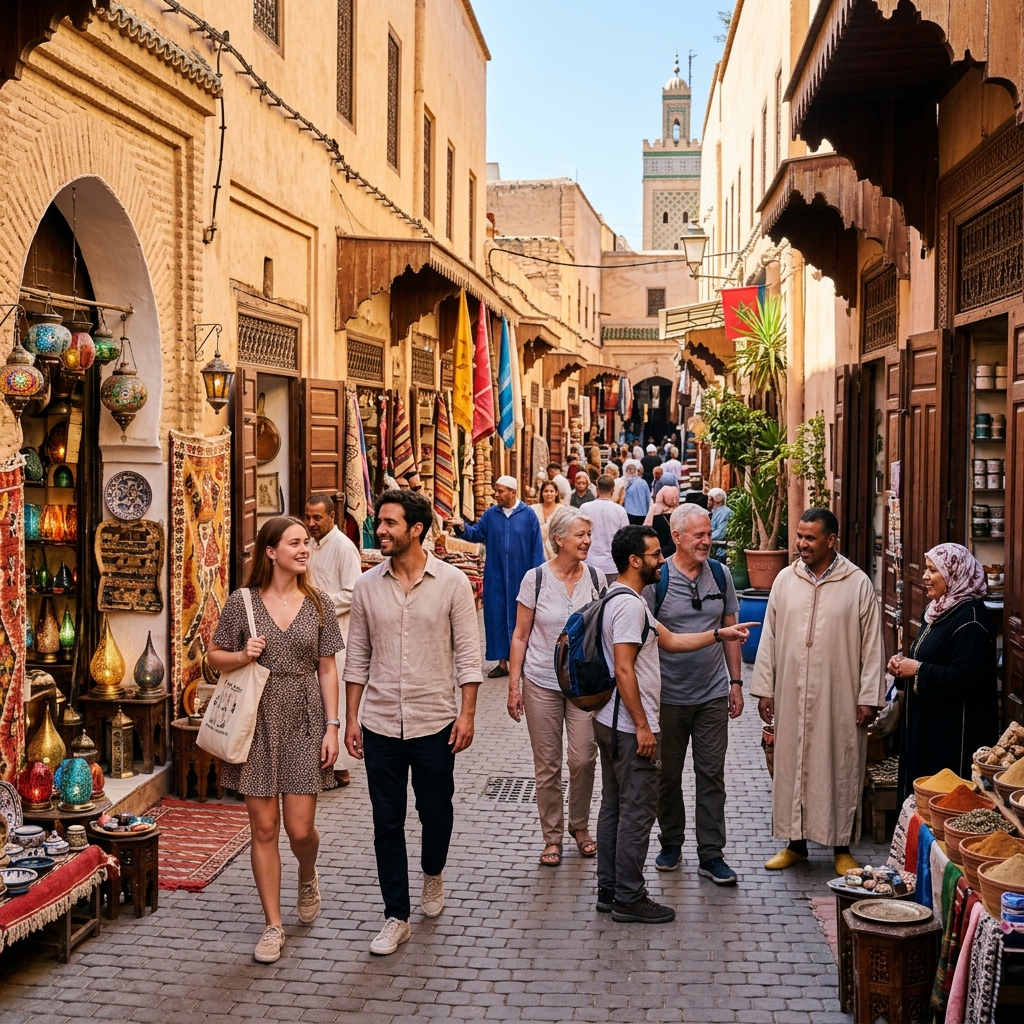
When you enter the medina (the old walled city) of Fes or Marrakech for the first time, you will get lost. This isn’t a possibility; it’s a certainty. The medinas were intentionally designed as defensive labyrinths. There is no grid system. Streets that look like main arteries suddenly narrow into dead ends; covered alleys curve back on themselves.
Here is what no one tells you: getting lost is fine. It is actually the point.
When you inevitably lose your bearings, do not stop in the middle of a busy thoroughfare to stare at your phone. Step to the side. Better yet, go into a café, buy a mint tea, and figure it out there. If you need directions, do not ask a random person on the street (who may offer to guide you for a fee, leading to an awkward interaction when you arrive). Ask a shopkeeper who is physically inside their store. They cannot leave to guide you, so they will give you actual directions.
Google Maps works moderately well in Marrakech’s medina but is famously useless in Fes, where the high walls block GPS signals and the mapping of the 9,000 alleys is mostly fictional. Download Maps.me and the offline map of the city before you arrive — it relies on OpenStreetMap data which is significantly more accurate for Moroccan medinas.
The Concept of ‘Inshallah’ is Practical, Not Just Religious
You will hear the word ‘Inshallah’ (God willing) dozens of times a day. If you ask a train conductor if you will arrive on time, he will say ‘Inshallah.’ If you ask a tailor if your jacket will be ready by Tuesday, he will say ‘Inshallah.’
Westerners often misinterpret this as a fatalistic avoidance of responsibility. It isn’t. It is a deep cultural acknowledgment that human plans are inherently fragile. It means ‘I have every intention of making this happen, but the universe is ultimately outside my control.’
For a first-time visitor, this requires an adjustment of expectations. If you build a Morocco itinerary that requires military precision — train arriving at 10:05, taxi at 10:15, tour starting at 10:30 — you will spend your entire trip stressed. Leave slack in your schedule. Things take the time they take. The train might be delayed because of heat on the tracks. The taxi driver might stop to buy bread. Breathe out. You are on Moroccan time now.
The Money Situation: Cash is Still King
Morocco is modernizing rapidly (the high-speed rail is world-class, the highways are excellent), but the everyday economy remains deeply cash-dependent. While high-end hotels, major restaurants, and large supermarkets accept international credit cards, the places that make Morocco interesting — the souks, the small local cafés, the street food stalls, the taxis — do not.
You will need Moroccan Dirhams (MAD). The dirham is a closed currency, meaning you technically cannot buy or sell it outside the country (though this is occasionally possible at major exchange hubs, the rates are terrible).
Do not exchange all your money at the airport; the rates are poor. Change enough for a taxi and your first day, then use ATMs in the city. ATMs are everywhere in major cities and generally reliable, though they occasionally run out of cash on Sunday evenings. Always choose ‘Decline Conversion’ if the ATM offers to charge you in your home currency — let your own bank do the math; it will always be cheaper.
Carry small change (coins and 20/50 dirham notes). Handing a 200 dirham note to a taxi driver for a 15 dirham fare early in the morning is a recipe for a frustrated argument about who should have change.
The Reality of Hustle and Hassle
Let’s be honest about this: in the tourist hubs of Marrakech, Fes, and Tangier, you will be approached. People will offer to be your guide, try to sell you things, or point you in the ‘right direction’ (which is usually toward their cousin’s carpet shop).
First-time visitors usually react in one of two ways: they either engage enthusiastically with everyone (and quickly become exhausted) or they become aggressively defensive and ignore everyone (which makes them miserable and isolates them from genuine Moroccan hospitality).
The middle path requires a specific skill: polite, firm detachment. A hand on your heart, a smile, and a firm ‘La, shukran’ (No, thank you) while continuing to walk at your original pace is 95% effective. You do not need to explain why you don’t want the item. You do not need to break your stride.
Understand that the hustle is economic, not personal. It is the friction of a developing economy meeting the global north. Do not let it make you cynical. For every person trying to extract twenty dirhams from you for false directions, there are ten Moroccans who will invite you into their home, feed you until you cannot move, and ask for absolutely nothing in return.
How to Eat Without Getting Sick
Moroccan food is glorious, but your stomach flora is not accustomed to the local microbiology. The rules for the first few days are simple:
- Do not drink the tap water. Ever. Brush your teeth with bottled or filtered water.
- Avoid ice in drinks unless you are in a high-end hotel that explicitly states they use filtered water for ice.
- Eat where the locals eat. A busy street food stall with high turnover is significantly safer than an empty restaurant with a menu in six languages where the meat has been sitting in a fridge for three days.
- If you eat raw vegetables or fruit, make sure it is something you can peel yourself (bananas, oranges) or that you are eating in a place you trust entirely.
Tagines are generally very safe because they are slow-cooked at high temperatures.
The Friday Rhythm
Morocco is a Muslim country, and Friday is the holy day. This changes the rhythm of the week in ways that catch tourists off guard.
Friday afternoon (between roughly 12:30 PM and 3:00 PM) is the time for Jumu’ah (the congregational prayer). Many shops in the medina will close, some for a few hours, some for the rest of the day. The streets empty out.
Friday is also traditionally couscous day. Moroccans do not eat couscous every day (it is labor-intensive and heavy); they eat it on Fridays after prayer, usually with family. If you want authentic couscous, order it on a Friday in a traditional restaurant. If a place offers it on a Tuesday, they are either a specialized tourist restaurant or they are microwaving it.
The Cats
You will notice the cats immediately. They are everywhere. Moroccan cities operate a complex, decentralized feline welfare system where cats are fed by butchers, fishmongers, and residents. They are generally respected (cats hold a favored position in Islamic tradition) and keep the rodent population under control.
They are beautiful, often friendly, and completely feral. Do not pet them. They are not vaccinated, and while rabies is rare in urban cats, fungal infections like ringworm are not. Take photos, leave them scraps if you wish, but keep your hands to yourself.
What to Wear (Briefly)
I will write a longer guide specifically on this, but the short version for first-timers: modesty matters. You are not required to cover your head (unless entering a mosque, though non-Muslims are prohibited from entering almost all mosques in Morocco anyway, save the Hassan II in Casablanca).
For both men and women, covering shoulders and knees is the baseline of respect in public spaces. You will see tourists in Marrakech wearing hot pants and string bikinis under sheer covers. You will also see the deep, quiet disrespect in the eyes of the locals looking at them. Do not be that tourist. You are a guest in a conservative country. Dress like a respectful guest.
The Final Truth
Morocco will challenge you. It will exhaust you. It will occasionally frustrate you to the point of tears. And then, usually when you are sitting on a rooftop terrace as the call to prayer echoes across the city, or when someone hands you a glass of mint tea with a genuine smile that requires no language to understand, it will break your heart with its beauty.
Embrace the chaos. Leave your expectations at the airport. You are in for the trip of a lifetime.
Experience the true heart of Moroccan heritage through its culinary traditions. Join us in preserving and honoring these ancestral recipes.
What People Are Saying
No comments yet. Be the first — we'd love to hear from you.
Rachid Bouarfa
Culturally Verified & Fact-CheckedThe Moroccan Food editorial team brings together native culinary researchers, heritage preservationists, and experienced home cooks across Marrakech, Fes, and Casablanca. Every recipe and cultural guide is reviewed against ancestral oral traditions and authentic regional practices.