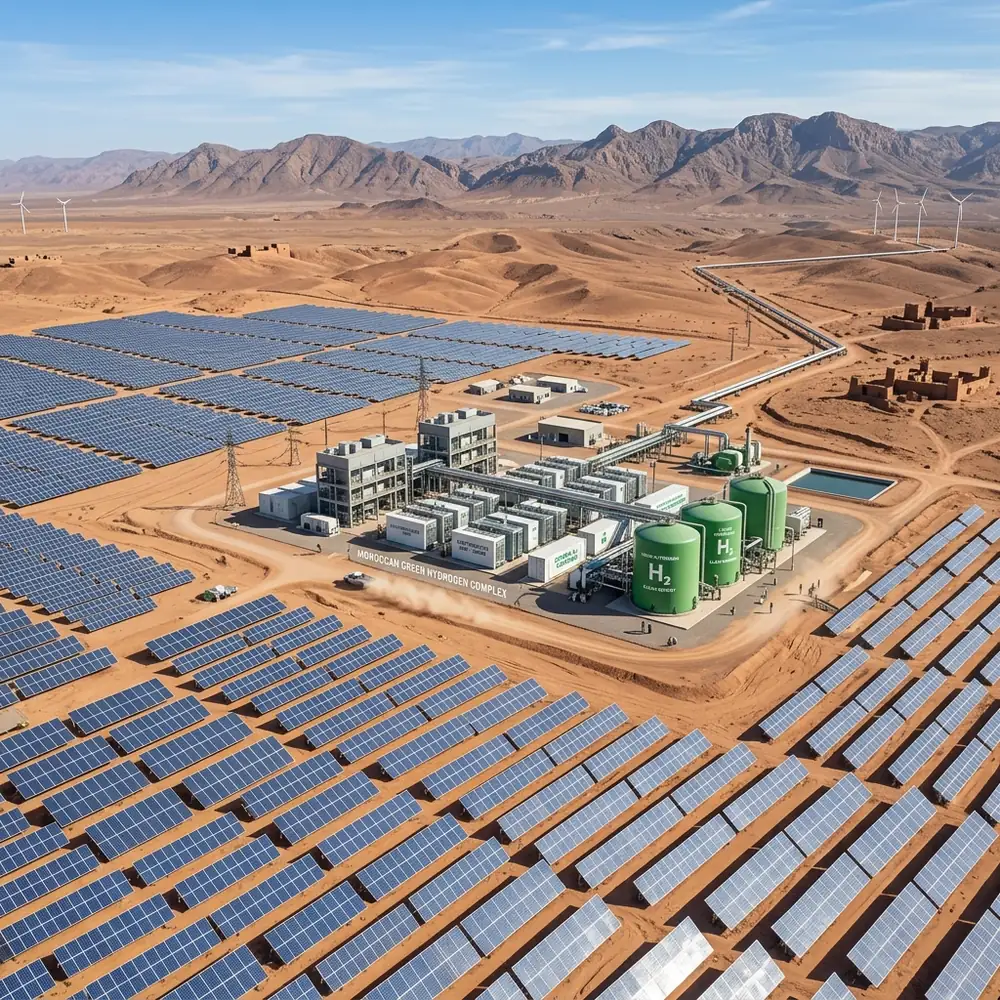
The 'Offre Maroc' Green Hydrogen Charter: Positioning the Sahara as Europe's Clean Fuel Hub

In March 2024, the Head of Government issued a landmark circular operationalizing the royal vision for Morocco’s next industrial frontier: the Offre Maroc (Morocco Offer) incentive framework for green hydrogen and clean synthetic fuels. Born out of strategic working sessions chaired by King Mohammed VI, the charter formally unlocked public land, fiscal incentives, and regulatory fast-tracking to establish the Kingdom as a premier global hub for green molecule manufacturing. With international energy majors seeking cost-effective locations to produce clean hydrogen at gigawatt scale, Morocco has stepped forward with an integrated proposition anchored in the vast territorial expanses of its southern provinces.
The geographic footprint allocated for this industrial offensive is unprecedented in scale. The state has committed a public land reserve of one million hectares specifically designated for renewable hydrogen generation, water desalination, and downstream chemical synthesis. An initial tranche of 300,000 hectares has been made available to pre-qualified institutional consortia across three southern regions: Guelmim-Oued Noun, Laâyoune-Sakia El Hamra, and Dakhla-Oued Ed-Dahab (Ministry of Energy Transition and Sustainable Development, 2024). By offering developers pre-identified land plots complete with contractual clarity and state-backed infrastructure access, Morocco removed the primary bureaucratic roadblock that historically stalled renewable mega-projects elsewhere in the world.
The foundational competitive advantage of the Moroccan Sahara is not simply available land, but a rare meteorological phenomenon: the colocation of world-class solar irradiance and relentless, laminar wind resources. Along the southern Atlantic coastline, direct normal solar irradiation regularly exceeds 2,300 kilowatt-hours per square metre per year. Simultaneously, constant Atlantic trade winds blow across the coastal plateaus, delivering sustained wind speeds averaging between 9 and 10 metres per second at turbine hub heights.
When utility-scale wind farms and photovoltaic fields are co-located and synchronized to feed centralized water electrolyzers, they achieve combined capacity factors exceeding 70% (IRENA, 2023). This exceptional capacity factor means electrolyzers can operate with minimal downtime, dramatically lowering the levelized cost of hydrogen (LCOH). According to comparative economic assessments by the World Bank (World Bank, 2023), Morocco’s green hydrogen production costs are projected to dip toward $1.50 per kilogram by 2030, placing the Kingdom among the three most competitive production zones globally alongside Chile and Australia.
While international attention focuses on export potentials, the domestic economic anchor of Morocco’s green hydrogen revolution is centered on agriculture and mining. State-owned fertilizer and phosphate giant OCP Group is executing an aggressive $13 billion green investment plan running from 2023 to 2027. Morocco holds over 70% of the world’s known phosphate reserves, making the nation the bedrock of international food security. To transform raw phosphate rock into finished diammonium phosphate (DAP) and nitrogen-phosphorus-potassium (NPK) fertilizers, OCP historically imported between 1.5 million and 2 million tonnes of grey ammonia annually, derived from fossil natural gas and subject to severe international price shocks.
Under the Offre Maroc framework, OCP Group is building dedicated green ammonia manufacturing complexes in Tarfaya and Jorf Lasfar. By utilizing dedicated solar and wind energy combined with desalinated seawater to split water molecules into green hydrogen, OCP reacts that hydrogen with atmospheric nitrogen to synthesize green ammonia on a massive scale (OCP Group, 2024). The company plans to replace 100% of its imported fossil ammonia with domestically synthesized green ammonia by 2026, shielding Moroccan agriculture from external geopolitical supply disruptions while reducing national greenhouse gas emissions by millions of tonnes annually.
The European Union’s aggressive push toward carbon neutrality has accelerated demand for Moroccan clean molecules. Under the EU’s RePowerEU directive and the revised Renewable Energy Directive (RED III), European industries face mandatory quotas requiring at least 42% of industrial hydrogen consumption to originate from renewable fuels of non-biological origin by 2030. European industrial economies, constrained by limited land and lower solar irradiance, cannot domestically produce the quantities of green hydrogen required to decarbonize their steelmaking, chemical, and maritime logistics sectors.
Morocco has positioned itself as the logical southern energy partner to the European continent. Bilateral partnerships have been established with Germany through the H2Global initiative, the Netherlands through green corridor agreements with the Port of Rotterdam, and France through maritime transport frameworks. Infrastructure development is advancing on the ground. The construction of the Dakhla Atlantique port, a multi-billion-dirham deepwater maritime complex, incorporates specialized bunkering and export terminals designed specifically to load chilled liquid green ammonia and synthetic e-kerosene onto ocean-going tankers for direct shipment to European reception terminals. In parallel, technical feasibility studies are examining dedicated subsea hydrogen pipelines linking North Africa directly into the Iberian green pipeline network (European Commission, 2024).
The economic philosophy driving the Offre Maroc extends beyond functioning as a raw exporter of green energy. Moroccan policymakers are determined to avoid the historical extractive models that characterized the fossil fuel era. The charter establishes strict local content requirements, targeting domestic industrial integration rates of 30% to 40% across the project lifecycle (CESE, 2023).
Under these regulations, international project developers must commit to sourcing structural components, civil engineering, electrical balance-of-plant equipment, and specialized maintenance services from domestic Moroccan suppliers. The state is simultaneously partnering with domestic technical universities, including the Mohammed VI Polytechnic University (UM6P) in Benguerir, to establish specialized hydrogen engineering faculties, laboratory testing platforms, and vocational training academies across Laâyoune and Guelmim. This institutional ecosystem guarantees that thousands of specialized, high-wage technical and scientific careers are created directly within the southern provinces.
Environmental safeguards have been embedded into the core design of the Offre Maroc. To prevent industrial water consumption from competing with domestic municipal needs or fragile desert aquifers, all green hydrogen facilities are required by law to construct dedicated, closed-loop seawater desalination infrastructure powered by their own renewable installations. Brine outfalls must meet the stringent dispersion standards established by the national environmental agency, preventing thermal or chemical harm to coastal fisheries.
The Offre Maroc represents a profound geopolitical reconfiguration. By pairing vast territorial resources, unmatched climatic endowments, sovereign industrial consumers, and proximity to high-demand European markets, Morocco is executing an energy transition that transcends defensive climate mitigation. The Kingdom is actively building the physical and economic infrastructure to power the global clean economy, transforming its ancient desert into an engine of sustainable twenty-first-century prosperity.
Houssam Elmrabet
Experience the true heart of Moroccan heritage through its culinary traditions. Join us in preserving and honoring these ancestral recipes.
What People Are Saying
No comments yet. Be the first — we'd love to hear from you.
Houssam Elmrabet
Culturally Verified & Fact-CheckedHoussam Elmrabet is a Moroccan researcher in territorial marketing and cultural heritage preservation. His work documents regional gastronomic identities, local agricultural heritage, and how ancestral culinary traditions define authentic territorial branding across the Kingdom.