Morocco's Music Festivals 2026: Gnaoua, Mawazine, Timitar and the Global Scene That Puts Morocco on the Map
Morocco’s Music Festivals 2026: Gnaoua, Mawazine, Timitar and the Global Scene That Puts Morocco on the Map
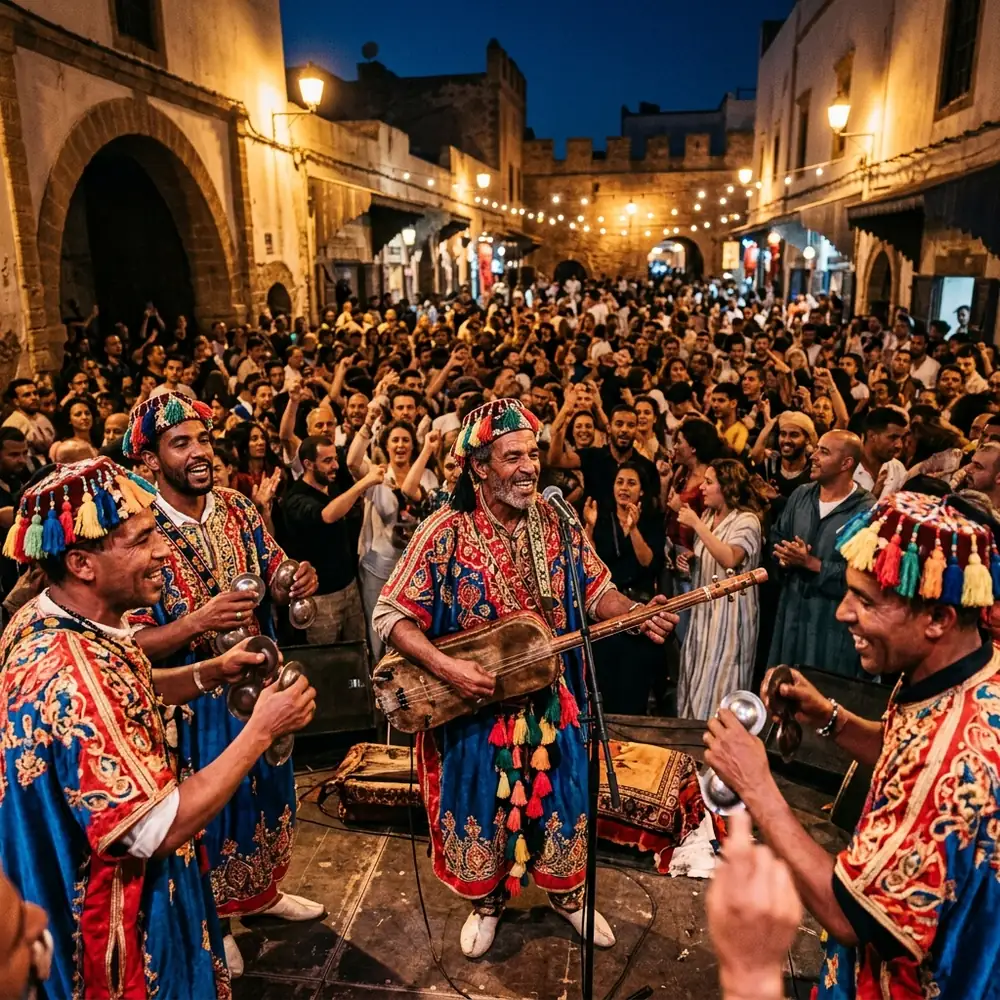
I remember the first time I heard Gnawa music properly — not as background sound in a medina café, not recorded on a phone speaker, but live. It was in Essaouira, at 2am, in a small square behind the main stage of the festival. Four musicians with their guembri and their krakebs, playing for each other as much as for the small crowd that had gathered. The hypnotic pulse of the bass lute, the rhythmic clash of the iron castanets, a singer with a voice that seemed to come from somewhere below speech — I stood there for an hour and a half and barely noticed the time passing.
That’s what live music in Morocco does when it works: it pulls you into something much older and deeper than entertainment. This country’s musical traditions are extraordinary, and the festival scene that has grown up around them in the past twenty years has become one of Africa’s most lively and internationally significant.
Here’s what’s happening in 2026, and why it matters.
The Gnaoua World Music Festival, Essaouira
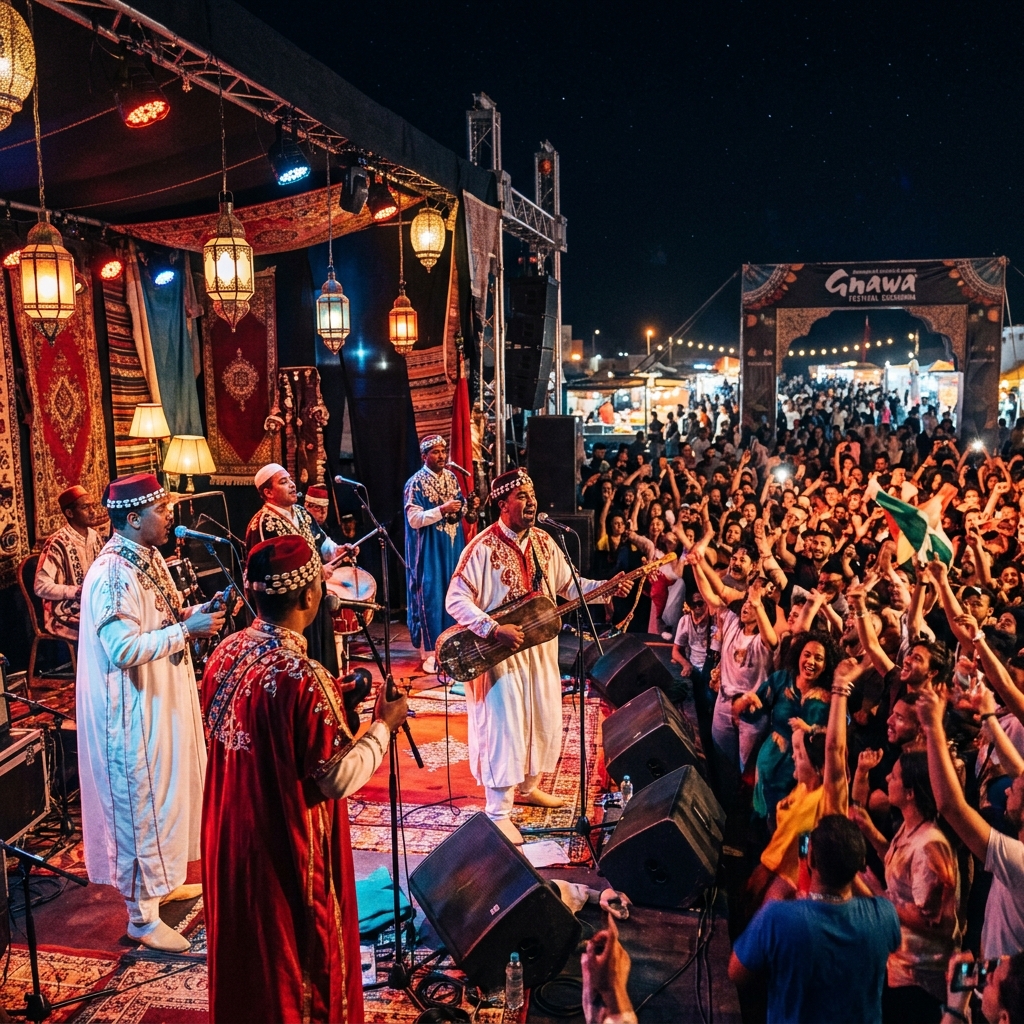
The oldest and arguably still the most important festival in Morocco’s contemporary music calendar. Founded in 1998 in the Atlantic city of Essaouira, the Gnaoua World Music Festival brings together masters of the ancient Gnawa spiritual tradition with musicians from jazz, blues, world music, and contemporary electronic genres for four days of collaboration that are as musically adventurous as they are culturally rooted.
What is Gnawa music?
Gnawa music is not entertainment in the conventional sense — at least not in its original context. It’s the special practice of the Gnawa Brotherhood, a spiritual community descended from sub-Saharan African slaves brought to Morocco from the 15th century onward. Their ceremonies (lila or derdeba) are all-night healing rituals in which music, color, incense, and trance states are used to communicate with spiritual entities and address the ailments of participants.
The central instrument is the guembri (also called the sintir), a three-stringed bass lute with a skin resonator that produces a sound unlike anything in Western music — warm, woody, and somehow both ancient and completely contemporary. The krakebs (iron castanets) provide the driving rhythm that can run for hours without variation and without losing intensity.
In 2019, UNESCO inscribed Gnawa music on its Representative List of Intangible Cultural Heritage of Humanity — a recognition long overdue.
The Festival Experience
Essaouira is an extraordinary venue for this event. The ancient fortified port city, with its reliable Atlantic wind and its whitewashed walls, creates a natural amphitheater effect in its open squares and on its city ramparts. The main Moulay Hassan square stage hosts the big international collaborations — in recent years these have included jazz masters, Afrobeat artists, Senegalese griots, and electronic producers from Europe and North America.
But the heart of the festival is the night music: informal sessions in the medina’s smaller squares and courtyard venues, sometimes going until dawn, where Maalems (master musicians) play the traditional repertoire for audiences who understand what they’re hearing. These sessions are where the festival’s deepest value lies.
The 2026 edition typically takes place in late June. Attendance has grown to over 400,000 visitors over the four days, but the medina’s nighttime sessions remain accessible and intimate if you know where to find them — which means staying in the medina rather than one of the beach hotels, arriving early for the smaller venues, and following the sound.
Mawazine: Rhythms of the World, Rabat
If the Gnaoua Festival is Morocco’s soul, Mawazine is its ambition on display. Launched in 2001 under the high patronage of King Mohammed VI, Mawazine has grown into one of the world’s largest music festivals by attendance — consistently in the top five globally, with figures of 2.5 to 3 million people across nine days.
The production scale is staggering. Nine stages across Rabat and Salé host simultaneous performances, with the main OLM stage on the banks of the Bou Regreg capable of accommodating 100,000 people. The international lineup over the years has included Beyoncé, Rihanna, Shakira, Alicia Keys, Kylie Minogue, Bruno Mars, and dozens of other global headliners.
But what I find most genuinely interesting about Mawazine — and what makes it more than just a corporate music event — is the parallel programming. Several stages are dedicated to Arab and African music: contemporary Moroccan chaabi, Egyptian sha’bi, Algerian raï, West African griots, Amazigh folk music. For Moroccan audiences, these stages often draw as large a crowd as the international headline acts.
The festival is largely free for Moroccan citizens (tickets for the main stage premium areas cost a few hundred dirhams, but most events have no charge). This democratic approach to cultural access is one of the things that genuinely distinguishes Mawazine from European festival models.
The 2026 edition runs in late May–early June. Book accommodation in Rabat months in advance if you plan to attend.
Timitar: Songs of the Amazigh People, Agadir
Timitar occupies a different cultural register from both Gnaoua and Mawazine. Founded in 2004 in Agadir, it is explicitly an Amazigh music festival — dedicated to the cultural expression of Morocco’s indigenous Berber population and their linguistic and artistic heritage.
The name itself (‘timitar’ means ‘signs’ or ‘signals’ in Tachelhit, the Amazigh language of the Souss) signals the festival’s intent: to mark the presence and vitality of Amazigh culture at a moment when its languages and traditions are actively being reclaimed and celebrated after centuries of marginalization.
The musical range within the festival is extraordinary. Traditional ahwach (collective dance songs of the Atlas and Anti-Atlas), one-woman-one-voice izlan (lyric poetry), the electrified contemporary Amazigh pop that has developed particularly strongly in the Souss region, hip-hop in Tachelhit, collaborations between Amazigh musicians and West African artists — all of this coexists under the Timitar umbrella.
What still surprises me even today is how emotionally powerful the festival feels for Amazigh attendees. This is not just entertainment — it’s cultural affirmation on a massive scale, in a country where the official recognition of Amazigh identity (including the 2011 constitution that recognized Tamazight as an official language alongside Arabic) is still relatively recent.
Timitar takes place in late July in Agadir. The Al Abdi stadium and the beachfront locations make it a genuinely pleasant festival to navigate.
Other Festivals Worth Your Calendar
The Fes Festival of World special Music
Perhaps the most intellectually ambitious of Morocco’s festivals. Held annually in Fes in June, it brings together Sufi devotional music from across the Islamic world — qawwali from Pakistan, sama from Turkey, special chant from various Christian traditions, Jewish cantorial music — in a gesture of interfaith musical dialogue that feels particularly significant in the current global moment.
The setting is extraordinary: concerts take place in the ruins of Bab Makina (a 19th-century royal gateway), in the gardens of the Batha Museum, and in the courtyard of the Qarawiyyin. The acoustic quality of these spaces, combined with the quality of the programming, makes this one of the finest music experiences available anywhere in the world.
The International Nomads Festival, Assa
The most remote and culturally specific festival on this list. Held in the small southern town of Assa, near the Algerian border, this celebration of nomadic and Saharan cultures brings together musicians and artists from nomadic communities across the Sahel and the Maghreb. It’s not easy to reach and that’s rather the point.
Planning Your Festival Visit
For the Gnaoua Festival: book accommodation in Essaouira at least three months in advance — the city fills completely. Stay in the medina if at all possible. Bring layers (the Essaouira wind is a constant and not always friendly companion in late June).
For Mawazine: Rabat has significantly more accommodation capacity than Essaouira, but the city still fills during the festival. The ONCF train runs frequently between Casablanca and Rabat and is the smartest way to get there.
For Timitar: Agadir’s hotel infrastructure is large and accommodating. The beachfront location makes it a pleasant festival for families. Heatwave conditions are possible in late July — stay hydrated and use the shade.
For the Fes special Music Festival: Fes is one of Morocco’s most atmospheric cities and the festival transforms it entirely. The combination of medieval architecture and world-class music is simply unmatched. Book early.
Experience the true heart of Moroccan heritage through its culinary traditions. Join us in preserving and honoring these ancestral recipes.
What People Are Saying
No comments yet. Be the first — we'd love to hear from you.
Yasmine Belkadi
Culturally Verified & Fact-CheckedThe Moroccan Food editorial team brings together native culinary researchers, heritage preservationists, and experienced home cooks across Marrakech, Fes, and Casablanca. Every recipe and cultural guide is reviewed against ancestral oral traditions and authentic regional practices.