Morocco's Water Crisis: How Morocco Is Building the World's Most Ambitious Desalination Programme
Morocco’s Water Crisis: How Morocco Is Building the World’s Most Ambitious Desalination Programme
In 2022, Morocco’s largest dam, the Al Massira reservoir near Settat, stood at 3% capacity. Three percent. A reservoir that normally supplies Casablanca, Morocco’s largest city, and irrigates much of the Souss agricultural plain was essentially a large puddle.
The crisis did not start in 2022. It has been building for decades. But 2022 was the year it became impossible to ignore.
Understanding Morocco’s Water Situation
Morocco receives the majority of its precipitation between November and April, almost entirely from Atlantic weather systems. The rest of the year — five to seven months — is essentially dry.
The country’s water security depends critically on:
- Snow accumulation in the Atlas Mountains, which feeds rivers through the spring melt
- Rainfall in northern Morocco (the Rif Mountains and the Atlantic coastal plain)
- Groundwater aquifers in the south and the Souss-Massa plain
All three are under pressure.
The Numbers That Define the Crisis:
- Morocco’s renewable fresh water per capita has dropped from ~2,800 m³/person/year in 1960 to approximately 550 m³/person/year today — below the international “water stress” threshold of 1,000 m³
- 40% of Morocco’s GDP is directly or indirectly dependent on water-intensive agriculture
- The Souss-Massa aquifer in the south, which supplies Agadir and the intensive farming region, is being depleted at 3–4 times its natural recharge rate
- Average annual rainfall has declined by 20–30% in many regions over the past 30 years
The Desalination Answer: What Morocco Is Actually Building
Morocco announced its National Programme for the Supply of Drinking Water and Irrigation (PNAEPI) with a price tag of 143 billion MAD (~13 billion EUR). The centrepiece is an aggressive desalination programme.
Chtouka Ait Baha (Agadir) — Africa’s Largest Desalination Plant
The most advanced project is already operational. The Chtouka plant, built by the ACWA Power consortium, has a capacity of 275,000 m³/day — enough to supply drinking water for approximately 1 million people and irrigation for 15,000 hectares of agriculture in the Souss-Massa region.
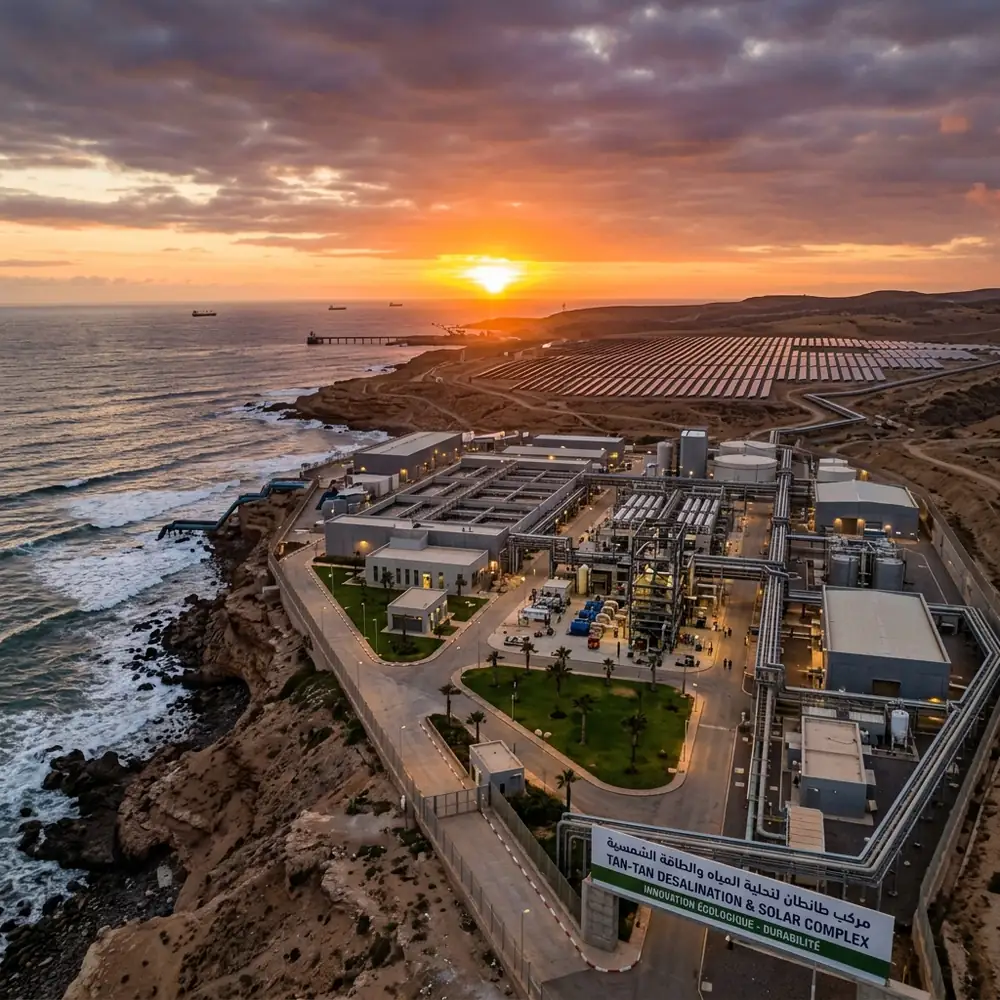
This plant is solar-powered, which matters: traditional desalination is extremely energy-intensive, making it expensive and carbon-heavy. By running off Morocco’s expanding solar capacity (particularly the Noor solar complex at Ouarzazate), the cost and emissions footprint are significantly reduced.
Casablanca — The Big One
A new desalination plant for the Greater Casablanca region (population ~7 million) is under construction, with a target capacity of 300,000 m³/day. This will be the largest desalination plant in Africa when complete.
The plant is located on the Atlantic coast south of Casablanca. The brine discharge management — the most environmentally sensitive aspect of desalination — will use a dispersal system designed to minimise coastal ecosystem impact.
Other Plants Under Construction or Planned:
- El Jadida (supplying the industrial phosphate corridor)
- Tan-Tan (southern Atlantic coast, serving the emerging agri-south zone)
- Dakhla (far south, supporting the port and economic zone development)
Total desalination capacity target by 2030: Over 1 billion m³/year.
The Energy Equation: Why Solar Makes This Work
Desalination is essentially converting electricity into fresh water. The energy requirement is high — roughly 3–5 kWh per cubic metre of water produced.
At grid electricity prices, this makes desalination expensive. But Morocco is uniquely positioned to change this equation.
The Noor solar complex near Ouarzazate is one of the world’s largest concentrated solar power (CSP) installations. Morocco generates surplus solar energy during peak daylight hours. Running desalination plants off this surplus dramatically cuts the cost per cubic metre.
By 2030, Morocco aims to generate 52% of its electricity from renewables (it was already at 40%+ in 2025). The more renewable capacity is built, the cheaper desalination becomes. It is a virtuous cycle — if it works.
What This Means for Moroccan Agriculture
The Souss-Massa plain south of Agadir produces a significant share of Europe’s winter tomatoes, peppers, and courgettes. This agricultural system has existed by mining groundwater at unsustainable rates for decades.
Desalinated water, if delivered efficiently to agricultural users, changes the equation: the aquifer depletion slows or reverses, farming continues, and the regional economy is sustained.
The challenge: Desalinated water costs more than groundwater to produce. Large industrial farms can absorb this cost. Smaller traditional farms may not be able to, creating economic pressure for consolidation.
Environmental Considerations: The Honest Trade-offs
Desalination has real environmental costs that the programme’s enthusiasts do not always emphasise:
Brine discharge: For every litre of fresh water produced, desalination generates approximately 1.5 litres of highly concentrated salt brine. This must be returned to the ocean in a way that does not destroy local marine ecosystems. Dilution systems and deep-water discharge pipes can manage this, but imperfectly.
Energy demands: Even with solar, building and operating hundreds of thousands of cubic metres of daily desalination capacity requires enormous infrastructure.
Ecosystem downstream: Rivers that currently deliver reduced but real freshwater to coastal ecosystems will face further reduction as more water is extracted. The Souss river estuary and its bird populations are particularly sensitive.
These are not reasons to abandon the programme. They are reasons to require rigorous environmental monitoring as it scales.
Frequently Asked Questions
Will Morocco’s water crisis affect my travel plans? In most tourist contexts: no. Hotels and major cities maintain water supply through priority agreements. Visitors are unlikely to experience shortages. That said, in rural areas during dry summers, water can be scarce.
Can I drink tap water in Morocco? It is treated and technically meets safety standards in cities. The taste (from chlorination) is often off-putting. Bottled water is widely available.
Is Morocco’s desalination programme an African first? Not exactly — Algeria has operated desalination since the 1970s. But Morocco’s current programme is the largest integrated desalination-plus-renewables initiative on the continent.
How does this affect Morocco’s position on climate change internationally? It strengthens it. Morocco has consistently positioned itself as a climate leadership country since COP22 in Marrakech (2016). The desalination programme — especially when powered by renewable energy — is a practical demonstration of climate adaptation.
Experience the true heart of Moroccan heritage through its culinary traditions. Join us in preserving and honoring these ancestral recipes.
What People Are Saying
No comments yet. Be the first — we'd love to hear from you.
The Moroccan Editorial Team
Culturally Verified & Fact-CheckedThe Moroccan Food editorial team brings together native culinary researchers, heritage preservationists, and experienced home cooks across Marrakech, Fes, and Casablanca. Every recipe and cultural guide is reviewed against ancestral oral traditions and authentic regional practices.