Moulay Idriss Zerhoun: Morocco's Holiest City, What Visitors Can See, and Why the Moussem Matters
Moulay Idriss Zerhoun: What It Is and What Visiting It Honestly Involves
There are places where the honest account of visiting is more useful than the account that produces maximum enthusiasm, and Moulay Idriss Zerhoun is one of them. Not because the town is not worth visiting — it is genuinely worth visiting — but because the experience of visiting it as a non-Muslim is specific in its access limitations and those limitations are better understood in advance than discovered upon arrival.
Moulay Idriss Zerhoun is built on and around the hillside above the tomb of Moulay Idriss I — the great-great-grandson of the Prophet Mohammed who arrived in Morocco in 789 CE, established the first Islamic state in the region, and founded the city of Fes before his death in 791. His burial place on the Zerhoun massif became immediately special to the Moroccan Islamic community and has remained so for over 1,200 years.
For most of those 1,200 years, the town was closed to non-Muslims — actively forbidden, enforced by religious decree. European travelers who managed to enter, like the American writer Edith Wharton who visited during the French protectorate period, described the experience as requiring careful cover and some risk. The restriction was officially lifted in 2005, and the town is now open to non-Muslim visitors without restriction for the public spaces: the streets, the main plaza, the views over the town from the cylindrical minaret of the secondary mosque, the craft and food shops.
The tomb of Moulay Idriss himself — enclosed in the qoubba (domed tomb chamber) within the shrine complex — remains accessible only to Muslims. The shrine's entrance is marked by a wooden bar across the door, knee-height, that non-Muslim visitors should not cross. This is a respect-based restriction rather than a policed one, and observing it correctly is both required and easy to do.
Who Was Moulay Idriss I and Why Is He Morocco's Most Important Saint?
Moulay Idriss I (born approximately 745 CE, died 791 CE) was a sharif — a descendant of the Prophet Mohammed through his grandson Hassan ibn Ali — who fled the Abbasid Caliphate's persecution following his family's defeat at the Battle of Fakh in 786 CE. He arrived in Morocco with a single companion, sought refuge with the Awraba Amazigh tribe whose territory covered the Zerhoun region, was received as a guest of honor and recognized as a descendent of the Prophet, and within two years had organized the tribes of the region into a political confederation that he ruled as the first Islamic state in Morocco.
His accomplishment — converting and unifying a substantially non-Muslim Amazigh population into a functioning Islamic polity in under three years, without military conquest — was remarkable by any standard, and his death in 791 (probably by poison, in the account that has Abbasid agents pursuing him into Morocco) at age forty-five prevented what would certainly have been a longer reign.
His son Moulay Idriss II — who continued the dynasty from Fes — finished the city his father had begun. Both Moulay Idriss I and Moulay Idriss II are venerated as the twin founding saints of Moroccan Islam, and their respective shrines — Moulay Idriss I at Zerhoun, Moulay Idriss II in the Fes medina — are among the most visited special sites in Morocco.
What Does the Town Look Like and What Can Visitors Do There?
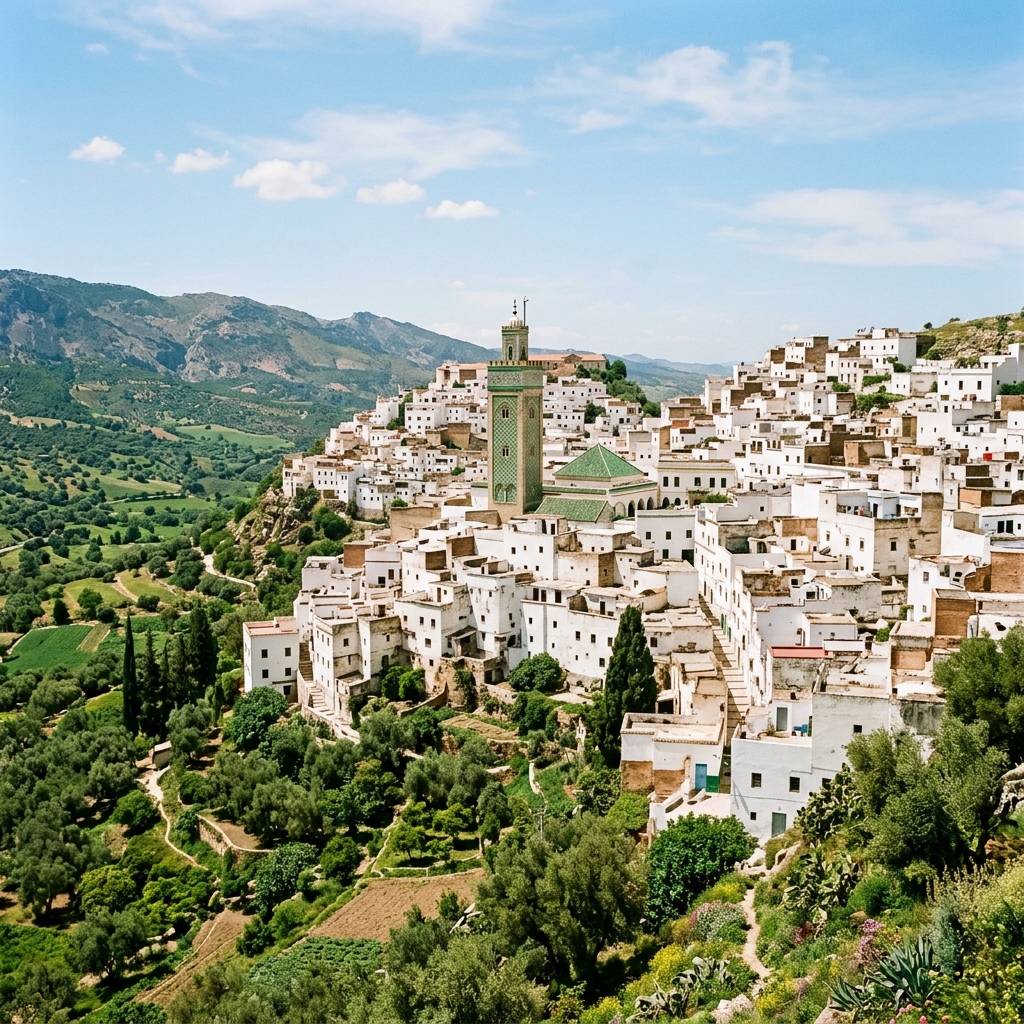
Moulay Idriss Zerhoun is built on two hills — the Khiber and the Tasga — with the shrine complex at their junction, and the town climbs the hillsides in the organic, gravity-defying way of North African hilltop settlements, with stairs substituting for streets in the steepest sections and the whitewashed walls making the town read, from a distance, as a single pale mass on the green Zerhoun hillside.
The main plaza below the shrine — the place — is where the town's commercial and social life concentrates: cafés, a modest market, the craft sellers who supply the pilgrim economy. The view from the plaza up toward the green-tiled roof of the shrine is the canonical image of Moulay Idriss.
Visitors can walk through most of the town's accessible streets. The approach to the shrine exterior — the gate, the tiled facade, the wooden bar marking the entrance — can be viewed and photographed from outside respectfully. The cylindrical minaret of the Sidi Abdallah el-Hajjam mosque (unusual in Morocco for its cylindrical form rather than the typical square Moroccan minaret) is visible from the plaza and from various points in the town's upper streets.
The best thing to do in Moulay Idriss, in my view, is to walk to the terrace above the main plaza — a short walk through the upper streets — that provides a panoramic view over the entire town, the Volubilis plain visible below to the west, the Zerhoun massif above. From this terrace, the town's organization on its hills is completely readable: the shrine in the center, the town climbing away from it in every direction that gravity permits, the agricultural land of the Zerhoun plateau visible beyond. This is the view that makes Moulay Idriss Zerhoun comprehensible as a place built by and for devotion.
What Is the Annual Moussem and Who Attends?
The moussem of Moulay Idriss I, held annually in late August or early September, is one of the largest pilgrimage gatherings in Morocco — several hundred thousand people over the moussem's duration, drawn from across the country and from the Moroccan diaspora in Europe. The moussem is simultaneously a religious event (pilgrimage to the shrine, communal prayer, seeking the baraka of the saint) and a social-commercial event (the large temporary market that accompanies the pilgrimage, family reunions, the regional entertainment of the tbourida equestrian display).
The town's capacity to receive the moussem crowd vastly exceeds its resident population, and the accommodation and logistics of the moussem period are organized through collective structures — the tents and temporary shelters that expand the town's sleeping capacity, the communal kitchens — that have been refined over centuries of repetition.
Non-Muslim visitors can observe the moussem from outside the shrine's ceremonial areas. The marketplace, the tbourida displays on the plain below the town, the general festive atmosphere of the gathering are all accessible. The sanctuary areas during the peak devotional ceremonies are not. This limitation does not prevent a meaningful engagement with the event; it defines the terms of a respectful one.
The Invisible Invitation
Come to Moulay Idriss in the early morning, before the pilgrims of the day's visiting have arrived in numbers. Walk to the upper terrace and sit with the view for twenty minutes. The town is quiet at this hour, the shrine below you the still center of the concentric circles of devotion that have organized this hillside for twelve centuries. You may not enter the shrine. This is not a failure or a deprivation — it is the correct shape of what this place is. Some centers are not accessible to everyone, and understanding what you can be near without being inside is itself a form of knowledge. The baraka of the place does not require entry. The view is complete. Come back in August for the moussem if you want to understand the full scale of what this center draws toward it. The rest of the year is the quiet version of the same thing.
SEO Meta Description: What is Moulay Idriss Zerhoun and can non-Muslims visit? The history of Moulay Idriss I, what the shrine access restrictions mean, the cylindrical minaret, and the August moussem pilgrimage explained.
Experience the true heart of Moroccan heritage through its culinary traditions. Join us in preserving and honoring these ancestral recipes.
What People Are Saying
No comments yet. Be the first — we'd love to hear from you.
Youssef Amazigh
Culturally Verified & Fact-CheckedThe Moroccan Food editorial team brings together native culinary researchers, heritage preservationists, and experienced home cooks across Marrakech, Fes, and Casablanca. Every recipe and cultural guide is reviewed against ancestral oral traditions and authentic regional practices.