Nigella vs. Cumin: Understanding the Dark Seeds of Morocco
Nigella vs. Cumin: Understanding the Dark Seeds of Morocco
When a traveler enters the spice souk of Marrakech asking for ‘black cumin,’ they often leave with the wrong ingredient. The terminology surrounding the dark seeds of North Africa is famously labyrinthine. As a traditional herbalist, I must clarify the deep differences between Sanouj (Nigella Sativa) and actual black cumin (Kamoun Aswad), as mixing them up will drastically alter both your recipe and your remedy.
What is the difference between Sanouj and Black Cumin?
Though they look somewhat similar to the untrained eye, these two seeds belong to entirely different botanical families.
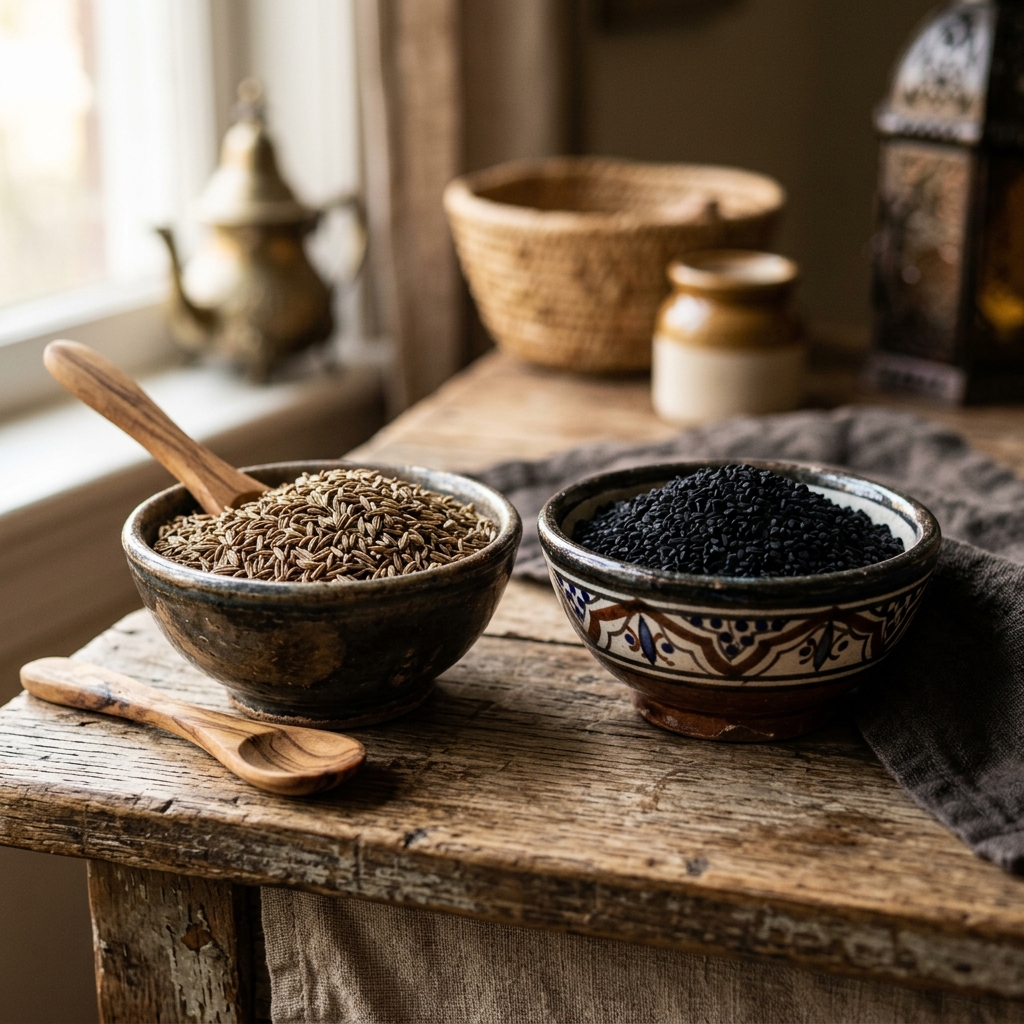
- Sanouj (Nigella Sativa): Often incorrectly translated as ‘black cumin,’ these seeds are pitch-black, matte, and sharply angular (like tiny pieces of coal). They smell faintly of oregano and onions, and are used primarily for immune-boosting medicine or baking bread.
- Black Cumin (Kamoun Aswad): This is a true cousin of standard brown cumin (Bunium persicum). The seeds are crescent-shaped, dark brown, and striated. They possess a heavy, deeply earthy, and smoky aroma, used strictly to flavor heavy meat dishes and never used in baking.
Navigating the apothecary like a local
Our ancestors knew that precision in herbalism is the line between medicine and poison. If you use Sanouj in a slow-cooked lamb tagine thinking it is black cumin, the dish will turn violently bitter and medicinal. Conversely, if you try to cure a winter cold by inhaling the steam of black cumin, you will simply smell like a roasting kitchen. When approaching the apothecary, you must ask for the seeds by their authentic Darija names to ensure you receive the correct botanical power.
The visual test for the spice market
- If you are unsure what the merchant is handing you, crush a few seeds between your fingers; if it smells like a savory tagine, it is cumin. If it smells peppery and sharp like oregano, it is Sanouj.
- Look at the shape: true black cumin is curved like a tiny moon, while Sanouj is jagged and irregular.
The Invisible Invitation
The brass scales of the apothecary are waiting, and the jars of dark seeds are lined up against the wall. Do not be intimidated by the mysteries of the souk. Walk with us, and we will teach you the ancient language of the spices.
Experience the true heart of Moroccan heritage through its culinary traditions. Join us in preserving and honoring these ancestral recipes.
What People Are Saying
No comments yet. Be the first — we'd love to hear from you.
Ghina Mrabet
Culturally Verified & Fact-CheckedThe Moroccan Food editorial team brings together native culinary researchers, heritage preservationists, and experienced home cooks across Marrakech, Fes, and Casablanca. Every recipe and cultural guide is reviewed against ancestral oral traditions and authentic regional practices.