Ouarzazate Food Guide: Gateway to the Sahara and Its Unique Berber Cuisine
There is a particular quality to the light in Ouarzazate in the late afternoon, when the sun drops behind the Jbel Sarhro and the mud-brick walls of the old kasbahs turn the color of warm embers. The town sits at 1,160 meters above sea level, where the High Atlas suddenly runs out of mountain and the Draa Valley opens southward into the pre-Saharan plains. The air is dry and clear in a way that Marrakech, four hours north, never quite is.
Most people pass through Ouarzazate on their way to somewhere else — the Sahara dunes at Merzouga, the kasbah at Aït Benhaddou, the rose valley of Kelaat M’Gouna. That is understandable. It is also a mistake, at least from a food perspective. The cuisine of this region is distinct from what you find on the tourist circuit further north, and it rewards the traveler who slows down long enough to find it.
The Draa Valley Berber Kitchen
The Draa Valley, which runs south of Ouarzazate toward the oasis towns of Zagora and M’Hamid, is one of Morocco’s great agricultural corridors. Date palms line the river for hundreds of kilometers. Between them: pomegranates, almonds, figs, barley, and the small kitchen gardens that Amazigh (Berber) families have cultivated on the same plots for many generations.
The cooking that comes from this landscape is direct and elemental. There is less of the elaborate spice layering you find in Fes or Marrakech, and more emphasis on the quality of a single ingredient — the sweetness of a slow-braised lamb shank, the texture of hand-pounded barley flour, the fragrance of wild thyme gathered from the slopes above the valley.
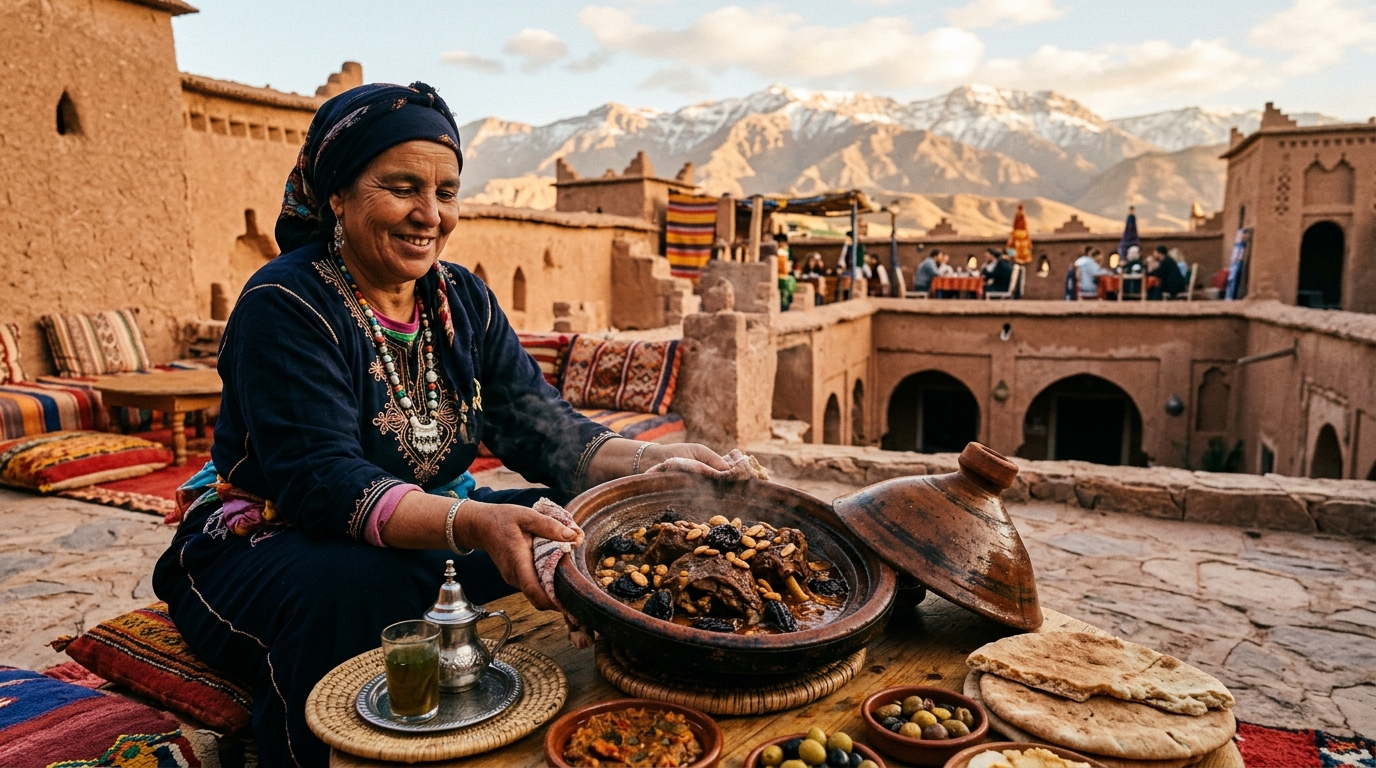
Lamb and prune tagine is the flagship dish of the Draa Valley. The prunes here — dried from local purple plums — are soft and concentrated and nothing like the prunes in a supermarket back home. They go into the tagine with lamb, onions, cinnamon, and a careful hand with ginger. The sweetness balances the richness of the meat in a way that sounds like too much and tastes like exactly enough. This dish is found throughout Morocco, but in the Draa Valley, where the prunes are local and the lamb has been raised on mountain scrub, it is at its best.
Medfouna is a stuffed flatbread that most travelers never encounter because it does not appear on restaurant menus — it is street food, market food, home food. A thick round of semolina-wheat dough is filled with a mixture of spiced minced meat, onion, and herbs, then baked or griddled until the crust is golden and the filling has steamed itself into something entirely unified. In some parts of the Draa Valley, the filling is sweetened with a small amount of sugar and smen (aged butter), creating a savory-sweet interior that is genuinely remarkable. Find medfouna at the morning market in Ouarzazate city or along the road between Ouarzazate and Agdz.
The Dates of Tafilalet
The Tafilalet region — centered around Erfoud and Er Rachidia, east of Ouarzazate — produces some of the finest dates in the world. The Medjool variety that has become fashionable in health food shops globally is grown here in conditions that are essentially unchanged from medieval date cultivation: palm trees irrigated by traditional khettara (underground canals), harvested by hand in October.
In the souks around Ouarzazate, dates from Tafilalet are sold fresh in autumn, dried and pressed into blocks through winter, and processed into date paste used in sweets year-round. The quality difference between a Tafilalet Medjool bought from a roadside seller near Ouarzazate and anything you will find at an airport or a Western supermarket is significant. Buy them in the market, not from the decorated boxes in tourist shops. Ask specifically for medjoul or boufeggous (a local variety with thin skin and dense sweetness).
Kelaat M’Gouna and the Rose Water Sweets
About an hour northeast of Ouarzazate, the town of Kelaat M’Gouna sits in a valley dense with Rosa damascena — the Damask rose cultivated here since the roses were brought back from the Middle East, probably by Arab traders several centuries ago. Every spring, the valley turns pink and the entire town smells like a perfume house.
The rose water distilled from these flowers is used extensively in Moroccan sweets and is one of the most evocative flavors in the regional kitchen. Around Ouarzazate, look for:
- Seffa (sweet couscous with powdered sugar, cinnamon, and rose water)
- Chebakia made with a rose water syrup rather than plain honey
- Fekkas cookies flavored with rose water and almond
- Fresh sellou (a roasted flour, almond, and sesame confection) with a prominent rose note
The rose water sold in Kelaat M’Gouna’s market is worth buying in quantity — it is the genuine distilled product, not the diluted bottled version sold elsewhere, and it makes an extraordinary difference in any pastry recipe.
Desert Pantry: Khlii and Camel Milk
Before refrigeration, food preservation in the desert regions of Morocco was a matter of survival, and some of the techniques that developed in those conditions produced ingredients that are genuinely excellent.
Khlii (also spelled khli’i) is preserved dried meat, made by marinating strips of beef or mutton in a mixture of cumin, coriander, garlic, and salt, then slow-cooking them in their own fat until completely dry and preserved. The resulting product keeps without refrigeration for months and has a deeply concentrated, intensely savory flavor. It is used as a flavoring ingredient — added to eggs for a quick breakfast, crumbled into couscous, or stirred into a sauce for deep background flavor. In the region around Ouarzazate, khlii made with goat or camel meat is also occasionally found. Look for it in the covered market sections of the Ouarzazate souk.
Camel milk is sold at roadside stalls along the highway south of Ouarzazate toward Zagora. It has a slightly salty, slightly gamey flavor compared to cow’s milk, and a thinner consistency. Locals drink it plain, sometimes with a date for sweetness. It is also used in some regional sweets and is increasingly marketed for health properties. Try it once at least — it is one of those flavors that links you directly to the landscape you are traveling through.
Eating Near Aït Benhaddou Without Paying Tourist Prices
Aït Benhaddou, the UNESCO World Heritage kasbah about thirty kilometers north of Ouarzazate, has been used as a film set for Gladiator, Game of Thrones, The Mummy, Lawrence of Arabia, and dozens of other productions. This history is wonderful for the local economy and somewhat damaging to the local food prices.
The restaurants immediately facing the kasbah charge Marrakech prices for Marrakech-level food. Some are decent. None represent the local cuisine particularly well.
Better approach: walk across the ksar bridge (or wade the shallow stream in dry season) and find the small café run by a family in the village on the kasbah side. There are usually two or three of these, identifiable by the absence of laminated menus in six languages. Sit down, ask what they have today, and eat whatever they made that morning. It will almost always be a lamb or vegetable tagine, bread, and mint tea. It will be good. It will cost you a quarter of what the tourist-facing restaurants charge.
Alternatively, pack your own food for the Aït Benhaddou visit — dates, bread, and a thermos of coffee purchased from the Ouarzazate morning market — and save the restaurant stop for the return journey at a place in Ouarzazate town itself.
The Ouarzazate City Morning Market
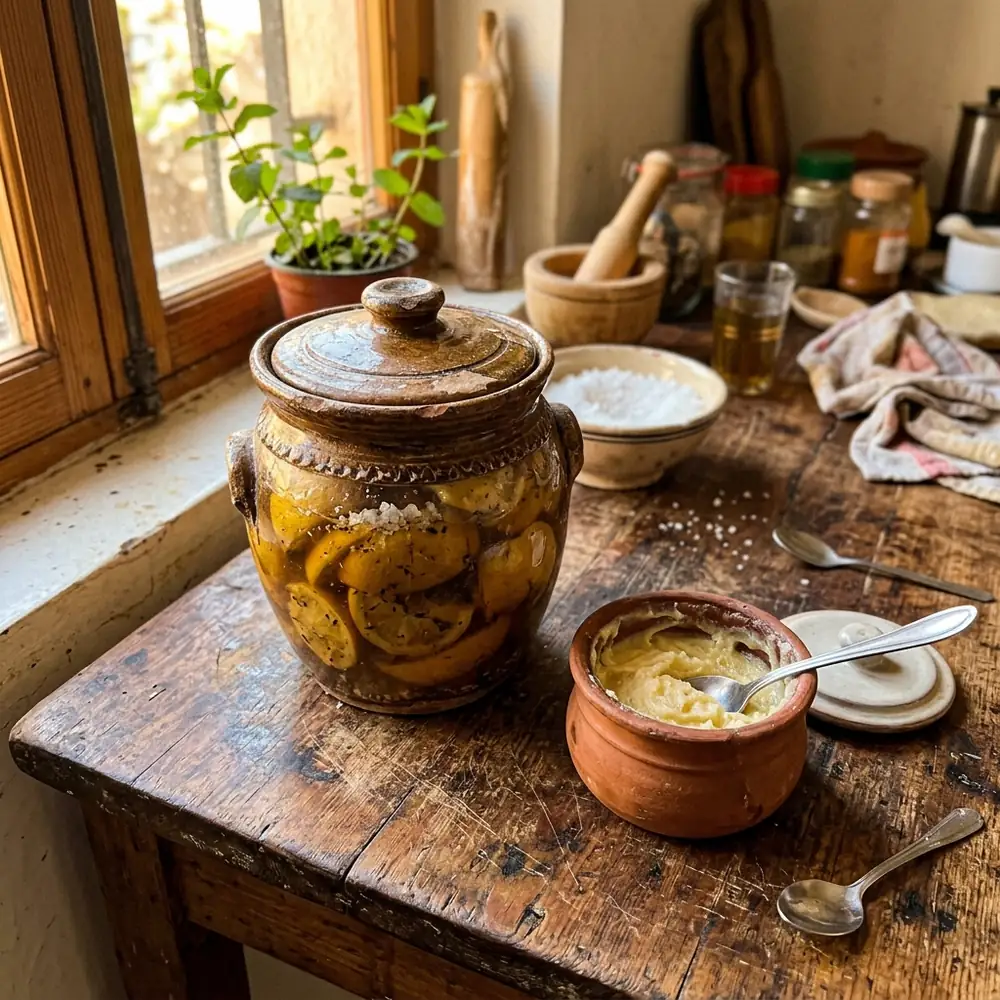
The covered municipal market in central Ouarzazate city is one of the most honest and unhurried markets in Morocco. It opens at sunrise and runs until about noon. The food section has excellent local produce: Draa Valley vegetables, herbs from the surrounding hills, preserved lemons made by women from the oasis villages, and dates at prices that reflect the source rather than the tourism markup.
The bread sellers arrive first, with round loaves and occasional msemen. By seven o’clock the olive vendors are set up. By eight, the butchers are working. If you are staying in Ouarzazate, this market is the right place to provision yourself for the day’s driving or hiking, and to eat breakfast standing up with the workers who come here every morning.
The Film Industry and What It Did to the Food Scene
Ouarzazate has hosted so many major film productions that it has its own substantial film industry infrastructure — studios, equipment rental companies, and a hospitality sector calibrated to serving international film crews for months at a time.
What this means for food: there are a handful of genuinely good restaurants in Ouarzazate that exist because film crews needed decent food over extended periods. These places tend to be more reliable than average for quality, though they are also priced accordingly. Several kasbah hotels converted to guesthouses have developed kitchens that learned to produce both Berber regional food and international dishes for mixed production-crew tables. The food culture is slightly hybrid as a result — less purely local than Zagora or Agdz, but more competent and varied than you might expect from a small city in the pre-Saharan zone.
When combining a kasbah visit with a food stop, the most practical approach is: eat your main meal in Ouarzazate, carry provisions for the kasbah visit, and eat your evening meal back in town where the kitchen quality is more consistent.
FAQ
What is the best time of year to visit Ouarzazate for food? October and November are ideal. The date harvest is just concluding, the summer heat has broken, the morning market is at its fullest with autumn produce, and the road conditions into the Draa Valley are good. Spring (March–April) is also excellent for the rose blossom season.
Can I find good food between Ouarzazate and Merzouga (the Sahara dunes)? Yes, but selectively. The roadside stop towns of Agdz, Zagora, and Mhamid each have morning markets worth exploring. Agdz in particular has a small but good covered market with excellent local dates and olive oil. Bring provisions from Ouarzazate for the stretches between towns.
Is Berber food very different from what I have eaten in Marrakech or Fes? Yes, noticeably so. The spice palette is simpler, the emphasis on grain and preserved ingredients is stronger, and the sweetness of Draa Valley produce (dates, prunes, pomegranate) features more prominently. Think of it as the same culinary tradition expressed by people working with a different landscape.
Are there restaurants in Ouarzazate that specifically focus on regional Draa Valley cuisine? A few small places near the kasbah hotels do serve regional specialties, particularly on Fridays when lamb dishes and couscous are traditional. Ask your accommodation for recommendations — the best local food knowledge in Ouarzazate is almost always held by the guesthouse owners rather than in any guidebook.
Experience the true heart of Moroccan heritage through its traditions. Join us in preserving these ancestral rituals.
What People Are Saying
No comments yet. Be the first — we'd love to hear from you.
The Moroccan Food
A Moroccan cultural writer dedicated to documenting the authentic voice, history, and heritage of the Kingdom. Writing from within — to share what truly makes Morocco extraordinary.
Our Mission →