Ouezzane Extra Virgin Olive Oil: The Millenary Picholine Terroir of the Western Rif & Global Quality Standards
Ouezzane Extra Virgin Olive Oil: The Millenary Picholine Terroir of the Western Rif & Global Quality Standards
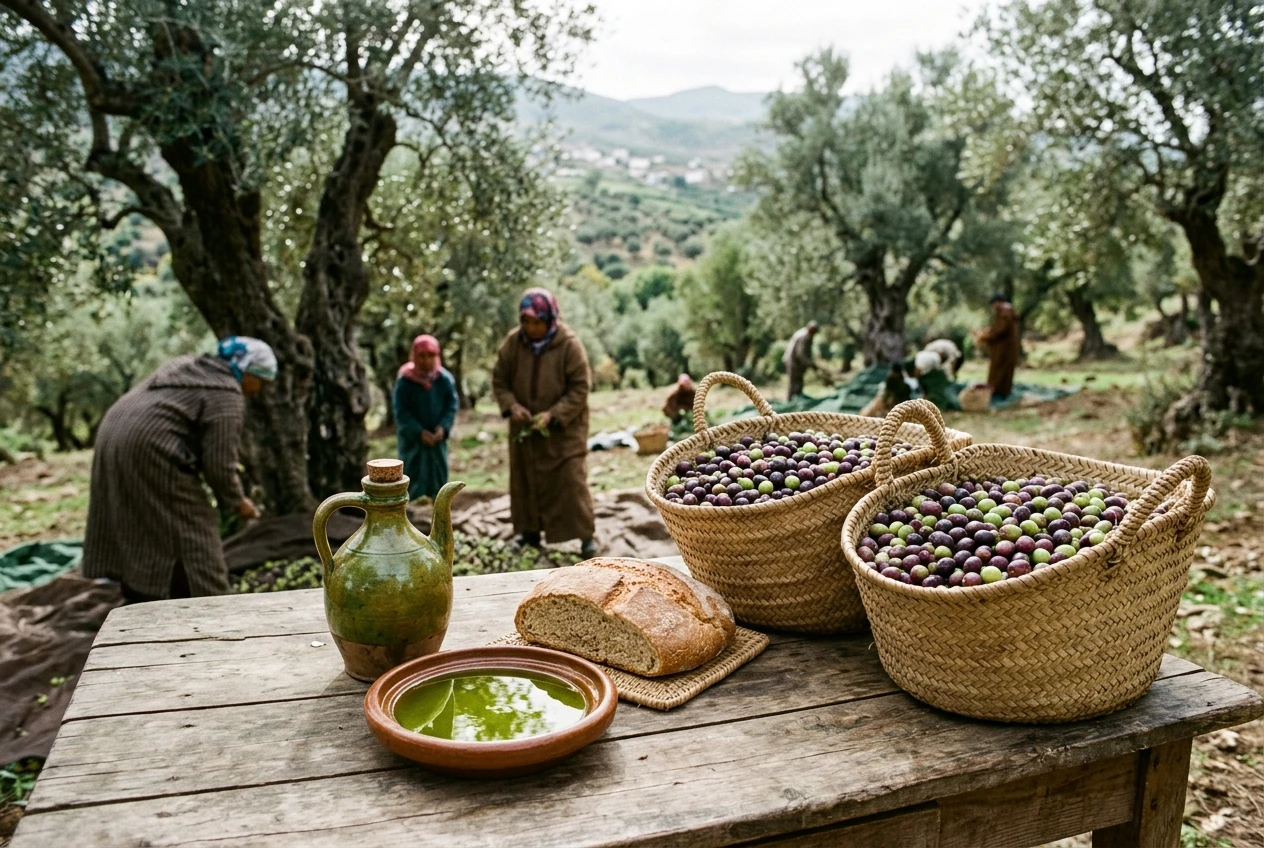
Rising gracefully above the rolling, undulating green hills of the southern Rif mountains sits the holy spiritual city of Ouezzane, long revered as Dar Dmana (the House of Safety). Yet beyond its spiritual legacy of peace and Sufi brotherhoods, Ouezzane holds another sacred mantle: it is the historical cradle and geographic epicenter of Morocco’s finest olive oil heritage.
Awarded the prestigious Appellation d’Origine Protégée (AOP Huile d’Olive d’Ouezzane), the liquid gold flowing from these millennia-old orchards represents the apex of Moroccan oleiculture. While mass-market industrial blends combine neutralized oils from disparate Mediterranean ports, Ouezzane’s single-estate oils are pressed exclusively from the noble Picholine Marocaine cultivar, producing an emerald-green nectar celebrated by international sensory panels for its intense green fruitiness, vibrant artichoke notes, and remarkable antioxidant longevity.
This scientific and agronomic investigation explores the distinctive geological soils of the Western Rif, the official production data monitored by INTERPROLIVE and MAPMDREF, the cold two-phase extraction technology elevating quality, and the biochemical standards that position Ouezzane oil on the world stage.
Geological Terroir: The Rolling Hills of the Western Rif
The exceptional quality of Ouezzane olive oil is direct testimony to its distinct topography, soil composition, and oceanic microclimate. Situated between the Mediterranean Rif mountains and the Atlantic coastal plains of the Gharb, Ouezzane enjoys a unique agro-climatic corridor:
- The Soil Architecture (Tirs and Dhess): The olive groves thrive on fertile, deep clay-limestone soils known locally as Tirs (dark, organic-rich vertisols) and Dhess (calcareous marl). These heavy soils possess exceptional water retention capacity, acting as natural underground sponges that slowly release winter rainfall to deep olive root systems throughout the blistering, rainless Mediterranean summers.
- Atlantic-Mediterranean Breeze Corridor: Located at elevations ranging from 250 to 750 meters above sea level, the groves benefit from constant breezes. Cool, humid oceanic air from the Atlantic mixes with warm breezes descending from the Rif peaks, naturally ventilating the olive tree canopy and preventing the buildup of fungal moisture that harbors the dreaded olive fruit fly (Bactrocera oleae).
- Millenary Picholine Marocaine Dominance: Over 95 percent of Ouezzane’s orchards are planted with the heirloom Picholine Marocaine variety. Endemically adapted over centuries to the microclimates of northern Morocco, this hardy tree produces small, asymmetrical, firm-fleshed drupes loaded with protective secoiridoid polyphenols.
Official Sector Statistics: INTERPROLIVE & MAPMDREF Data
Morocco’s olive oil sector represents the primary fruit arboriculture in the country, occupying over 65 percent of the national arboreal surface. Within this national matrix, Ouezzane serves as the benchmark of premium, certified terroir production.
The quantitative data below reflects multi-year audits from the Ministry of Agriculture, Maritime Fisheries, Rural Development, Water and Forests (MAPMDREF) and the Moroccan Interprofessional Olive Federation (INTERPROLIVE):
| Key Sector Metric | Official Statistical Value | Regulatory & Institutional Source |
|---|---|---|
| Provincial Olive Surface Area | 68,500 Hectares Under Cultivation | Regional Directorate of Agriculture (Tanger-Tétouan) |
| Average Annual Olive Harvest | 95,000 to 118,000 Metric Tons | Provincial Agricultural Directorate (DPA Ouezzane) |
| Extra Virgin Oil Output | 12,500 to 15,200 Metric Tons Annually | INTERPROLIVE Regional Processing Register |
| Average Oil Extraction Yield | 16 to 22 Liters of Oil per 100 kg Olives | National Agricultural Research Institute (INRA) |
| Modern Ecological Crushing Units | 48 Certified Continuous Two-Phase Mills | ONSSA Food Sanitation Inspection Cadastre |
| Free Oleic Acidity Benchmark | Consistently < 0.28% (Well Below IOC 0.8% Limit) | Official Chemistry Analysis Laboratory (LOARC Casablanca) |
| Total Phenolic Concentration | 480 to 650 mg/kg (Exceeds EU Health Claim Limit) | European Food Safety Authority (EFSA) Certified Labs |
These official laboratory metrics confirm that Ouezzane produces oils of clinical chemical purity that easily surpass the basic requirements of the International Olive Council (IOC).
The Cold-Extraction Revolution: From Maâsra to Two-Phase Decanters
For generations, Ouezzane olives were pressed in traditional village mills known as Maâsras, where heavy stone wheels crushed the olives and woven reed discs (Chouaris) were pressed with manual screw presses. While romantic and picturesque, exposure to atmospheric oxygen and stagnant wash-water in traditional mills often resulted in early oxidation and high peroxide levels.
Over the past decade, under Morocco’s national agricultural modernization plans (Plan Maroc Vert and Génération Green), Ouezzane underwent an unprecedented technological transformation:
- Immediate Post-Harvest Milling: Olives are hand-picked at dawn using vibrating combs and collected on clean nets, completely avoiding soil contact. The fruit is transported to the cooperative mill in ventilated plastic crates and crushed within 6 to 12 hours of leaving the tree.
- Continuous Two-Phase Centrifugation: Olives enter closed stainless steel hammer mills that shatter the flesh without pulverizing the woody stone. Malaxation is conducted in sealed, nitrogen-blanketed vats at temperatures strictly regulated below 27°C (Extraction à Froid) for no more than 30 minutes.
- Zero Added Water Decantation: Modern two-phase horizontal decanters separate the oil directly from the solid pomace (Grignon) without adding external dilution water. This critical ecological innovation preserves all water-soluble polyphenols within the oil while eliminating polluting liquid waste (Margines).
The resulting oil is immediately micro-filtered and stored under inert nitrogen gas in temperature-controlled stainless steel tanks, guaranteeing fresh-from-the-tree vitality until the moment of bottling.
Biochemistry: The Longevity Molecule & Oleocanthal
What distinguishes AOP Ouezzane extra virgin olive oil from common seed oils and refined vegetable oils is its complex pharmaceutical bio-activity:
- Heart-Healthy Oleic Acid (C18:1): Monounsaturated fatty acids account for 72 to 78 percent of total lipid weight, contributing to the reduction of low-density lipoprotein (LDL) cholesterol while preserving high-density lipoprotein (HDL) levels.
- Oleuropein and Hydroxytyrosol: Potent phenolic antioxidants present at concentrations between 480 and 650 mg/kg. Under European Union Regulation No. 432/2012, olive oils containing more than 250 mg/kg qualify for the official health claim that their polyphenols contribute to the protection of blood lipids from oxidative stress.
- Oleocanthal (The Peppery Throat Bite): When tasting fresh Ouezzane oil, you will experience a sharp, pleasant burning or coughing sensation in the back of the throat, known professionally as ardence. This is caused by oleocanthal, a natural phenolic compound proven in pharmacological studies to mimic the anti-inflammatory action of ibuprofen by selectively inhibiting COX-1 and COX-2 enzymes.
Sensory Character & The Art of the Moroccan Table
A professional organoleptic assessment of certified Ouezzane extra virgin olive oil reveals an unmistakable sensory profile:
Tasting Notes
- The Visual: Luminous, deep emerald green with brilliant golden flashes, exhibiting rich viscosity in the glass.
- The Aroma (Nose): Explosive green fruitiness (Fruité vert). Fresh-cut green grass, raw green artichoke leaves, wild tomato vine, and green apple skin.
- The Palate & Finish: A smooth, velvety initial entry with flavors of fresh sweet almond, rapidly transitioning into a pleasant structural bitterness on the sides of the tongue and a persistent, tingling peppery finish (ardence) at the throat.
Culinary Mastery in Northern Morocco
In Ouezzane and Chefchaouen, extra virgin olive oil is the foundational medium of culinary existence:
- Northern Bissara: The quintessential comfort soup of the Rif mountains. Dried peeled fava beans (Foul) are slow-simmered with whole garlic cloves, puréed into a velvety potage, and served steaming hot in terracotta bowls. The crowning glory is a generous pool of unheated Ouezzane olive oil, dusted with freshly ground cumin and sharp cayenne pepper.
- Tagine Chamali: Northern seafood and vegetable tagines use Ouezzane oil to build complex Chermoula marinades with fresh cilantro, smashed garlic, and preserved lemons, where the oil’s high smoke point and stability withstand gentle braising without degrading.
- The Breakfast Ritual: Freshly baked, blistered Harcha (semolina flatbread) or warm, whole-grain barley bread dipped directly into a shallow bowl of Ouezzane oil alongside fresh goat cheese (Jben Beldi) and wild mountain olives cured with wild thyme and orange peel.
Frequently Asked Questions (FAQ)
What does “AOP Ouezzane” guarantee to international consumers?
The AOP (Appellation d’Origine Protégée) seal certifies that 100 percent of the olives were cultivated, harvested, crushed, and bottled strictly within the geographic territory of Ouezzane. It legally guarantees zero blending with imported or refined oils, zero chemical solvents, an acidity level below 0.5% (typically under 0.28%), and full traceability from grove to bottle.
Why is there a bitter, spicy kick in real Ouezzane olive oil?
Bitterness and peppery pungency are not defects; they are the scientific proof of high quality! They signify an abundance of natural polyphenols (oleuropein and oleocanthal). Sweet, flat olive oils that lack peppery bite have usually lost their antioxidants through oxidation, high-temperature pressing, or industrial refining.
Can I fry or sauté with Ouezzane extra virgin olive oil?
Yes. High-quality extra virgin olive oil from Picholine Marocaine possesses a smoke point around 205°C to 210°C, well above standard pan-frying temperatures (160°C to 180°C). Its high concentration of monounsaturated oleic acid and protective antioxidants makes it significantly more resistant to thermal degradation than corn, sunflower, or soybean oils.
Experience the true heart of Moroccan heritage through its culinary traditions. Join us in preserving and honoring these ancestral recipes.
What People Are Saying
No comments yet. Be the first — we'd love to hear from you.
Houssam Elmrabet
Culturally Verified & Fact-CheckedHoussam Elmrabet is a Moroccan researcher in territorial marketing and cultural heritage preservation. His work documents regional gastronomic identities, local agricultural heritage, and how ancestral culinary traditions define authentic territorial branding across the Kingdom.