The Philosophy of Karam: Why the Moroccan Host Never Eats First and the Sacred Laws of the Round Table
The Philosophy of Karam: Why the Moroccan Host Never Eats First and the Sacred Laws of the Round Table
Slug: philosophy-of-karam-moroccan-hospitality-table-etiquette
Category: History & Culture
Excerpt: The deep anthropology behind Morocco's legendary hospitality: the communal single platter, the invisible three-finger rule, the etiquette of presenting prime meat morsels to guests, and why leaving an empty plate is an art.
Marhaba bikum. Welcome to my table.
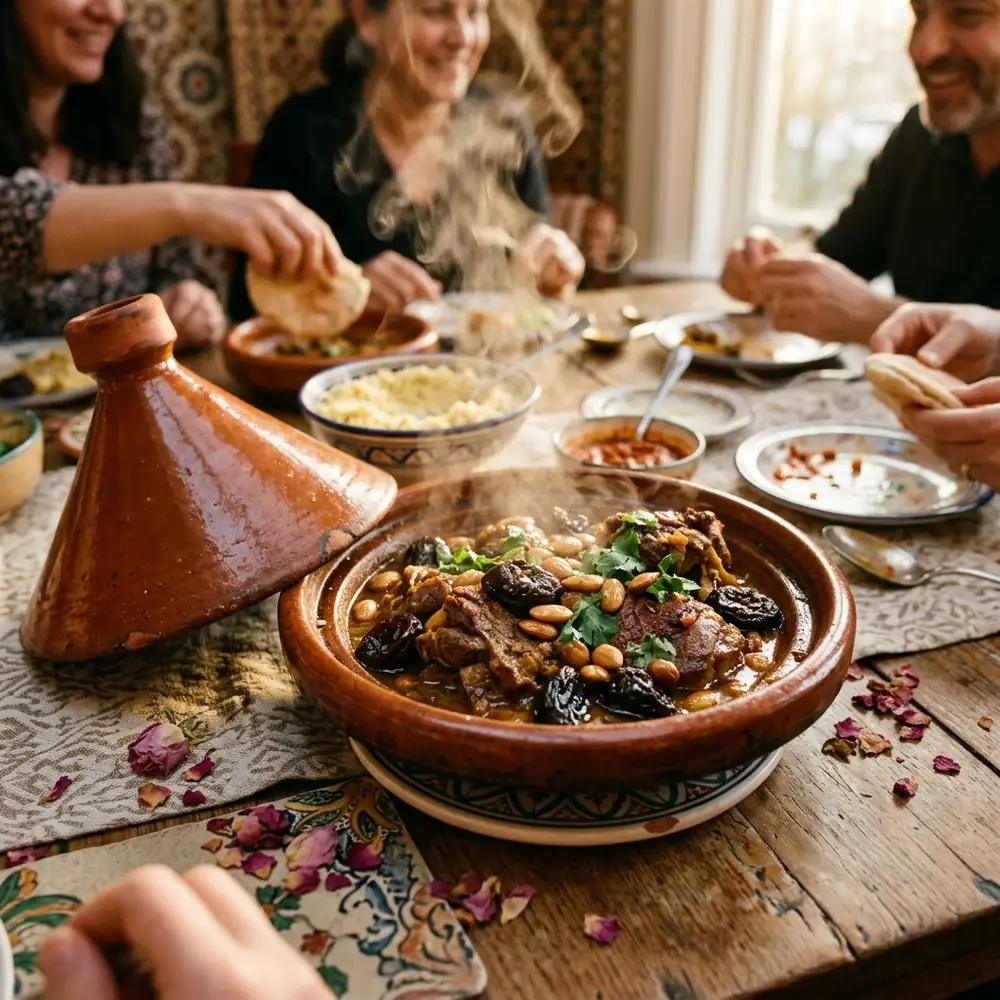
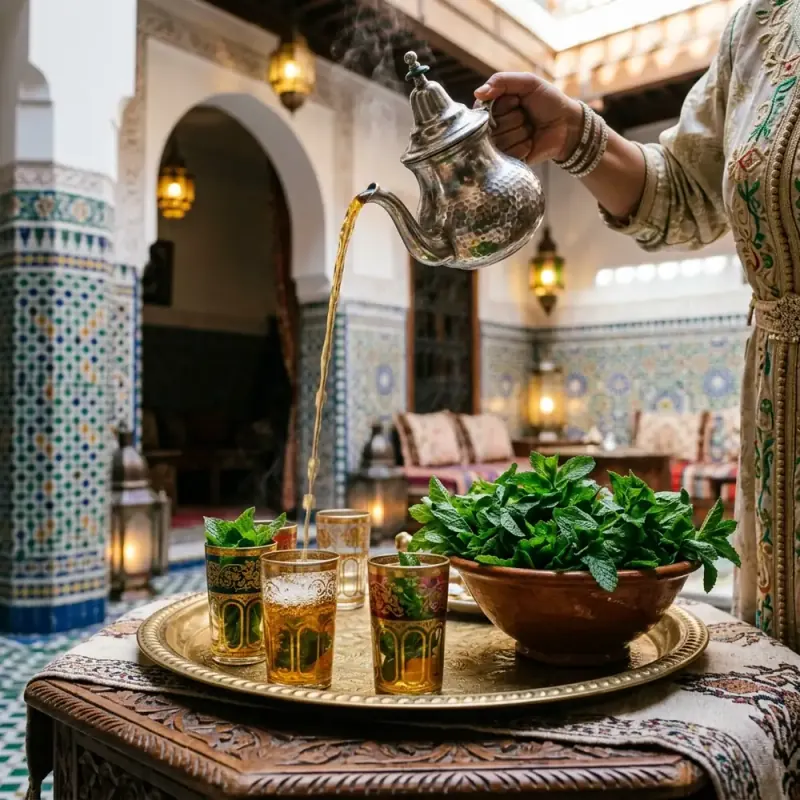
Pull up a low, carved cedarwood stool, settle into the firm cushions of the sdader bench, and let me pour you a stream of amber mint tea from high above, watching the golden froth crown the glass. Before us sits a round table—low to the ground, gleaming with polished brass, encircled by aromas of slow-simmered cinnamon, smen, and saffron that have drifted through this courtyard since early morning.
Let me tell you a secret that no tourist guidebook will ever explain: in a traditional Moroccan home, a meal is never simply an act of feeding the body. It is a sacred liturgy. It is a 1,200-year-old treaty of peace, an unwritten code of honor forged in the fierce generosity of the high Atlas mountains and refined in the aristocratic riads of Fez and Marrakech. In our language, we call this Karam—a word that English translates pale and flat as "hospitality," but which in our bones means something closer to the total offering of one's dignity, wealth, and soul to the stranger who crosses the threshold.
When you sit at a Moroccan table, you enter an invisible web of manners (Adab), unspoken signals, and reciprocal grace. Here, the host never eats first, the bread is both vessel and prayer, and the single communal platter transforms a circle of separate individuals into one core.
1. The Architecture of the Mida: The Sacred Geometry of Equality
To understand Moroccan food culture, you must first look down at the table itself. In the ancestral homes of our kingdom, you will never find a long, rectangular banquet table with an imposing "head of the table" where a patriarch sits above the rest.
Instead, you find the Mida—a circular, low wooden or brass table.
       [Guest of Honor]
              │
    [Guest] ──┼── [Guest]
          \   │   /
           \  │  /
 [Host] ────(MIDA)──── [Elder]
           /  │  \
          /   │   \
    [Family] ─┼── [Family]
              │
         [Moul Dar]
   (Egalitarian Geometry)
The circle is not an accidental design; it is a profound philosophical statement. At a round table, every single diner sits at the exact same radial distance from the steaming platter at the center. There is no first place, no last place, no high seat, and no corner of exile. The prince, the traveling merchant, the grandmother, and the young apprentice sit shoulder to shoulder, their knees almost touching under the embroidered table linen.
This physical geometry reflects the Amazigh and Islamic concept of Jama'a—the unified community. By gathering around a single center, everyone at the table acknowledges a shared destiny. What is in the dish belongs equally to all, yet it is navigated with an etiquette so exquisite and subtle that an outsider might easily miss the entire silent conversation taking place between dipping pieces of warm bread.
2. Baraka in the Single Platter: The Antidote to Individualism
In modern Western dining, each guest is handed their own isolated porcelain plate—a private territory guarded with fork and knife. In Morocco, individual plating for a traditional feast is considered an oddity, almost an act of emotional coldness.
We eat from a single, grand earthenware tabsi or the base of the tagine itself.
┌────────────────────────────────────────────────────────┐
│               THE COMMUNAL PLATTER (TABSI)             │
│                                                        │
│                  [Guest Zone 1]                        │
│                     . · ' · .                          │
│                 . ·           · .                      │
│     [Zone 3]   :   PRIME MEAT  :   [Guest Zone 2]      │
│                :   & SAFFRON   :                       │
│                 . ·  MARROW   · .                      │
│                     ' · . · '                          │
│                   [Host Zone]                          │
│               (Invisible Boundaries)                   │
└────────────────────────────────────────────────────────┘
Why? Because of Baraka—the spiritual principle of divine grace, abundance, and blessing. Our elders have taught us for generations that Baraka does not descend upon divided portions; it descends directly into the center of a communal dish where hands meet in harmony. The Prophet’s tradition echoes through every household: "Eat together and do not separate, for the blessing is with the group."
When four, six, or eight people eat from one dish, an unspoken chemistry occurs. You cannot be selfish when you share a single platter. You must constantly monitor the pace of the person next to you. If your neighbor is shy, you slow down; if an elder reaches for a tender piece of braised artichoke, you yield your hand; if a child is learning, you guide their fingers. The single platter dissolves the ego.
3. The Invisible Frontier: Koul Men Qoddamek
While the platter is communal, it is far from an unregulated free-for-all. Every diner possesses an invisible, sacred wedge of territory directly in front of them.
This is governed by the ironclad rule: "Koul men qoddamek" (Eat strictly from what is directly in front of you).
                      Communal Platter Center
                         /            \
                        /   TENDER     \
                       /     MEAT       \
                      /                  \
                     /  YOUR INVISIBLE    \
                    /    TERRITORIAL       \
                   /        WEDGE           \
                  /                          \
                 └────────────┬───────────────┘
                              │
                    [Diner's Hands & Bread]
To reach across the platter to pluck a sweet prune, an almond, or a caramelized piece of onion from someone else’s zone is considered the height of bad manners (qillat al-adab). You eat outward from the edge of your triangle toward the center, creating a neat, orderly progression through the sauce and vegetables.
There is, however, one magnificent exception to this rule: The Host's Privilege of Gifting.
4. The Silent Choreography: Why the Host Never Eats First
If you watch an experienced Moroccan host (Moul Dar or the family matriarch, Lalla), you will witness an extraordinary performance of culinary selflessness.
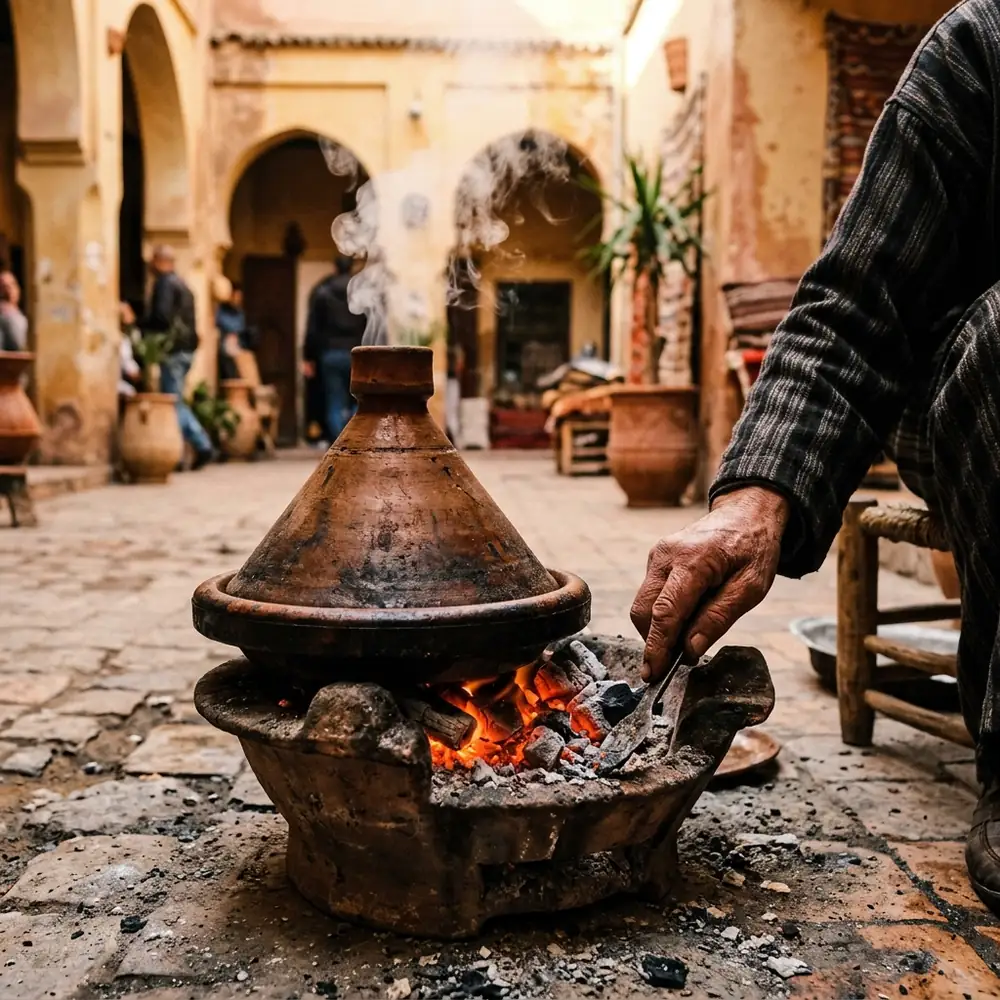
When the conical tagine lid is lifted with a flourish, releasing a cloud of sweet steam scented with ginger, turmeric, and coriander, the host does not immediately dig in. Instead, they invite everyone with a warm, open hand and the sacred phrase: "Bismillah" (In the name of God, begin).
The host waits until every guest has broken their bread and taken their first mouthful. Throughout the entire meal, the host's eyes are quietly scanning the table:
- Is the guest’s bread basket full?
- Has the sauce level in the guest's quadrant dropped?
- Is someone hesitating to take the prime cut of meat?
                 THE HOST'S VIGILANT RHYTHM
┌──────────────────────────────────────────────────────────┐
│ 1. Invocation & Invitation ("Bismillah, marhaba bikum")  │
│ 2. Waits for all guests to take first bite               │
│ 3. Stealthily carves & deposits prime morsels to guests   │
│ 4. Feigns constant appetite so guests never feel hurried │
│ 5. Holds bread until the very last guest withdraws hand  │
└──────────────────────────────────────────────────────────┘
The host practices what anthropologists call hyper-vigilant hospitality. They will actively carve the tenderest portions of lamb shoulder, the melting marrow bone, or the sweetest roasted sweet potato using only their thumb and two fingers, and gently slide these delicacies across the platter directly into your zone.
You must never push this meat back. To decline a morsel offered by the host is to reject their love and blessing. You accept it with a slight bow of the head, a hand over your heart, and the prayer: "Llah ykhelaf alik" (May God replenish your abundance).
And here is the most poetic law of all: The host never stops eating first. Even if the host is completely full, they will continue to hold a small piece of bread in their fingers, lightly dipping it into the edge of the sauce, pretending to eat. Why? Because the moment the host puts down their bread and withdraws their hand, the guests feel shy and immediately stop eating out of politeness. The host remains at the table, a guardian of the feast, until the very last guest has leaned back, sighing with contented exhaustion.
5. The Invisible Mechanics of the Three-Finger Rule
In the West, dining requires an arsenal of cold stainless steel: soup spoons, salad forks, steak knives, dessert spoons. In the traditional Moroccan dining art, the human hand is the ultimate instrument of precision and sensory pleasure.
However, eating with your hand is not simply grabbing food. It is an exacting discipline governed by anatomical physics and strict etiquette.
                  THE THREE-FINGER ANATOMY
                           Middle Finger
                            (Al-Wusta)
                                 │
             Index Finger ───────┼─────── Thumb
            (Ash-Shababah)       │        (Al-Ibham)
                                 │
                      ┌──────────────────────┐
                      │ THE GOLDEN PINCH     │
                      │ • Palm elevated      │
                      │ • Ring/Pinky tucked  │
                      │ • Bread forms pocket │
                      └──────────────────────┘
The Rules of the Right Hand
- The Hand of Purity: We eat exclusively with the right hand (al-yad al-yumna). The left hand remains resting quietly in the lap or is used solely to steady the water glass or pass clean bread.
- The Three Fingers (Al-Asabi' ath-Thalatha): One eats using only the thumb, index finger, and middle finger. The ring finger and pinky finger are tucked back toward the palm.
- The Clean Palm Law: The food, sauce, and grease must never touch the palm of your hand or the web between your fingers. Only the first two knuckles of the three fingers should ever come into contact with the food. If an elder looks at your hand and sees sauce smeared across your palm, it indicates haste and a lack of refinement.
6. Bread as the Golden Utensil: Lqma d-Dhab
How does one eat rich, slow-simmered sauces and melting meat without letting sauce touch the fingers?
The answer is our daily bread: Khobz.
In Morocco, bread is revered. If a piece of bread falls to the floor, an elder will pick it up, kiss it reverently, touch it to their forehead, and place it high on a ledge so birds may eat it. Bread is Ni'ma—a divine gift of sustenance.
THE "PIGEON'S BEAK" TECHNIQUEStep 1: Tear small square of Khobz │ Step 2: Fold crust-side outward │ Step 3: Form curved pinch with 3 fingers │ Step 4: Pinch meat + sauce inside pocket │ Step 5: Lift cleanly to mouth (Zero Drips)
At the table, you tear off a morsel of warm crusty bread roughly the size of a walnut. You fold it between your three fingers to form a small concave scoop—what traditional cooks call Mnqar t-Teyr (the pigeon’s beak).
With this bread scoop, you pinch a bite-sized piece of meat, wrap it with a caramelized onion or a sliver of preserved lemon, sweep up a glossy drop of sauce, and lift it to your mouth in one fluid, immaculate motion. The bread acts as an edible glove and a sponge, ensuring not a single drop of rich golden oil drips onto the table linen.
7. The Anthropology of the Empty Plate: The Art of the Polite Surplus
In many Anglo-Saxon and Northern European cultures, cleaning your plate until it looks as if it were washed in the sink is the highest compliment you can pay the cook; it signals that you loved every crumb.
In Morocco, if you scour the communal platter until not a drop of sauce or a grain of couscous remains, you have committed a catastrophic social offense.
┌────────────────────────────────────────────────────────┐
│               THE MEANING OF THE PLATTER               │
├──────────────────────────┬─────────────────────────────┤
│ CLEANED BARE PLATTER     │ POLITE SURPLUS (HADRA)      │
├──────────────────────────┼─────────────────────────────┤
│ ❌ "The host did not     │ ✅ "Your generosity was     │
│    provide enough."      │    overwhelming."           │
│ ❌ Suggests poverty and  │ ✅ Proves the house has     │
│    scarcity.             │    infinite abundance.      │
│ ❌ Leaves no blessing    │ ✅ Shares Baraka with the   │
│    for the second circle │    kitchen and home.        │
└──────────────────────────┴─────────────────────────────┘
An empty platter sends a devastating message to the Moroccan host: "You did not prepare enough food. Your generosity had a limit, and we left your table still hungry."
To honor the host, guests must always leave a deliberate, polite surplus in the center of the dish—a portion known in some regions as the Hadra or Haqq al-Mida (the right of the table). Leaving food on the platter announces to the world: "We were fed until our souls were satisfied, and the host's bounty exceeded our capacity to consume it."
What Happens to the Remaining Feast?
Do not fear that this remaining food is discarded! In Moroccan homes, the feast operates in concentric circles of honor:
- The First Circle: The guests of honor and elders dine first at the Mida.
- The Second Circle: The platter is refreshed with hot sauce and shared with the extended family, the children, and the hardworking women and men who prepared the feast.
- The Third Circle: Any remaining delicacies are shared with neighbors, guards, or those in need in the quarter.
Nothing is wasted; the Baraka flows outward into the neighborhood.
8. The Ritual of Scent & Water: The Tesliya & The High-Poured Tea
The meal in Morocco is bookended by ancient sensory rituals that enhance hygiene into poetry.
[Arrival] ──> [Brass Basin Hand-Wash] ──> [Bismillah] ──> [Communal Feast]
                                                               │
[Mint Tea Ceremony] <── [Orange Blossom Water] <── [Post-Meal Hand-Wash]
The Hand-Washing Ceremony (Lwaddan & Tas)
Before a single piece of bread is touched, the youngest member of the family or the host brings the Tas wa Briq—an ornate, chased silver or brass pitcher and basin.
They hold the basin before each guest, pouring a gentle stream of warm water scented with rose petals or lemon slices over the guest's right hand while offering a clean, embroidered towel. The same ceremony is repeated immediately after the meal to cleanse the fingers of savory oils and spices.
The Floral Blessing (M'rash)
In traditional Fassi and Marrakshi homes, after the post-meal washing, the host will produce a slender, long-necked silver sprinkler called a M'rash.
They gently sprinkle drops of pure distilled orange blossom water (Ma Zhar) or rosewater (Ma Wared) onto the palms, forearms, and even the hair of the guests. As you rub the cool floral water into your hands, the heavy, savory scents of cumin, lamb, and garlic vanish, replaced by the celestial perfume of an Andalusian orchard in springtime.
The Culmination: Atay bi Naana
Finally, the silver tea service (Siniya) arrives. The host brews Chinese gunpowder green tea with fresh mountain spearmint, bruised absinthe (Sheeba) in the cold months, and towering sugar cones (Qaleb d-Sokkar).
The tea is poured from at least two feet in the air, creating a rich, dense foam (Raza or turban) on the rim of the glass. This high pour is not theatrical showmanship; the drop oxygenates the tea, softens the bitterness of the green tea tannins, and releases the volatile menthol oils into the room, creating the perfect digestive conclusion to a magnificent feast.
9. Grandmother's Secrets: Lalla's Unwritten Laws of the Table
Here are six timeless pieces of wisdom passed down through generations of Moroccan matriarchs to keep your table blessed and harmonious:
- The Salt of Welcome: Never let a guest sit at a bare table. Even before the main dishes are cooked, the table must have small dishes of green olives, toasted almonds, fresh bread, and salted cumin. A bare table is an inhospitable table.
- The Voice of the Kettle: Never boil your tea water twice. Re-boiled water loses its oxygen, flattening the tea and turning the mint dark and bitter.
- The Saffron Rub: When preparing a feast tagine, never drop saffron threads directly into hot oil. The oil sears and seals the threads, trapping their flavor. Instead, dry the threads on the warm lid of the tagine, crush them between your palms into a splash of warm spring water, and pour that golden perfume over the meat as it simmers.
- The Bread Slicing Rule: Never cut traditional round Moroccan bread with a metal knife in front of guests. Bread is torn gently with clean hands along its natural grain. The knife is seen as an instrument of division, whereas hand-torn bread represents shared warmth.
- The Cooling Gesture: If a dish arrives boiling hot from the coals, the host should never blow on the food with their breath (Nafkh). Instead, gently break the crown of vegetables with your bread to let the steam escape naturally into the room.
- The Parting Du'a: When a guest stands up from the table, the host should never ask, "Did you have enough?" Rather, look into their eyes and say: "Bsseha wa r-raha, dar darkum" (With your health and peace, this house is forever your house).
10. Frequently Asked Questions (FAQ)
What should I do if I am left-handed when dining in Morocco?
If you are naturally left-handed, it is completely acceptable to explain gently to your host before the meal: "Smehliya, ana a'ssri" (Forgive me, I am left-handed). Moroccan hosts are deeply accommodating and understand natural differences. However, make an effort to use only that one hand for eating and keep your other hand clean and rested.
Is it rude to ask for a fork or spoon at a traditional Moroccan gathering?
It is not considered rude, and any hospitable host will gladly bring you a spoon (M'alqa) if you request one. However, trying to eat with bread and your three fingers is seen as a wonderful sign of respect and appreciation for the culture. Hosts delight in seeing guests embrace the tactile joy of the Lqma.
Why do Moroccans constantly insist that you eat more (Kul, kul!)?
In Moroccan culture, hospitality is an active, passionate duty. A host worries constantly that a guest might be held back by shyness (Hchouma). By insisting repeatedly (Zid chwiya, kul men hadi!), the host gives you full cultural permission to indulge without feeling self-conscious. If you are truly full, place your right hand over your heart, smile warmly, and say: "L-Hamdoulillah, chba't, Llah ykhelaf alikum" (Praise be to God, I am truly full, may God bless your home).
Why is cumin placed in a separate dish on the table rather than cooked into everything?
While cumin is used in many marinades (chermoula), high heat and long braising can make ground cumin turn slightly bitter. In Moroccan dining, freshly toasted, stone-ground cumin from regions like Alnif is placed in small decorative earthenware dishes alongside sea salt. This allows each diner to dust their own bite of slow-roasted lamb (Méchoui) or boiled vegetables with fragrant, unburnt cumin aroma right before it enters the mouth.
11. Visualizing Karam: High-Resolution Photographic Prompts
Image Prompt 1
- Subject: A wide overhead flat-lay shot of a low, circular carved Moroccan cedarwood table (Mida). In the center sits a large ceramic Fez-blue painted platter (Tabsi Fassi) filled with a golden lamb tagine garnished with glistening caramelized prunes, toasted almonds, and hard-boiled eggs dusted with cinnamon. Around the platter are small terracotta dishes of olives, warm round crusty Khobz, and three pairs of hands gracefully reaching with folded bread.
- Vibe: Ancestral warmth, communal unity, timeless Moroccan hospitality.
- Style: Rich chiaroscuro lighting, deep shadows, warm candlelight reflecting off polished brass lanterns in the background.
- Format: 50mm lens, medium format digital photograph, ultra-detailed texture on the glazed zellige tiles and embroidered tablecloth.
Image Prompt 2
- Subject: Extreme close-up macro shot of a host's hand demonstrating the "three-finger rule." The thumb, index, and middle finger are holding a folded piece of golden, semolina-dusted bread (Khobz), delicately pinching a tender, braised piece of lamb shank dripping with rich saffron and ginger sauce. The palm and knuckles remain completely clean.
- Vibe: Elegance, culinary precision, tactile intimacy.
- Style: Editorial food photography, shallow depth of field, creamy background blur showcasing Moroccan mosaic tilework (Zellige).
- Format: 85mm f/1.4 portrait lens, soft natural window light.
Image Prompt 3
- Subject: A traditional Moroccan silver hand-washing ceremony (Tas wa Briq). An embossed antique silver pitcher is pouring a thin, crystalline stream of warm water into a matching pierced silver basin held over a low stool. Fresh pink rose petals float in the basin water, and an embroidered linen towel rests nearby.
- Vibe: Aristocratic refinement, sacred ritual, sensory cleanliness.
- Style: Moody heritage photography, soft morning light catching the water droplets and the intricate filigree engravings of the silver.
- Format: 35mm film aesthetic, subtle grain, high dynamic range.
Image Prompt 4
- Subject: A Moroccan host pouring steaming amber mint tea from an ornate silver teapot held high in the air into a row of colorful gilded tea glasses on a polished round brass tray (Siniya). A thick, creamy crown of white foam (Raza) forms on top of the tea in mid-pour, with fresh bruised mint sprigs bursting out of the teapot spout.
- Vibe: Dynamic energy, celebratory culmination, fragrant steam.
- Style: High-speed shutter catching the liquid arc in crisp clarity, ambient warm salon lighting with lantern glows.
- Format: DSLR, 70mm lens, sharp focus on the foaming glass, warm color grade.
Image Prompt 5
- Subject: A cozy Moroccan family salon (Salon Beldi) at dusk. Three generations of a family sitting on plush velvet sdader banquettes around a steaming round tagine table. A grandmother with traditional henna-patterned hands smiles warmly as she offers a choice morsel of meat to a young guest.
- Vibe: Generational love, grandmotherly wisdom, heartwarming family gathering.
- Style: Documentary lifestyle photography, warm amber tones, candid authentic emotional expression.
- Format: 35mm wide angle, natural ambient evening light mixed with interior lantern glow.
Experience the true heart of Moroccan heritage through its culinary traditions. Join us in preserving and honoring these ancestral recipes.
What People Are Saying
No comments yet. Be the first — we'd love to hear from you.
Lalla Fatima & The Medina Culinary Guild
Culturally Verified & Fact-CheckedThe Moroccan Food editorial team brings together native culinary researchers, heritage preservationists, and experienced home cooks across Marrakech, Fes, and Casablanca. Every recipe and cultural guide is reviewed against ancestral oral traditions and authentic regional practices.