The Best Riad Cooking Classes in Marrakech: What to Expect and How to Choose
My friend Fatima taught me how to make couscous by hand on a Tuesday afternoon in her riad kitchen in the Mellah, and it took nearly two hours to do what takes a pot of boiling water and a box five minutes. That was the point. The slowness was the lesson. You cannot rush the steam through hand-rolled semolina. You cannot rush Moroccan cooking. The riad class where you learn this truth is worth infinitely more than any class where you stir a pre-measured spice blend into a pre-cut pot of chicken.
The problem is that Marrakech has roughly two hundred cooking classes on offer at any given moment, ranging from genuinely life-changing experiences to glorified photo opportunities with a tagine prop. Choosing the right one requires knowing what separates them.
The One Non-Negotiable: It Must Start at the Souk
This is the single most reliable indicator of a quality cooking class. Good classes begin in the market, not in the kitchen.
When a class starts at the souk — ideally one of the working neighborhood markets rather than the main tourist souk near Jemaa el Fna — it is telling you something important: the teacher understands that Moroccan cooking is inseparable from the ingredients that go into it, and that ingredients in Morocco are inseparable from the act of choosing them yourself.
At the market, a good instructor will show you how to pick a ripe quince for a tagine (it should be fragrant, not rock-hard), how to choose chickens (a live bird selected and prepared in front of you, which is not for everyone but is the reality), and what the fresh herbs look like vs. the dried bundles. You will understand why Moroccan cooking tastes the way it does before you have cooked a single thing.
Classes that start with “here is your apron and here are your pre-measured ingredients” are saving time in a way that costs you the most valuable part of the experience.
Real Home Kitchen vs. Demonstration Kitchen
A demonstration kitchen is a purpose-built teaching space designed to look like a Moroccan home. It usually has good lighting, a long central counter, matching aprons, and everything pre-arranged for efficient instruction. These spaces are clean, well-organized, and produce consistent results.
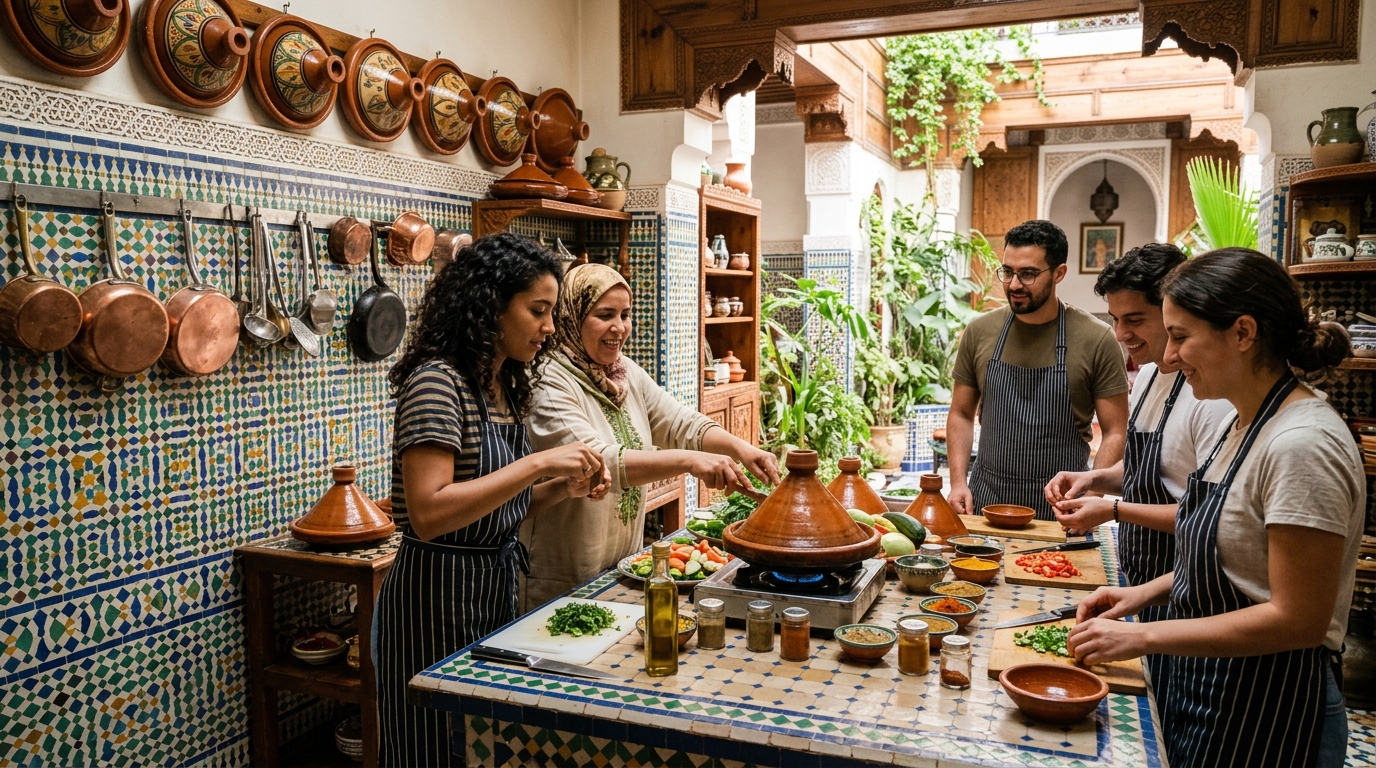
A real riad kitchen is low-ceilinged, often tiled in hand-cut zellige, fitted with gas burners that have individual personalities, and run by someone whose grandmother made the same dish in the same kitchen. The copper pots are heavy and dented. The kefta grinder is older than the instructor’s children. The bread is going to bake in the communal oven down the street because there is not room for one inside.
These two experiences are not comparable. The demonstration kitchen will teach you a recipe. The riad kitchen will teach you a way of thinking about food. If you have a choice, choose the second one, even if the instruction is slightly less polished.
What You Should Actually Learn to Make
Given four to five hours in a Moroccan cooking class, these are the three things worth prioritizing:
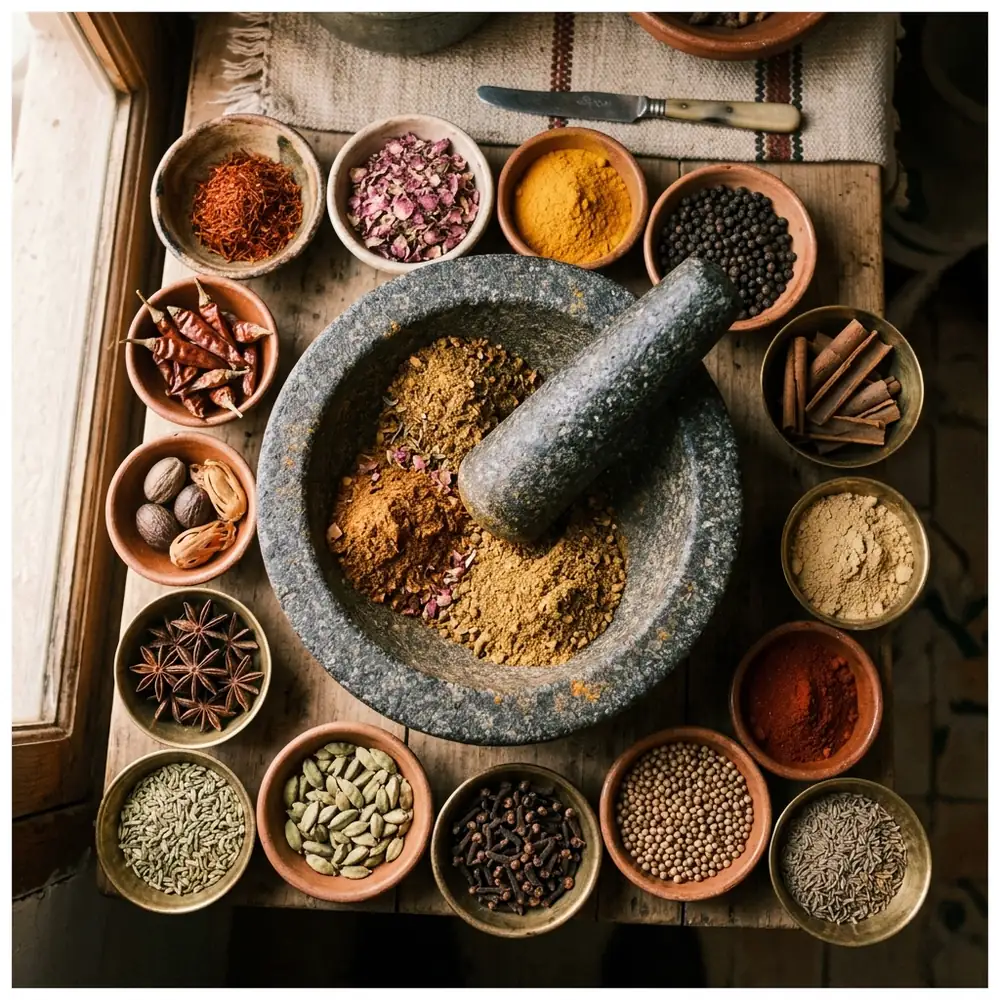
How to build a tagine spice base. Not the spices themselves, but the technique — how you cook the onion down first until it almost dissolves, how you add the ginger and saffron and let them open in the warm oil before anything else goes in, how you build the liquid level carefully so the vegetables steam rather than boil, and why you never, ever lift the tagine lid early. This technique transfers to everything. Once you understand the architecture of a Moroccan stew, you can improvise endlessly.
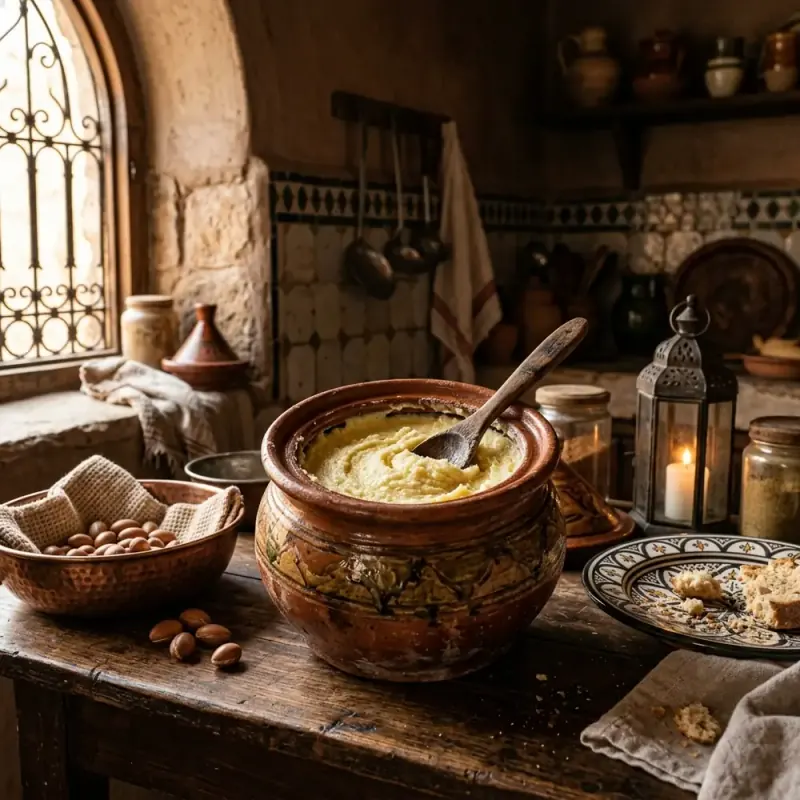
How to make real couscous by hand. Box couscous is pre-steamed semolina that you reconstitute with hot water. It is not the same thing as hand-rolled couscous, which involves dampening raw semolina, rolling it between your palms until tiny grains form, drying it slightly, and then steaming it in a couscoussier — not once, but twice, sometimes three times, with raking and re-steaming between rounds. The difference in texture is substantial. The difference in flavor is even more so. This is the dish most worth learning badly in a class so you can learn it properly at home afterward.
Pastry work for bastilla. The warqa pastry that wraps a proper bastilla is one of the more technically demanding things in Moroccan cooking — thin enough to see light through, made by pressing wet dough in overlapping circles on a flat griddle. A good class will walk you through the warqa technique slowly, which means you will not get it right on the first try. That is fine. You will understand what you are aiming for, and that is enough.
What to skip: any class that promises to teach you a full seven-course Moroccan dinner in three hours. A proper tagine alone needs at least ninety minutes of simmering. The arithmetic does not work.
What the Riad Itself Should Look Like
The riad is not just a venue — it is part of what you are paying for. A genuine traditional riad cooking class should take place in a space that reflects how Marrakchis actually live, which means certain things should be present.
Zellige tile work: the hand-cut geometric tilework that lines the lower walls and often the floors of traditional Moroccan homes. Modern riads sometimes use machine-cut tiles that look similar but have slightly uniform edges. Hand-cut zellige is slightly imperfect, with small variations in each piece, which is exactly the point.
A central courtyard: the Moroccan riad is designed around an interior garden or water feature, open to the sky. The kitchen typically opens off one side of the courtyard. If the cooking class is in a room without access to the courtyard — particularly if it is in a basement or a closed interior room — that is usually a sign the “riad” is more of a restaurant using the name.
Copper cookware: traditional Moroccan kitchens use copper pots, brass kettles for tea, and clay tagines for slow cooking. Stainless steel and non-stick pans are functional but tell you nothing about the tradition. The presence of well-used copper and clay in the kitchen is a good sign.
Riad Class vs. Tourist Restaurant Class
Many restaurants in Marrakech offer “cooking classes” that are really just lunch with a demonstration component. You watch a chef make something in the open kitchen, you sit down and eat it, and you leave with a printed recipe card. This is not a cooking class. It is a restaurant meal with theater.
A genuine class has you physically making the food: kneading the dough, grinding the spices, handling the raw ingredients, making the mistakes, and correcting them. Your hands should smell like cumin and preserved lemon at the end. If they do not, you did not really cook.
The price difference is real and reflects genuine differences in labor. A demonstration-style restaurant class might cost 200 to 300 dirhams. A genuine four to five hour riad class with souk visit, hands-on cooking, and shared meal should cost 500 to 800 dirhams. The latter is worth it by almost any measure.
Which Neighborhoods to Look In
The Mellah (Jewish Quarter): The area around Place des Ferblantiers and the Mellah market has some of the most authentic small riad cooking experiences in Marrakech. The neighborhood is less visited than the main medina and the families who run classes here tend to have been doing so for longer, often starting as a way of hosting friends of friends before formalizing the offering.
Bab Doukkala: The northwestern edge of the medina, near this old gate, is a largely residential neighborhood with less tourist infrastructure. Several women-run cooking cooperatives operate here, some in connection with development programs that train local women in hospitality. These classes are often among the most genuine and the most fairly priced.
Avoid classes that advertise primarily in Jemaa el Fna: the square’s immediate surroundings are the most tourist-saturated square meters in Morocco. Classes marketed from here are almost invariably the theatrical restaurant-demo variety.
The Post-Class Meal and What Comes Next
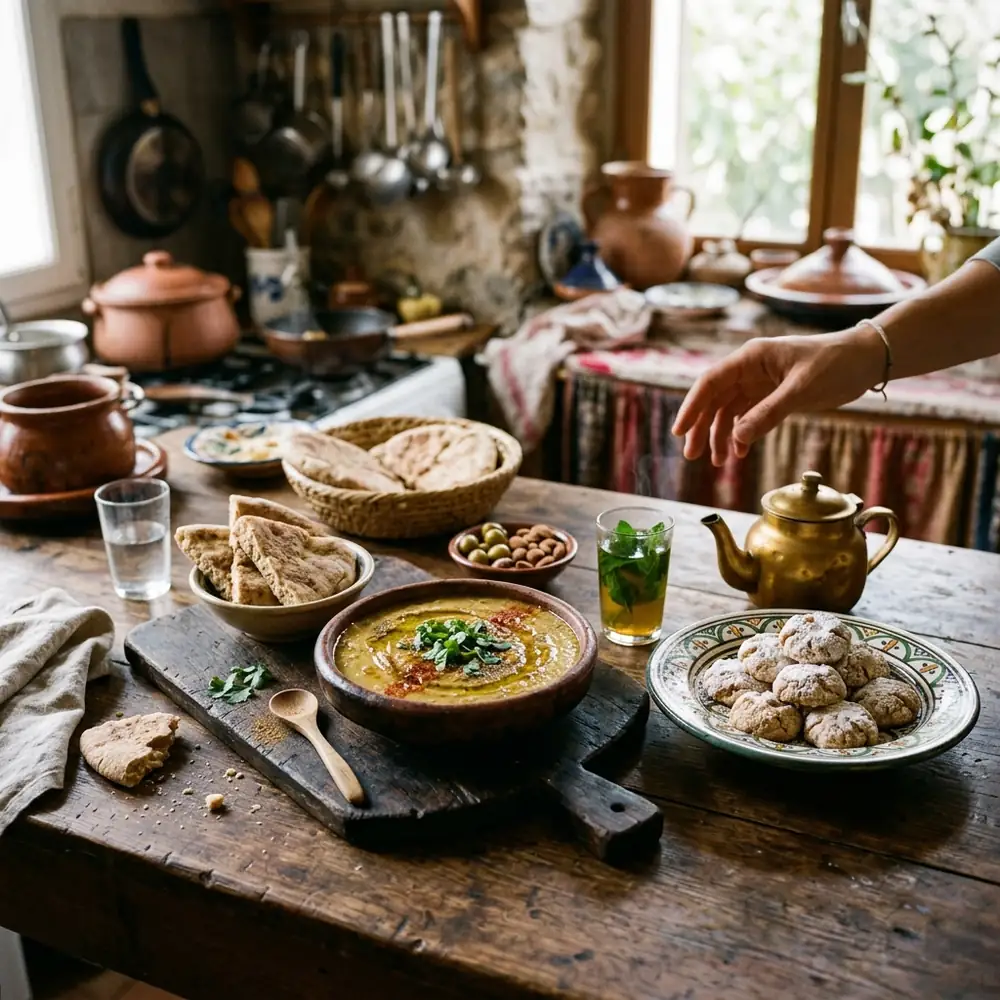
In a proper Moroccan home cooking class, you eat what you cooked. This is how it should be. There should be mint tea, khobz, the dishes you made, and enough quiet to actually taste what took you three hours to prepare.
Moroccan eating etiquette at a home table: wait for the host to begin, eat from the section of the communal dish nearest to you (do not reach across), use your right hand or bread for communal tagines, accept second servings graciously and then feel free to decline subsequent ones. Saying “la, shukran” (no, thank you) with genuine warmth is always understood.
What you take home is the recipe, yes, but more than that — a structural understanding of Moroccan flavor. Warm spices added early, acid (lemon, preserved lemon) added late. Fat as carrier of flavor, not just cooking medium. Sweetness and savoriness in the same dish without apology. Once you understand this, Moroccan food becomes something you can improvise, not just reproduce.
FAQ
How far in advance should I book a riad cooking class in Marrakech? For good small-group classes, booking three to five days ahead is usually sufficient outside of peak season. During high season (October–November and March–April), a week or more is safer. The best small classes cap at six to eight people, and they fill.
Are riad cooking classes suitable for children? Many are, particularly the family-run ones. Check with the host in advance. Tasks like hand-rolling couscous or shaping briouat are well-suited to children’s involvement. Very young children may find the souk visit overstimulating.
I have dietary restrictions. Can I still do a Moroccan cooking class? Yes. Most good classes are flexible if you communicate in advance. Vegetarian Moroccan cooking is extensive — vegetable tagines, couscous with seven vegetables, lentil and chickpea dishes. Gluten-free is harder given the bread culture but workable. Alert your host when booking.
What should I wear to a cooking class? Comfortable clothes you do not mind getting turmeric on. Closed shoes are practical at the souk. Some riads provide aprons; others do not. Tying back long hair is sensible. Leave the linen shirt in the riad.
Experience the true heart of Moroccan heritage through its traditions. Join us in preserving these ancestral rituals.
What People Are Saying
No comments yet. Be the first — we'd love to hear from you.
The Moroccan Food
A Moroccan cultural writer dedicated to documenting the authentic voice, history, and heritage of the Kingdom. Writing from within — to share what truly makes Morocco extraordinary.
Our Mission →