The Rif Mountains: Morocco's Green North, Its Cannabis Economy, and the Republic That Lasted Five Years
The Rif: The Part of Morocco That Has Always Done Things Differently
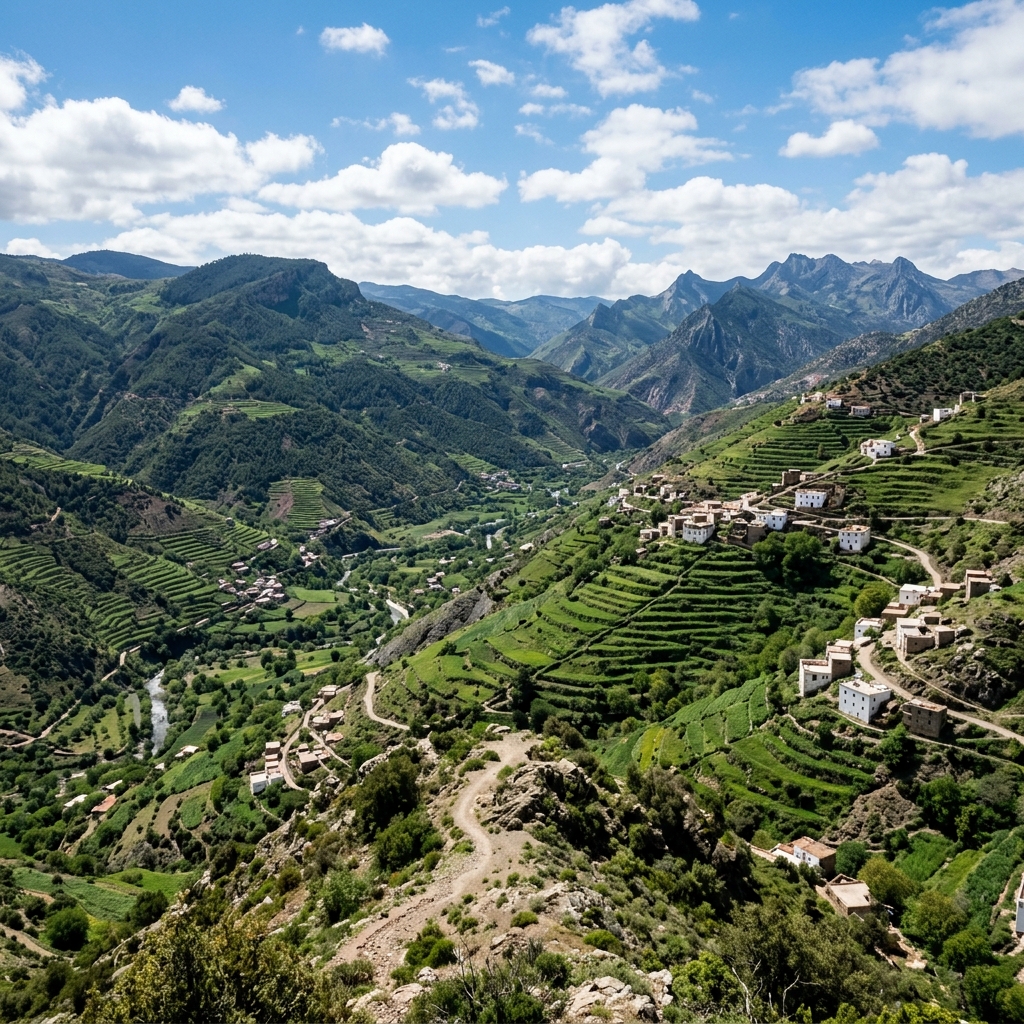
The Rif Mountains — the arc of ranges running parallel to Morocco's Mediterranean coast from Tangier to the Algerian border — are the part of Morocco that most clearly resists the generalization that the country's tourism narrative tends to produce. Morocco is not the Sahara and the medinas and the Atlas. Morocco is also the Rif: the green-terraced slopes above the Mediterranean coast, the cedar and oak forests of the interior, the Amazigh (Tarifit-speaking) communities whose relationship to the Moroccan state has historically been more contentious than the smoother integration narratives suggest, and the cannabis agriculture that the Rif Valley has been sustaining since at least the 15th century and that continues to account for a significant portion of global cannabis production despite — or perhaps because of — its ambiguous legal status in Morocco.
Let me approach the Rif with the specificity it deserves, beginning with its geography and moving toward its history and contemporary reality.
What Is the Physical Character of the Rif?
The Rif is geologically distinct from the Atlas: where the Atlas is the product of the African-Eurasian tectonic collision that began in the Eocene, the Rif is part of the Betic-Rif arc — the same mountain system as Spain's Sierra Nevada and Baetic ranges, separated from them by the opening of the Strait of Gibraltar approximately 5.5 million years ago. The Rif and the Spanish mountains across the strait are, geologically, the same chain.
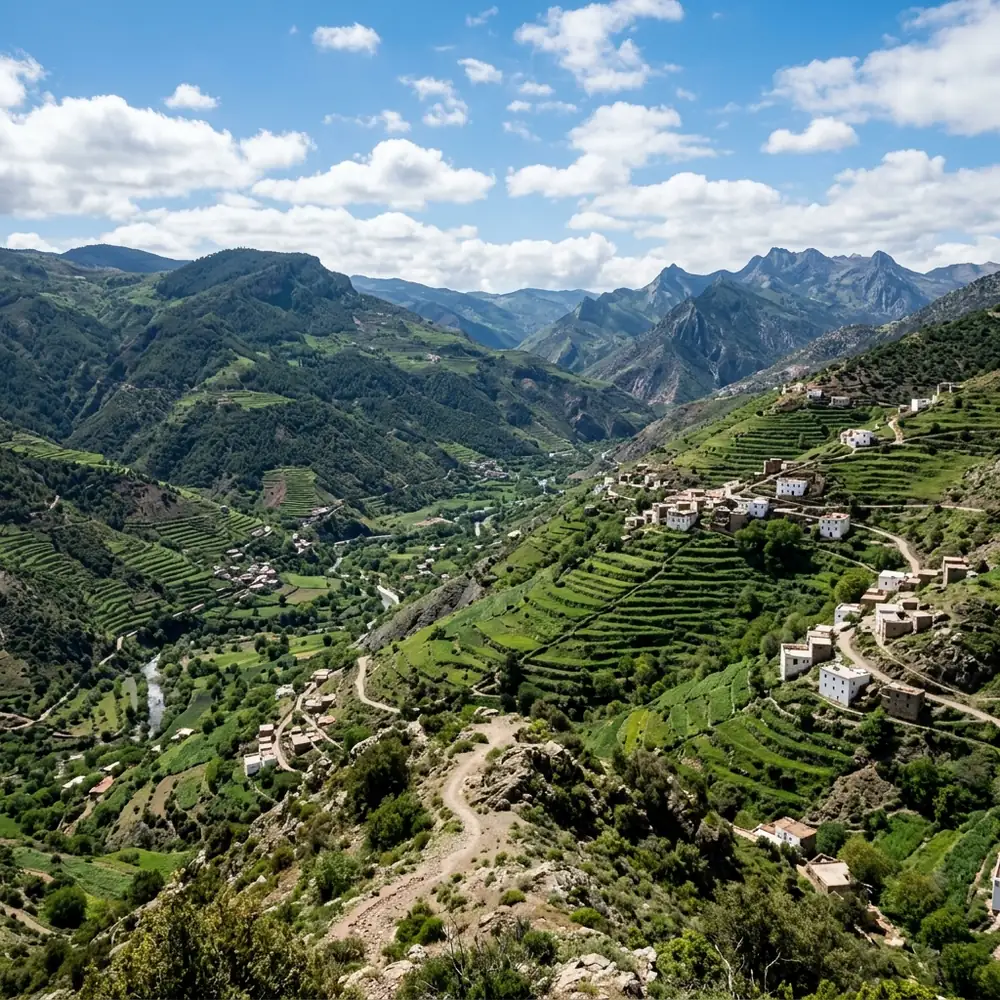
The Mediterranean influence on the Rif's climate produces a landscape that is immediately distinct from the rest of Morocco: green in a way that the Atlas, the pre-Sahara, and the Atlantic plains are not. The Rif's slopes receive significant rainfall, support dense vegetation including cork oak (Quercus suber) and cedar forests in the higher areas, and produce the agricultural variety — olives, almonds, figs, citrus — that the Mediterranean climate everywhere enables.
The highest peaks — Jbel Tidiquin at 2,456 meters — are modest compared to the Atlas but significant enough that the interior valleys have historically been isolated from each other and from the coast in a way that produced the strong local identities and the resistance to central authority that characterize Rifian history.
Who Was Abd el-Krim al-Khattabi and What Was the Rif Republic?
Abd el-Krim al-Khattabi (1882-1963) is one of the most significant anti-colonial figures of the 20th century — a Rifian Amazigh leader whose successful military resistance to Spanish colonial occupation in the early 1920s produced an independent state (the Republic of the Rif) that held out for five years, inflicted the heaviest colonial military defeat in North African history at the Battle of Annual (1921), and inspired anti-colonial independence movements from Asia to sub-Saharan Africa decades before decolonization became a global movement.
The context: following the 1906 Algeciras Conference, Spain and France divided Morocco into zones of influence, with Spain controlling the Rif and the Mediterranean coast as its "protectorate." The Spanish occupation of the Rif was conducted with particular violence and incompetence — the Annual disaster of 1921, in which approximately 10,000 Spanish soldiers were killed in a Rifian counterattack organized by Abd el-Krim, was the worst defeat of a European colonial army by a non-European force in the 20th century.
Abd el-Krim established the Republic of the Rif — with a constitution, a government, foreign policy ambitions, and a professional army — that held the Spanish and subsequently the French (who joined the campaign against him in 1925) at bay until 1926, when a combined Franco-Spanish force of several hundred thousand soldiers, using aerial bombardment and chemical weapons, finally suppressed the republic.
Abd el-Krim surrendered in 1926, was exiled to Réunion, escaped to Egypt in 1947 while being transferred to France, and spent the remainder of his life in Cairo, refusing to return to Morocco until it achieved full independence from France — which Morocco did in 1956, but Abd el-Krim never returned, dying in Cairo in 1963.
What Is the Cannabis Economy and How Is It Understood?
The Ketama region of the central Rif — the valley area around the town of that name — is one of the world's primary cannabis producing areas, with estimates of cultivated area ranging from 30,000 to 100,000 hectares depending on the source and the year. The production is primarily for the production of hashish (kif or chira in Moroccan terminology) for export to Europe.
The cannabis agriculture in the Rif predates the current legal frameworks around it by centuries — historical accounts from the 15th century onward document cannabis cultivation in the region. The economic dependence of the Rif's rural communities on cannabis is a direct consequence of the region's agricultural marginalization: the Rif's terrain and climate make alternative cash crops difficult to establish at competitive prices, and the cannabis market, illegal but persistent, has provided income that legitimate agricultural alternatives have not matched.
Morocco's approach to the cannabis question has been evolving: legislation passed in 2021 permits licensed cannabis cultivation for medical and industrial purposes, a partial acknowledgment of the economic reality of the Rif's production without full legalization of the traditional market.
The Invisible Invitation
Drive the road from Chefchaouen toward Al Hoceima in the morning — the road that climbs from the blue city's valley into the Rif interior, the cedar forests thickening above Chefchaouen as the altitude increases, the Mediterranean visible at moments through the forest when the road turns south. Stop anywhere in the cedar forest and walk in for five minutes. The silence of the Rif cedar forest is different from the silence of the Atlas — more enclosed, the trees taller and the canopy denser, the undergrowth thicker from the higher rainfall. This silence has been here since before the colonial period, before the republic, before the European naming of these mountains. The Rifian Amazigh have been moving through this forest for millennia. Their history — the resistance, the republic, the suppression, the continuing marginality in the national narrative — is not visible in the trees. But the trees are the landscape that produced the people who produced the history. Stand in it. Then continue driving.
SEO Meta Description: What are the Rif Mountains of Morocco? The Rifian Amazigh identity, Abd el-Krim al-Khattabi and the 1921 Republic, the Battle of Annual explained, and the cannabis economy's historical roots.
Experience the true heart of Moroccan heritage through its culinary traditions. Join us in preserving and honoring these ancestral recipes.
What People Are Saying
No comments yet. Be the first — we'd love to hear from you.
Youssef Amazigh
Culturally Verified & Fact-CheckedThe Moroccan Food editorial team brings together native culinary researchers, heritage preservationists, and experienced home cooks across Marrakech, Fes, and Casablanca. Every recipe and cultural guide is reviewed against ancestral oral traditions and authentic regional practices.