The Rif Mountains: Northern Morocco's Most Misunderstood Region Has More to Offer Than Its Reputation
The Rif: What the Mountains Are When You See Past the Reputation
I am going to acknowledge the kif immediately because not doing so would be more dishonest than doing it in the opening paragraph. The Rif Mountains — particularly the western Rif between Chefchaouen and Al Hoceima — are a significant global source of cannabis resin (kif, hashish). The cultivation is technically illegal under Moroccan law, has been largely tolerated as an economic reality in a mountainous region with limited agricultural alternatives, and was partially legalized for medical and industrial use in 2021, a policy shift that is changing the political economy of the region in ways that are still working themselves out. The kif is there, the cultivation is visible, and pretending otherwise would make this a less useful account.
With that acknowledged: the Rif is considerably more than its drug geography, and the international perception that reduces it to that single element misses a region of extraordinary natural beauty, genuine cultural distinctiveness, and a historical complexity that deserves more attention than it gets.
What Are the Rif Mountains and What Is Their Geography?
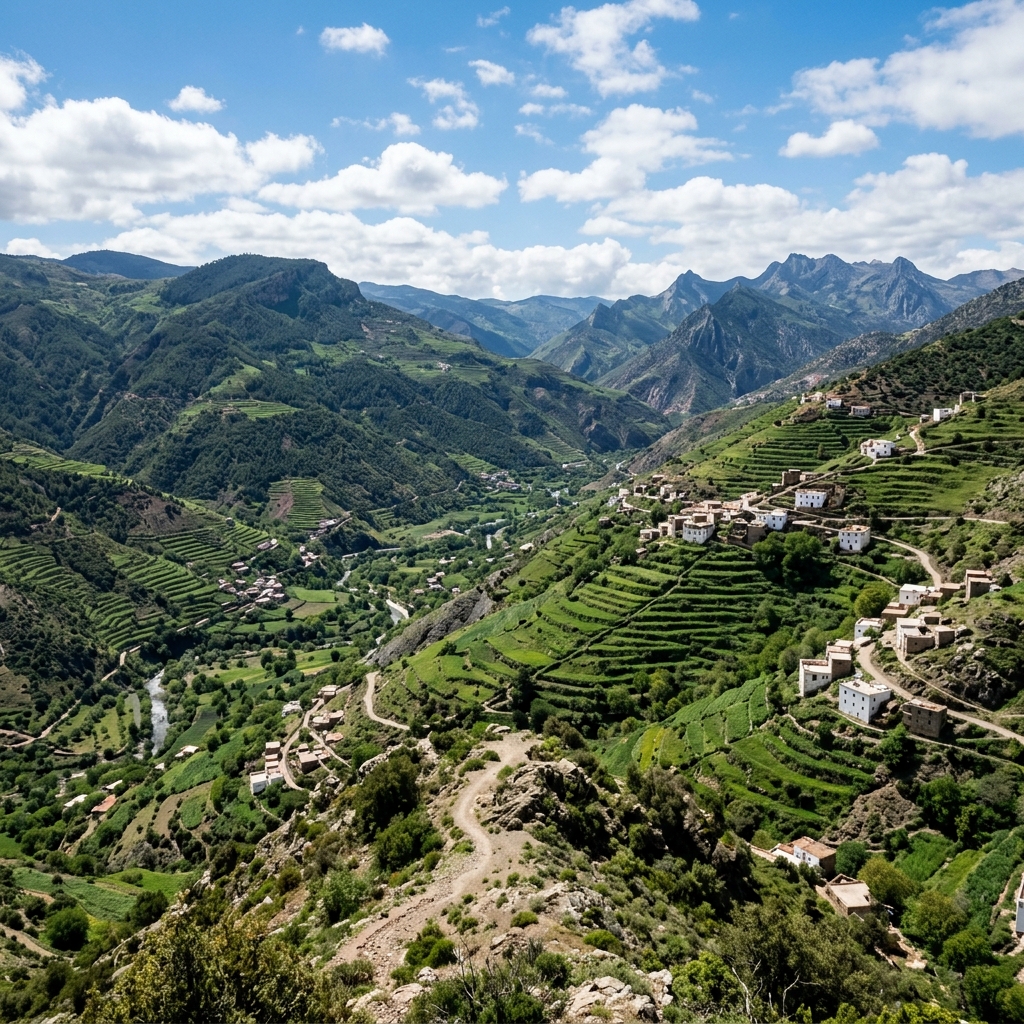
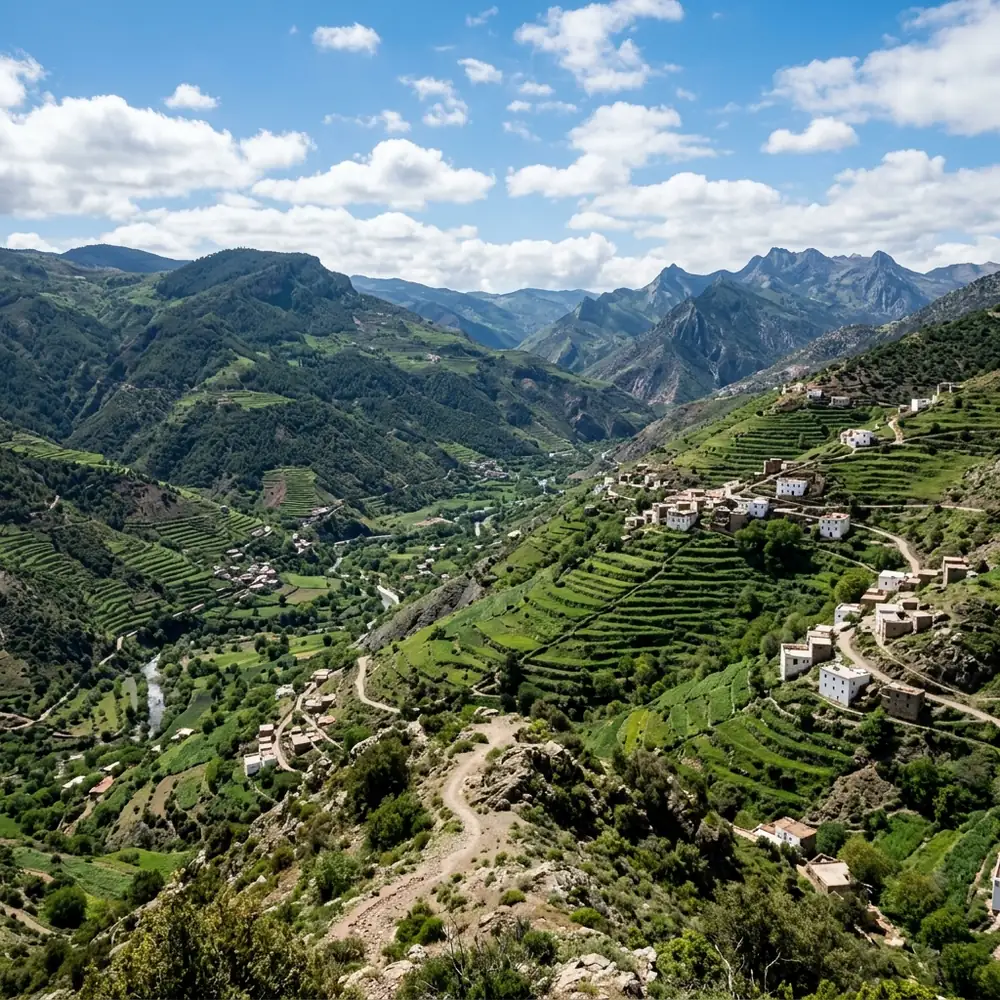
The Rif is a mountain range running roughly east-west across the northern edge of Morocco, separating the Mediterranean coast from the interior plateau. At its highest points — the Jbel Tidirhine at 2,448 meters and the Jbel Sidi Bou Younes at 2,312 meters — the Rif is genuinely alpine in character, with cedar and oak forests, spring wildflower meadows, and a visual scale that the better-known Atlas ranges do not monopolize.
The Mediterranean coast of the Rif — the Al Hoceima region and the Alborán Sea shoreline — is among the most dramatic Mediterranean coastal scenery accessible from Morocco: deep blue water, steep cliffs, coves with narrow beaches of rounded stone rather than sand, fishing villages perched on headlands. This coastline is extensively used by Moroccan families from the northern cities for summer holidays and is almost entirely unvisited by international tourists, which means that in September and October — after the Moroccan summer season but before the winter rains — you can be on a beach in the Rif Mediterranean that has perhaps fifteen people on it.
The western Rif — the Ghomara and Jbala mountains between Tétouan and Chefchaouen — is lower and greener, with the particular Mediterranean-Atlantic climate that sustains the dense forest and the bright wildflower season. The road from Chefchaouen down to the coast through the Talembote gorge is one of the most beautiful drives in Morocco and one of the least known.
What Is the Rif’s Historical and Cultural Distinctiveness?
The Rif’s Amazigh population — primarily speaking the Tarifit dialect of Tamazight, distinct from the Tachelhit of the south and the Tamazight of the Middle Atlas — maintained significant political and cultural independence from the Moroccan central state for most of the pre-colonial period. The region’s rugged terrain made it difficult for imperial forces to project control, and the Rifian tribal confederations had their own political organization and their own legal codes (izerfan) that operated parallel to the Makhzen’s authority.
This independence was most dramatically expressed in the Rif War of 1921-1926, when Abd el-Krim al-Khattabi — a Rifian leader of extraordinary military and political intelligence — organized the Rifian tribes into what was effectively a modern army, defeated a Spanish force of 60,000 at the Battle of Annual (killing approximately 13,000 Spanish soldiers in a single battle, one of the worst defeats of a European colonial force in North African history), and established the Republic of the Rif — a short-lived but genuine attempt at modern state-building in the mountains. The Republic was eventually crushed by a combined French-Spanish force of 400,000 soldiers, including the first documented use of chemical weapons in Africa (Spanish and French aircraft dropped mustard gas on Rifian villages). Abd el-Krim surrendered in 1926.
The Rif’s relationship with the Moroccan state since independence has also been complicated. The 1958-59 uprising against the newly independent Moroccan state, suppressed violently by Hassan II’s forces, remains a contested historical memory. The Hirak Rif protest movement of 2016-2017 — organized around economic grievances in the Al Hoceima region — resulted in lengthy prison sentences for its leaders and ongoing tensions. The Rif’s sense of being economically and politically marginal within Morocco is not paranoia. It has historical substance.
What Is the Rif’s Specific Culinary Tradition?
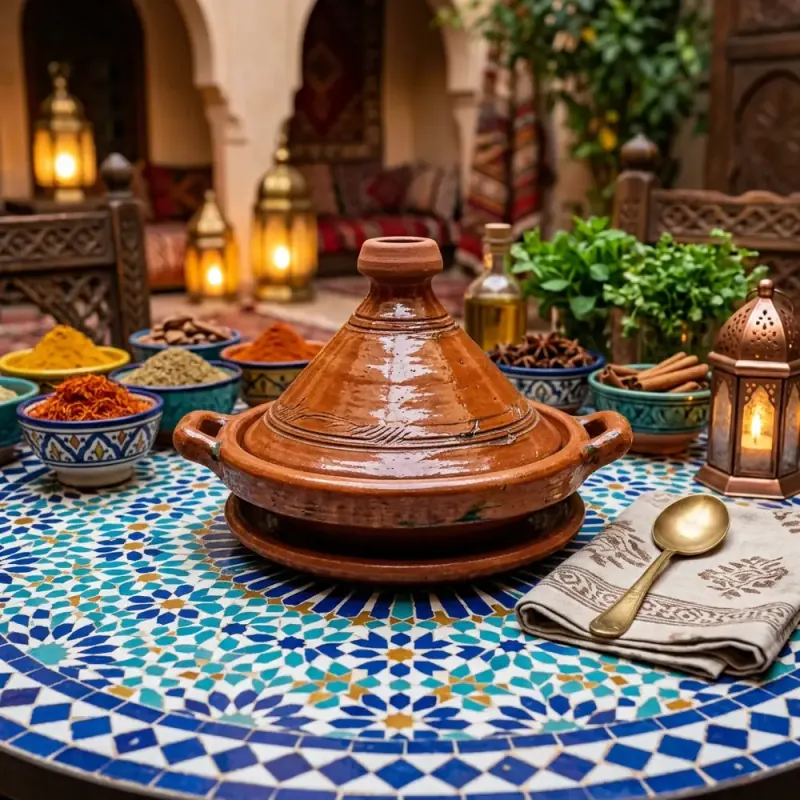
The Rif has a culinary tradition distinct from the imperial city cuisine that most food writing about Morocco focuses on. Rifian cooking is mountain cooking: simpler, more robust, less spiced, centered on the olive oil, fresh herbs, and wild greens of the Mediterranean highland landscape rather than on the complex spice blends of the plains cities.
Harcha — a semolina flatbread cooked in a dry pan, firmer and grainier than baghrir, eaten with olive oil, honey, or jam — is the bread of the Rif rather than khobz. Asida — a thick porridge of cornmeal or semolina, drizzled with argan oil and honey — is a Rif breakfast staple. Wild greens collected from the mountain meadows — bakkoula (mallow), wild chicory, dandelion, various slata preparations — appear in Rifian cooking in a way that urban Moroccan cooking has largely lost contact with.
The olive oil of the Rif region — particularly from the Beni Snassen and Msoun regions in the eastern Rif — is excellent and largely uncelebrated outside the region, pressed from olive varieties that produce an oil of good quality and reasonable price that competes with the more expensive Meknès and Marrakech brands without the marketing infrastructure of those regions.
The Invisible Invitation
The road from Chefchaouen to Al Hoceima takes approximately three hours and passes through a landscape that is not in any guidebook in the way it deserves to be: cedar forest in the high passes, the switchback descent through the Talembote gorge with the river visible below, the opening of the Ghis plain as you approach the coast, and finally the Mediterranean appearing at the horizon. Stop somewhere in the middle section where the cedars are old enough to be large and the forest has a density that produces genuine shade. Get out of the car. The silence in a Rif cedar forest in October — after the tourist season, before the winter rains — is deep in the way that silence in old-growth forest is always deep. This is also Morocco. It is less photographed than the rest of it. That is an incomplete reason to go. It is not a wrong one.
SEO Meta Description: What is the Rif region of Morocco beyond kif? The mountains, Abd el-Krim’s Republic of the Rif, Mediterranean coastline, Rifian cuisine, and the historical relationship with the Moroccan state.
Experience the true heart of Moroccan heritage through its culinary traditions. Join us in preserving and honoring these ancestral recipes.
What People Are Saying
No comments yet. Be the first — we'd love to hear from you.
Youssef Amazigh
Culturally Verified & Fact-CheckedThe Moroccan Food editorial team brings together native culinary researchers, heritage preservationists, and experienced home cooks across Marrakech, Fes, and Casablanca. Every recipe and cultural guide is reviewed against ancestral oral traditions and authentic regional practices.